
Early Serum Biomarkers for Severity Stratification in Patients with Acute Pancreatitis: A Review
DOI:
https://doi.org/10.5281/zenodo.22202955Keywords:
Acute Pancreatitis, Severity Stratification, C-Reactive Protein, Blood Urea Nitrogen, BISAPAbstract
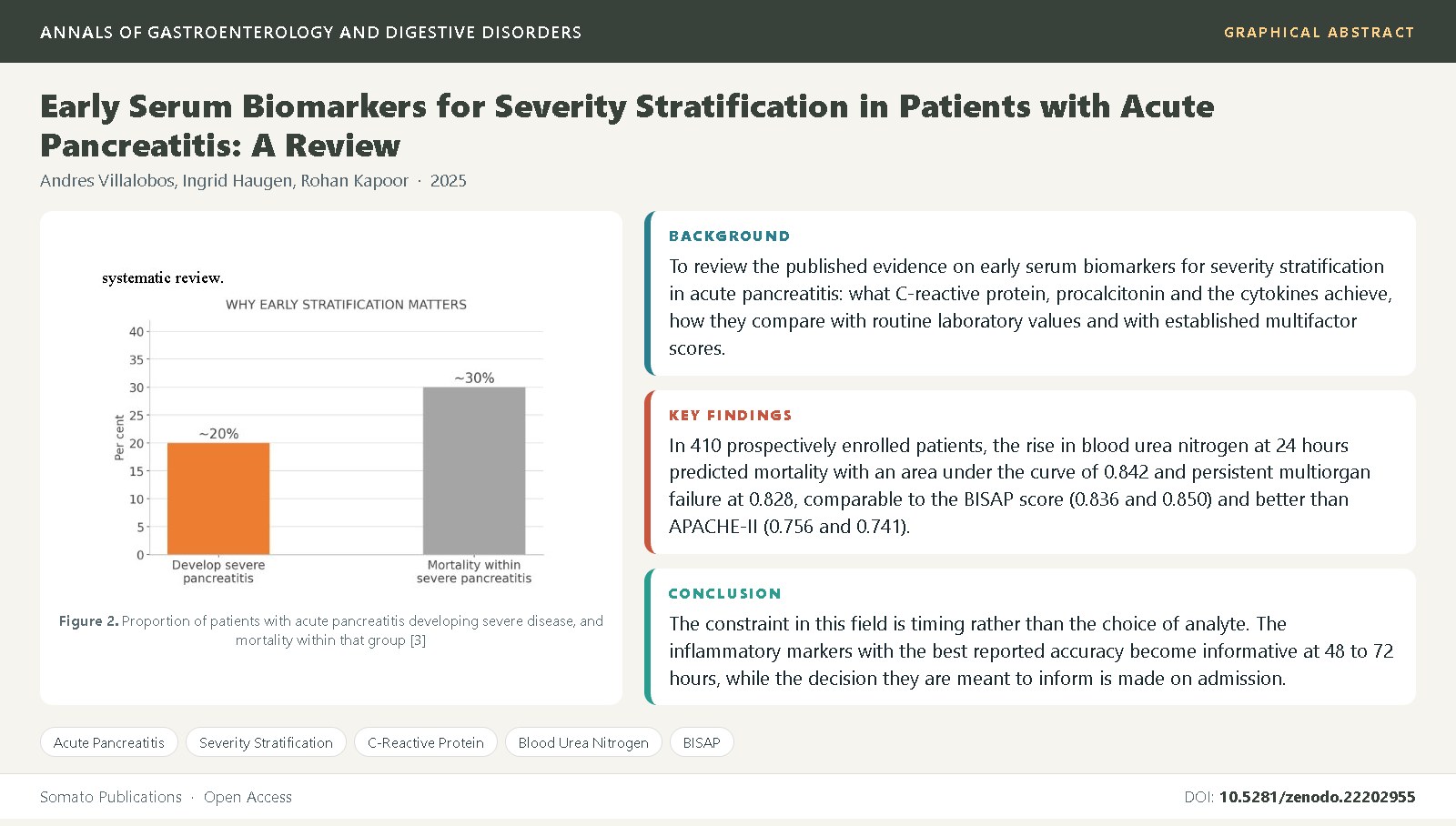
Roughly one patient in five with acute pancreatitis develops severe disease, and mortality in that group approaches thirty per cent. Identifying them on the first day is the point of severity stratification. Decades of biomarker work have produced a large literature and, on the evidence reviewed here, no marker that clearly outperforms a routine blood urea nitrogen measurement. Objectives: To review the published evidence on early serum biomarkers for severity stratification in acute pancreatitis: what C-reactive protein, procalcitonin and the cytokines achieve, how they compare with routine laboratory values and with established multifactor scores, and why the timing of measurement determines the answer. Material and Methods: Narrative review of prospective cohorts, comparative accuracy studies, pooled analyses and consensus classifications indexed in PubMed and the major gastroenterology and critical care journals. Studies were eligible if they reported the accuracy of a serum marker or clinical score for predicting severity, organ failure, infected necrosis or mortality in a defined population with acute pancreatitis. No new patient data were generated; every estimate quoted is one published by the original investigators. Results: In 410 prospectively enrolled patients, the rise in blood urea nitrogen at 24 hours predicted mortality with an area under the curve of 0.842 and persistent multiorgan failure at 0.828, comparable to the BISAP score (0.836 and 0.850) and better than APACHE-II (0.756 and 0.741). For severe pancreatitis specifically, BISAP outperformed both, at 0.873 against 0.756 for the urea rise and 0.761 for APACHE-II. Rise in urea was the only variable independently associated with mortality on multivariable analysis, with an odds ratio of 12.7 (95% CI 4.2-16.6). C-reactive protein has a conventional threshold of 150 mg/L at 48 hours, but its discrimination is poor before 72 hours and improves substantially only afterwards, by which time the clinical
question has usually answered itself. Conclusion: The constraint in this field is timing rather than the choice of analyte. The inflammatory markers with the best reported accuracy become informative at 48 to 72 hours, while the decision they are meant to inform is made on admission. Routine values available within the first day perform as well as more elaborate alternatives and should be used in preference to waiting. Abbreviations: AP – Acute Pancreatitis, SAP – Severe Acute Pancreatitis, BUN – Blood Urea Nitrogen, CRP – C-Reactive Protein, PCT – Procalcitonin, IL-6 – Interleukin 6, BISAP – Bedside Index of Severity in Acute Pancreatitis, APACHE-II – Acute Physiology and Chronic Health Evaluation II, CTSI – Computed Tomography Severity Index, PASS – Pancreatitis Activity Scoring System, HAPS – Harmless Acute Pancreatitis Score, AUC – Area Under the Receiver Operating Characteristic Curve, POF – Persistent Organ Failure.
References
Whitcomb DC. "Acute pancreatitis". N Engl J Med 354(2006):2142-2150.
Forsmark CE, Baillie J. "AGA Institute technical review on acute pancreatitis". Gastroenterology 132(2007):2022-2044.
Pando E, Alberti P, Mata R, Gomez MJ, Vidal L, Cirera A, Dopazo C, Blanco L, Gomez C, Caralt M, Balsells J, Charco R. "Early changes in blood urea nitrogen (BUN) can predict mortality in acute pancreatitis: comparative study between BISAP score, APACHE-II, and other laboratory markers: a prospective observational study". Can J Gastroenterol Hepatol (2021):6643595.
Banks PA, Bollen TL, Dervenis C, Gooszen HG, Johnson CD, Sarr MG, Tsiotos GG, Vege SS. "Classification of acute pancreatitis 2012: revision of the Atlanta classification and definitions by international consensus". Gut 62(2013):102-111.
Bradley EL 3rd. "A clinically based classification system for acute pancreatitis". Arch Surg 128(1993):586-590.
Knaus WA, Draper EA, Wagner DP, Zimmerman JE. "APACHE II: a severity of disease classification system". Crit Care Med 13(1985):818-829.
Wu BU, Johannes RS, Sun X, Tabak Y, Conwell DL, Banks PA. "The early prediction of mortality in acute pancreatitis: a large population-based study". Gut 57(2008):1698-1703.
Wang AJ, Xu S, Hong JB, Liu P, Xia L, Zhu Y, He WH, Chen YX, Lü NH. "The comparison of different clinical scoring systems for predicting prognosis in acute pancreatitis based on the revised Atlanta classification". Zhonghua Nei Ke Za Zhi 52(2013):668-671.
Luo X, Wang J, Wu Q, Peng L, Yang G, Li X, et al. "A modified Ranson score to predict disease severity, organ failure, pancreatic necrosis, and pancreatic infection in patients with acute pancreatitis". Front Med (Lausanne) 10(2023):1145471.
Buxbaum J, Quezada M, Chong B, Gupta N, Yu CY, Lane C, et al. "The Pancreatitis Activity Scoring System predicts clinical outcomes in acute pancreatitis: findings from a prospective cohort study". Am J Gastroenterol 113(2018):755-764.
Wu BU, Johannes RS, Sun X, Conwell DL, Banks PA. "Early changes in blood urea nitrogen predict mortality in acute pancreatitis". Gastroenterology 137(2009):129-135.
Brivet FG, Emilie D, Galanaud P. "Pro- and anti-inflammatory cytokines during acute severe pancreatitis: an early and sustained response, although unpredictable of death. Parisian Study Group on Acute Pancreatitis". Crit Care Med 27(1999):749-755.
Sternby H, Hartman H, Johansen D, Thorlacius H, Regnér S. "Laboratory markers predicting severity of acute pancreatitis". Scand J Gastroenterol 50(2015):1230-1237.
Pápai M, Benczúr B, Farkas N, Ernss B, Hegyi P, et al. "Persistently high procalcitonin and C-reactive protein are good predictors of infection in acute necrotizing pancreatitis: a systematic review and meta-analysis". Int J Mol Sci 25(2024):1273.
Hong W, Lin S, Zippi M, Geng W, Stock S, et al. "Serum albumin is independently associated with persistent organ failure in acute pancreatitis". Can J Gastroenterol Hepatol (2017):5297143.
Wu BU, Hwang JQ, Gardner TH, Repas K, Delee R, Yu S, et al. "Lactated Ringer’s solution reduces systemic inflammation compared with saline in patients with acute pancreatitis". Clin Gastroenterol Hepatol 9(2011):710-717.
Lankisch PG, Weber-Dany B, Hebel K, Maisonneuve P, Lowenfels AB. "The harmless acute pancreatitis score: a clinical algorithm for rapid initial stratification of nonsevere disease". Clin Gastroenterol Hepatol 7(2009):702-705.
Büchler MW, Gloor B, Müller CA, Friess H, Seiler CA, Uhl W. "Acute necrotizing pancreatitis: treatment strategy according to the status of infection". Ann Surg 232(2000):619-626.
Rodriguez JR, Razo AO, Targarona J, Thayer SP, Rattner DW, Warshaw AL, Fernandez-del Castillo C. "Debridement and closed packing for sterile or infected necrotizing pancreatitis". Ann Surg 247(2008):294-299.
Allison SP, Lobo DN. "The clinical significance of hypoalbuminaemia". Clin Nutr 43(2024):909-914.





