
The Relationship between Sleep Disturbance, Quality of Life and Psychosocial Functioning in Pediatric Patients with Inflammatory Bowel Disease
Keywords:
Sleep disturbance, Inflammatory bowel disease, Quality of life, Psychosocial functioning and childrenAbstract
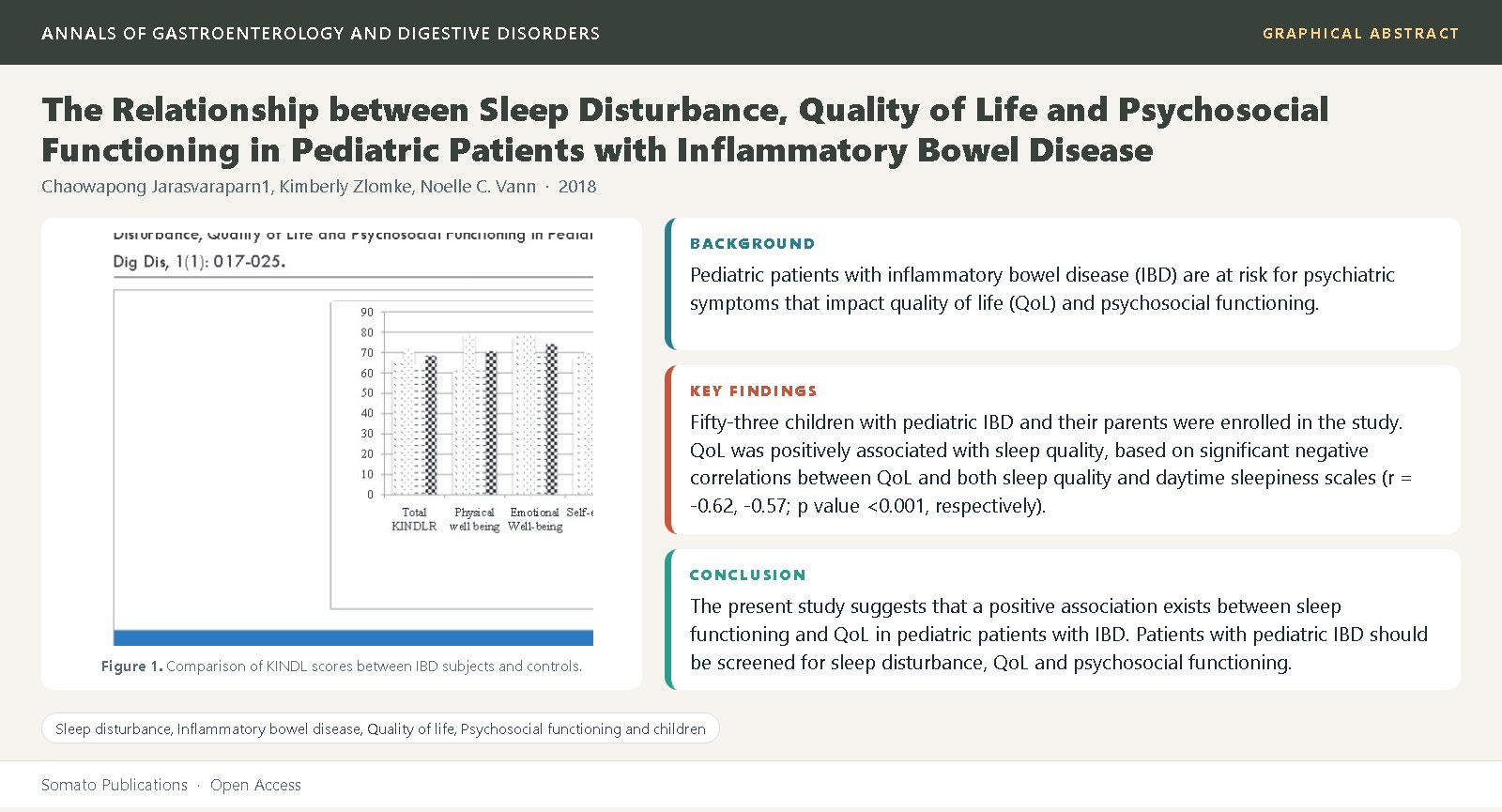
Background: Pediatric patients with inflammatory bowel disease (IBD) are at risk for psychiatric symptoms that impact quality of life (QoL) and psychosocial functioning. Sleep disturbance has been reported to impose adverse effects on host defense mechanisms by affecting the magnitude and characteristics of the inflammatory response. The current study sought to assess the relationships among sleep disturbance, QoL, and psychosocial functioning in children with IBD. Methods: Pediatric IBD patients completed multiple measures of sleep and daytime functioning as well as measures of QoL and psychosocial functioning. The parents completed complementary measures of sleep, QoL, and psychosocial functioning. The HRQOL results for subjects with IBD were compared to a healthy control group. Results: Fifty-three children with pediatric IBD and their parents were enrolled in the study. QoL was positively associated with sleep quality, based on significant negative correlations between QoL and both sleep quality and daytime sleepiness scales (r = -0.62, -0.57; p value <0.001, respectively). Patients with CD reported significantly better QoL and psychosocial functioning than patients with UC. The QoL was similar between IBD patients and healthy controls. Conclusions: The present study suggests that a positive association exists between sleep functioning and QoL in pediatric patients with IBD. Patients with pediatric IBD should be screened for sleep disturbance, QoL and psychosocial functioning. Prevention and intervention strategies of sleep disturbance aimed at improving QoL and psychosocial functioning in children with IBD should be developed and evaluated.
References
Kappelman, MD., Rifas-Shiman, SL., Kleinman, K., Ollendorf, D., Bousvaros, A., Grand, RJ., et al. (2007) The prevalence and geographic distribution of Crohn’s disease and ulcerative colitis in the United States. Clin Gastroenterol Hepatol, 5(12):1424–1429.
Hanauer, SB. (2006) Inflammatory bowel disease: epidemiology, pathogenesis, and therapeutic opportunities. Inflamm Bowel Dis, 12(Suppl 1): S3-S9.
Kim, J., Hakim, F., Kheirandish-Gozal, L., Gozal, D. (2011) Inflammatory pathways in children with insufficient or disordered sleep. Respir Physiol Neurobiol, 178(3): 465-474.
Sonnenberg, A. (1990) Occupational Occupational distribution of inflammatory bowel disease among German employees. Gut, 31(9): 1037-1040.
Tang, Y., Preuss, F., Turek, FW., Jakate, S., Keshavarzian, A. (2009) Sleep deprivation worsens inflammation and delays recovery in a mouse model of colitis. Sleep Med, 10(6): 597-603.
Mullington, JM., Simpson, NS., Meier-Ewert, HK., Haack, M. (2010) Sleep loss and inflammation. Best Pract Res Clin Endocrinol Metab, 24(5): 775-784.
Irwin, MR., Wang, M., Campomayor, CO., Collado-Hidalgo, A., Cole, S. (2006) Sleep deprivation and activation of morning levels of cellular and genomic markers of inflammation. Arch Intern Med, 166(16): 1756-1762.
Labyak, SE., Bourguignon, C., Docherty, S. (2003) Sleep quality in children with juvenile rheumatoid arthritis. Holist Nurs Pract, 17(4): 193-200.
Davis, ID., Greenbaum, LA., Gipson, D., Wu, LL., Sinha, R., Matsuda- Abedini, M., et al. (2012) Prevalence of sleep disturbances in children and adolescents with chronic kidney disease. Pediatr Nephrol, 27(3): 451-459.
Heng, K., Wirrell, E. (2006) Sleep disturbance in children with migraine. J Child Neurol, 21(9): 761-766.
Pillar, G., Schuscheim, G., Weiss, R., Malhotra, A., Shlitner, A., Peled, N., et al. (2003) Interactions between hypoglycemia and sleep architecture in children with type 1 diabetes mellitus. J Pediatr, 142(2): 163-168.
Mackner, LM., Crandall, WV. (2007) Psychological factors affecting pediatric inflammatory bowel disease. Curr Opin Pediatr, 19(5): 548- 552.
Owens, JA., Spirito, A., McGuinn, M. (2000) The Children’s Sleep Habits Questionnaire (CSHQ): psychometric properties of a survey instrument for school-aged children. Sleep, 23(8): 1043-1051.
Buysse, D.J., Reynolds, C.F., Monk, T.H, Berman, SR., Kupfer, DJ. (1989) The Pittsburgh Sleep Quality Index (PSQI): A new instrument for psychiatric research and practice. Psychiatry Res, 28(2): 193-213.
Drake, C., Nickel, C., Burduvali, E., Roth, T., Jefferson, C., Pietro, B. (2003) The Pediatric Daytime Sleepiness Scale (PDSS): Sleep Habits and School Outcomes in Middle-school Children. Sleep, 26(4): 455- 458.
LeBourgeois MK, Giannotti F, Cortesi F, Wolfson, AR., Harsh, J. (2005) The Relationship Between Reported Sleep Quality and Sleep Hygiene in Italian and American Adolescents. Pediatrics, 115(1 Suppl): 257- 265.
Bullinger, M., Brütt, AL., Erhart, M., Ravens-Sieberer, U. (2008) Psychometric properties of the KINDL-R questionnaire: results of the BELLA study. Eur Child Adolesc Psychiatry, 17(Suppl 1): 125-132.
Reed-Knight, B., Hayutin, LG., Lewis, JD., Blount, RL. (2011) Factor structure of the pediatric symptom checklist with a pediatric gastroenterology sample. J Clin Psychol Med Settings, 18(3): 299-306.
Hyams, JS., Ferry, GD., Mandel, FS., Gryboski, JD., Kibort, PM., Kirschner, BS., et al. (1991) Development and validation of a pediatric Crohn’s disease activity index. J Pediatr Gastroenterol Nutr, 12(4): 439-447.
Turner, D., Hyams, J., Markowitz, J., Lerer, T., Mack, DR., Evans, J., et al. (2009) Appraisal of the Pediatric Ulcerative Colitis Activity Index (PUCAI). Inflamm Bowel Dis, 15: 1218-1223.
Ranjbaran, Z., Keefer, L., Farhadi, A., Stepanski, E., Sedghi, S., Keshavarzian, A. (2007) Impact of sleep disturbances in inflammatory bowel disease. J Gastroenterol Hepatol, 22: 1748–1753.
Uemura, R., Fujiwara, Y., Iwakura, N., Shiba, M., Watanabe, K., Kamata, N., et al. (2016) Sleep disturbances in Japanese patients with inflammatory bowel disease and their impact on disease flare. Springerplus, 5(1): 1792.
Schindlbeck, KA., Becker, J., Berger, F., Mehl, A., Rewitzer, C., Geffe, S., et al. (2017) Impact of restless legs syndrome in patients with inflammatory bowel disease on sleep, fatigue, and quality of life. Int J Colorectal Dis, 32(1): 125-130.
Mrakotsky, C., Forbes, PW., Bernstein, JH., Grand, RJ., Bousvaros, A., Szigethy, E., et al. (2013) Acute cognitive and behavioral effects of systemic corticosteroids in children treated for inflammatory bowel disease. J Int Neuropsychol Soc, 19(1): 96-109.
Chouliaras, G., Margoni, D., Dimakou, K., Fessatou, S., Panayiotou, I,. Roma-Giannikou, E. (2017) Disease impact on the quality of life of children with inflammatory bowel disease. World J Gastroenterol, 23(6): 1067-1075.
Engstrom, I. (1999) Inflammatory bowel disease in children and adolescents: mental health and family functioning. J Pediatr Gastroenterol Nutr, 28: 528–533.
Mackner, LM., Crandall, WV. (2006) Brief report: psychosocial adjustment in adolescents with inflammatory bowel disease. J Pediatr Psychol, 31(3): 281-285.
Pirinen, T., Kolho, KL., Ashorn, M., Aronen, ET. (2014) Sleep and Emotional and Behavioral symptoms in adolescent with inflammatory bowel disease. Sleep Disord, 2014: 379450.
Haapamäki, J., Roine, RP., Sintonen, H., Kolho, KL. (2011) Healthrelated quality of life in paediatric patients with inflammatory bowel disease related to disease activity. J Paediatr Child Health, 47(11): 832-837.
Otley, AR., Griffiths, AM., Hale, S., Kugathasan, S., Pfefferkorn, M., Mezoff, A., et al. (2006) Health-related quality of life in the first year after a diagnosis of pediatric inflammatory bowel disease. Inflamm Bowel Dis, 12(8): 684-691.
Mueller, R., Ziade, F., Pittet, V., Fournier, N., Ezri, J., Schoepfer, A., et al. (2016) Quality of Life in Swiss Paediatric Inflammatory Bowel Disease Patients: Do Patients and Their Parents Experience Disease in the Same Way? J Crohns Colitis, 10(3): 269-276.
Diederen, K., Haverman, L., Grootenhuis, MA. (2017) Parental distress and quality of life in pediatric inflammatory bowel disease: implications for the outpatient clinic. J Pediatr Gastroenterol Nutr.
Claar, RL., van Tilburg, MAL., Abdullah, B., Langer, S., Sherif, D., Whitehead, WE., et al. (2017) Psychological distress and quality of life in pediatric crohn disease: impact of pain and disease state. J Pediatr Gastroenterol Nutr, 65(4): 420-424.
Varni, JW., Shulman, RJ., Self, MM., Saeed, SA., Patel, AS., Nurko, S., et al. (2016) Gastrointestinal symptoms predictors of health-related quality of life in patient with inflammatory bowel disease. J Pediatr Gastroenterol Nutr, 63(6): e186-e192.
Gallo, J., Grant, A., Otley, AR., Orsi, M., MacIntyre, B., Gauvry, S., et al. (2014) Do parents and children agree? Quality-of-life assessment of children with inflammatory bowel disease and their parents. J Pediatr Gastroenterol Nutr, 58(4): 481-485.
Kalafateli, M., Triantos, C., Theocharis, G., Giannakopoulou, D., Koutroumpakis, E., Chronis, A., et al. (2013) Health-related quality of life in patients with inflammatory bowel disease: a single-center experience. Ann Gastroenterol, 26(3): 243-248.
IsHak, WW., Pan, D., Steiner, AJ., Feldman, E., Mann, A., Mirocha, J., et al. (2017) Patient-Reported Outcomes of Quality of Life, Functioning, and GI/Psychiatric Symptom Severity in Patients with Inflammatory Bowel Disease (IBD). Inflamm Bowel Dis, 23(5): 798-803.
Varni, JW., Franciosi, JP., Shulman, RJ., Saeed, S., Nurko, S., Neigut, DA., et al. (2015) PedsQL gastrointestinal symptoms scale and gastrointestinal worry scales in pediatric patients with inflammatory bowel disease in comparison with healthy controls. Inflamm Bowel Dis, 21(5): 1115-1124.
Frolkis, AD., Dykeman, J., Negrón, ME., Debruyn, J., Jette, N., Fiest, KM., et al. (2013) Risk of surgery for inflammatory bowel diseases has decreased over time: a systematic review and meta-analysis of population-based studies. Gastroenterology, 145(5): 996-1006.
Carlsen, K., Jakobsen, C., Kallemose, T., Paerregaard, A., Riis, LB., Munkholm, P., et al. (2017) F-calprotectin and Blood Markers Correlate to Quality of Life in Pediatric Inflammatory Bowel Disease. J Pediatr Gastroenterol Nutr, 65(5): 539-545.





