
The Characteristics of Esophageal Multichannel Intraluminal Impedance-PH Measurements in Infants Experiencing Brief Resolved Unexplained Events
Keywords:
Brief resolved unexplained events, Apparent life-threatening events, Multichannel intraluminal impedance-pH study; Gastroesophageal reflux disease; InfantsAbstract
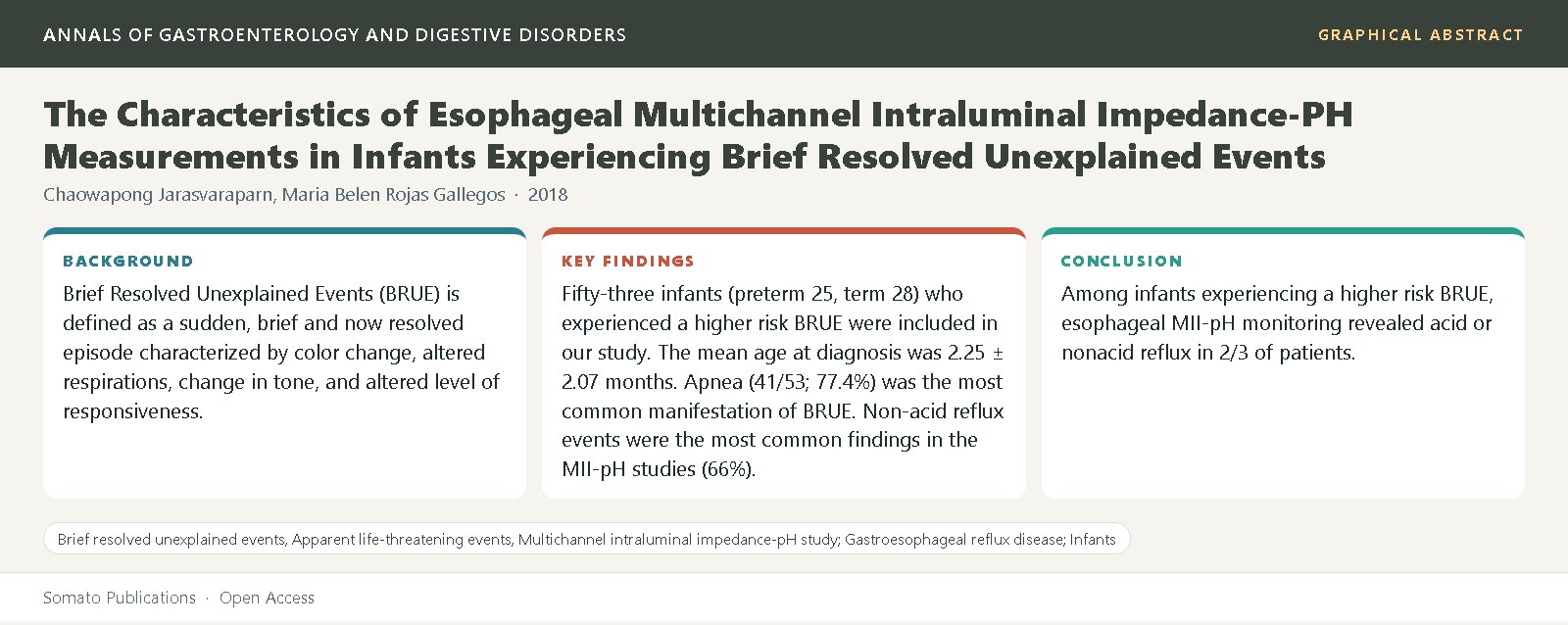
Background: Brief Resolved Unexplained Events (BRUE) is defined as a sudden, brief and now resolved episode characterized by color change, altered respirations, change in tone, and altered level of responsiveness. This study aims to identify the characteristics of esophageal Multichannel Intraluminal Impedance-pH (MII-pH) monitoring in infants who have experienced a BRUE. Methods: This study was a retrospective review of records of infants younger than 12 months who presented to the University of South Alabama Children’s and Women’s Hospital with an admission diagnosis of BRUE. Patients who underwent esophageal MII-pH monitoring between October 2015 and February 2017 and diagnosed with BRUE were initially included in this study. Results: Fifty-three infants (preterm 25, term 28) who experienced a higher risk BRUE were included in our study. The mean age at diagnosis was 2.25 ± 2.07 months. Apnea (41/53; 77.4%) was the most common manifestation of BRUE. Non-acid reflux events were the most common findings in the MII-pH studies (66%). MII-pH results showed 6/53 (11%) acid reflux, 17/53 (32%) non-acid reflux and 12/53 (23%) both acid/nonacid reflux and 18/53 (34%) were normal. There were significant differences in the longest acid reflux episode and the Reflux Symptom Sensitivity Index (RSSI) of coughing/choking/gagging between preterm and term infants. The Reflux Symptom Index (RSI), RSSI and Reflux Symptom Association Probability (RSAP) were significantly correlated with each other in all symptoms (pain/fussiness, coughing/ choking/gagging and vomiting). Conclusions: Among infants experiencing a higher risk BRUE, esophageal MII-pH monitoring revealed acid or nonacid reflux in 2/3 of patients.
References
Tieder, JS., Bonkowsky, JL., Etzel, RA., Franklin, WH., Gremse, DA., Herman. B., et al. (2016) Brief Resolved Unexplained Events (Formerly Apparent Life-Threatening Events) and Evaluation of Lower-Risk Infants: Executive Summary. Pediatrics 137(5): e20160591.
Tieder, JS., Cowan, CA., Garrison, MM., Christakis, DA. (2008) Variation in inpatient resource utilization and management of apparent life threatening events. J Pediatr, 152(5): 629-635.
Zimbric, G., Bonkowsky, JL., Jackson, WD., Maloney, CG., Srivastava, R. (2012) Advance outcomes associated with gastroesophageal reflux disease are rare following an apparent life-threatening event. J Hosp Med, 7(6): 476-481.
Blasco-Alonso, J., Yun-Castilla, C., Girón Fernández-Crehuet, F., Peláez- Cantero, MJ., Serrano-Nieto, J., Navas-López, VM,, et al. (2014) Esophageal multichannel intraluminal impedance and pH testing in the study of apparent life threatening episode incidents in infants. Rev Esp Enferm Dig, 106(3): 159-164.
Wenzl, TG., Schenke, S., Peschgens, T., Silny, J., Heimann, G., Skopnik, H. (2001) Association of apnea and nonacid gastroesophageal reflux in infants: Investigations with the intraluminal impedance technique. Pediatr Pulmonol, 31(2): 144-149.
Mousa, H., Woodley, FW., Metheney, M., Hayes, J. (2005) Testing the association between gastroesophageal reflux and apnea in infants. J Pediatr Gastroenterol Nutr, 41(2): 169-177.
Lüthold, SC., Rochat, MK., Bähler, P. (2010) Disagreement between symptom-reflux association analysis parameters in pediatric gastroesophageal reflux disease investigation. World J Gastroenterol, 16(19): 2401-2406.
Magistà, AM., Indrio, F., Baldassarre, M., Bucci, N., Menolascina, A., Mautone, A., et al. (2007) Multichannel intraluminal impedance to detect relationship between gastroesophageal reflux and apnoea of prematurity. Dig Liver Dis, 39(3): 216-221.
Abu Jawdeh, EG., Martin, RJ. (2013) Neonatal apnea and gastroesophageal reflux (GER): is there a problem? Early Hum Dev, 89(1): S14-S16.
Veereman-Wauters, G., Bochner, A., Van Caillie-Bertrand, M. (1991) Gastroesophageal reflux in infants with a history of near-miss sudden infant death. J Pediatr Gastroenterol Nutr, 12(3): 319-323.
Kahn, A., Rebuffat, E., Sottiaux, M., Blum, D., Yasik, EA. (1990) Sleep apneas and acid esophageal reflux in control infants and in infants with an apparent life-threatening event. Biol Neonate, 57: 144.
Tirosh, E., Jaffe, M. (1996) Apnea of infancy, seizures, and gastroesophageal reflux: an important but infrequent association. J Child Neurol 11(2): 98-100.
Peter, CS., Sprodowski, N., Bohnhorst, B., Silny, J., Poets, CF. (2002) Gastroesophageal reflux and apnea of prematurity: no temporal relationship. Pediatrics, 109(1): 8–11.
Barrington, KJ., Tan, K., Rich, W. (2002) Apnea at discharge and gastroesophageal reflux in the preterm infant. J Perinatol, 22(1): 8–11.
Arad-Cohen, N., Cohen, A., Tirosh, E. (2000) The relationship between gastroesophageal reflux and apnea in infants. J Pediatr, 137(3): 321-326.
Di Fiore, J., Arko, M., Herynk, B., Martin, R., Hibbs, AM. (2010) Characterization of cardiorespiratory events following gastroesophageal reflux in preterm infants. J Perinatol, 30(10): 683- 687.
Tieder, JS., Altman, RL., Bonkowsky, JL., Brand, DA., Claudius, I., Cunningham, DJ., et al. (2013) Management of apparent lifethreatening events in infants: a systematic review.JPediatr, 163(1): 94-9.e1-6.
Sankaran, J., Qureshi, AH., Woodley, F. (2016) Effect of Severity of Esophageal Acidification on Sleep vs Wake Periods in Infants Presenting with Brief Resolved Unexplained Events. J Pediatr, 179: 42-48.
Bredenoord, AJ., Weusten, BL., Smout, AJ. (2005) Symptom association analysis in ambulatory gastro-oesophageal reflux monitoring. Gut, 54(12): 1810-1817.
Funderburk, A., Nawab, U., Abraham, S., DiPalma, J., Epstein, M., Aldridge, H., et al. (2016) Temporal Association Between Refluxlike Behaviors and Gastroesophageal Reflux in Preterm and Term Infants. J Pediatr Gastroenterol Nutr, 62(4): 556-561.
Hasenstab, KA., Jadcherla, SR. (2014) Respiratory events in infants presenting with apparent life threatening events: is there an explanation from esophageal motility? J Pediatr, 165(2): 250-255.
Duncan, DR., Amirault, J., Mitchell, P., Larson, K., Rosen, RL. (2017) Oropharyngeal Dysphagia is Strongly Correlated With Apparent Life- Threatening Events. J Pediatr Gastroenterol Nutr, 65(2): 168-172.
Iacono, G., Carroccio, A., Cavataio F, Montalto G, Kazmierska I, Lorello D, et al. (1996) Gastroesophageal reflux and cow’s milk allergy in infants: a prospective study. J Allergy Clin Immunol, 97(3): 822–827.





