
Acute Kidney Injury Secondary to Exertional Rhabdomyolysis: A Review of Published Cases
DOI:
https://doi.org/10.5281/zenodo.22279461Keywords:
Rhabdomyolysis, Acute kidney injury, Exercise, Creatine kinase, DialysisAbstract
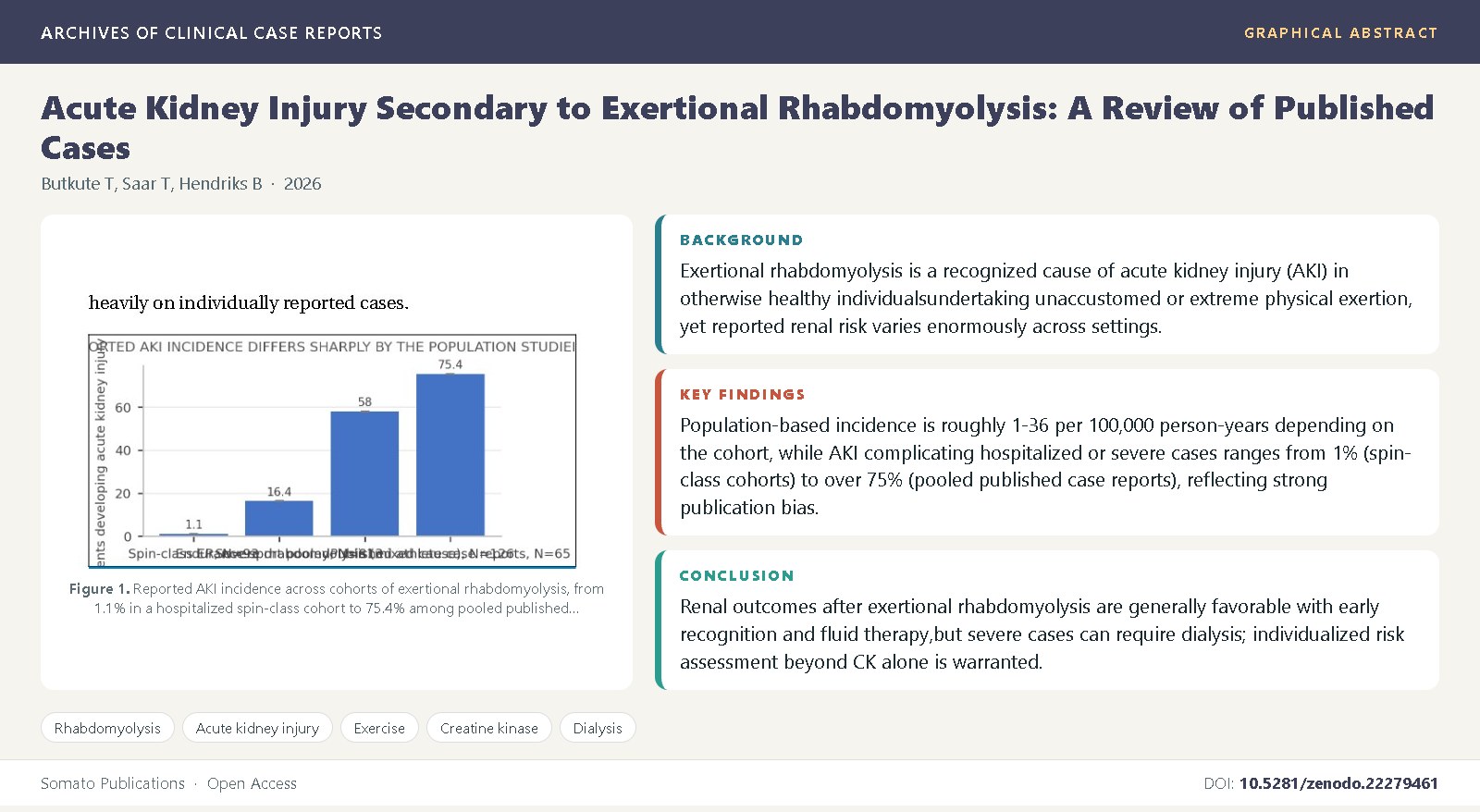
Background: Exertional rhabdomyolysis is a recognized cause of acute kidney injury (AKI) in otherwise healthy individuals
undertaking unaccustomed or extreme physical exertion, yet reported renal risk varies enormously across settings.
Objective: To synthesize published case reports, case series, and cohort data on AKI complicating exertional rhabdomyolysis.
Methods: Narrative review of individual published cases, athletic and military case series, population-based cohorts, and
management guidelines. Findings: Population-based incidence is roughly 1-36 per 100,000 person-years depending on the cohort, while AKI complicating hospitalized or severe cases ranges from 1% (spin-class cohorts) to over 75% (pooled published case reports), reflecting strong publication bias. Peak creatine kinase (CK) correlates imperfectly with AKI; sickle cell trait and inadequate hydration are recurrent predisposing factors. Fluid resuscitation remains the mainstay of prevention; bicarbonate and mannitol lack proven
benefit. Conclusions: Renal outcomes after exertional rhabdomyolysis are generally favorable with early recognition and fluid therapy,
but severe cases can require dialysis; individualized risk assessment beyond CK alone is warranted.
References
Bosch, X., Poch, E., Grau, J.M. (2009) Rhabdomyolysis and Acute Kidney Injury. New England Journal of Medicine, 361(1): 62-72.
Chavez, L.O., Leon, M., Einav, S., Varon, J. (2016) Beyond muscle destruction: a systematic review of rhabdomyolysis for clinical practice. Critical Care, 20: 135.
Petejova, N., Martinek, A. (2014) Acute kidney injury due to rhabdomyolysis and renal replacement therapy: a critical review. Critical Care, 18(3): 224.
Scalco, R.S., Snoeck, M., Quinlivan, R., Treves, S., Laforet, P., Jungbluth, H., et al. (2016) Exertional rhabdomyolysis: physiological response or manifestation of an underlying myopathy? BMJ Open Sport and Exercise Medicine, 2(1): e000151.
AlHumaidan, H.M., Alrubaysh, M.A., Hakeem, A.A., Alsager, A.H., AlSubaie, A.E., Albusair, M.K., et al. (2026) From the Field to the Emergency Room: A Systematic Case-Level Review of Exertional Rhabdomyolysis and Acute Kidney Injury in Athletes. Cureus, 18(6): e111662.
Sabouri, A.H., Yurgionas, B., Khorasani, S., Durant, E.J., Kafaie, J., Hung, Y.Y., et al. (2024) Acute Kidney Injury in Hospitalized Patients With Exertional Rhabdomyolysis. JAMA Network Open, 7(8): e2427464.
Luetmer, M.T., Boettcher, B.J., Franco, J.M., Reisner, J.H., Cheville, A.L., Finnoff, J.T. (2020) Exertional Rhabdomyolysis: A Retrospective Population-based Study. Medicine and Science in Sports and Exercise, 52(3): 608-615.
Armed Forces Health Surveillance Division (2025) Update: Exertional Rhabdomyolysis Among Active Component Members of the U.S. Armed Forces, 2020-2024. Medical Surveillance Monthly Report, 32(6): 11-16.
Nelson, D.A., Deuster, P.A., Carter, R., Hill, O.T., Wolcott, V.L., Kurina, L.M. (2016) Sickle Cell Trait, Rhabdomyolysis, and Mortality among U.S. Army Soldiers. New England Journal of Medicine, 375(5): 435-442.
Lim, S.Y.W., Chong, C.J., Liu, Z., Kan, J.Y.L. (2023) Clinical outcomes of hospitalised individuals with spin-induced exertional rhabdomyolysis. Annals of the Academy of Medicine Singapore, 52(7): 356-363.
Rojas-Valverde, D., Sanchez-Urena, B., Crowe, J., Timon, R., Olcina, G. (2021) Exertional rhabdomyolysis and acute kidney injury in endurance sports: A systematic review. European Journal of Sport Science, 21(2): 261-274.
Rodriguez, E., Soler, M.J., Rap, O., Barrios, C., Orfila, M.A., Pascual, J. (2013) Risk Factors for Acute Kidney Injury in Severe Rhabdomyolysis. PLOS ONE, 8(12): e82992.
Hopkins, B.S., Li, D., Svet, M., Kesavabhotla, K., Dahdaleh, N.S. (2019) CrossFit and rhabdomyolysis: A case series of 11 patients presenting at a single academic institution. Journal of Science and Medicine in Sport, 22(7): 758-762.
Schlegel, P., Polivka, T. (2024) Beyond the intensity: A systematic review of rhabdomyolysis following high-intensity functional training. Apunts Sports Medicine, 59: 100447.
Cucchiari, D., Colombo, I., Amato, O., Podesta, M.A., Reggiani, F., Valentino, R., et al. (2018) Exertional rhabdomyolysis leading to acute kidney injury: when genetic defects are diagnosed in adult life. CEN Case Reports, 7(1): 62-65.
Vincent, A.C., Swiostek, I., Shaffie, R. (2026) Exertional Rhabdomyolysis, Hyposthenuria, and Acute Kidney Injury: The Non-benign Side of Sickle Cell Trait. Cureus, 18(2): e103115.
Berry, A.C., Lenchus, J.D., Avalos, D., Caplan, A., Berry, B.B., Monzel, M.J. (2014) Exertional Rhabdomyolysis: A Case of Markedly Elevated Creatine Kinase Without Acute Kidney Injury. Journal of Medical Cases, 5(9): 483-485.
Guven, A.T., Ozelsancak, R. (2023) Exertional rhabdomyolysis-induced "normokalemic" severe acute kidney injury. A case report and a brief literature review. DAHUDER Medical Journal, 3(3): 100-104.
Zhang, Y. (2024) Exertional Rhabdomyolysis Induced Acute Kidney Injury: A Case Report and Literature Review. Case Reports in Clinical Medicine, 13(3): 53-62.
Al Badi, A., Al Rasbi, S., Alalawi, A.M. (2020) Exercise-Induced Rhabdomyolysis: A Case Report and Literature Review. Cureus, 12(8): e10037.
Dai, R., Meng, Q. (2022) Exertional Rhabdomyolysis Combined with Acute Kidney Injury and Complicated by Posterior Reversible Encephalopathy Syndrome. Internal Medicine, 61(24): 3729-3732.
Benaini, I., Bouayed, M.Z., Oujidi, Y., Ismaili, M.F., Laaribi, I., Zaid, I., et al. (2026) Severe Rhabdomyolysis With Acute Kidney Injury Triggered by Influenza A and Strenuous Exercise in a Healthy Adolescent: A Dual-Hit Mechanism. Cureus, 18(2): e104029.
McMahon, G.M., Zeng, X., Waikar, S.S. (2013) A Risk Prediction Score for Kidney Failure or Mortality in Rhabdomyolysis. JAMA Internal Medicine, 173(19): 1821.
Simpson, J.P., Taylor, A., Sudhan, N., Menon, D.K., Lavinio, A. (2016) Rhabdomyolysis and acute kidney injury: creatine kinase as a prognostic marker and validation of the McMahon Score in a 10-year cohort. European Journal of Anaesthesiology, 33(12): 906-912.
Jehle, D.V., Schultz, H., Khatri, R., Forks, P.J., Paul, K.K., Reed, S.A., et al. (2025) Creatine Kinase Elevations and Risk of Renal Failure and Dialysis in Patients With Rhabdomyolysis. Cureus, 17(6): e86536.
Burgess, S. (2022) Rhabdomyolysis: An evidence-based approach. Journal of the Intensive Care Society, 23(4): 513-517.
Kodadek, L., Carmichael, S.P., Seshadri, A., Pathak, A., Hoth, J., Appelbaum, R., et al. (2022) Rhabdomyolysis: an American Association for the Surgery of Trauma Critical Care Committee Clinical Consensus Document. Trauma Surgery and Acute Care Open, 7(1): e000836.
Michelsen, J., Cordtz, J., Liboriussen, L., Behzadi, M.T., Ibsen, M., Damholt, M.B., et al. (2019) Prevention of rhabdomyolysis-induced acute kidney injury - A DASAIM/DSIT clinical practice guideline. Acta Anaesthesiologica Scandinavica, 63(5): 576-586.





