
Ocular Toxoplasmosis in Immunocompetent Adults: A Review of Published Cases
DOI:
https://doi.org/10.5281/zenodo.22279550Keywords:
Ocular toxoplasmosis, Retinochoroiditis, Posterior uveitis, Toxoplasma gondii, ImmunocompetentAbstract
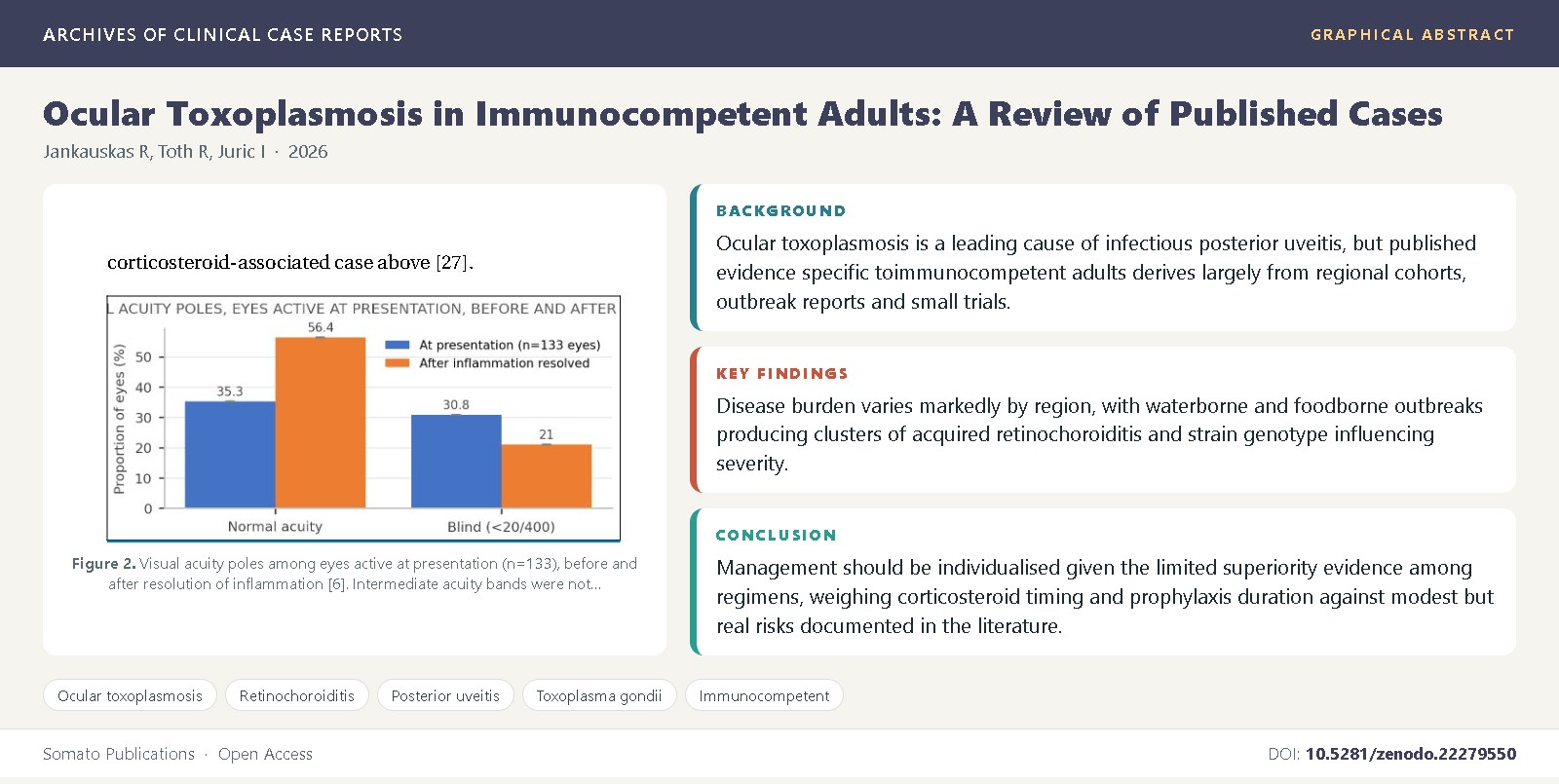
Background: Ocular toxoplasmosis is a leading cause of infectious posterior uveitis, but published evidence specific to
immunocompetent adults derives largely from regional cohorts, outbreak reports and small trials. Objective: To review published case reports, case series, cohort studies and trials of ocular toxoplasmosis in immunocompetent adults. Methods: Narrative review of case reports, case series, observational cohorts, randomised trials and systematic reviews. Findings: Disease burden varies markedly by region, with waterborne and foodborne outbreaks producing clusters of acquired retinochoroiditis and strain genotype influencing severity. Aqueous humour testing (Goldmann-Witmer coefficient, immunoblot, trimethoprim-sulfamethoxazole, pyrimethamine-sulfadiazine and intravitreal clindamycin-dexamethasone produce broadly equivalent outcomes; prophylaxis reduces recurrence during treatment, but this benefit narrows by ten years. Conclusions: Management should be individualised given the limited superiority evidence among regimens, weighing corticosteroid timing and prophylaxis duration against modest but real risks documented in the literature.
References
Bowie, W.R., King, A.S., Werker, D.H., Isaac-Renton, J.L., Bell, A., Eng, S.B., et al. (1997) Outbreak of toxoplasmosis associated with municipal drinking water. The Lancet, 350(9072): 173-177.
Burnett, A.J. (1998) Multiple cases of acquired toxoplasmosis retinitis presenting in an outbreak. Ophthalmology, 105(6): 1032-1037.
Glasner, P.D., Silveira, C., Kruszon-Moran, D., Martins, M.C., Burnier, M., Silveira, S., et al. (1992) An Unusually High Prevalence of Ocular Toxoplasmosis in Southern Brazil. American Journal of Ophthalmology, 114(2): 136-144.
Holland, G.N. (2003) Ocular toxoplasmosis: a global reassessment. Part I: epidemiology and course of disease. American Journal of Ophthalmology, 136(6): 973-988.
Kovacevic-Pavicevic, D., Radosavljevic, A., Ilic, A., Kovacevic, I., Djurkovic-Djakovic, O. (2012) Clinical pattern of ocular toxoplasmosis treated in a referral centre in Serbia. Eye, 26(5): 723-728.
Arruda, S., Vieira, B.R., Garcia, D.M., Araujo, M., Simoes, M., Moreto, R., et al. (2021) Clinical manifestations and visual outcomes associated with ocular toxoplasmosis in a Brazilian population. Scientific Reports, 11(1): 3137.
Bosch-Driessen, L.E.H., Berendschot, T.T.J.M., Ongkosuwito, J.V., Rothova, A. (2002) Ocular toxoplasmosis. Ophthalmology, 109(5): 869-878.
Khan, A., Jordan, C., Muccioli, C., Vallochi, A.L., Rizzo, L.V., Belfort, R., et al. (2006) Genetic Divergence of Toxoplasma gondii Strains Associated with Ocular Toxoplasmosis, Brazil. Emerging Infectious Diseases, 12(6): 942-949.
Gilbert, R.E., Freeman, K., Lago, E.G., Bahia-Oliveira, L.M.G., Tan, H.K., Wallon, M., et al. (2008) Ocular Sequelae of Congenital Toxoplasmosis in Brazil Compared with Europe. PLoS Neglected Tropical Diseases, 2(8): e277.
Bhikoo, R., Damato, E.M., Guest, S., Sims, J. (2019) Primary Ocular Toxoplasmosis Presenting to Uveitis Services in a Non-endemic Setting. Korean Journal of Ophthalmology, 33(6): 514-519.
Seers, T., Myneni, J., Chaudhry, N.L., Ugarte, M. (2021) Bilateral ocular toxoplasmosis in a returning traveller: age and route of infection as potential risk factors. BMJ Case Reports, 14(1): e237068.
Paquentin-Jimenez, R., Rivera-Sempertegui, R., Concha-Del-Rio, L.E. (2025) Small but threatening: Punctate Outer Retinal Toxoplasmosis (PORT), a case series report. PLoS Neglected Tropical Diseases, 19(4): e0013013.
Fekkar, A., Bodaghi, B., Touafek, F., Le Hoang, P., Mazier, D., Paris, L. (2008) Comparison of Immunoblotting, Calculation of the Goldmann-Witmer Coefficient, and Real-Time PCR Using Aqueous Humor Samples for Diagnosis of Ocular Toxoplasmosis. Journal of Clinical Microbiology, 46(6): 1965-1967.
Talabani, H., Asseraf, M., Yera, H., Delair, E., Ancelle, T., Thulliez, P., et al. (2009) Contributions of Immunoblotting, Real-Time PCR, and the Goldmann-Witmer Coefficient to Diagnosis of Atypical Toxoplasmic Retinochoroiditis. Journal of Clinical Microbiology, 47(7): 2131-2135.
Robert-Gangneux, F., Binisti, P., Antonetti, D., Brezin, A., Yera, H., Dupouy-Camet, J. (2004) Usefulness of Immunoblotting and Goldmann-Witmer Coefficient for Biological Diagnosis of Toxoplasmic Retinochoroiditis. European Journal of Clinical Microbiology and Infectious Diseases, 23(1): 34-38.
Garweg, J.G., Jacquier, P., Boehnke, M. (2000) Early Aqueous Humor Analysis in Patients with Human Ocular Toxoplasmosis. Journal of Clinical Microbiology, 38(3): 996-1001.
Soheilian, M., Sadoughi, M.-M., Ghajarnia, M., Dehghan, M.H., Yazdani, S., Behboudi, H., et al. (2005) Prospective randomized trial of trimethoprim/sulfamethoxazole versus pyrimethamine and sulfadiazine in the treatment of ocular toxoplasmosis. Ophthalmology, 112(11): 1876-1882.
Baharivand, N., Mahdavifard, A., Fouladi, R.F. (2013) Intravitreal clindamycin plus dexamethasone versus classic oral therapy in toxoplasmic retinochoroiditis: a prospective randomized clinical trial. International Ophthalmology, 33(1): 39-46.
Bosch-Driessen, L.H., Verbraak, F.D., Suttorp-Schulten, M.S.A., van Ruyven, R.L.J., Klok, A.M., Hoyng, C.B., et al. (2002) A prospective, randomized trial of pyrimethamine and azithromycin vs pyrimethamine and sulfadiazine for the treatment of ocular toxoplasmosis. American Journal of Ophthalmology, 134(1): 34-40.
Pradhan, E., Bhandari, S., Gilbert, R.E., Stanford, M. (2016) Antibiotics versus no treatment for toxoplasma retinochoroiditis. Cochrane Database of Systematic Reviews, 2016(5): CD002218.
Alvarez-Garcia, V., Rubio-Romero, L., Maldonado, M.A., Gomez-Suarez, M., de-la-Torre, A. (2021) Ocular toxoplasmosis in immunocompetent adults: current cost-effectiveness of four treatment regimens in Colombia. Heliyon, 7(11): e08265.
Holland, G.N. (2004) Ocular toxoplasmosis: a global reassessment. Part II: disease manifestations and management. American Journal of Ophthalmology, 137(1): 1-17.
Silveira, C., Belfort, R., Muccioli, C., Holland, G.N., Victora, C.G., Horta, B.L., et al. (2002) The effect of long-term intermittent trimethoprim/sulfamethoxazole treatment on recurrences of toxoplasmic retinochoroiditis. American Journal of Ophthalmology, 134(1): 41-46.
Fernandes Felix, J.P., Lira, R.P.C., Zacchia, R.S., Toribio, J.M., Nascimento, M.A., Arieta, C.E.L. (2014) Trimethoprim-Sulfamethoxazole Versus Placebo to Reduce the Risk of Recurrences of Toxoplasma gondii Retinochoroiditis: Randomized Controlled Clinical Trial. American Journal of Ophthalmology, 157(4): 762-766.e1.
Fernandes Felix, J.P., Lira, R.P.C., Grupenmacher, A.T., Assis Filho, H.L.G., Cosimo, A.B., Nascimento, M.A., et al. (2020) Long-term Results of Trimethoprim-Sulfamethoxazole Versus Placebo to Reduce the Risk of Recurrent Toxoplasma gondii Retinochoroiditis. American Journal of Ophthalmology, 213: 195-202.
Keshavarz, T., Furtado, J.M., Smith, J.R. (2026) Antimicrobial Drug Prophylaxis for Recurrent Ocular Toxoplasmosis. Pathogens, 15(4): 388.
Lin, H.-Y., Lee, W.-J.A. (2022) The Role of Corticosteroids in Treating Acute Ocular Toxoplasmosis in an Immunocompetent Patient: A Case Report. Frontiers in Medicine, 9: 843050.





