
Late-Onset Congenital Adrenal Hyperplasia Presenting with Secondary Amenorrhoea: A Review of Published Cases
DOI:
https://doi.org/10.5281/zenodo.22279180Keywords:
Congenital adrenal hyperplasia, 21-hydroxylase deficiency, Secondary amenorrhoea, Hirsutism, Polycystic ovary syndromeAbstract
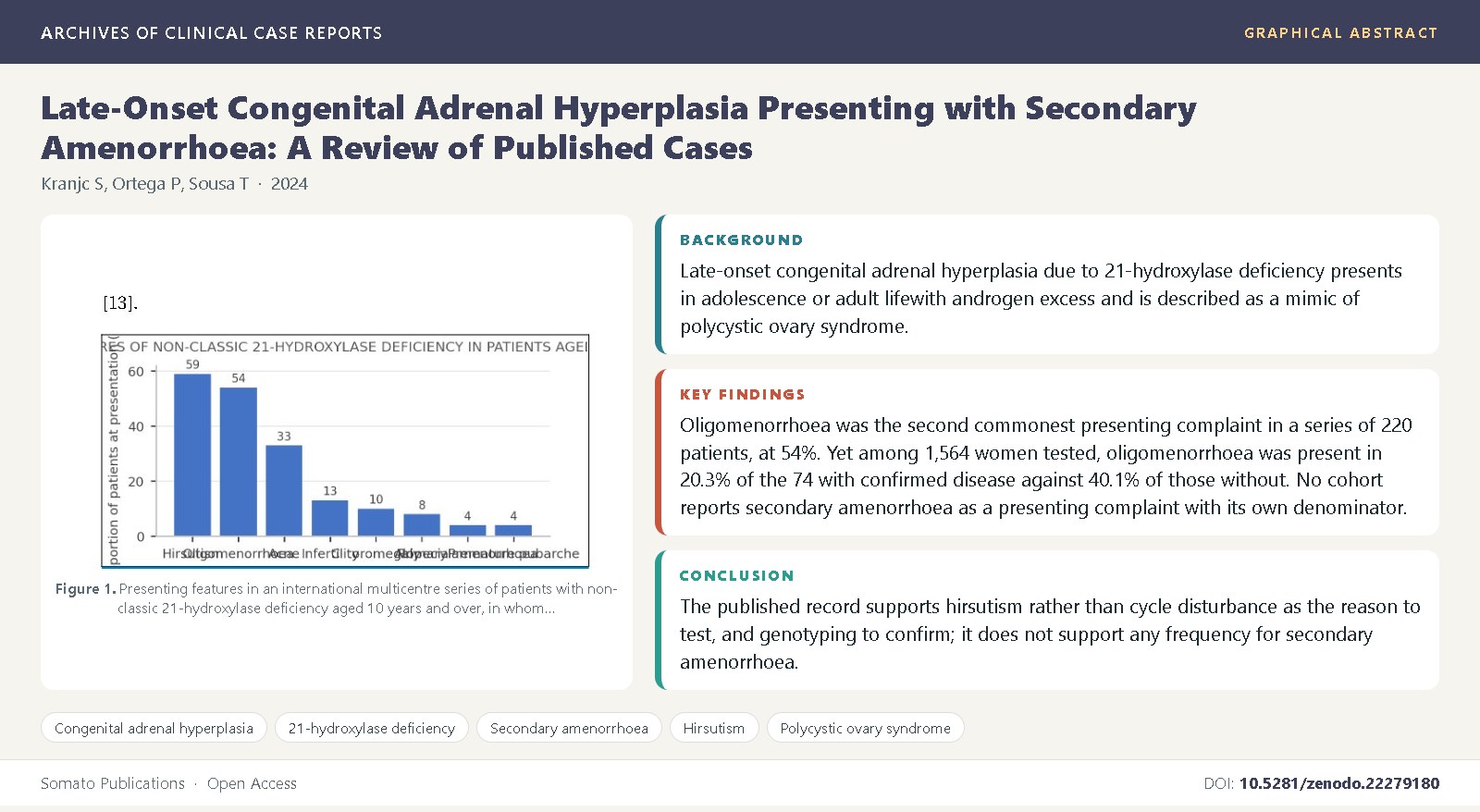
Background: Late-onset congenital adrenal hyperplasia due to 21-hydroxylase deficiency presents in adolescence or adult life
with androgen excess and is described as a mimic of polycystic ovary syndrome. Objective: To determine how often the condition presents with secondary amenorrhoea and whether menstrual disturbance justifies testing. Methods: Narrative review of published cohorts, prevalence studies, genotyping series and individual case reports. Findings: Oligomenorrhoea was the second commonest presenting complaint in a series of 220 patients, at 54%. Yet among 1,564 women tested, oligomenorrhoea was present in 20.3% of the 74 with confirmed disease against 40.1% of those without. No cohort reports secondary amenorrhoea as a presenting complaint with its own denominator. Conclusions: The published record supports hirsutism rather than cycle disturbance as the reason to test, and genotyping to confirm; it does not support any frequency for secondary amenorrhoea.
References
Merke, D.P., Auchus, R.J. (2020) Congenital adrenal hyperplasia due to 21-hydroxylase deficiency. New England Journal of Medicine, 383(13): 1248-1261.
Falhammar, H., Nordenstrom, A. (2015) Nonclassic congenital adrenal hyperplasia due to 21-hydroxylase deficiency: clinical presentation, diagnosis, treatment, and outcome. Endocrine, 50(1): 32-50.
New, M.I., Lorenzen, F., Lerner, A.J., Kohn, B., Oberfield, S.E., Levine, L.S., et al. (1983) Genotyping steroid 21-hydroxylase deficiency: hormonal reference data. Journal of Clinical Endocrinology and Metabolism, 57(2): 320-326.
Dewailly, D., Vantyghem-Haudiquet, M.C., Sainsard, C., Buvat, J., Cappoen, J.P., Ardaens, K., et al. (1986) Clinical and biological phenotypes in late-onset 21-hydroxylase deficiency. Journal of Clinical Endocrinology and Metabolism, 63(2): 418-423.
Papadakis, G., Kandaraki, E.A., Tseniklidi, E., Papalou, O., Diamanti-Kandarakis, E. (2019) Polycystic ovary syndrome and NC-CAH: distinct characteristics and common findings. A systematic review. Frontiers in Endocrinology, 10: 388.
Speiser, P.W., Dupont, B., Rubinstein, P., Piazza, A., Kastelan, A., New, M.I. (1985) High frequency of nonclassical steroid 21-hydroxylase deficiency. American Journal of Human Genetics, 37(4): 650-667.
Livadas, S., Bothou, C. (2019) Management of the female with non-classical congenital adrenal hyperplasia (NCCAH): a patient-oriented approach. Frontiers in Endocrinology, 10: 366.
Hannah-Shmouni, F., Morissette, R., Sinaii, N., Elman, M., Prezant, T.R., Chen, W., et al. (2017) Revisiting the prevalence of nonclassic congenital adrenal hyperplasia in US Ashkenazi Jews and Caucasians. Genetics in Medicine, 19(11): 1276-1279.
Carmina, E., Dewailly, D., Escobar-Morreale, H.F., Kelestimur, F., Moran, C., Oberfield, S., et al. (2017) Non-classic congenital adrenal hyperplasia due to 21-hydroxylase deficiency revisited: an update with a special focus on adolescent and adult women. Human Reproduction Update, 23(5): 580-599.
Escobar-Morreale, H.F., Sanchon, R., San Millan, J.L. (2008) A prospective study of the prevalence of nonclassical congenital adrenal hyperplasia among women presenting with hyperandrogenic symptoms and signs. Journal of Clinical Endocrinology and Metabolism, 93(2): 527-533.
Azziz, R., Hincapie, L.A., Knochenhauer, E.S., Dewailly, D., Fox, L., Boots, L.R. (1999) Screening for 21-hydroxylase-deficient nonclassic adrenal hyperplasia among hyperandrogenic women: a prospective study. Fertility and Sterility, 72(5): 915-925.
Nakhleh, A., Saiegh, L., Shehadeh, N., Weintrob, N., Sheikh-Ahmad, M., Supino-Rosin, L., et al. (2023) Screening for non-classic congenital adrenal hyperplasia in women: new insights using different immunoassays. Frontiers in Endocrinology, 13: 1048663.
Huang, Y., Jiang, H., Zhu, X., et al. (2025) Long-read sequencing analysis of non-classical congenital adrenal hyperplasia prevalence and carrier frequency in Chinese polycystic ovarian syndrome patients. Journal of Ovarian Research, 18: 252.
Moran, C., Azziz, R., Carmina, E., Dewailly, D., Fruzzetti, F., Ibanez, L., et al. (2000) 21-Hydroxylase-deficient nonclassic adrenal hyperplasia is a progressive disorder: a multicenter study. American Journal of Obstetrics and Gynecology, 183(6): 1468-1474.
Witchel, S.F., Azziz, R. (2010) Nonclassic congenital adrenal hyperplasia. International Journal of Pediatric Endocrinology, 2010: 625105.
Bidet, M., Bellanne-Chantelot, C., Galand-Portier, M.B., Tardy, V., Billaud, L., Laborde, K., et al. (2009) Clinical and molecular characterization of a cohort of 161 unrelated women with nonclassical congenital adrenal hyperplasia due to 21-hydroxylase deficiency and 330 family members. Journal of Clinical Endocrinology and Metabolism, 94(5): 1570-1578.
Livadas, S., Dracopoulou, M., Dastamani, A., Sertedaki, A., Maniati-Christidi, M., Magiakou, A.M., et al. (2015) The spectrum of clinical, hormonal and molecular findings in 280 individuals with nonclassical congenital adrenal hyperplasia caused by mutations of the CYP21A2 gene. Clinical Endocrinology (Oxford), 82(4): 543-549.
Speiser, P.W., Arlt, W., Auchus, R.J., Baskin, L.S., Conway, G.S., Merke, D.P., et al. (2018) Congenital adrenal hyperplasia due to steroid 21-hydroxylase deficiency: an Endocrine Society clinical practice guideline. Journal of Clinical Endocrinology and Metabolism, 103(11): 4043-4088.
Ambroziak, U., Kepczynska-Nyk, A., Kurylowicz, A., Malunowicz, E.M., Wojcicka, A., Miskiewicz, P., et al. (2016) The diagnosis of nonclassic congenital adrenal hyperplasia due to 21-hydroxylase deficiency, based on serum basal or post-ACTH stimulation 17-hydroxyprogesterone, can lead to false-positive diagnosis. Clinical Endocrinology (Oxford), 84(1): 23-29.
New, M.I., Abraham, M., Gonzalez, B., Dumic, M., Razzaghy-Azar, M., Chitayat, D., et al. (2013) Genotype-phenotype correlation in 1,507 families with congenital adrenal hyperplasia owing to 21-hydroxylase deficiency. Proceedings of the National Academy of Sciences of the United States of America, 110(7): 2611-2616.
Wilson, R.C., Nimkarn, S., Dumic, M., Obeid, J., Azar, M., Najmabadi, H., et al. (2007) Ethnic-specific distribution of mutations in 716 patients with congenital adrenal hyperplasia owing to 21-hydroxylase deficiency. Molecular Genetics and Metabolism, 90(4): 414-421.
Ali, M., Ahmad, M.H., Mirza, Z.A. (2024) A rare case of non-classical type of congenital adrenal hyperplasia in a 27-year-old female. Journal of Ayub Medical College Abbottabad, 36(2): 436-438.
Rizwan, A., Hayat, M. (2015) Unusual presentation with polymenorrhagia and markedly high 17-hydroxy progesterone levels in a lady with Non-Classic Congenital Adrenal Hyperplasia. JPMA. The Journal of the Pakistan Medical Association, 65(8): 889-891.
Navabi, K., Bose, V. (2025) Nonclassical congenital adrenal hyperplasia presenting with isolated hirsutism in a young adult: a case report. Cureus, 17(7): e88750.
Bidet, M., Bellanne-Chantelot, C., Galand-Portier, M.B., Golmard, J.L., Tardy, V., Morel, Y., et al. (2010) Fertility in women with nonclassical congenital adrenal hyperplasia due to 21-hydroxylase deficiency. Journal of Clinical Endocrinology and Metabolism, 95(3): 1182-1190.
Moran, C., Azziz, R., Weintrob, N., Witchel, S.F., Rohmer, V., Dewailly, D., et al. (2006) Reproductive outcome of women with 21-hydroxylase-deficient nonclassic adrenal hyperplasia. Journal of Clinical Endocrinology and Metabolism, 91(9): 3451-3456.
Eyal, O., Ayalon-Dangur, I., Segev-Becker, A., Schachter-Davidov, A., Israel, S., Weintrob, N. (2017) Pregnancy in women with nonclassic congenital adrenal hyperplasia: time to conceive and outcome. Clinical Endocrinology (Oxford), 87(5): 552-556.
Spritzer, P., Billaud, L., Thalabard, J.C., Birman, P., Mowszowicz, I., Raux-Demay, M.C., et al. (1990) Cyproterone acetate versus hydrocortisone treatment in late-onset adrenal hyperplasia. Journal of Clinical Endocrinology and Metabolism, 70(3): 642-646.





