
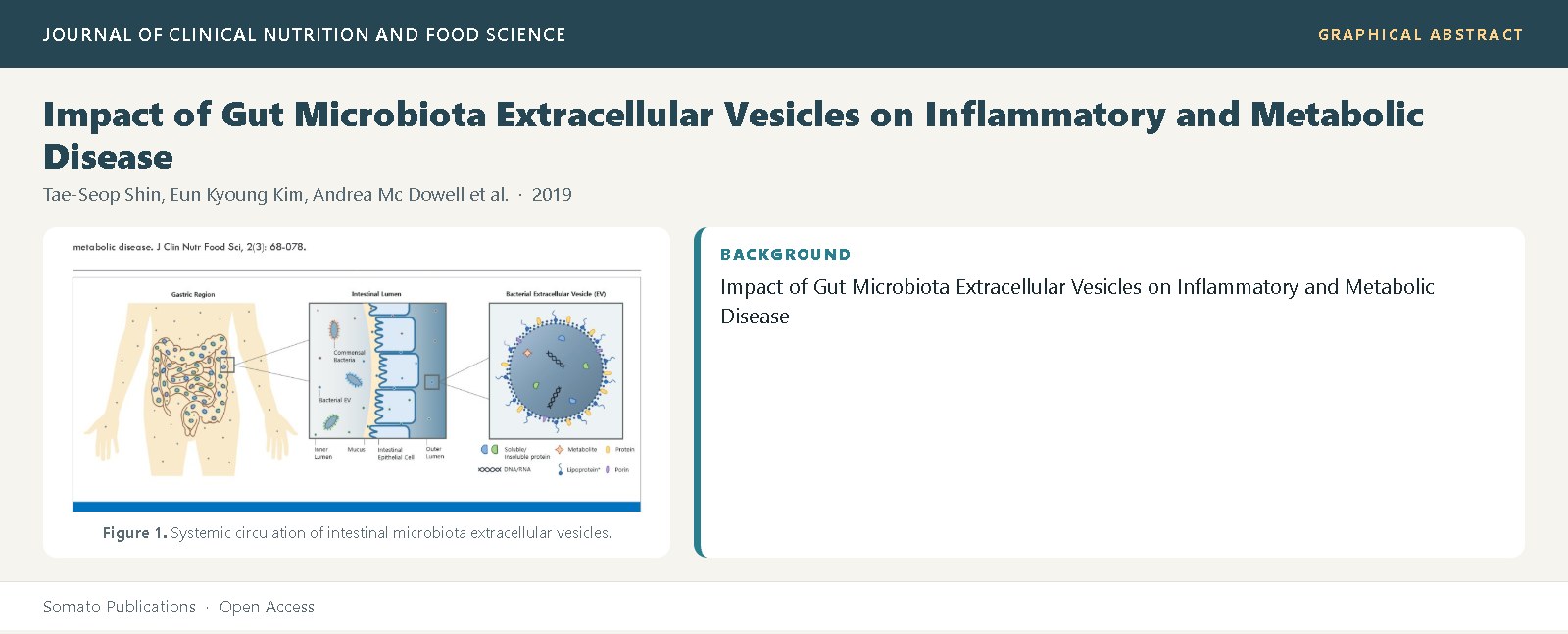
Impact of Gut Microbiota Extracellular Vesicles on Inflammatory and Metabolic Disease
Abstract
References
Ley, RE., Peterson, DA., Gordon, JI. (2006) Ecological and evolutionary forces shaping microbial diversity in the human intestine. Cell, 124(4): 837–848.
Clemente, JC., Ursell, LK., Parfrey, LW., Knight, R. (2012) The impact of the gut microbiota on human health: An integrative view. Cell, 148(6): 1258–1270.
Mashburn-Warren, LM., Whiteley, M. (2006) Special delivery: Vesicle trafficking in prokaryotes. Mol Microbiol, 61(4): 839–846.
Bomberger, JM., Maceachran, DP., Coutermarsh, BA., Ye, S., O’Toole, GA., Stanton, BA. (2009) Long-distance delivery of bacterial virulence factors by pseudomonas aeruginosa outer membrane vesicles. PLoS Pathog, 5(4): e1000382.
Kuehn, MJ., Kesty, NC. (2005) Bacterial outer membrane vesicles and the host-pathogen interaction. Genes Dev, 19(22): 2645–2655.
Weinstock, GM. (2012) Genomic approaches to studying the human microbiota. Nature, 489(7415): 250–256.
Nelson, KE., Weinstock, GM., Highlander, SK., Worley, KC., Creasy, HH., Wortman, JR., et al. (2010) A Catalog of Reference Genomes from the Human Microbiome. The Human Microbiome Jumpstart Reference Strains Consortium. Science, 328(5981): 994–999.
Huttenhower, C., Gevers, D., Knight, R., Abubucker, S., Badger, JH., Chinwalla, AT., et al. (2012) Structure, function and diversity of the healthy human microbiome. Nature, 486(7402): 207–214.
Turnbaugh, PJ., Quince, C., Faith, JJ., McHardy, AC., Yatsunenko, T., Niazi, F., et al. (2010) Organismal, genetic, and transcriptional variation in the deeply sequenced gut microbiomes of identical twins. Proc Natl Acad Sci U S A, 107(16): 7503–7508.
Nam, YD., Jung, MJ., Roh, SW., Kim, MS., Bae, JW. (2011) Comparative analysis of korean human gut microbiota by barcoded pyrosequencing. PLoS One, 6(7): e22109.
Eckburg, PB., Bik, EM., Bernstein, CN., Purdom, E., Dethlefsen, L., Sargent, M., et al. (2005) Diversity of the Human Intestinal Microbial Flora. Science, 308(5728): 1635–1638.
Arumugam, M., Raes, J., Pelletier, E., Le, Paslier, D., Yamada, T., Mende, DR., et al. (2011) Enterotypes of the human gut microbiome. Nature, 473(7346): 174–180.
Filippo, C., Cavalieri, D., Paola, M., Ramazzotti, M., Poullet, JB., et al. (2010) Impact of diet in shaping gut microbiota revealed by a comparative study in children from Europe and rural Africa. PNAS, 107(33): 14691–14696.
De, Filippo, C., Cavalieri, D., Di Paola, M., Ramazzotti, M., Poullet, JB., Massart, S., et al. (2010) Impact of diet in shaping gut microbiota revealed by a comparative study in children from Europe and rural Africa. Proc Natl Acad Sci U S A, 107(33): 14691–14696.
Hehemann, JH., Correc, G., Barbeyron, T., Helbert, W., Czjzek, M., Michel, G. (2010) Transfer of carbohydrate-active enzymes from marine bacteria to Japanese gut microbiota. Nature, 464(7290): 908– 912.
Nurmi, E., Haapamäki, J., Paavilainen, E., Rantanen, A., Hillilä, M., Arkkila, P. (2013) The burden of inflammatory bowel disease on health care utilization and quality of life. Scand J Gastroenterol. 48(1): 51–57.
McGuckin, MA., Eri, R., Simms, LA., Florin, TH., Radford-Smith, G. (2009) Intestinal barrier dysfunction in inflammatory bowel diseases. Inflamm Bowel Dis. 15(1): 100–113.
Tlaskalová-Hogenová, H., Stěpánková, R., Kozáková, H., Hudcovic, T., Vannucci, L., Tučková, L., et al. (2011) The role of gut microbiota (commensal bacteria) and the mucosal barrier in the pathogenesis of inflammatory and autoimmune diseases and cancer: Contribution of germ-free and gnotobiotic animal models of human diseases. Cell Mol Immunol, 8(2): 110–120.
Michielan, A., D’Incà, R. (2015) Intestinal Permeability in Inflammatory Bowel Disease: Pathogenesis, Clinical Evaluation, and Therapy of Leaky Gut. Mediators Inflamm, 2015: 628157.
Frank, DN., St, Amand, AL., Feldman, RA., Boedeker, EC., Harpaz, N., Pace, NR. (2007) Molecular-phylogenetic characterization of microbial community imbalances in human inflammatory bowel diseases. Proc Natl Acad Sci U S A, 104(34): 13780–13785.
Walker, AW., Sanderson, JD., Churcher, C., Parkes, GC., Hudspith, BN., Rayment, N., et al. (2011) High-throughput clone library analysis of the mucosa-associated microbiota reveals dysbiosis and differences between inflamed and non-inflamed regions of the intestine in inflammatory bowel disease. BMC Microbiol, 11: 7.
Joossens, M., Huys, G., Cnockaert, M., De, Preter, V., Verbeke, K., Rutgeerts, P., et al. (2011) Dysbiosis of the faecal microbiota in patients with Crohn’s disease and their unaffected relatives. Gut, 60(5): 631–637.
Shaw, SY., Blanchard, JF., Bernstein, CN. (2010) Association between the use of antibiotics in the first year of life and pediatric inflammatory bowel disease. Am J Gastroenterol, 105(12): 2687–2692.
Kang, CS., Ban, M., Choi, EJ., Moon, HG., Jeon, JS., Kim, DK., et al. (2013) Extracellular Vesicles Derived from Gut Microbiota, Especially Akkermansia muciniphila, Protect the Progression of Dextran Sulfate Sodium-Induced Colitis. PLoS One, 8(10): e76520.
Seo, MK., Park, EJ., Ko, SY., Choi, EW., Kim, S. (2018) Therapeutic effects of kefir grain Lactobacillus-derived extracellular vesicles in mice with 2,4,6-trinitrobenzene sulfonic acid-induced inflammatory bowel disease. J Dairy Sci, 101(10): 8662-8671.
Kasubuchi, M., Hasegawa, S., Hiramatsu, T., Ichimura, A., Kimura., I. (2015) Dietary gut microbial metabolites, short-chain fatty acids, and host metabolic regulation. Nutrients, 7(4): 2839-2849.
Qin, J., Li, Y., Cai, Z., Li, S., Zhu, J., Zhang, F., et al. (2012) A metagenomewide association study of gut microbiota in type 2 diabetes,” Nature, 490(7418): 55-60.
De Vadder, F., Kovatcheva-Datchary, P., Goncalves, D., Vinera, J., Zitoun, C., Duchampt, A., et al. (2014) Microbiota-generated metabolites promote metabolic benefits via gut-brain neural circuits. Cell, 156(1- 2): 84-96.
Ley, RE., Bäckhed, F., Turnbaugh, P., Lozupone, CA., Knight, RD., Gordon, JI. (2005) Obesity alters gut microbial ecology. Proc Natl Acad Sci U S A, 102(31): 11070-11075.
Turnbaugh, PJ., Bäckhed, F., Fulton, L., Gordon, JI. (2008) Diet-Induced Obesity Is Linked to Marked but Reversible Alterations in the Mouse Distal Gut Microbiome. Cell Host Microbe, 3(4): 213-223.
Turnbaugh, PJ., Ley, RE., Mahowald, MA., Magrini, V., Mardis, ER., Gordon, JI. (2006) An obesity-associated gut microbiome with increased capacity for energy harvest. Nature, 444(7122): 1027-1031.
Ley, RE., Turnbaugh, PJ., Klein, S., Gordon, JI. (2006) Microbial ecology: human gut microbes associated with obesity. Nature, 444(7122): 1022-1023.
Turnbaugh, PJ., Gordon, JI. (2009) The core gut microbiome, energy balance and obesity. J Physiol, 587(Pt 17): 4153-4158.
Schwiertz, A., Taras, D., Schäfer, K., Beijer, S., Bos, NA., Donus, C., et al. (2010) Microbiota and SCFA in lean and overweight healthy subjects. Obesity (Silver Spring), 18(1): 190-195.
Jumpertz, R., Le, DS., Turnbaugh, PJ., Trinidad, C., Bogardus, C., Gordon, JI., et al. (2011) Energy-balance studies reveal associations between gut microbes, caloric load, and nutrient absorption in humans. Am J Clin Nutr, 94(1): 58-65.
Cani, PD., Amar, J., Iglesias, MA., Poggi, M., Knauf, C., Bastelica, D., et al. (2007) Metabolic endotoxemia initiates obesity and insulin resistance. Diabetes, 56(7): 1761-1772.
Tsukumo, DM., Carvalho-Filho, MA., Carvalheira, JB., Prada, PO., Hirabara, SM., Schenka, AA., et al. (2007) Loss-of-function mutation in Toll-like receptor 4 prevents diet-induced obesity and insulin resistance. Diabetes, 56(8): 1986-1998.
Choi, Y., Kwon, Y., Kim, DK., Jeon, J., Jang, SC., Wang, T., et al. (2015) Gut microbe-derived extracellular vesicles induce insulin resistance, thereby impairing glucose metabolism in skeletal muscle,” Scientific Reports, 5: 1–11.
Chelakkot, C., Choi, Y., Kim, DK., Park, HT., Ghim, J., Kwon, Y., et al. (2018) Akkermansia muciniphila-derived extracellular vesicles influence gut permeability through the regulation of tight junctions. Exp Mol Med, 50(2): e450.
Ashrafian, F., Shahriary, A., Behrouzi, A., Moradi, HR., Keshavarz Azizi Raftar, S., et al. (2019) Akkermansia muciniphila-Derived Extracellular Vesicles as a Mucosal Delivery Vector for Amelioration of Obesity in Mice. Front Microbiol, 10: 2155.





