
Minimally Invasive Transforaminal Lumbar Interbody Fusion for Degenerative Spondylolisthesis
DOI:
https://doi.org/10.5281/zenodo.22310367Keywords:
Minimally invasive surgery, Transforaminal lumbar interbody fusion, Degenerative spondylolisthesis, Spinal fusion, Patient-reported outcomesAbstract
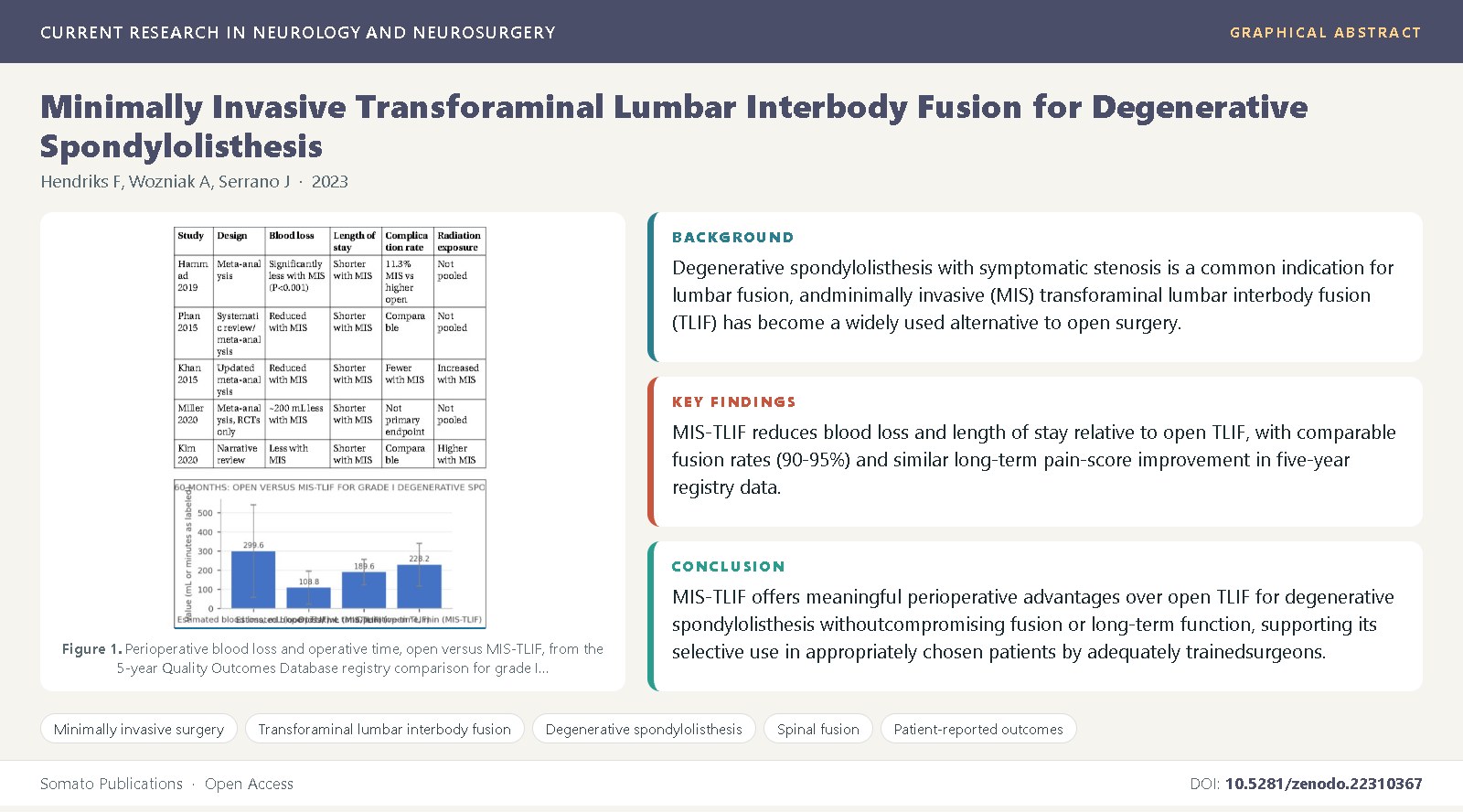
Background: Degenerative spondylolisthesis with symptomatic stenosis is a common indication for lumbar fusion, and
minimally invasive (MIS) transforaminal lumbar interbody fusion (TLIF) has become a widely used alternative to open surgery.
Objective: To synthesise published evidence comparing MIS-TLIF with open TLIF for degenerative spondylolisthesis.
Methods: Narrative review of indication studies, technique descriptions, comparative cohorts, randomized and registry data, and
meta-analyses. Findings: MIS-TLIF reduces blood loss and length of stay relative to open TLIF, with comparable fusion rates (90-95%) and similar long-term pain-score improvement in five-year registry data. Complication and reoperation rates are broadly similar
between techniques, though MIS-TLIF carries a front-loaded learning curve and greater fluoroscopic exposure.
Conclusions: MIS-TLIF offers meaningful perioperative advantages over open TLIF for degenerative spondylolisthesis without
compromising fusion or long-term function, supporting its selective use in appropriately chosen patients by adequately trained
surgeons.
References
Herkowitz, H.N., Kurz, L.T. (1991) Degenerative lumbar spondylolisthesis with spinal stenosis: a prospective study comparing decompression with decompression and intertransverse process arthrodesis. Journal of Bone and Joint Surgery American, 73(6): 802-808.
Harms, J., Rolinger, H. (1982) Die operative Behandlung der Spondylolisthese durch dorsale Aufrichtung und ventrale Verblockung. Zeitschrift für Orthopädie und ihre Grenzgebiete, 120(3): 343-347.
Foley, K.T., Holly, L.T., Schwender, J.D. (2003) Minimally invasive lumbar fusion. Spine, 28(15 Suppl): S26-S35.
Schwender, J.D., Holly, L.T., Rouben, D.P., Foley, K.T. (2005) Minimally invasive transforaminal lumbar interbody fusion (TLIF): technical feasibility and initial results. Journal of Spinal Disorders and Techniques, 18(Suppl): S1-S6.
Holly, L.T., Schwender, J.D., Rouben, D.P., Foley, K.T. (2006) Minimally invasive transforaminal lumbar interbody fusion: indications, technique, and complications. Neurosurgical Focus, 20(3): E6.
Kepler, C.K., Vaccaro, A.R., Hilibrand, A.S., Anderson, D.G., Rihn, J.A., Albert, T.J., Radcliff, K.E. (2014) National trends in the use of fusion techniques to treat degenerative spondylolisthesis. Spine, 39(19): 1584-1589.
Matsunaga, S., Ijiri, K., Hayashi, K. (2000) Nonsurgically managed patients with degenerative spondylolisthesis: a 10- to 18-year follow-up study. Journal of Neurosurgery, 93(2 Suppl): 194-198.
Weinstein, J.N., Lurie, J.D., Tosteson, T.D., Hanscom, B., Tosteson, A.N., Blood, E.A., et al. (2007) Surgical versus nonsurgical treatment for lumbar degenerative spondylolisthesis. New England Journal of Medicine, 356(22): 2257-2270.
Garg, B., Mehta, N. (2019) Minimally invasive transforaminal lumbar interbody fusion (MI-TLIF): A review of indications, technique, results and complications. Journal of Clinical Orthopaedics and Trauma, 10(Suppl 1): S156-S162.
Park, P., Foley, K.T. (2008) Minimally invasive transforaminal lumbar interbody fusion with reduction of spondylolisthesis: technique and outcomes after a minimum of 2 years' follow-up. Neurosurgical Focus, 25(2): E16.
Khan, N.R., Clark, A.J., Lee, S.L., Venable, G.T., Rossi, N.B., Foley, K.T. (2015) Surgical outcomes for minimally invasive vs open transforaminal lumbar interbody fusion: an updated systematic review and meta-analysis. Neurosurgery, 77(6): 847-874.
Hammad, A., Wirries, A., Ardeshiri, A., Nikiforov, O., Geiger, F. (2019) Open versus minimally invasive TLIF: literature review and meta-analysis. Journal of Orthopaedic Surgery and Research, 14: 229.
Phan, K., Rao, P.J., Kam, A.C., Mobbs, R.J. (2015) Minimally invasive versus open transforaminal lumbar interbody fusion for treatment of degenerative lumbar disease: systematic review and meta-analysis. European Spine Journal, 24(5): 1017-1030.
Miller, L.E., Bhattacharyya, S., Pracyk, J. (2020) Minimally invasive versus open transforaminal lumbar interbody fusion for single-level degenerative disease: a systematic review and meta-analysis of randomized controlled trials. World Neurosurgery, 133: 358-365.e4.
Kim, C.H., Easley, K., Lee, J.S., Hong, J.Y., Virk, M., Hsieh, P.C., Yoon, S.T. (2020) Comparison of minimally invasive versus open transforaminal interbody lumbar fusion. Global Spine Journal, 10(2 Suppl): 143S-150S.
Chen, X., Lin, G.X., Rui, G., et al. (2022) Comparison of perioperative and postoperative outcomes of minimally invasive and open TLIF in obese patients: a systematic review and meta-analysis. Journal of Pain Research, 15: 41-52.
Sulaiman, W.A.R., Singh, M. (2014) Minimally invasive versus open transforaminal lumbar interbody fusion for degenerative spondylolisthesis grades 1-2: patient-reported clinical outcomes and cost-utility analysis. Ochsner Journal, 14(1): 32-37.
Parker, S.L., Mendenhall, S.K., Shau, D.N., Zuckerman, S.L., Godil, S.S., Cheng, J.S., McGirt, M.J. (2014) Minimally invasive versus open transforaminal lumbar interbody fusion for degenerative spondylolisthesis: comparative effectiveness and cost-utility analysis. World Neurosurgery, 82(1-2): 230-238.
Chan, A.K., Chou, D., Bydon, M., Michalopoulos, G.D., Park, P., Agarwal, N., et al. (2023) Minimally invasive versus open transforaminal lumbar interbody fusion for grade I lumbar spondylolisthesis: 5-year follow-up from the prospective multicenter Quality Outcomes Database registry. Neurosurgical Focus, 54(1): E2.
Serban, D., Calina, N., Tender, G. (2017) Standard versus minimally invasive transforaminal lumbar interbody fusion: a prospective randomized study. BioMed Research International, 2017: 7236970.
Seng, C., Siddiqui, M.A., Wong, K.P., Zhang, K., Yeo, W., Tan, S.B., et al. (2013) Five-year outcomes of minimally invasive versus open transforaminal lumbar interbody fusion: a matched-pair comparison study. Spine, 38(23): 2049-2055.
Heemskerk, J.L., Oluwadara Akinduro, O., Clifton, W., Quiñones-Hinojosa, A., Abode-Iyamah, K.O. (2021) Long-term clinical outcome of minimally invasive versus open single-level transforaminal lumbar interbody fusion for degenerative lumbar diseases: a meta-analysis. Spine Journal, 21(12): 2049-2065.
Mummaneni, P.V., Bisson, E.F., Kerezoudis, P., Glassman, S., Foley, K., Slotkin, J.R., et al. (2017) Minimally invasive versus open fusion for Grade I degenerative lumbar spondylolisthesis: analysis of the Quality Outcomes Database. Neurosurgical Focus, 43(2): E11.
Chan, A.K., Bisson, E.F., Bydon, M., Glassman, S.D., Foley, K.T., Potts, E.A., et al. (2020) A comparison of minimally invasive and open transforaminal lumbar interbody fusion for grade 1 degenerative lumbar spondylolisthesis: an analysis of the prospective Quality Outcomes Database. Neurosurgery, 87(3): 555-562.
Goh, G.S., Tay, A.Y.W., Zeng, G.J., Soh, R.C.C. (2025) Long-term results of minimally invasive transforaminal lumbar interbody fusion in elderly patients: a 5-year follow-up study. Global Spine Journal, 15(3): 838-845.
Sclafani, J.A., Kim, C.W. (2014) Complications associated with the initial learning curve of minimally invasive spine surgery: a systematic review. Clinical Orthopaedics and Related Research, 472(6): 1711-1717.
Silva, P.S., Pereira, P., Monteiro, P., Silva, P.A., Vaz, R. (2013) Learning curve and complications of minimally invasive transforaminal lumbar interbody fusion. Neurosurgical Focus, 35(2): E7.
Chan, A.K., Bisson, E.F., Bydon, M., Glassman, S.D., Foley, K.T., Potts, E.A., et al. (2019) A comparison of minimally invasive transforaminal lumbar interbody fusion and decompression alone for degenerative lumbar spondylolisthesis. Neurosurgical Focus, 46(5): E13.





