
High-Fat Diet Reverses Neuroprotection Attained by Moderate Aerobic Exercise in the Spastic Han-Wistar Rat, a Model of Ataxia
Keywords:
cerebellum, BDNF, ataxia, treadmill, Purkinje cellsAbstract
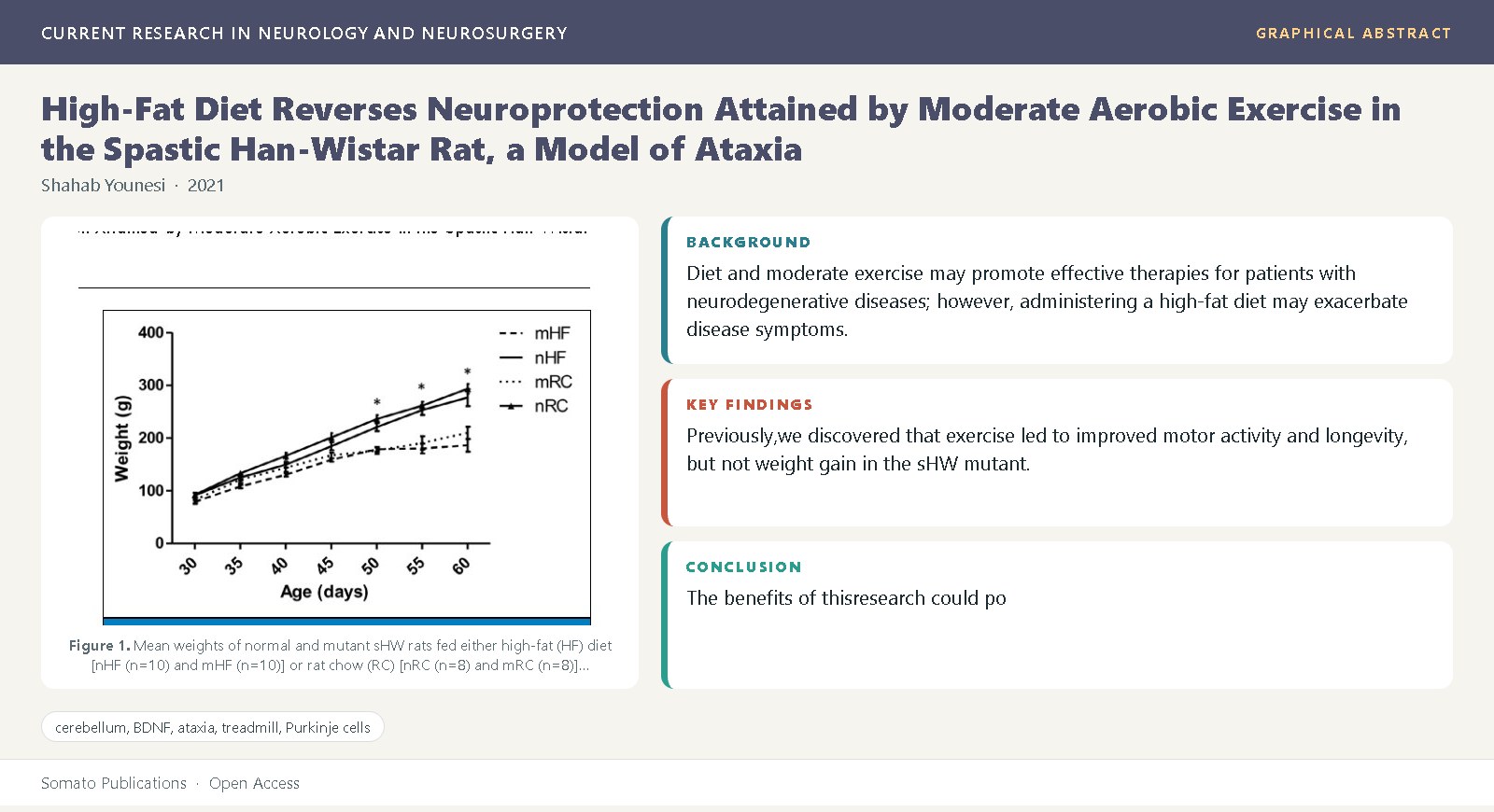
Diet and moderate exercise may promote effective therapies for patients with neurodegenerative diseases; however, administering a high-fat diet may exacerbate disease symptoms. To examine the effect of high-fat diet on exercise-induced neuroprotection, a high-fat diet was provided to spastic Han-Wistar (sHW) rats (Rattus norvegicus), a model of ataxia. Previously,
we discovered that exercise led to improved motor activity and longevity, but not weight gain in the sHW mutant. What effect
would a high-fat diet be on exercising mutants? Mutant and normal male siblings at 30 days of age were given either a highfat diet (HF; 58% fat calories) or commercial rat chow diet (RC; 13% fat calories), and half of the rats were run on a treadmill
at 15m/min for 30 min at a 15o
incline for five days/week. While weight gain was similar among the exercising or sedentary
mutants regardless of diet, a significant increase in longevity of the mutants feeding on the RC compared to the HF-fed mutants
was observed. Normal rats were unaffected by consuming either diet. Brain-derived neurotrophic factor (BDNF) has been
reported to be elevated after acute exercise. Hence, we investigated whether there was a correlation between the effect of HF
treatment and BDNF expression quantified using an enzyme-linked immunosorbent assay (ELISA). Our results showed that
BDNF levels in the cortex, hippocampus and cerebellum were affected by both diet and exercise (p=0.009). The benefits of this
research could po
References
Mercadillo, RE., Galvez, V., Díaz, R., Paredes, L., Velázquez-Moctezuma, J., Hernandez-Castillo, CR., et al. (2015) Social and cultural elements associated with neurocognitive dysfunctions in spinocerebellar ataxia type 2 patients. Front Psychiatry, 6: 90.
Anheim, M., Tranchant, C., Koenig, M. (2012) The autosomal recessive cerebellar ataxias. N Engl J Med, 366(7): 636-646.
Sugawara, M., Wada, C., Okawa, S., Kobayashi, M., Sageshima, M., Imota, T., et al. (2008) Purkinje cell loss in the cerebellar flocculus in patients with ataxia with ocular motor apraxia type 1/early-onset ataxia with ocular motor apraxia and hypoalbuminemia. EurNeurol, 59(1-2): 18-23.
van de Warrenburg, BP., van Gaalen, J., Boesch, S., Burgunder, JM., Dürr, A., Giunti, P., et al. (2014)EFNS/ENS Consensus on the diagnosis and management of chronic ataxias in adulthood. Eur J Neurol, 21(4): 552-562.
Sarva, H., Shanker, VL. (2014) Treatment options in degenerative cerebellar ataxia: a systematic review. Mov Disord Clin Pract, 1(4): 291-298.
Martineau, L., Noreau, A., Dupré, N. (2014)Therapies for ataxias. CurrTreat Options Neurol, 16(7): 300.
Sung, YH. (2015) Effects of treadmill exercise on hippocampal neurogenesis in an MPTP /probenecid-induced Parkinson's disease mouse model. J PhysTherSci, 27(10): 3203-3206.
Uhlendorf, T., Van Kummer, B., Yaspelkis, III B., Cohen, R. (2011)Neuroprotective effects of moderate aerobic exercise on the spastic Han–Wistar rat, a model of ataxia. Brain Res, 1369: 216-222.
Van Kummer, B., Cohen, R. (2015) Exercise-induced neuroprotection in the spastic Han Wistar rat: the possible role of brain-derived neurotrophic factor. Biomed Res Int, 2015: 834543.
Spagnuolo, M., Mollica, M., Maresca, B., Cavaliere, G., Cefaliello, C., Trinchese, G., et al. (2015). High fat diet and inflammation-modulation of haptoglobin level in rat brain. Front Cell Neurosci, 9: 479.
Park, H., Park, M., Choi, J., Park, K., Chung, H., Lee, J., (2010) A high-fat diet impairs neurogenesis: involvement of lipid peroxidation and brain-derived neurotrophic factor. Neurosci Lett, 482(3): 235-239.
Wu, H., Liu, Q., Kalavagunta, PK., Huang, Q., Lv, W., An, X., et al. (2018) Normal diet vs high fat diet-A comparative study: Behavioral and immunological changes in adolescent male mice. Metabol Brain Dis, 33(1): 177-190.
Vucetic, Z., Carlin, J., Totoki, K., Reyes, T. (2012) Epigenetic dysregulation of the dopamine system in diet-induced obesity. J Neurochem, 120(6): 891-898.
Cohen, R., Fisher, R., Duong, T., Handley, V., Campagnoni, A., Hull,C., et al. (1991) Altered excitatory amino acid function and morphology of the cerebellum of the spastic Han-Wistar rat. Brain Res Mol Brain Res, 11(1): 27-36.
Levine, M., Cohen, R., Duong, T., Fisher, R., Watson J, Campagnoni A, Margulis J, Buchwald N. (1992). The spastic Han-Wistar: A genetic model of amino acid inducedexcitotoxicity. Brain Dysfunct, 5:106-20.
Cepeda, C., Crawford, C., Margulies, J., Watson, J., Levine, M., Cohen, R. (2002) Enhanced epileptogenic susceptibility in a genetic model of reactive synaptogenesis: the spastic Han-Wistar rat. Dev Neurosci, 24(4): 262-271.
Brunson, K., Khanna, A., Cromwell, H., Cohen, R. (2001) Effect of the noncompetitive NMDA antagonists MK-801 and ketamine on the spastic Han-Wistar mutant: a rat model of excitotoxicity. Dev Neurosci, 23(1): 31-40.
Nisim, A., Hernandez, C., Cohen, R. (1999)The neuroprotective effects of non-NMDA antagonists in the cerebellum of the spastic Han Wistar mutant. Dev Neurosci, 21: 76-86.
Brann, DW., Dhandapani, K., Wakade, C., Mahesh, VB., Khan, MM. (2007) Neurotrophic and neuroprotective actions of estrogen: basic mechanisms and clinical implications. Steroids, 72(5): 381-405.
Assaad, H., Yao, K., Tekwe, C., Feng, S., Bazer, F., Zhou, L., et al. (2014) Analysis of energy expenditure in diet-induced obese rats. Front Biosci, 19: 967-985.
Li, G., Liu, JY., Zhang, HX., Li, Q., Zhang, SW. (2015) Exercise training attenuates sympathetic activation and oxidative stress in diet-induced obesity. Physiol Res, 64(3): 355- 367.
Buettner, R., Parhofer, KG., Woenckhaus, M., Wrede, CE., Kunz-Schughart, LA., Scholmerich, J., et al. (2006) Defining high-fat rat models: metabolic and molecular effects of different fat types. J Mol Endocrinol, 36(3): 485-501.
Marques, C., Meireles, M., Norberto, S., Leite, J., Freitas, J., Pestana, D., et al. (2015) High-fat diet-induced obesity rat model: a comparison between Wistar and Sprague-Dawley rat. Adipocyte, 5(1): 11-21.
Souza, R., Fernandez, G., Cunha, J., Piedade, W., Soares, L., Souza, P., et al. (2015) Regulation of cardiac microRNAs induced by aerobic exercise training during heart failure. Am J Physiol Heart Circ Physiol, 309(10): H1629-41.
Longhi, R., Almeida, RF., Machado, L., Duarte, M., Souza, DG., Machado, P., et al. (2016) Effect of a trans fatty acid-enriched diet on biochemical and inflammatory parameters in Wistar rats. Eur J Nutr, 56(3): 1003-1016.
Pencea, V., Bingaman, KD., Wiegand, SJ., Luskin, MB. (2001) Infusion of brain-derived neurotrophic factor into the lateral ventricle of the adult rat leads to new neurons in the parenchyma of the striatum, septum, thalamus, and hypothalamus. J Neurosci, 21(17): 6706-6717.
Lin, G., Zhang, H., Sun, F., Lu, Z., Reed-Maldonado, A., Lee, Y., et al. (2016) Brain-derived neurotrophic factor promotes nerve regeneration by activating the JAK/STAT pathway in Schwann cells. Transl Androl Urol, 5(2): 167-175.
Takahashi, M., Ishikawa, K., Sato, N., Obayashi, M., Niimi, Y., Ishiguro, T., et al. (2012) Reduced brain-derived neurotrophic factor (BDNF) mRNA expression and presence of BDNF-immunoreactive granules in the spinocerebellar ataxia type 6 (SCA6) cerebellum. Neuropathology, 32(6): 595-603.
Katsu-Jiménez, Y., Loría, F., Corona, JC., Díaz-Nido, J. (2016) Gene transfer of brain-derived neurotrophic factor (BDNF) prevents neurodegeneration triggered by FXN deficiency. Mol Ther, 24(5): 877-889.
Vigers, AJ., Amin, DS., Talley-Farnham, T., Gorski, JA., Xu, B., Jones, KR. (2012) Sustained expression of BDNF is required for maintenance of dendritic spines and normal behavior. Neuroscience 212: 1–18.
Pons, V., Rivest, S. (2020) Beneficial roles of microglia and growth factors in MS, a brief review. (2020) Front Cell Neurosci, 14: 284.
Meng, H., Larson, S., Gao, R., Qiao, X. (2007) BDNF transgene improves ataxic and motor behaviors in Stargazer mice. Brain Res, 1160: 47-57.
Cai, M., Wang, H., Li, J., Zhang, Y., Xin, L., Li, F., et al. (2016) The signaling mechanisms of hippocampal endoplasmic reticulum stress affecting neuronal plasticity-related protein levels in high fat diet-induced obese rats and the regulation of aerobic exercise. Brain Behav Immun, 57: 347-359.





