
Scaffold Stiffness and Lineage Commitment in Human Mesenchymal Stromal Cells
DOI:
https://doi.org/10.5281/zenodo.22238001Keywords:
matrix stiffness; mechanotransduction; mesenchymal stromal cells; viscoelasticity; hydrogelsAbstract
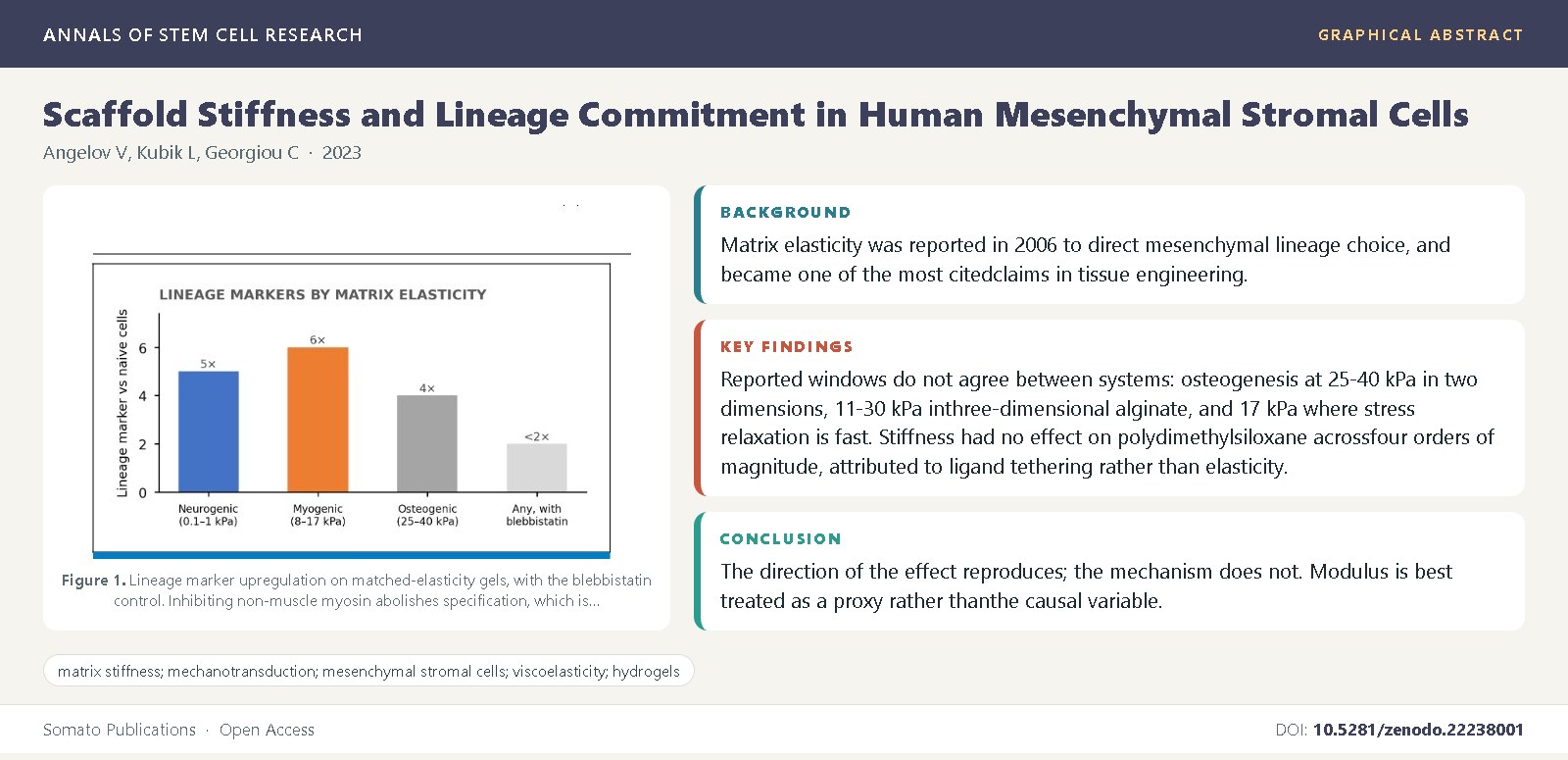
Background: Matrix elasticity was reported in 2006 to direct mesenchymal lineage choice, and became one of the most cited
claims in tissue engineering.
Objective: To review how that claim has held up, what the objections are, and whether elastic modulus is the right variable.
Methods: Narrative review of the founding studies, the mechanotransduction literature, and the work that has qualified
them.
Findings: Reported windows do not agree between systems: osteogenesis at 25-40 kPa in two dimensions, 11-30 kPa in
three-dimensional alginate, and 17 kPa where stress relaxation is fast. Stiffness had no effect on polydimethylsiloxane across
four orders of magnitude, attributed to ligand tethering rather than elasticity. The same gel yields different moduli by
measurement method.
Conclusions: The direction of the effect reproduces; the mechanism does not. Modulus is best treated as a proxy rather than
the causal variable.
References
Pelham, R.J., Wang, Y.L. (1997) Cell locomotion and focal adhesions are regulated by substrate flexibility. Proc Natl Acad Sci U S A, 94(25): 13661-13665.
Yeung, T., Georges, P.C., Flanagan, L.A., Marg, B., Ortiz, M., Funaki, M., et al. (2004) Effects of substrate stiffness on cell morphology, cytoskeletal structure, and adhesion. Cell Motil Cytoskeleton, 60(1): 24-34.
McBeath, R., Pirone, D.M., Nelson, C.M., Bhadriraju, K., Chen, C.S. (2004) Cell shape, cytoskeletal tension, and RhoA regulate stem cell lineage commitment. Dev Cell, 6(4): 483-495.
Discher, D.E., Janmey, P., Wang, Y.L. (2005) Tissue cells feel and respond to the stiffness of their substrate. Science, 310(5751): 1139-1143.
Engler, A.J., Sen, S., Sweeney, H.L., Discher, D.E. (2006) Matrix elasticity directs stem cell lineage specification. Cell, 126(4): 677-689.
Wells, R.G. (2008) The role of matrix stiffness in regulating cell behavior. Hepatology, 47(4): 1394-1400.
Wang, N., Tytell, J.D., Ingber, D.E. (2009) Mechanotransduction at a distance: mechanically coupling the extracellular matrix with the nucleus. Nat Rev Mol Cell Biol, 10(1): 75-82.
Kechagia, J.Z., Ivaska, J., Roca-Cusachs, P. (2019) Integrins as biomechanical sensors of the microenvironment. Nat Rev Mol Cell Biol, 20(8): 457-473.
Elosegui-Artola, A., Oria, R., Chen, Y., Kosmalska, A., Perez-Gonzalez, C., Castro, N., et al. (2016) Mechanical regulation of a molecular clutch defines force transmission and transduction in response to matrix rigidity. Nat Cell Biol, 18(5): 540-548.
Dupont, S., Morsut, L., Aragona, M., Enzo, E., Giulitti, S., Cordenonsi, M., et al. (2011) Role of YAP/TAZ in mechanotransduction. Nature, 474(7350): 179-183.
Panciera, T., Azzolin, L., Cordenonsi, M., Piccolo, S. (2017) Mechanobiology of YAP and TAZ in physiology and disease. Nat Rev Mol Cell Biol, 18(12): 758-770.
Elosegui-Artola, A., Andreu, I., Beedle, A.E.M., Lezamiz, A., Uroz, M., Kosmalska, A.J., et al. (2017) Force triggers YAP nuclear entry by regulating transport across nuclear pores. Cell, 171(6): 1397-1410.
Swift, J., Ivanovska, I.L., Buxboim, A., Harada, T., Dingal, P.C.D.P., Pinter, J., et al. (2013) Nuclear lamin-A scales with tissue stiffness and enhances matrix-directed differentiation. Science, 341(6149): 1240104.
Vining, K.H., Mooney, D.J. (2017) Mechanical forces direct stem cell behaviour in development and regeneration. Nat Rev Mol Cell Biol, 18(12): 728-742.
Trappmann, B., Gautrot, J.E., Connelly, J.T., Strange, D.G.T., Li, Y., Oyen, M.L., et al. (2012) Extracellular-matrix tethering regulates stem-cell fate. Nat Mater, 11(7): 642-649.
Wen, J.H., Vincent, L.G., Fuhrmann, A., Choi, Y.S., Hribar, K.C., Taylor-Weiner, H., et al. (2014) Interplay of matrix stiffness and protein tethering in stem cell differentiation. Nat Mater, 13(10): 979-987.
Ye, K., Wang, X., Cao, L., Li, S., Li, Z., Yu, L., et al. (2015) Matrix stiffness and nanoscale spatial organization of cell-adhesive ligands direct stem cell fate. Nano Lett, 15(7): 4720-4729.
Huebsch, N., Arany, P.R., Mao, A.S., Shvartsman, D., Ali, O.A., Bencherif, S.A., et al. (2010) Harnessing traction-mediated manipulation of the cell/matrix interface to control stem-cell fate. Nat Mater, 9(6): 518-526.
Khetan, S., Guvendiren, M., Legant, W.R., Cohen, D.M., Chen, C.S., Burdick, J.A. (2013) Degradation-mediated cellular traction directs stem cell fate in covalently crosslinked three-dimensional hydrogels. Nat Mater, 12(5): 458-465.
Lee, H.P., Stowers, R., Chaudhuri, O. (2019) Volume expansion and TRPV4 activation regulate stem cell fate in effects of substrate stiffness on mesenchymal stem cells. three-dimensional microenvironments. Nat Commun, 10(1): Biomaterials, 181: 182-188. 529.
Caliari, S.R., Burdick, J.A. (2016) A practical guide to hydrogels for cell culture. Nat Methods, 13(5): 405-414.
Chaudhuri, O., Gu, L., Darnell, M., Klumpers, D., Bencherif, S.A., Weaver, J.C., et al. (2015) Substrate stress relaxation regulates cell spreading. Nat Commun, 6: 6365.
Chaudhuri, O., Gu, L., Klumpers, D., Darnell, M., Bencherif, S.A., Weaver, J.C., et al. (2016) Hydrogels with tunable stress relaxation regulate stem cell fate and activity. Nat Mater, 15(3): 326-334.
Chaudhuri, O., Cooper-White, J., Janmey, P.A., Mooney, D.J., Shenoy, V.B. (2020) Effects of extracellular matrix viscoelasticity on cellular behaviour. Nature, 584(7822): 535-546.
Guvendiren, M., Burdick, J.A. (2012) Stiffening hydrogels to probe short- and long-term cellular responses to dynamic mechanics. Nat Commun, 3: 792.
Yang, C., Tibbitt, M.W., Basta, L., Anseth, K.S. (2014) Mechanical memory and dosing influence stem cell fate. Nat Mater, 13(6): 645-652.
Killaars, A.R., Grim, J.C., Walker, C.J., Hushka, E.A., Brown, T.E., Anseth, K.S. (2018) Extended exposure to stiff microenvironments leads to persistent chromatin remodeling in human mesenchymal stem cells. Adv Sci, 6(3): 1801483.
Gandin, A., Murugesan, Y., Torresan, V., Ulliana, L., Citron, A., Contessotto, P., et al. (2021) Simple yet effective methods to probe hydrogel stiffness for mechanobiology. Sci Rep, 11(1): 22668.
Norman, M.D.A., Ferreira, S.A., Jowett, G.M., Bozec, L., Gentleman, E. (2021) Measuring the elastic modulus of soft culture surfaces and three-dimensional hydrogels using atomic force microscopy. Nat Protoc, 16(5): 2418-2449.
Darnell, M., Gu, L., Mooney, D. (2018) RNA-seq reveals diverse





