
Quality Control Standards and Release Criteria for Clinical-Grade Stem Cell Products
DOI:
https://doi.org/10.5281/zenodo.22238016Keywords:
release criteria; potency assay; sterility testing; cell therapy; quality controlAbstract
Background: A cell therapy is released to a patient on a panel of tests, and the panel is largely inherited from criteria written
to make research comparable rather than to predict clinical effect.
Objective: To review the release criteria in current use, what each establishes, and where the evidence for them is weakest.
Methods: Narrative review of position statements, validation studies and published release panels from clinical programmes.
Findings: Across six named clinical programmes, viability specifications sit at 70% or above while identity thresholds for the
same marker range from 30% to 90%. Cells can meet a viability specification and still have lost immunosuppressive function
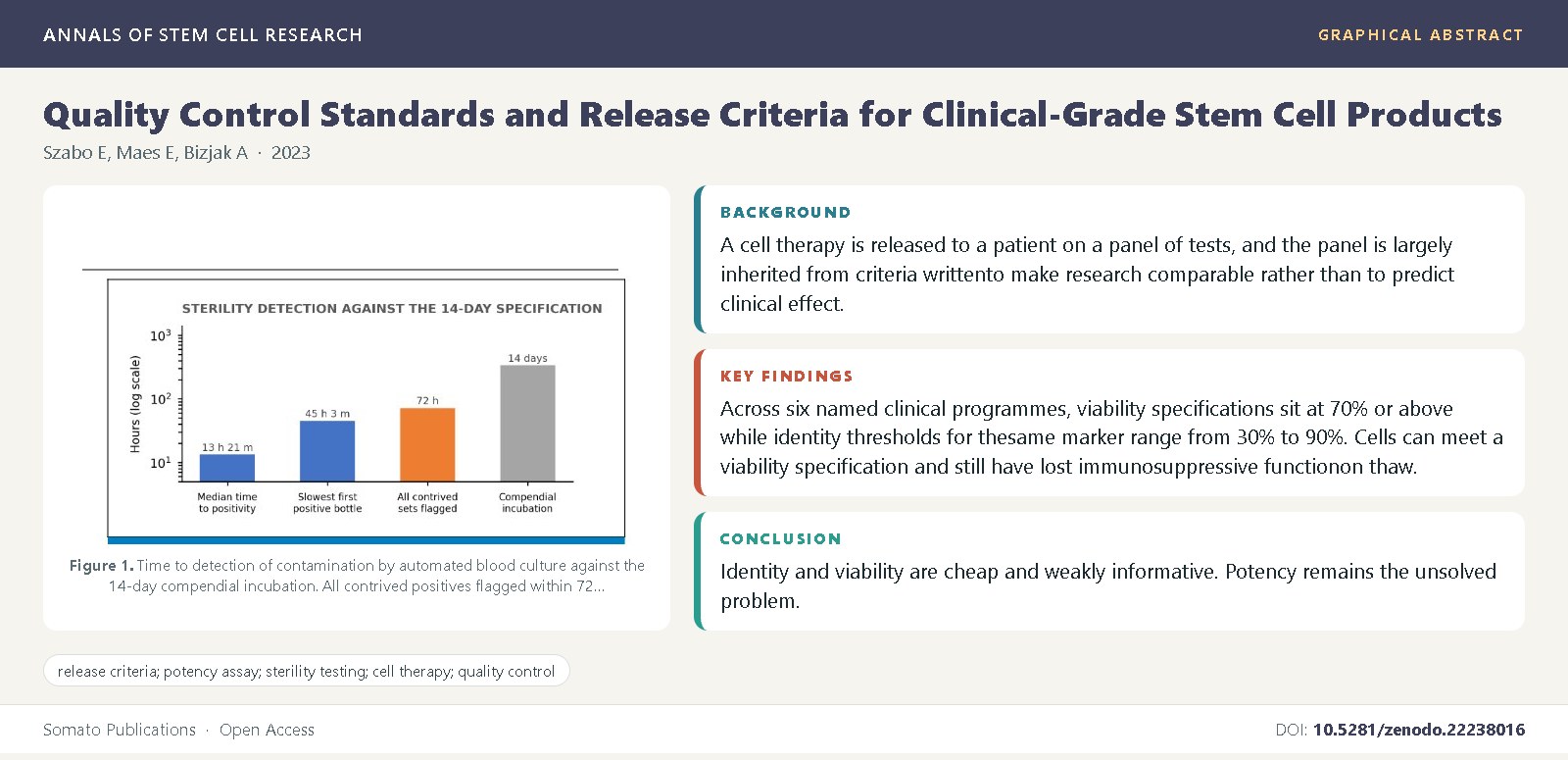
on thaw. Automated sterility detection flagged all contrived positives within 72 hours against a 14-day compendial incubation,
for products whose shelf life is hours.
Conclusions: Identity and viability are cheap and weakly informative. Potency remains the unsolved problem.
References
Dominici, M., Le Blanc, K., Mueller, I., Slaper-Cortenbach, I., Marini, F., Krause, D., et al. (2006) Minimal criteria for defining multipotent mesenchymal stromal cells. The International Society for Cellular Therapy position statement. Cytotherapy, 8(4): 315-317.
Viswanathan, S., Shi, Y., Galipeau, J., Krampera, M., Leblanc, K., Martin, I., et al. (2019) Mesenchymal stem versus stromal cells: International Society for Cell and Gene Therapy Mesenchymal Stromal Cell committee position statement on nomenclature. Cytotherapy, 21(10): 1019-1024.
Krampera, M., Galipeau, J., Shi, Y., Tarte, K., Sensebe, L. (2013) Immunological characterization of multipotent mesenchymal stromal cells - the International Society for Cellular Therapy (ISCT) working proposal. Cytotherapy, 15(9): 1054-1061.
Galipeau, J., Sensebe, L. (2018) Mesenchymal stromal cells: clinical challenges and therapeutic opportunities. Cell Stem Cell, 22(6): 824-833.
von Werz, V., Szarzynski, A., Zigon-Branc, S., Spadiut, O. (2025) Quality standards for NK cell immunotherapies. Front Bioeng Biotechnol, 13: 1716975.
Francois, M., Copland, I.B., Yuan, S., Romieu-Mourez, R., Waller, E.K., Galipeau, J. (2012) Cryopreserved mesenchymal stromal cells display impaired immunosuppressive properties as a result of heat-shock response and impaired interferon-gamma licensing. Cytotherapy, 14(2): 147-152.
Burand, A.J., Gramlich, O.W., Brown, A.J., Ankrum, J.A. (2017) Function of cryopreserved mesenchymal stromal cells with and without interferon-gamma prelicensing is context dependent. Stem Cells, 35(5): 1437-1439.
Galipeau, J., Krampera, M. (2015) The challenge of defining mesenchymal stromal cell potency assays and their potential use as release criteria. Cytotherapy, 17(2): 125-127.
Bravery, C.A., Carmen, J., Fong, T., Oprea, W., Hoogendoorn, K.H., Woda, J., et al. (2013) Potency assay development for cellular therapy products: an ISCT review of the requirements and experiences in the industry. Cytotherapy, 15(1): 9-19.
Torrents, S., Grau-Vorster, M., Vives, J. (2023) Potency assays: the bugaboo of stem cell therapy. Adv Exp Med Biol, 1420: 29-38.
Chinnadurai, R., Rajan, D., Qayed, M., Arafat, D., Garcia, M., Liu, Y., et al. (2018) Potency analysis of mesenchymal stromal cells using a combinatorial assay matrix approach. Cell Rep, 22(9): 2504-2517.
Khuu, H.M., Patel, N., Carter, C.S., Murray, P.R., Read, E.J. (2006) Sterility testing of cell therapy products: parallel comparison of automated methods with a CFR-compliant method. Transfusion, 46(12): 2071-2082.
Liu, C., Weber, C., Sempek, D.S., Grossman, B.J., Burnham, C.D. (2013) Sterility testing of apheresis hematopoietic progenitor cell products using an automated blood culture system. Transfusion, 53(11): 2659-2666.
Lowder, J.N., Whelton, P. (2003) Microbial contamination of cellular products for hematolymphoid transplantation therapy: assessment of the problem and strategies to minimize the clinical impact. Cytotherapy, 5(5): 377-390.
Snyder, M., Lawrence, A., Reese, J., Wald, D., Anderson, N., Ransom, E. (2026) Evaluation of an automated blood culture detection system for sterility testing of cellular and gene therapy products. Microbiol Spectr, 14(4): e02902-25.
Fenwick, A.J., Misra, A., Martin, I. (2025) Finding the middle way: rethinking cGMP for sterility testing of cellular therapy products in minimal manipulation settings. J Clin Microbiol, 63(12).
Peredeltchouk, M., Wilson David, S.A., Bhattacharya, B., Volokhov, D.V., Chizhikov, V. (2010) Detection of mycoplasma contamination in cell substrates using reverse transcription-PCR assays. J Appl Microbiol, 110(1): 54-60.
Francois, P., Rusconi, G., Arnaud, L., Mariotta, L., Giraudo, L., Minonzio, G., et al. (2021) Inter-center comparison of good manufacturing practices-compliant stromal vascular fraction and proposal for release acceptance criteria: a review of 364 productions. Stem Cell Res Ther, 12(1): 373.
Tarte, K., Gaillard, J., Lataillade, J.J., Fouillard, L., Becker, M., Mossafa, H., et al. (2010) Clinical-grade production of human mesenchymal stromal cells: occurrence of aneuploidy without transformation. Blood, 115(8): 1549-1553.
Andrews, P.W., Barbaric, I., Benvenisty, N., Draper, J.S., Ludwig, T., Merkle, F.T., et al. (2022) The consequences of recurrent genetic and epigenetic variants in human pluripotent stem cells. Cell Stem Cell, 29(12): 1624-1636.
Kuroda, T., Yasuda, S., Matsuyama, S., Tano, K., Kusakawa, S., Sawa, Y., et al. (2015) Highly sensitive droplet digital PCR method for detection of residual undifferentiated cells in cardiomyocytes derived from human pluripotent stem cells. Regen Ther, 2: 17-23.
Watanabe, T., Yasuda, S., Kusakawa, S., Kuroda, T., Furukawa, H., Futamura, M., et al. (2024) Multisite studies for optimization of a highly efficient culture assay used for in vitro detection of residual undifferentiated human pluripotent stem cells intermingled in cell therapy products. Regen Ther, 26: 315-323.
Yasuda, S., Sato, Y. (2015) Tumorigenicity assessment of human cell-processed therapeutic products. Biologicals, 43(5): 416-421.
Piao, J., Zabierowski, S., Dubose, B.N., Hill, E.J., Navare, M., Claros, N., et al. (2021) Preclinical efficacy and safety of a human embryonic stem cell-derived midbrain dopamine progenitor product, MSK-DA01. Cell Stem Cell, 28(2): 217-229.
Doi, D., Magotani, H., Kikuchi, T., Ikeda, M., Hiramatsu, S., Yoshida, K., et al. (2020) Pre-clinical study of induced pluripotent stem cell-derived dopaminergic progenitor cells for Parkinson’s disease. Nat Commun, 11(1): 3369.
Chirino, A.J., Mire-Sluis, A. (2004) Characterizing biological products and assessing comparability following manufacturing changes. Nat Biotechnol, 22(11): 1383-1391.
Tanaka, T., Lee, S.M., Mikami, M., Yokota, K., Takakura, K. (2020) Gaps between Asian regulations for eligibility of human mesenchymal stromal cells as starting materials of cell therapy products and comparability of mesenchymal stromal cell-based products subject to changes in their manufacturing process. Regen Ther, 15: 265-273.
Codinach, M., Blanco, M., Ortega, I., Lloret, M., Reales, L., Coca, M.I., et al. (2016) Design and validation of a consistent and reproducible manufacture process for the production of clinical-grade bone marrow-derived multipotent mesenchymal stromal cells. Cytotherapy, 18(9): 1197-1208.





