
Nutritional Status and Treatment Tolerance in Children Undergoing Leukemia Induction Therapy
DOI:
https://doi.org/10.5281/zenodo.22238196Keywords:
Paediatric Leukaemia, Nutritional Status, Induction Therapy, Anthropometry, Treatment ToleranceAbstract
Nutritional status at diagnosis predicts survival in childhood leukaemia, and the literature disagrees about how much. A large part of that disagreement is not biological: body mass index performs poorly in a child whose weight includes tumour bulk and steroid-driven fluid, and arm measurements detect what it misses. Objectives: To review the published evidence on nutritional status in children undergoing induction therapy for acute leukaemia: how often malnutrition is present, how it is measured, what it predicts for treatment tolerance and survival, and how status changes across induction itself. Material and Methods: Narrative review of observational cohorts, retrospective analyses, systematic reviews and nutritional assessment guidance indexed in PubMed and the major haematology, paediatric and nutrition journals. Studies were eligible if they reported the prevalence, measurement or clinical
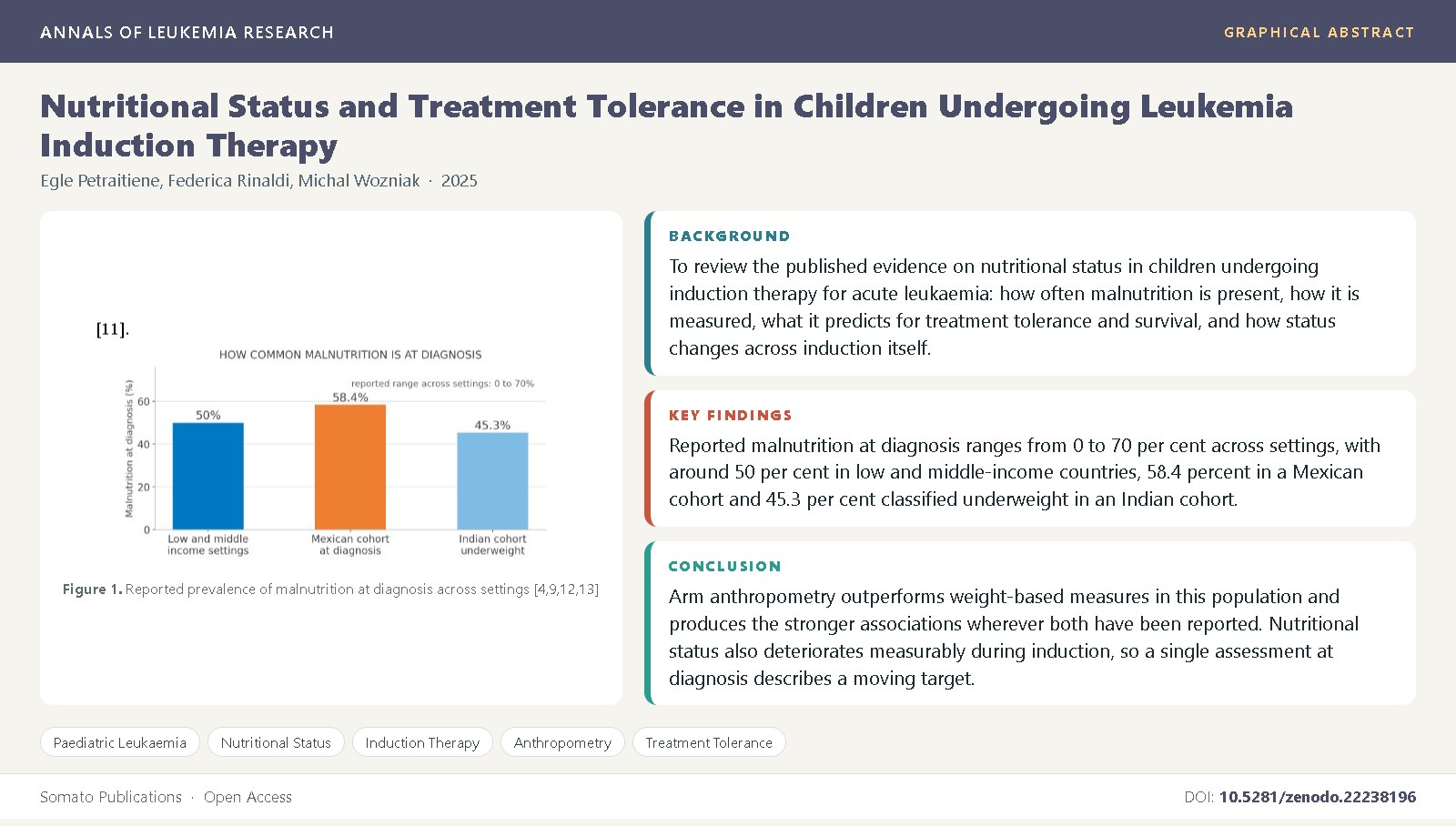
consequences of nutritional status in a defined paediatric acute leukaemia population. No new patient data were generated and no patients were recruited; every estimate quoted is one published by the original investigators. Results: Reported malnutrition at diagnosis ranges from 0 to 70 per cent across settings, with around 50 per cent in low and middle-income countries, 58.4 per
cent in a Mexican cohort and 45.3 per cent classified underweight in an Indian cohort. In the Mexican series, survival differed by body mass index category at 76 against 63 per cent (p = 0.049), while relapse differed more sharply by triceps skinfold, at 41 against 12 per cent below and above minus two standard deviations (p = 0.007). Stunting carried a hazard ratio for mortality of 6.214 (95% CI 1.372-28.154) and low triceps skinfold 2.91 (95% CI 1.27-6.68), while higher mid-upper arm circumference was protective at 0.85 (95% CI 0.73-1.00). Across induction in a European cohort of 50 children, the proportion with an abnormal body mass index rose from 6 to 20 per cent. Conclusion: Arm anthropometry outperforms weight-based measures in this population and produces the stronger associations wherever both have been reported. Nutritional status also deteriorates measurably during induction, so a single assessment at diagnosis describes a moving target. Abbreviations: ALL – Acute Lymphoblastic Leukaemia, AML – Acute Myeloid Leukaemia, BMI – Body Mass Index, MUAC – Mid-Upper Arm Circumference, TSF – Triceps Skinfold Thickness, SD – Standard Deviation, HR – Hazard Ratio, LMIC – Low and Middle-Income Country, HIC – High-Income Country, WHO – World Health Organization, MRD – Minimal Residual Disease, FM – Fat Mass, FFM – Fat-Free Mass.
References
Pui, CH., Yang, JJ., Hunger, SP., Pieters, R., Schrappe, M., Biondi, A., et al. (2015) Childhood acute lymphoblastic leukemia: progress through collaboration. J Clin Oncol, 33(27): 2938-2948.
Hunger, SP., Mullighan, CG. (2015) Acute lymphoblastic leukemia in children. N Engl J Med, 373(16): 1541-1552.
Barr, RD., Gomez-Almaguer, D., Jaime-Perez, JC., Ruiz-Arguelles, GJ. (2016) Importance of nutrition in the treatment of leukemia in children and adolescents. Arch Med Res, 47(8): 585-592.
Gonzalez-Torres, LA., Rodriguez-Ramirez, S., Perez-Cruz, E., Serrano-Sanchez, MF. (2024) Nutritional interventions in children with acute lymphoblastic leukemia undergoing antineoplastic treatment: a systematic review. Clin Nutr ESPEN, 62: 291-300.
World Health Organization. (2021) Malnutrition: key facts. Geneva: World Health Organization.
de Onis, M., Onyango, AW., Borghi, E., Siyam, A., Nishida, C., Siekmann, J. (2007) Development of a WHO growth reference for school-aged children and adolescents. Bull World Health Organ, 85(9): 660-667.
Orgel, E., Genkinger, JM., Aggarwal, D., Sung, L., Nieder, M., Ladas, EJ. (2016) Association of body mass index and survival in pediatric leukemia: a meta-analysis. Am J Clin Nutr, 103(3): 808-817.
Lange, BJ., Gerbing, RB., Feusner, J., Skolnik, J., Sacks, N., Smith, FO., Alonzo, TA. (2005) Mortality in overweight and underweight children with acute myeloid leukemia. JAMA, 293(2): 203-211.
Hernandez-Valdivia, E., Zamora-Nava, LE., Barr, RD., Mejia-Arangure, JM., Nunez-Enriquez, JC., et al. (2025) Nutritional status at diagnosis and its relationship with survival and relapse in Mexican children with acute lymphoblastic leukemia: a retrospective study. BMC Cancer, 25: 318.
Sala, A., Pencharz, P., Barr, RD. (2004) Children, cancer, and nutrition: a dynamic triangle in review. Cancer, 100(4): 677-687.
Butturini, AM., Dorey, FJ., Lange, BJ., Henry, DW., Gaynon, PS., Fu, C., et al. (2007) Obesity and outcome in pediatric acute lymphoblastic leukemia. J Clin Oncol, 25(15): 2063-2069.
Sharma, S., Bakhshi, S., Pandey, RM., Kumar, R., Dhawan, D., Gupta, YK. (2024) Evaluation of nutritional status during induction chemotherapy in patients with acute leukemia. Cureus, 16(11): e73892.
Israels, T., Renner, L., Hendricks, M., Hesseling, P., Howard, S., Molyneux, E. (2013) SIOP PODC: recommendations for supportive care of children with cancer in a low-income setting. Pediatr Blood Cancer, 60(6): 899-904.
Zimmermann, K., Ammann, RA., Kuehni, CE., De Geest, S., Cignacco, E. (2013) Malnutrition in pediatric patients with cancer at diagnosis and throughout therapy: a multicenter cohort study. Pediatr Blood Cancer, 60(4): 642-649.
Rogers, PC., Barr, RD. (2020) The relevance of nutrition to pediatric oncology: a cancer control perspective. Pediatr Blood Cancer, 67(Suppl 3): e28213.
Joffe, L., Dwyer, S., Glade Bender, JL., Frazier, AL., Ladas, EJ. (2019) Nutritional status and clinical outcomes in pediatric patients with solid tumors: a systematic review of the literature. Semin Oncol, 46(1): 48-56.
Petraitiene, S., Alasevicius, T., Staneviciene, I., Vaidotaite, G., Rageliene, L., et al. (2023) Changes in nutritional status during induction phase and their association with fever and minimal residual disease in paediatric acute lymphoblastic leukaemia. Medicina (Kaunas), 59(6): 1008.
Murphy, AJ., White, M., Davies, PS. (2010) Body composition of children with cancer. Am J Clin Nutr, 92(1): 55-60.
Antillon, F., Rossi, E., Molina, AL., Sala, A., Pencharz, P., Valsecchi, MG., Barr, R. (2013) Nutritional status of children during treatment for acute lymphoblastic leukemia in Guatemala. Pediatr Blood Cancer, 60(6): 911-915.
Ladas, EJ., Sacks, N., Meacham, L., Henry, D., Enriquez, L., Lowry, G., et al. (2005) A multidisciplinary review of nutrition considerations in the pediatric oncology population. Nutr Clin Pract, 20(4): 377-393.
Sacks, N., Hwang, WT., Lange, BJ., Tan, KS., Sandler, ES., Rogers, PC., et al. (2014) Proactive enteral tube feeding in pediatric patients undergoing chemotherapy. Pediatr Blood Cancer, 61(2): 281-285.
Barr, RD., Stevens, MCG. (2020) The influence of nutrition on clinical outcomes in children with cancer. Pediatr Blood Cancer, 67(Suppl 3): e28117.
Viani, K., Trehan, A., Manzoli, B., Schoeman, J. (2020) Assessment of nutritional status in children with cancer: a narrative review. Pediatr Blood Cancer, 67(Suppl 3): e28211.
Loeffen, EAH., Brinksma, A., Miedema, KGE., de Bock, GH., Tissing, WJE. (2015) Clinical implications of malnutrition in childhood cancer patients: infections and mortality. Support Care Cancer, 23(1): 143-150.
Brinksma, A., Roodbol, PF., Sulkers, E., Kamps, WA., de Bont, ESJM., Boot, AM., et al. (2015) Changes in nutritional status in childhood cancer patients: a prospective cohort study. Clin Nutr, 34(1): 66-73.
Orgel, E., Sposto, R., Malvar, J., Seibel, NL., Ladas, E., Gaynon, PS., Freyer, DR. (2014) Impact on survival and toxicity by duration of weight extremes during treatment for pediatric acute lymphoblastic leukemia. J Clin Oncol, 32(13): 1331-1337.
den Hoed, MAH., Pluijm, SMF., de Groot-Kruseman, HA., te Winkel, ML., Fiocco, M., van den Akker, ELT., et al. (2015) The negative impact of being underweight and weight loss on survival of children with acute lymphoblastic leukemia. Haematologica, 100(1): 62-69.
Pribnow, AK., Ortiz, R., Baez, LF., Mendieta, L., Luna-Fineman, S. (2017) Effects of malnutrition on treatment-related morbidity and survival of children with cancer in Nicaragua. Pediatr Blood Cancer, 64(11): e26590.
Lehrnbecher, T., Fisher, BT., Phillips, B., Alexander, S., Ammann, RA., Beauchemin, M., et al. (2020) Clinical practice guideline for antibacterial prophylaxis in pediatric patients with cancer. Clin Infect Dis, 71(1): 226-236.
Bochennek, K., Hassler, A., Perner, C., Gilfert, J., Schoning, S., et al. (2016) Infectious complications in children with acute myeloid leukemia: decreased mortality in multicenter trial AML-BFM 2004. Blood Cancer J, 6: e382.





