
Prognostic Value of Complex Karyotype and del(17p) in Patients with Chronic Lymphocytic Leukemia
DOI:
https://doi.org/10.5281/zenodo.22238182Keywords:
Chronic Lymphocytic Leukaemia, Complex Karyotype, del(17p), TP53, PrognosticationAbstract
Complex karyotype has been treated as a single adverse category in chronic lymphocytic leukaemia for two decades. The largest analysis of the question found it is nothing of the kind: five or more abnormalities are adverse regardless of anything else, three or four matter only alongside a TP53 lesion, and one particular complex pattern is associated with better survival than a normal karyotype. Objectives: To review the published evidence on complex karyotype and del(17p) in chronic lymphocytic leukaemia: how each is defined and detected, how often they occur and co-occur, what each predicts under chemoimmunotherapy and under targeted therapy, and whether karyotypic complexity carries information independent of TP53 status. Material and Methods: Narrative review of cytogenetic cohort analyses, trial correlative studies, sequencing work, consensus guidelines and methodological comparisons indexed in PubMed and the major haematology journals. Studies were eligible if they reported the frequency or prognostic effect of karyotypic
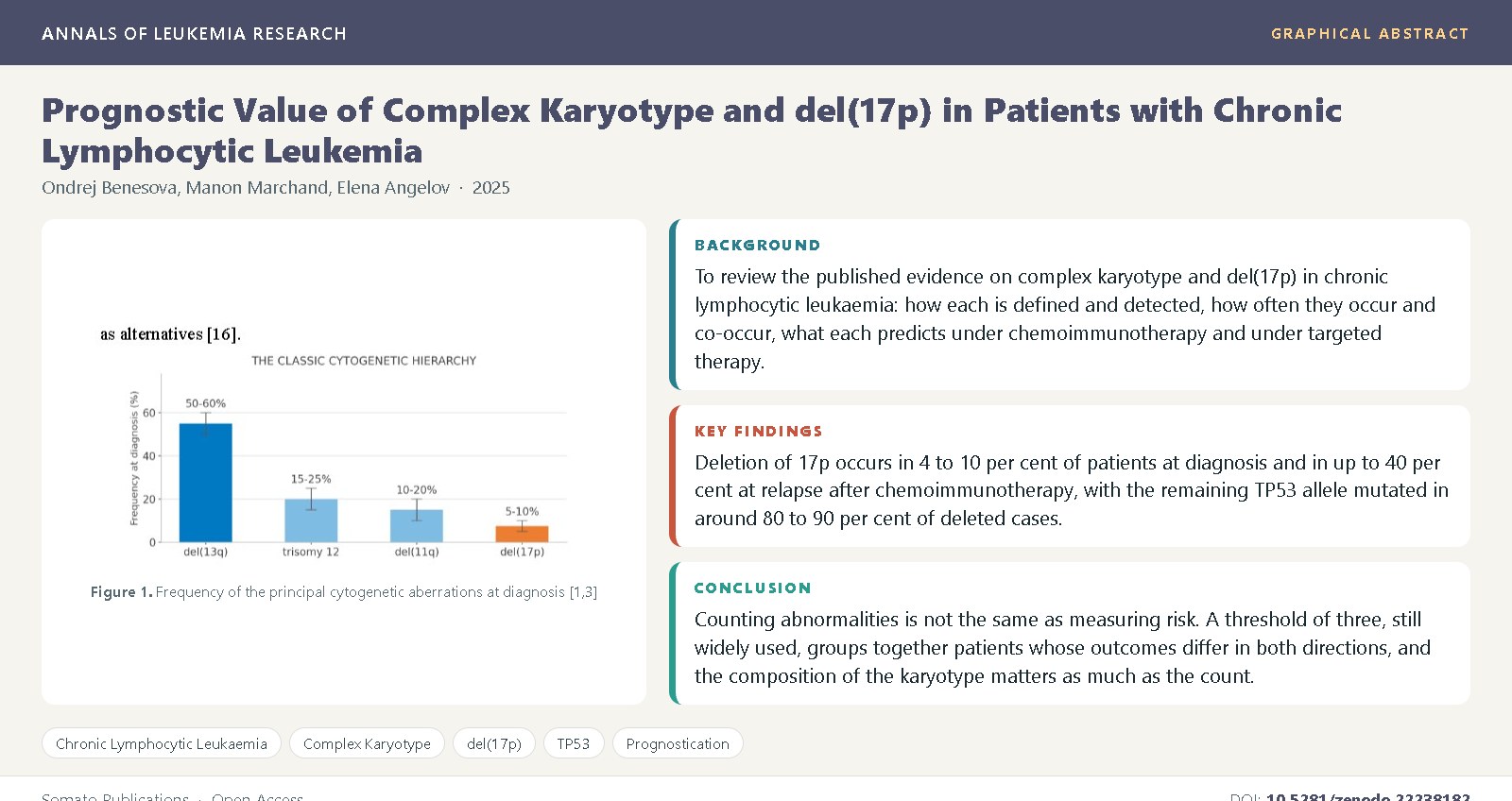
complexity or TP53 aberration in a defined chronic lymphocytic leukaemia population. No new patient data were generated and no patients were recruited; every estimate quoted is one published by the original investigators. Results: Deletion of 17p occurs in 4 to 10 per cent of patients at diagnosis and in up to 40 per cent at relapse after chemoimmunotherapy, with the remaining TP53 allele mutated in around 80 to 90 per cent of deleted cases. In a series of 3,539 patients, five or more chromosomal abnormalities defined a high-complexity group comprising 233 patients (6.5 per cent) with the shortest overall survival, independent of immunoglobulin mutational status and TP53 status. Three or four abnormalities were clinically relevant only in the presence of a TP53 lesion. Complex karyotypes characterised by trisomy 12 with trisomy 19 were associated with longer survival than in patients without a complex karyotype. Complexity retained prognostic value in patients treated with ibrutinib and with venetoclax, and in one series was associated with median progression-free survival of 34 against 40 months. Conclusion: Counting abnormalities is not the same as measuring risk. A threshold of three, still widely used, groups together patients whose outcomes differ in both directions, and the composition of the karyotype matters as much as the count. Abbreviations: CLL – Chronic Lymphocytic Leukaemia, CK – Complex Karyotype, hCK – High Complex Karyotype, CBA – Chromosome Banding Analysis, FISH – Fluorescence In Situ Hybridisation, IGHV – Immunoglobulin Heavy Chain Variable Region, M-CLL – IGHV-Mutated CLL, U-CLL – IGHV-Unmutated CLL, CIT – Chemoimmunotherapy, TTFT – Time to First Treatment, OS – Overall Survival, PFS – Progression-Free Survival, CLL-IPI – CLL International Prognostic Index.
References
Liehr, T., Weise, A., Hamid, AB., Fan, X., Klein, E., Aust, N., et al. (2015) Isochromosome 17q in chronic lymphocytic leukemia. Case Rep Genet, 2015: 305946.
Burger, JA. (2020) Treatment of chronic lymphocytic leukemia. N Engl J Med, 383(5): 460-473.
Döhner, H., Stilgenbauer, S., Benner, A., Leupolt, E., Kröber, A., Bullinger, L., et al. (2000) Genomic aberrations and survival in chronic lymphocytic leukemia. N Engl J Med, 343(26): 1910-1916.
Hallek, M., Cheson, BD., Catovsky, D., Caligaris-Cappio, F., Dighiero, G., Döhner, H., et al. (2018) iwCLL guidelines for diagnosis, indications for treatment, response assessment, and supportive management of CLL. Blood, 131(25): 2745-2760.
Eichhorst, B., Fink, AM., Bahlo, J., Busch, R., Kovacs, G., Maurer, C., et al. (2016) First-line chemoimmunotherapy with bendamustine and rituximab versus fludarabine, cyclophosphamide, and rituximab in patients with advanced chronic lymphocytic leukaemia (CLL10): an international, open-label, randomised, phase 3, non-inferiority trial. Lancet Oncol, 17(7): 928-942.
Delgado, J., Doubek, M., Baumann, T., Kotaskova, J., Molica, S., Mozas, P., et al. (2017) Chronic lymphocytic leukemia: a prognostic model comprising only two biomarkers separates patients with different outcome and simplifies the CLL-IPI. Am J Hematol, 92(4): 375-380.
Kröber, A., Seiler, T., Benner, A., Bullinger, L., Brückle, E., Lichter, P., et al. (2002) V(H) mutation status, CD38 expression level, genomic aberrations, and survival in chronic lymphocytic leukemia. Blood, 100(4): 1410-1416.
Stilgenbauer, S., Zenz, T. (2010) Understanding and managing ultra high-risk chronic lymphocytic leukemia. Hematology Am Soc Hematol Educ Program, 2010: 481-488.
Baliakas, P., Iskas, M., Gardiner, A., Davis, Z., Plevova, K., Nguyen-Khac, F., et al. (2014) Chromosomal translocations and karyotype complexity in chronic lymphocytic leukemia: a systematic reappraisal of classic cytogenetic data. Am J Hematol, 89(3): 249-255.
Herling, CD., Klaumünzer, M., Rocha, CK., Altmüller, J., Thiele, H., Bahlo, J., et al. (2016) Complex karyotypes and KRAS and POT1 mutations impact outcome in CLL after chlorambucil-based chemotherapy or chemoimmunotherapy. Blood, 128(3): 395-404.
Visentin, A., Bonaldi, L., Rigolin, GM., Mauro, FR., Martines, A., Frezzato, F., et al. (2019) Complex karyotype as a predictor of high-risk chronic lymphocytic leukemia: a single center experience. Leuk Res, 82: 22-28.
Baliakas, P., Jeromin, S., Iskas, M., Puiggros, A., Plevova, K., Nguyen-Khac, F., et al. (2019) Cytogenetic complexity in chronic lymphocytic leukemia: definitions, associations, and clinical impact. Blood, 133(11): 1205-1216.
Jondreville, L., Krzisch, D., Chapiro, E., Nguyen-Khac, F. (2020) The complex karyotype and chronic lymphocytic leukemia: prognostic value and diagnostic recommendations. Am J Hematol, 95(11): 1361-1367.
Chatzikonstantinou, T., Demosthenous, C., Baliakas, P. (2021) Biology and treatment of high-risk CLL: significance of complex karyotype. Front Oncol, 11: 788761.
Kröber, A., Bühler, A., Winkler, D., Zenz, T., Schäfer, S., Leupolt, E., et al. (2006) The value of molecular genetic markers for the risk assessment of patients with chronic lymphocytic leukemia. Br J Haematol, 133(3): 285-291.
Ljungstrom, V., Baliakas, P. (2021) Prognostic and predictive implications of cytogenetics and genomics in chronic lymphocytic leukemia. Hemato, 2(2): 181-193.
Baliakas, P., Hadzidimitriou, A., Sutton, LA., Minga, E., Agathangelidis, A., Nichelatti, M., et al. (2014) Clinical effect of stereotyped B-cell receptor immunoglobulins in chronic lymphocytic leukaemia: a retrospective multicentre study. Lancet Haematol, 1(2): e74-e84.
Baliakas, P., Moysiadis, T., Hadzidimitriou, A., Xochelli, A., Jeromin, S., Agathangelidis, A., et al. (2019) Tailored approaches grounded on immunogenetic features for refined prognostication in chronic lymphocytic leukemia. Haematologica, 104(2): 360-369.
Chapiro, E., Pramil, E., Diop, M., Roos-Weil, D., Dillard, C., Gabillaud, C., et al. (2022) "Double-hit" chronic lymphocytic leukemia, involving the TP53 and MYC genes. Front Oncol, 11: 826245.
Nguyen-Khac, F., Chapiro, E., Lesty, C., Gabillaud, C., Struski, S., Terre, C., et al. (2018) "Double-hit" chronic lymphocytic leukemia: an aggressive subgroup with 17p deletion and 8q24 gain. Am J Hematol, 93(3): 375-382.
Rodriguez-Vicente, AE., Bikos, V., Hernandez-Sanchez, M., Malcikova, J., Hernandez-Rivas, JM., Pospisilova, S. (2021) Dissecting the role of TP53 alterations in del(11q) chronic lymphocytic leukemia. Clin Transl Med, 11(2): e304.
Zenz, T., Eichhorst, B., Busch, R., Denzel, T., Habe, S., Winkler, D., et al. (2010) TP53 mutation and survival in chronic lymphocytic leukemia. J Clin Oncol, 28(29): 4473-4479.
Landau, DA., Carter, SL., Stojanov, P., McKenna, A., Stevenson, K., Lawrence, MS., et al. (2013) Evolution and impact of subclonal mutations in chronic lymphocytic leukemia. Cell, 152(4): 714-726.
Malcikova, J., Tausch, E., Rossi, D., Sutton, LA., Soussi, T., Zenz, T., et al. (2018) ERIC recommendations for TP53 mutation analysis in chronic lymphocytic leukemia: update on methodological approaches and results interpretation. Leukemia, 32(5): 1070-1080.
Kittai, AS., Miller, C., Goldstein, D., Huang, Y., Abruzzo, LV., Beckwith, K., et al. (2021) The impact of increasing karyotypic complexity and evolution on survival in patients with CLL treated with ibrutinib. Blood, 138(23): 2372-2382.
Puiggros, A., Collado, R., Calasanz, MJ., Ortega, M., Ruiz-Xiville, N., Lopez-Rodriguez, C., et al. (2017) Patients with chronic lymphocytic leukemia and complex karyotype show an adverse outcome even in absence of TP53/ATM FISH deletions. Oncotarget, 8(33): 54297-54303.
Al-Sawaf, O., Lilienweiss, E., Bahlo, J., Robrecht, S., Fink, AM., Patten, P., et al. (2020) High efficacy of venetoclax plus obinutuzumab in patients with complex karyotype and chronic lymphocytic leukemia. Blood, 135(11): 866-870.
Roberts, AW., Davids, MS., Pagel, JM., Kahl, BS., Puvvada, SD., Gerecitano, JF., et al. (2016) Targeting BCL2 with venetoclax in relapsed chronic lymphocytic leukemia. N Engl J Med, 374(4): 311-322.
Puckrin, R., Chua, N., Chin, K. (2022) Ibrutinib plus venetoclax in patients with complex karyotype and chronic lymphocytic leukemia. HemaSphere, 6: 553-554.
Brown, JR., Hillmen, P., O’Brien, S., Barrientos, JC., Reddy, NM., Coutre, SE., et al. (2018) Extended follow-up and impact of high-risk prognostic factors from the phase 3 RESONATE study in patients with previously treated CLL/SLL. Leukemia, 32(1): 83-91.
Rigolin, GM., Cavallari, M., Quaglia, FM., Formigaro, L., Lista, E., Urso, A., et al. (2017) In CLL, comorbidities and the complex karyotype are associated with an inferior outcome independently of CLL-IPI. Blood, 129(26): 3495-3498.
Chapiro, E., Nguyen-Khac, F., Cornillet-Lefebvre, P., Struski, S., Cabrol, C., Lefebvre, C., et al. (2017) Near-tetraploidy is associated with Richter transformation in chronic lymphocytic leukemia patients receiving ibrutinib. Blood Adv, 1(19): 1584-1588.
Dreger, P., Ghia, P., Schetelig, J., van Gelder, M., Kimby, E., Michallet, M., et al. (2018) High-risk chronic lymphocytic leukemia in the era of pathway inhibitors: integrating molecular and cellular therapies. Blood, 132(9): 892-902.
Dreger, P., Schetelig, J., Andersen, N., Corradini, P., van Gelder, M., Gribben, J., et al. (2014) Managing high-risk CLL during transition to a new treatment era: stem cell transplantation or novel agents? Blood, 124(26): 3841-3849.
Puiggros, A., Blanco, G., Baliakas, P., Bosch, F., Espinet, B. (2024) Comparison of karyotype scoring guidelines for evaluating karyotype complexity in chronic lymphocytic leukemia. Leukemia, 38(4): 909-912.
Gunnarsson, R., Mansouri, L., Isaksson, A., Goransson, H., Cahill, N., Jansson, M., et al. (2011) Array-based genomic screening at diagnosis and follow-up in chronic lymphocytic leukemia. Haematologica, 96(8): 1161-1169.
Ouillette, P., Collins, R., Shakhan, S., Li, J., Peres, E., Kujawski, L., et al. (2011) Acquired genomic copy number aberrations and survival in chronic lymphocytic leukemia. Blood, 118(11): 3051-3061.
Leeksma, AC., Baliakas, P., Moysiadis, T., Puiggros, A., Plevova, K., Van der Kevie-Kersemaekers, AM., et al. (2021) Genomic arrays identify high-risk chronic lymphocytic leukemia with genomic complexity: a multi-center study. Haematologica, 106(1): 87-97.
Klintman, J., Barmpouti, K., Knight, SJL., Robbe, P., Dreau, H., Clifford, R., et al. (2018) Clinical-grade validation of whole genome sequencing reveals robust detection of low-frequency variants and copy number alterations in CLL. Br J Haematol, 182(3): 412-417.
Puente, XS., Pinyol, M., Quesada, V., Conde, L., Ordonez, GR., Villamor, N., et al. (2011) Whole-genome sequencing identifies recurrent mutations in chronic lymphocytic leukaemia. Nature, 475(7354): 101-105.
Quesada, V., Conde, L., Villamor, N., Ordonez, GR., Jares, P., Bassaganyas, L., et al. (2012) Exome sequencing identifies recurrent mutations of the splicing factor SF3B1 gene in chronic lymphocytic leukemia. Nat Genet, 44(1): 47-52.
Puente, XS., Bea, S., Valdes-Mas, R., Villamor, N., Gutierrez-Abril, J., Martin-Subero, JI., et al. (2015) Non-coding recurrent mutations in chronic lymphocytic leukaemia. Nature, 526(7574): 519-524.
Landau, DA., Tausch, E., Taylor-Weiner, AN., Stewart, C., Reiter, JG., Bahlo, J., et al. (2015) Mutations driving CLL and their evolution in progression and relapse. Nature, 526(7574): 525-530.
Stilgenbauer, S., Schnaiter, A., Paschka, P., Zenz, T., Rossi, M., Dohner, K., et al. (2014) Gene mutations and treatment outcome in chronic lymphocytic leukemia: results from the CLL8 trial. Blood, 123(21): 3247-3254.
Byrd, JC., Furman, RR., Coutre, SE., Flinn, IW., Burger, JA., Blum, KA., et al. (2013) Targeting BTK with ibrutinib in relapsed chronic lymphocytic leukemia. N Engl J Med, 369(1): 32-42.
Blanco, G., Puiggros, A., Baliakas, P., Athanasiadou, A., Garcia-Malo, M., Collado, R., et al. (2016) Karyotypic complexity rather than chromosome 8 abnormalities aggravates the outcome of chronic lymphocytic leukemia patients with TP53 aberrations. Oncotarget, 7(49): 80916-80924.





