
Clonal Haematopoiesis and Progression to Myelodysplastic Syndrome in Patients with Unexplained Cytopenias
DOI:
https://doi.org/10.5281/zenodo.22238153Keywords:
Clonal Cytopenia of Undetermined Significance, Clonal Haematopoiesis, Myelodysplastic Syndrome; Somatic Mutation, Risk PredictionAbstract
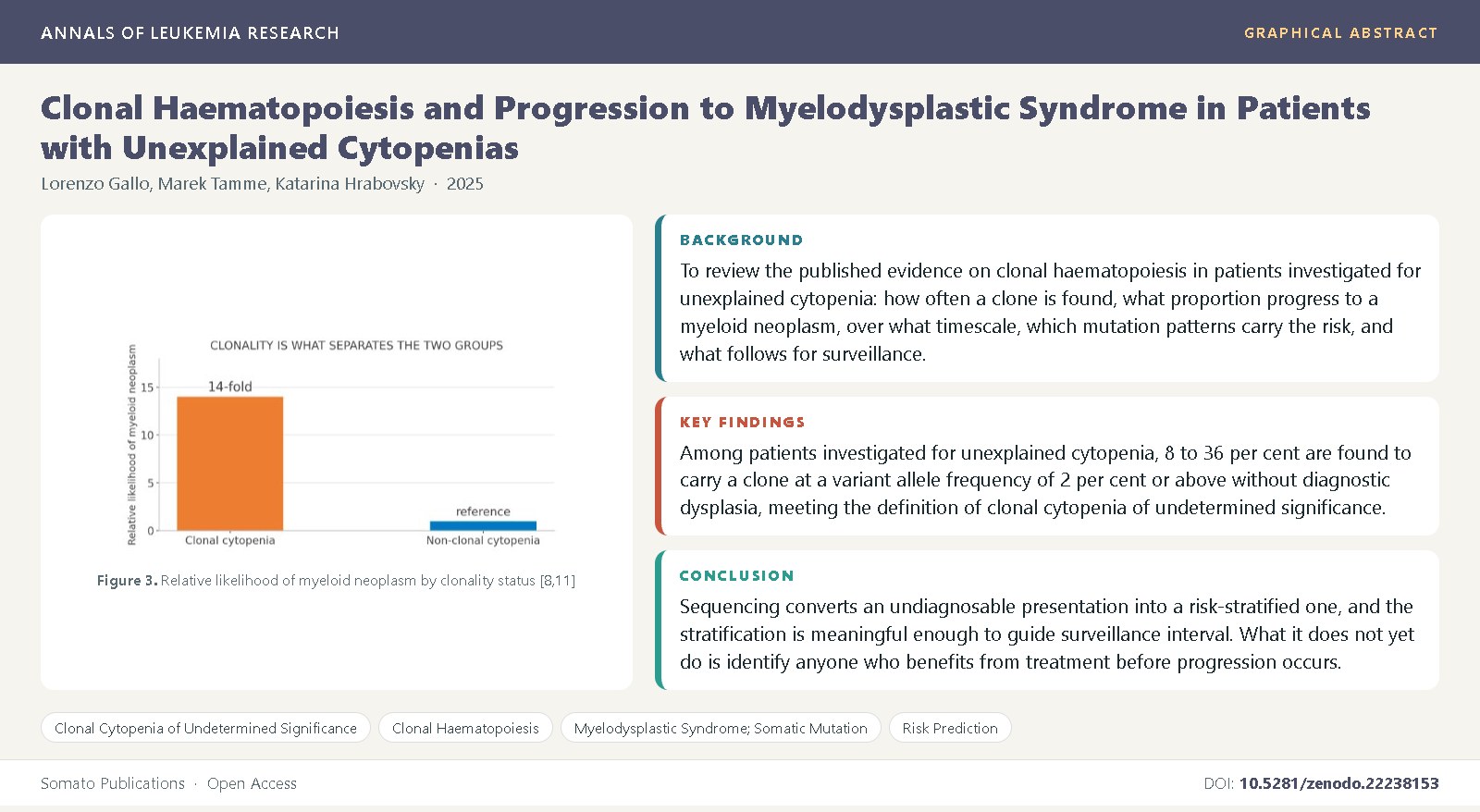
A patient with unexplained cytopenia and no dysplasia used to be told there was nothing to find. Targeted sequencing now identifies a clone in a substantial minority of them, and the clone changes the answer: myeloid neoplasm becomes fourteen times more likely, and which mutations are present predicts how likely. Objectives: To review the published evidence on clonal haematopoiesis in patients investigated for unexplained cytopenia: how often a clone is found, what proportion progress to a myeloid neoplasm, over what timescale, which mutation patterns carry the risk, and what follows for surveillance. Material and Methods: Narrative review of prospective cohorts, sequencing studies, comparative analyses and consensus definitions indexed in PubMed and
the major haematology journals. Studies were eligible if they reported the prevalence, mutation profile or outcome of clonal haematopoiesis in a defined population investigated for cytopenia of unknown cause. No new patient data were generated and no patients were recruited; every estimate quoted is one published by the original investigators. Results: Among patients investigated for unexplained cytopenia, 8 to 36 per cent are found to carry a clone at a variant allele frequency of 2 per cent or above without diagnostic dysplasia, meeting the definition of clonal cytopenia of undetermined significance. Myeloid neoplasm is approximately fourteen times more likely in that group than in patients whose cytopenia is non-clonal. In a prospective cohort of 400 such patients, 20 per cent developed a myeloid neoplasm within ten years, predominantly myelodysplastic syndrome (46 per cent of progressions) and overlap syndromes (32 per cent), and 84 per cent of all progressions occurred within the first five years. The number of mutated genes was the strongest single predictor. Spliceosome mutations, RUNX1 and JAK2 predict progression specifically, as does the combination of a DNA methylation gene mutation with at least one other lesion. Conclusion: Sequencing converts an undiagnosable presentation into a risk-stratified one, and the stratification is meaningful enough to guide surveillance interval. What it does not yet do is identify anyone who benefits from treatment before progression occurs. Abbreviations: CCUS – Clonal Cytopenia of Undetermined Significance, ICUS – Idiopathic Cytopenia of Undetermined Significance, CUS – Cytopenia of Undetermined Significance, CHIP – Clonal Haematopoiesis of Indeterminate Potential, CHRS – Clonal Haematopoiesis Risk Score, MDS – MyelodysplasticSyndrome, MPN – Myeloproliferative Neoplasm, AML – Acute Myeloid Leukaemia, VAF – Variant Allele Frequency, NGS – Next-Generation Sequencing,
PPV – Positive Predictive Value.
References
Valent, P., Horny, HP., Bennett, JM., Fonatsch, C., Germing, U., Greenberg, P., et al. (2007) Definitions and standards in the diagnosis and treatment of the myelodysplastic syndromes: consensus statements and report from a working conference. Leuk Res, 31(6): 727-736.
Valent, P., Orazi, A., Steensma, DP., Ebert, BL., Haase, D., Malcovati, L., et al. (2017) Proposed minimal diagnostic criteria for myelodysplastic syndromes (MDS) and potential pre-MDS conditions. Oncotarget, 8(43): 73483-73500.
Sperling, AS., Gibson, CJ., Ebert, BL. (2017) The genetics of myelodysplastic syndrome: from clonal haematopoiesis to secondary leukaemia. Nat Rev Cancer, 17(1): 5-19.
Papaemmanuil, E., Gerstung, M., Malcovati, L., Tauro, S., Gundem, G., Van Loo, P., et al. (2013) Clinical and biological implications of driver mutations in myelodysplastic syndromes. Blood, 122(22): 3616-3627.
Steensma, DP., Bejar, R., Jaiswal, S., Lindsley, RC., Sekeres, MA., Hasserjian, RP., Ebert, BL. (2015) Clonal hematopoiesis of indeterminate potential and its distinction from myelodysplastic syndromes. Blood, 126(1): 9-16.
Jaiswal, S., Fontanillas, P., Flannick, J., Manning, A., Grauman, PV., Mar, BG., et al. (2014) Age-related clonal hematopoiesis associated with adverse outcomes. N Engl J Med, 371(26): 2488-2498.
Genovese, G., Kähler, AK., Handsaker, RE., Lindberg, J., Rose, SA., Bakhoum, SF., et al. (2014) Clonal hematopoiesis and blood-cancer risk inferred from blood DNA sequence. N Engl J Med, 371(26): 2477-2487.
Gurnari, C., Pagliuca, S., Visconte, V. (2022) Clonal cytopenias of undetermined significance: potential predictor of myeloid malignancies? Clin Adv Hematol Oncol, 20(6): 371-378.
Malcovati, L., Gallì, A., Travaglino, E., Ambaglio, I., Rizzo, E., Molteni, E., et al. (2017) Clinical significance of somatic mutation in unexplained blood cytopenia. Blood, 129(25): 3371-3378.
Cargo, C., Bernard, E., Beinortas, T., Bolton, KL., Glover, P., Warren, H., et al. (2023) Predicting cytopenias, progression, and survival in patients with clonal cytopenia of undetermined significance: a prospective cohort study. Lancet Haematol, 10(12): e1030-e1039.
Bejar, R. (2017) CHIP, ICUS, CCUS and other four-letter words. Leukemia, 31(9): 1869-1871.
Cargo, C., Beinortas, T., Bolton, KL., Glover, P., Warren, H., Bewicke-Copley, F., et al. (2025) Long-term outcome and progression risk in clonal cytopenia of undetermined significance. Blood.
Gallì, A., Todisco, G., Catamo, E., Sala, C., Elena, C., Pozzi, S., et al. (2021) Relationship between clone metrics and clinical outcome in clonal cytopenia. Blood, 138(11): 965-976.
Shanmugam, V., Parnes, A., Kalyanaraman, R., Morgan, EA., Kim, AS. (2019) Clinical utility of targeted next-generation sequencing-based screening of peripheral blood in the evaluation of cytopenias. Blood, 134(24): 2222-2225.
Weeks, LD., Niroula, A., Neuberg, D., Wong, W., Lindsley, RC., Luskin, MR., et al. (2023) Prediction of risk for myeloid malignancy in clonal hematopoiesis. NEJM Evid, 2(5): EVIDoa2200310.
Steensma, DP. (2018) Clinical implications of clonal hematopoiesis. Mayo Clin Proc, 93(8): 1122-1130.
Kwon, J., Kim, S., Lee, JH., Kim, YJ., Park, S., Kim, HJ., et al. (2022) Clinical implications and genetic features of clonal cytopenia of undetermined significance compared to lower-risk myelodysplastic syndrome. Br J Haematol, 198(4): 703-712.
Kern, W., Bacher, U., Haferlach, C., Alpermann, T., Haferlach, T. (2022) Abnormal CD13/HLA-DR expression pattern on myeloblasts predicts development of myeloid neoplasia in patients with clonal cytopenia of undetermined significance. Hemasphere, 6(10): e778.
Ravn Berg, S., Dietrich, S., Bruserud, O., Gjertsen, BT., Hovland, R., Reikvam, H. (2023) LEP promoter methylation in the initiation and progression of clonal cytopenia of undetermined significance and myelodysplastic syndrome. Clin Epigenetics, 15: 88.
Rossi, M., Meggendorfer, M., Zampini, M., Tettamanti, M., Riva, E., Travaglino, E., et al. (2021) Clinical relevance of clonal hematopoiesis in persons aged ≥80 years. Blood, 138(21): 2093-2105.
Kim, D., Al Hadidi, S., Yang, H., Al Ali, N., Padron, E., Sallman, DA., et al. (2021) Treatment outcome of clonal cytopenias of undetermined significance: a single-institution retrospective study. Blood Cancer J, 11: 46.
Greenberg, PL., Tuechler, H., Schanz, J., Sanz, G., Garcia-Manero, G., Solé, F., et al. (2012) Revised international prognostic scoring system for myelodysplastic syndromes. Blood, 120(12): 2454-2465.
Bernard, E., Tuechler, H., Greenberg, PL., Hasserjian, RP., Arango Ossa, JE., Nannya, Y., et al. (2022) Molecular international prognostic scoring system for myelodysplastic syndromes. NEJM Evid, 1(7): EVIDoa2200008.
Khoury, JD., Solary, E., Abla, O., Akkari, Y., Alaggio, R., Apperley, JF., et al. (2022) The 5th edition of the World Health Organization classification of haematolymphoid tumours: myeloid and histiocytic/dendritic neoplasms. Leukemia, 36(7): 1703-1719.
Arber, DA., Orazi, A., Hasserjian, RP., Borowitz, MJ., Calvo, KR., Kvasnicka, HM., et al. (2022) International consensus classification of myeloid neoplasms and acute leukemias. Blood, 140(11): 1200-1228.





