
IKZF1 Deletions and Risk Stratification in Paediatric B-Cell Precursor Acute Lymphoblastic Leukemia
DOI:
https://doi.org/10.5281/zenodo.22238140Keywords:
Acute Lymphoblastic Leukaemia, IKZF1, Risk Stratification, Minimal Residual Disease, Paediatric OncologyAbstract
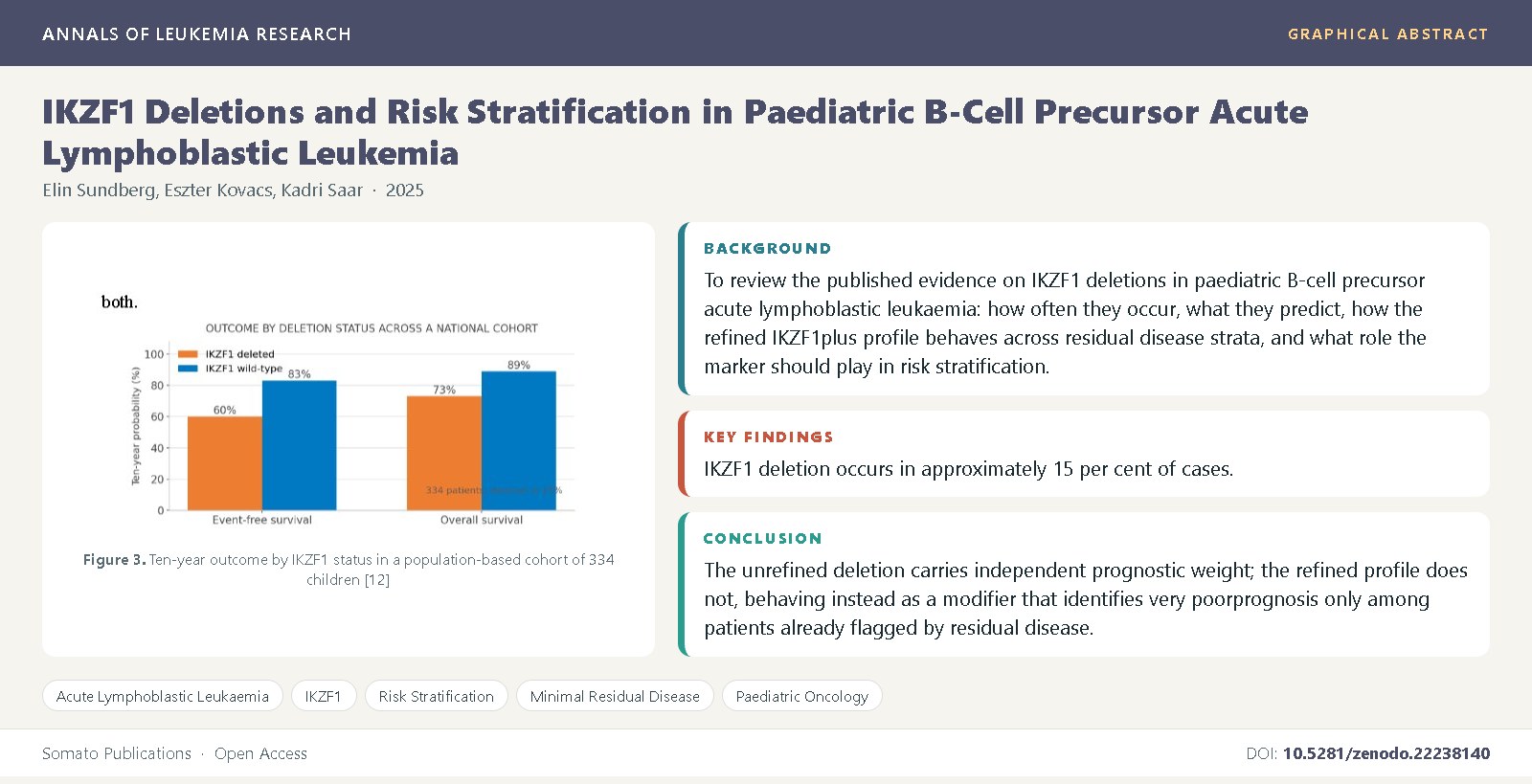
IKZF1 deletion is among the most reproducible adverse genetic markers in childhood leukaemia and is routinely described as an independent prognostic factor. The refined version of the marker turns out to carry almost no independent weight at all: its effect is conditional on measurable residual disease, and in good responders it disappears. Objectives: To review the published evidence on IKZF1 deletions in paediatric B-cell precursor acute lymphoblastic leukaemia: how often they occur, what they predict, how the refined IKZF1plus profile behaves across residual disease strata, and what role the marker should play in risk stratification. Material and Methods: Narrative review of cooperative group trial analyses, population-based cohorts, international collaborative studies and mechanistic work indexed in PubMed and the major haematology journals. Studies were eligible if they reported the frequency, prognostic effect or biological consequences of IKZF1 alteration in a defined paediatric B-cell precursor acute lymphoblastic leukaemia population. No new patient data were generated and no patients were recruited; every estimate quoted is one published by the original investigators. Results: IKZF1 deletion occurs in approximately 15 per cent of cases. In a population-based cohort of 334 children, deletion was associated with ten-year event-free survival of 60 against 83 per cent (p < 0.001) and overall survival of 73 against 89 per cent (p = 0.001), and remained the strongest independent factor for relapse and death after adjustment for white cell count and residual disease. Screening 694 samples from a separate trial gave five-year event-free survival of 0.69 against 0.85 (p < 0.0001) with cumulative relapse of 0.21 against 0.10 (p = 0.001). The refined IKZF1plus profile behaved very differently across residual
disease strata: five-year event-free survival was 94 per cent in residual disease standard-risk patients, 40 per cent in intermediate-risk and 30 per cent in high-risk (p ≤ 0.001), with corresponding relapse incidences of 6, 60 and 60 per cent. Conclusion: The unrefined deletion carries independent prognostic weight; the refined profile does not, behaving instead as a modifier that identifies very poor
prognosis only among patients already flagged by residual disease. A child with the adverse genotype and a clean day-33 marrow has a 94 per cent event-free survival. Abbreviations: ALL – Acute Lymphoblastic Leukaemia, BCP-ALL – B-Cell Precursor ALL, IKZF1 – IKAROS Family Zinc Finger 1, ∆IKZF1 – IKZF1 Deletion, MRD – Minimal Residual Disease, EFS – Event-Free Survival, OS – Overall Survival, RFS – Relapse-Free Survival, MLPA – Multiplex Ligation-Dependent Probe Amplification, SNP – Single Nucleotide Polymorphism, WBC – White Blood Cell Count, HR – Hazard Ratio.
References
Pui, CH., Yang, JJ., Hunger, SP., Pieters, R., Schrappe, M., Biondi, A., et al. (2015) Childhood acute lymphoblastic leukemia: progress through collaboration. J Clin Oncol, 33(27): 2938-2948.
Hunger, SP., Mullighan, CG. (2015) Acute lymphoblastic leukemia in children. N Engl J Med, 373(16): 1541-1552.
Conter, V., Bartram, CR., Valsecchi, MG., Schrauder, A., Panzer-Grümayer, R., Möricke, A., et al. (2010) Molecular response to treatment redefines all prognostic factors in children and adolescents with B-cell precursor acute lymphoblastic leukemia: results in 3184 patients of the AIEOP-BFM ALL 2000 study. Blood, 115(16): 3206-3214.
Campana, D., Pui, CH. (2017) Minimal residual disease-guided therapy in childhood acute lymphoblastic leukemia. Blood, 129(14): 1913-1918.
Mullighan, CG., Su, X., Zhang, J., Radtke, I., Phillips, LA., Miller, CB., et al. (2009) Deletion of IKZF1 and prognosis in acute lymphoblastic leukemia. N Engl J Med, 360(5): 470-480.
Mullighan, CG., Goorha, S., Radtke, I., Miller, CB., Coustan-Smith, E., Dalton, JD., et al. (2007) Genome-wide analysis of genetic alterations in acute lymphoblastic leukaemia. Nature, 446(7137): 758-764.
Roberts, KG. (2018) Genetics and prognosis of ALL in children vs adults. Hematology Am Soc Hematol Educ Program, 2018: 137-145.
Harvey, RC., Mullighan, CG., Wang, XF., Dobbin, KK., Davidson, GS., Bedrick, EJ., et al. (2010) Identification of novel cluster groups in pediatric high-risk B-precursor acute lymphoblastic leukemia with gene expression profiling: correlation with genome-wide DNA copy number alterations, clinical characteristics, and outcome. Blood, 116(23): 4874-4884.
Dörge, P., Meissner, B., Zimmermann, M., Möricke, A., Schrauder, A., Bouquin, JP., et al. (2013) IKZF1 deletion is an independent predictor of outcome in pediatric acute lymphoblastic leukemia treated according to the ALL-BFM 2000 protocol. Haematologica, 98(3): 428-432.
Clappier, E., Grardel, N., Bakkus, M., Rapion, J., De Moerloose, B., Kastner, P., et al. (2015) IKZF1 deletion is an independent prognostic marker in childhood B-cell precursor acute lymphoblastic leukemia, and distinguishes patients benefiting from pulses during maintenance therapy: results of the EORTC Children’s Leukemia Group study 58951. Leukemia, 29(11): 2154-2161.
van der Veer, A., Waanders, E., Pieters, R., Willemse, ME., Van Reijmersdal, SV., Russell, LJ., et al. (2013) Independent prognostic value of BCR-ABL1-like signature and IKZF1 deletion, but not high CRLF2 expression, in children with B-cell precursor ALL. Blood, 122(15): 2622-2629.
Olsson, L., Ivanov Ofverholm, I., Noren-Nystrom, U., Zachariadis, V., Nordlund, J., Sjogren, H., et al. (2015) The clinical impact of IKZF1 deletions in paediatric B-cell precursor acute lymphoblastic leukaemia is independent of minimal residual disease stratification in Nordic Society for Paediatric Haematology and Oncology treatment protocols used between 1992 and 2013. Br J Haematol, 170(6): 847-858.
Stanulla, M., Dagdan, E., Zaliova, M., Möricke, A., Palmi, C., Cazzaniga, G., et al. (2018) IKZF1plus defines a new minimal residual disease-dependent very-poor prognostic profile in pediatric B-cell precursor acute lymphoblastic leukemia. J Clin Oncol, 36(12): 1240-1249.
Boer, JM., van der Veer, A., Rizopoulos, D., Fiocco, M., Sonneveld, E., de Groot-Kruseman, HA., et al. (2016) Prognostic value of rare IKZF1 deletion in childhood B-cell precursor acute lymphoblastic leukemia: an international collaborative study. Leukemia, 30(1): 32-38.
Braun, M., Pastorczak, A., Sndek, n., Taha, J., Madzio, J., Jatczak-Pawlik, I., et al. (2022) Prognostic significance of IKZF1 deletions and IKZF1plus profile in children with B-cell precursor acute lymphoblastic leukemia treated according to the ALL-IC BFM 2009 protocol. Hematol Oncol, 40(3): 430-441.
Flohr, T., Schrauder, A., Cazzaniga, G., Panzer-Grümayer, R., van der Velden, V., Fischer, S., et al. (2008) Minimal residual disease-directed risk stratification using real-time quantitative PCR analysis of immunoglobulin and T-cell receptor gene rearrangements in the international multicenter trial AIEOP-BFM ALL 2000 for childhood acute lymphoblastic leukemia. Leukemia, 22(4): 771-782.
van der Veer, A., Zaliova, M., Mottadelli, F., De Lorenzo, P., Te Kronnie, G., Harrison, CJ., et al. (2014) IKZF1 status as a prognostic feature in BCR-ABL1-positive childhood ALL. Blood, 123(11): 1691-1698.
Vora, A., Goulden, N., Wade, R., Mitchell, C., Hancock, J., Hough, R., et al. (2013) Treatment reduction for children and young adults with low-risk acute lymphoblastic leukaemia defined by minimal residual disease (UKALL 2003): a randomised controlled trial. Lancet Oncol, 14(3): 199-209.
Vora, A., Goulden, N., Mitchell, C., Hancock, J., Hough, R., Rowntree, C., et al. (2014) Augmented post-remission therapy for a minimal residual disease-defined high-risk subgroup of children and young people with clinical standard-risk and intermediate-risk acute lymphoblastic leukaemia (UKALL 2003): a randomised controlled trial. Lancet Oncol, 15(8): 809-818.
Schrappe, M., Valsecchi, MG., Bartram, CR., Schrauder, A., Panzer-Grümayer, R., Möricke, A., et al. (2011) Late MRD response determines relapse risk overall and in subsets of childhood T-cell ALL: results of the AIEOP-BFM-ALL 2000 study. Blood, 118(8): 2077-2084.
Pieters, R., de Groot-Kruseman, H., Van der Velden, V., Fiocco, M., van den Berg, H., et al. (2016) Successful therapy reduction and intensification for childhood acute lymphoblastic leukemia based on minimal residual disease monitoring: study ALL10 from the Dutch Childhood Oncology Group. J Clin Oncol, 34(22): 2591-2601.
Moorman, AV., Enshaei, A., Schwab, C., Wade, R., Chilton, L., Elliott, A., et al. (2014) A novel integrated cytogenetic and genomic classification refines risk stratification in pediatric acute lymphoblastic leukemia. Blood, 124(9): 1434-1444.
Mullighan, CG. (2012) The molecular genetic makeup of acute lymphoblastic leukemia. Hematology Am Soc Hematol Educ Program, 2012: 389-396.
Boissel, N., Baruchel, A. (2018) Acute lymphoblastic leukemia in adolescent and young adults: treat as adults or as children? Blood, 132(4): 351-361.
Stanulla, M., Cave, H., Moorman, AV. (2020) IKZF1 deletions in pediatric acute lymphoblastic leukemia: still a poor prognostic marker? Blood, 135(4): 252-260.





