
Evaluation of gait analysis as a Prognostic Tool in post-stroke hemiparesis
DOI:
https://doi.org/10.5281/zenodo.22815110Keywords:
gait analysis, post-stroke hemiparesis, prognosis, gait speed, rehabilitationAbstract
Background: Gait disturbance is one of the most disabling and persistent consequences of stroke, and clinicians have long sought objective measures that predict which patients will regain independent, community-level walking.
Objective: This review synthesizes evidence on clinical and instrumented gait analysis as a prognostic tool for functional walking recovery in post-stroke hemiparesis, spanning spatiotemporal, kinetic, kinematic, and electromyographic measures.
Methods: We reviewed longitudinal cohort studies, validation studies of standardized gait scales, and rehabilitation trials that report gait-derived measures alongside walking outcomes such as community ambulation, discharge disposition, and long-term functional independence.
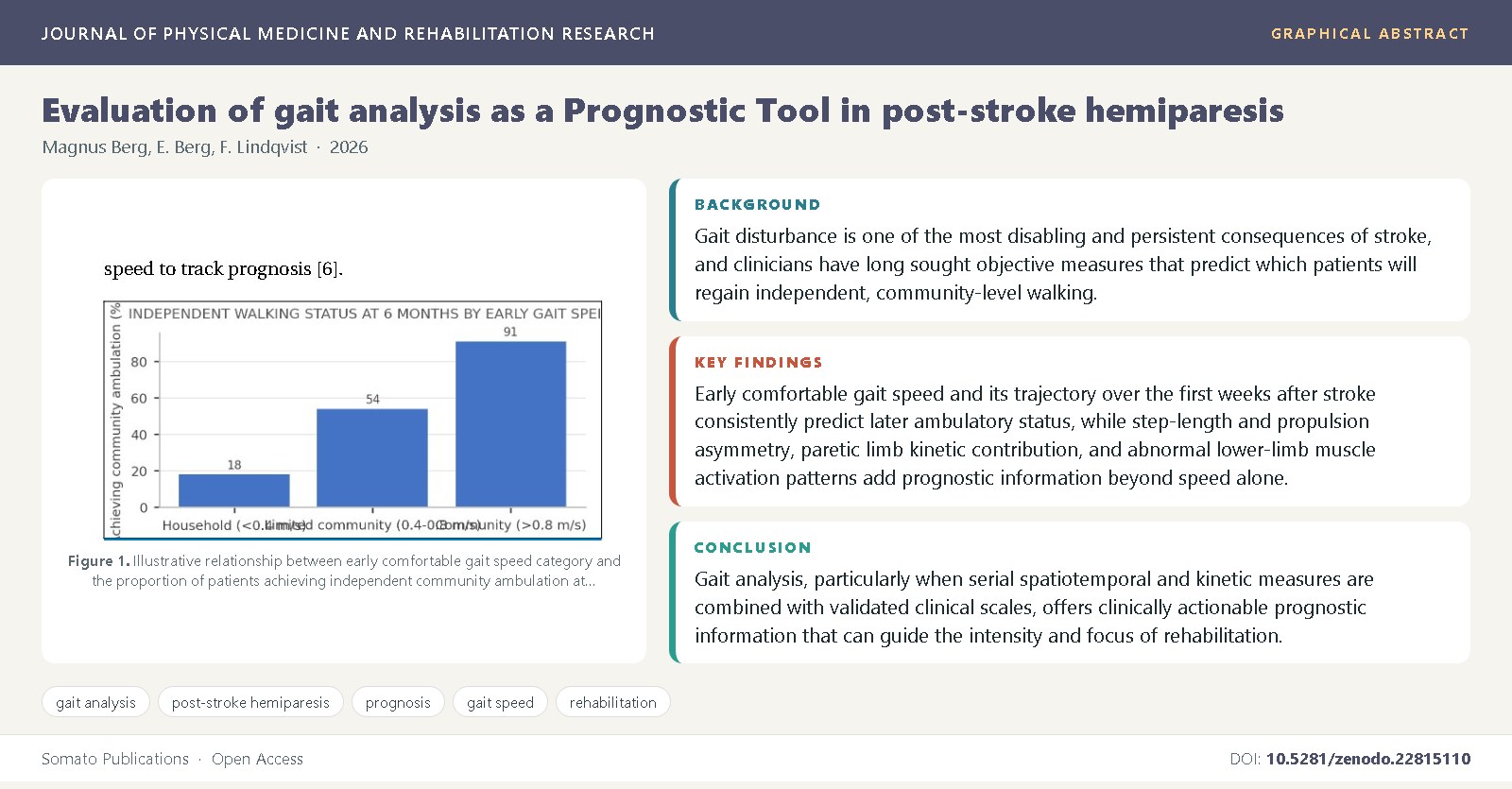
Findings: Early comfortable gait speed and its trajectory over the first weeks after stroke consistently predict later ambulatory status, while step-length and propulsion asymmetry, paretic limb kinetic contribution, and abnormal lower-limb muscle activation patterns add prognostic information beyond speed alone; standardized tools such as the Functional Ambulation Category and instrumented gait laboratories or wearable sensors improve the precision and reproducibility of these predictions.
Conclusions: Gait analysis, particularly when serial spatiotemporal and kinetic measures are combined with validated clinical scales, offers clinically actionable prognostic information that can guide the intensity and focus of rehabilitation, although further work is needed to standardize instrumented protocols for routine prognostic use.
References
Holden, M.K., Gill, K.M., Magliozzi, M.R., Nathan, J., Piehl-Baker, L. (1984) Clinical gait assessment in the neurologically impaired: reliability and meaningfulness. Physical Therapy, 64(1): 35-40. DOI: 10.1093/ptj/64.1.35
Mehrholz, J., Wagner, K., Rutte, K., Meissner, D., Pohl, M. (2007) Predictive validity and responsiveness of the Functional Ambulation Category in hemiparetic patients after stroke. Archives of Physical Medicine and Rehabilitation, 88(10): 1314-1319. DOI: 10.1016/j.apmr.2007.06.764
Perry, J., Garrett, M., Gronley, J.K., Mulroy, S.J. (1995) Classification of walking handicap in the stroke population. Stroke, 26(6): 982-989. DOI: 10.1161/01.STR.26.6.982
Bohannon, R.W. (1997) Comfortable and maximum walking speed of adults aged 20-79 years: reference values and determinants. Age and Ageing, 26(1): 15-19. DOI: 10.1093/ageing/26.1.15
Middleton, A., Fritz, S.L., Lusardi, M. (2015) Walking speed: the functional vital sign. Journal of Aging and Physical Activity, 23(2): 314-322. DOI: 10.1123/japa.2013-0236
Flansbjer, U.B., Holmback, A.M., Downham, D., Patten, C., Lexell, J. (2005) Reliability of gait performance tests in men and women with hemiparesis after stroke. Journal of Rehabilitation Medicine, 37(2): 75-82. DOI: 10.1080/16501970410017215
Wade, D.T., Wood, V.A., Heller, A., Maggs, J., Langton Hewer, R. (1987) Walking after stroke. Measurement and recovery over the first 3 months. Scandinavian Journal of Rehabilitation Medicine, 19(1): 25-30.
Nakayama, H., Jorgensen, H.S., Raaschou, H.O., Olsen, T.S. (1994) Recovery of walking function in stroke patients: the Copenhagen Stroke Study. Archives of Physical Medicine and Rehabilitation, 75(4): 394-398. DOI: 10.1016/0003-9993(94)90161-6
Jorgensen, H.S., Nakayama, H., Raaschou, H.O., Olsen, T.S. (1995) Recovery of walking function in stroke patients: outcome and time course of recovery. The Copenhagen Stroke Study. Archives of Physical Medicine and Rehabilitation, 76(1): 27-32. DOI:
1016/S0003-9993(95)80038-7 10. Kollen, B., van de Port, I., Lindeman, E., Twisk, J., Kwakkel, G. (2005) Predicting improvement in gait after stroke: a longitudinal prospective study. Stroke, 36(12): 2676-2680. DOI: 10.1161/01.STR.0000190839.29234.50
Kwakkel, G., Wagenaar, R.C., Koelman, T.W., Lankhorst, G.J., Koetsier, J.C. (1997) Effects of intensity of rehabilitation after stroke: a research synthesis. Stroke, 28(8): 1550-1556. DOI: 10.1161/01.STR.28.8.1550
Kwakkel, G., Kollen, B.J., Wagenaar, R.C. (2002) Long term effects of intensity of upper and lower limb training after stroke: a randomised trial. Journal of Neurology, Neurosurgery and Psychiatry, 72(4): 473-479. DOI: 10.1136/jnnp.72.4.473
Olney, S.J., Richards, C. (1996) Hemiparetic gait following stroke. Part I: Characteristics. Gait and Posture, 4(2): 136-148. DOI: 10.1016/0966-6362(96)01063-6
Olney, S.J., Griffin, M.P., Monga, T.N., McBride, I.D. (1991) Work and power in gait of stroke patients. Archives of Physical Medicine and Rehabilitation, 72(5): 309-314.
Wagenaar, R.C., Beek, W.J. (1992) Hemiplegic gait: a kinematic analysis using walking speed as a basis. Journal of Biomechanics, 25(9): 1007-1015. DOI: 10.1016/0021-9290(92)90036-Z
Kim, C.M., Eng, J.J. (2004) Symmetry in vertical ground reaction force is accompanied by contralateral changes in gait pattern in persons with stroke. Gait and Posture, 20(2): 140-146. DOI: 10.1016/j.gaitpost.2003.07.002
Balasubramanian, C.K., Bowden, M.G., Neptune, R.R., Kautz, S.A. (2007) Relationship between step length asymmetry and walking performance in subjects with chronic hemiparesis. Archives of Physical Medicine and Rehabilitation, 88(1): 43-49. DOI: 10.1016/j.apmr.2006.10.004
Bowden, M.G., Balasubramanian, C.K., Neptune, R.R., Kautz, S.A. (2006) Anterior-posterior ground reaction forces as a measure of paretic leg contribution in hemiparetic walking. Stroke, 37(4): 872-876. DOI: 10.1161/01.STR.0000204063.75779.8d
Patterson, K.K., Parafianowicz, I., Danells, C.J., Closson, V., Verrier, M.C., Staines, W.R., et al. (2008) Gait asymmetry in community-ambulating stroke survivors. Archives of Physical Medicine and Rehabilitation, 89(2): 304-310. DOI: 10.1016/j.apmr.2007.08.142
Hsu, A.L., Tang, P.F., Jan, M.H. (2003) Analysis of impairments influencing gait velocity and asymmetry of hemiplegic patients after mild to moderate stroke. Archives of Physical Medicine and Rehabilitation, 84(8): 1185-1193. DOI: 10.1016/S0003-9993(03)00030-3
Mulroy, S., Gronley, J., Weiss, W., Newsam, C., Perry, J. (2003) Use of cluster analysis for gait pattern classification of patients in the early and late recovery phases following stroke. Gait and Posture, 18(1): 114-125. DOI: 10.1016/S0966-6362(02)00165-0
Verheyden, G., Nieuwboer, A., De Wit, L., Feys, H., Schuback, B., Baert, I., et al. (2008) Time course of trunk topography in the first 12 weeks after stroke. Neurorehabilitation and Neural Repair, 22(2): 173-179. DOI: 10.1177/1545968307305448
Tyson, S.F., Hanley, M., Chillala, J., Selley, A., Tallis, R.C. (2006) Balance disability after stroke. Physical Therapy, 86(1): 30-38. DOI: 10.1093/ptj/86.1.30
Richards, C.L., Malouin, F., Wood-Dauphinee, S., Williams, J.I., Bouchard, J.P., Brunet, D. (1993) Task-specific physical therapy for optimization of gait recovery in acute stroke patients. Archives of Physical Medicine and Rehabilitation, 74(6): 612-620. DOI: 10.1016/0003-9993(93)90159-8
Buurke, J.H., Nene, A.V., Kwakkel, G., Erren-Wolters, V., IJzerman, M.J., Hermens, H.J. (2008) Recovery of gait after stroke: what changes? Neurorehabilitation and Neural Repair, 22(6): 676-683. DOI: 10.1177/1545968308317972
Mackay-Lyons, M.J., Makrides, L. (2002) Cardiovascular stress during a contemporary stroke rehabilitation program: is the intensity adequate to induce a training effect? Archives of Physical Medicine and Rehabilitation, 83(10): 1378-1383. DOI: 10.1053/apmr.2002.35089
Belda-Lois, J.M., Mena-del Horno, S., Bermejo-Bosch, I., Moreno, J.C., Pons, J.L., Farina, D., et al. (2011) Rehabilitation of gait after stroke: a review towards a top-down approach. Journal of NeuroEngineering and Rehabilitation, 8: 66. DOI: 10.1186/1743-0003-8-66
Duncan, P.W., Sullivan, K.J., Behrman, A.L., Azen, S.P., Wu, S.S., Nadeau, S.E., et al. (2011) Body-weight-supported treadmill rehabilitation after stroke. New England Journal of Medicine, 364(21): 2026-2036. DOI: 10.1056/NEJMoa1010790
Hesse, S. (2008) Treadmill training with partial body weight support after stroke: a review. NeuroRehabilitation, 23(1): 55-65. DOI: 10.3233/NRE-2008-23106
Mehrholz, J., Thomas, S., Elsner, B. (2017) Treadmill training and body weight support for walking after stroke. Cochrane Database of Systematic Reviews, 8: CD002840. DOI: 10.1002/14651858.CD002840.pub4
Chen, G., Patten, C., Kothari, D.H., Zajac, F.E. (2005) Gait deviations associated with post-stroke hemiparesis: improvement during treadmill walking using weight support, speed, support stiffness, and handrail hold. Gait and Posture, 22(1): 57-62. DOI: 10.1016/j.gaitpost.2004.06.008
Tyrell, C.M., Roos, M.A., Rudolph, K.S., Reisman, D.S. (2011) Influence of systematic increases in treadmill walking speed on gait kinematics after stroke. Physical Therapy, 91(3): 392-403. DOI: 10.2522/ptj.20090425
Kesar, T.M., Reisman, D.S., Perumal, R., Jancosko, A.M., Higginson, J.S., Rudolph, K.S., et al. (2011) Combined effects of fast treadmill walking and functional electrical stimulation on post-stroke gait. Gait and Posture, 33(2): 309-313. DOI: 10.1016/j.gaitpost.2010.11.019
Daly, J.J., Ruff, R.L. (2005) Electrically induced recovery of gait components for older patients with chronic stroke. American Journal of Physical Medicine and Rehabilitation, 84(11): 837-838. DOI: 10.1097/01.phm.0000186423.22377.6a
Louie, D.R., Eng, J.J. (2016) Powered robotic exoskeletons in post-stroke rehabilitation of gait: a scoping review. Journal of NeuroEngineering and Rehabilitation, 13: 53. DOI: 10.1186/s12984-016-0162-5
Verma, R., Arya, K.N., Sharma, P., Garg, R.K. (2012) Understanding gait control in post-stroke: implications for management. Journal of Bodywork and Movement Therapies, 16(1): 14-21. DOI: 10.1016/j.jbmt.2010.12.005
Beyaert, C., Vasa, R., Frykberg, G.E. (2015) Gait post-stroke: pathophysiology and rehabilitation strategies. Neurophysiologie Clinique, 45(4-5): 335-355. DOI: 10.1016/j.neucli.2015.09.005

Published
Issue
Section
License
Copyright (c) 2026 Magnus Berg, et al.

This work is licensed under a Creative Commons Attribution 4.0 International License.


