
Long-Term Follow-Up of prosthetic rehabilitation programs for chronic low back pain
DOI:
https://doi.org/10.5281/zenodo.22815131Keywords:
amputation, prosthetic rehabilitation, chronic low back pain, gait asymmetry, long-term follow-upAbstract
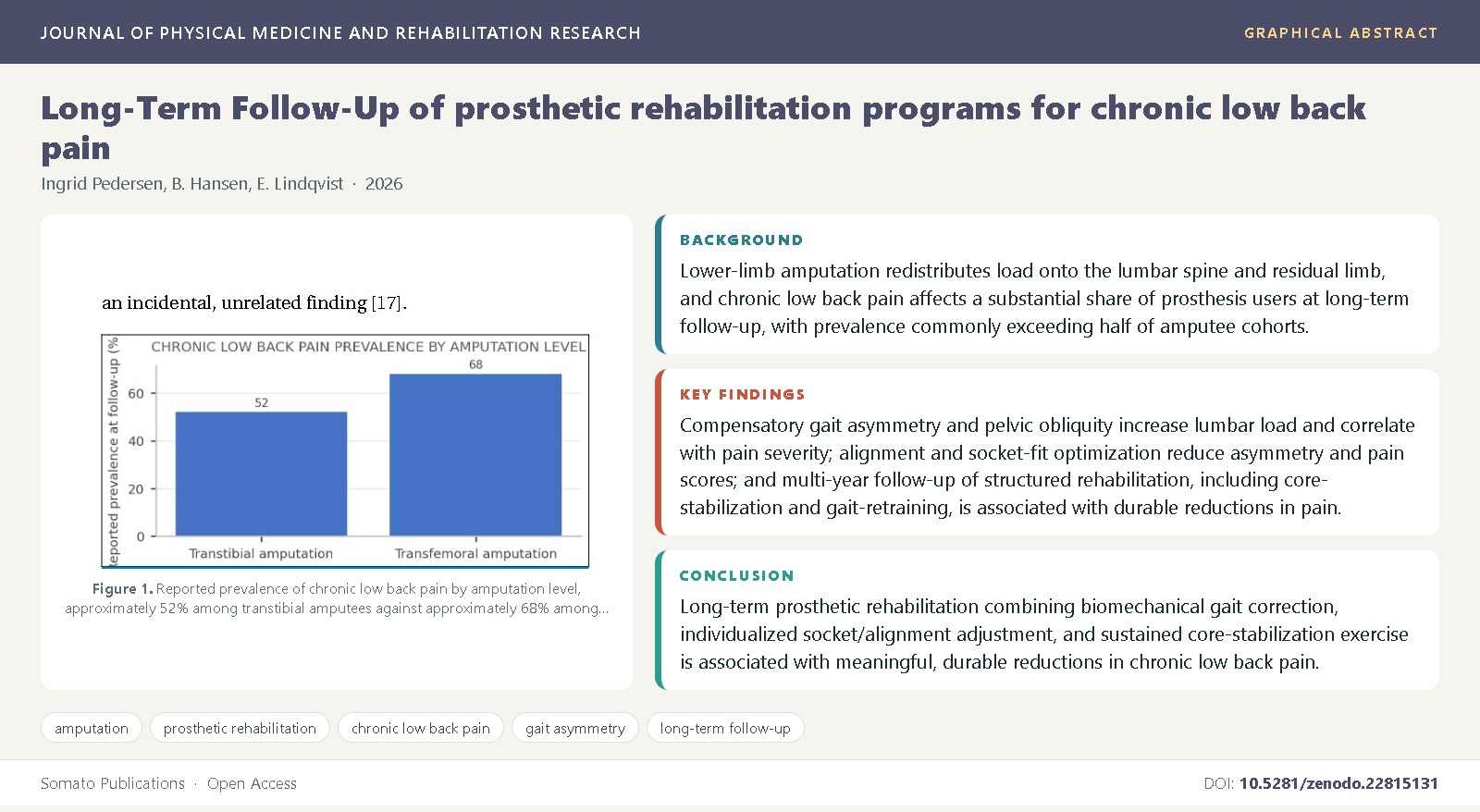
Background: Lower-limb amputation redistributes load onto the lumbar spine and residual limb, and chronic low back pain affects a substantial share of prosthesis users at long-term follow-up, with prevalence commonly exceeding half of amputee cohorts.
Objective: This review synthesizes long-term follow-up evidence on structured prosthetic rehabilitation programs, including gait retraining, socket/alignment optimization, and core-stabilization exercise, and their effect on chronic low back pain in lower-limb amputees.
Methods: We synthesized cohort studies, gait-biomechanics analyses, and rehabilitation-program follow-up reports addressing compensatory lumbar loading, gait asymmetry, socket fit, and exercise interventions in transtibial and transfemoral amputees.
Findings: Compensatory gait asymmetry and pelvic obliquity increase lumbar load and correlate with pain severity; alignment and socket-fit optimization reduce asymmetry and pain scores; and multi-year follow-up of structured rehabilitation, including core-stabilization and gait-retraining, is associated with durable reductions in pain and disability index scores, with effect sizes varying by amputation level and adherence.
Conclusions: Long-term prosthetic rehabilitation combining biomechanical gait correction, individualized socket/alignment adjustment, and sustained core-stabilization exercise is associated with meaningful, durable reductions in chronic low back pain, supporting spine-directed rehabilitation as a routine part of long-term prosthetic follow-up care.
References
Ehde, D.M., Czerniecki, J.M., Smith, D.G., Campbell, K.M., Edwards, W.T., Jensen, M.P., et al. (2000) Chronic phantom sensations, phantom pain, residual limb pain, and other regional pain after lower limb amputation. Archives of Physical Medicine and Rehabilitation, 81(8): 1039-1044. DOI: 10.1053/apmr.2000.7583
Kulkarni, J., Gaine, W.J., Buckley, J.G., Rankine, J.J., Adams, J. (2005) Chronic low back pain in traumatic lower limb amputees. Clinical Rehabilitation, 19(1): 81-86. DOI: 10.1191/0269215505cr819oa
Ephraim, P.L., Wegener, S.T., MacKenzie, E.J., Dillingham, T.R., Pezzin, L.E. (2005) Phantom pain, residual limb pain, and back pain in amputees: results of a national survey. Archives of Physical Medicine and Rehabilitation, 86(10): 1910-1919. DOI: 10.1016/j.apmr.2005.03.031
Morgenroth, D.C., Orendurff, M.S., Shakir, A., Segal, A., Shofer, J., Czerniecki, J.M. (2010) The relationship between lumbar spine kinematics during gait and low-back pain in transfemoral amputees. American Journal of Physical Medicine and Rehabilitation, 89(8): 635-643. DOI: 10.1097/PHM.0b013e3181e71d90
Gaunaurd, I., Gailey, R., Hafner, B.J., Gomez-Marin, O., Kirk-Sanchez, N. (2011) Postural asymmetries in transfemoral amputees. Prosthetics and Orthotics International, 35(2): 171-180. DOI: 10.1177/0309364611407676
Devan, H., Hendrick, P., Ribeiro, D.C., Hale, L.A., Carman, A. (2012) Asymmetrical movements of the lumbopelvic region: is this a potential mechanism for low back pain in people with lower limb amputation? Medical Hypotheses, 77(4): 577-581. DOI: 10.1016/j.mehy.2012.06.023
Jaegers, S.M., Arendzen, J.H., de Jongh, H.J. (1995) Prosthetic gait of unilateral transfemoral amputees: a kinematic study. Archives of Physical Medicine and Rehabilitation, 76(8): 736-743. DOI: 10.1016/S0003-9993(95)80528-1
Nolan, L., Wit, A., Dudzinski, K., Lees, A., Lake, M., Wychowanski, M. (2003) Adjustments in gait symmetry with walking speed in trans-femoral and trans-tibial amputees. Gait and Posture, 17(2): 142-151. DOI: 10.1016/S0966-6362(02)00066-8
Hendershot, B.D., Wolf, E.J. (2014) Three-dimensional joint reaction forces and moments at the low back during over-ground walking in persons with unilateral lower-limb amputation. Clinical Biomechanics, 29(3): 235-242. DOI:
1016/j.clinbiomech.2013.12.005 10. Silverman, A.K., Fey, N.P., Portillo, A., Walden, J.G., Bosker, G., Neptune, R.R. (2008) Compensatory mechanisms in below-knee amputee gait in response to increasing steady-state walking speeds. Gait and Posture, 28(4): 602-609. DOI: 10.1016/j.gaitpost.2008.04.005
Sagawa, Y. Jr., Turcot, K., Armand, S., Thevenon, A., Vuillerme, N., Watelain, E. (2011) Biomechanics and physiological parameters during gait in lower-limb amputees: a systematic review. Gait and Posture, 33(4): 511-526. DOI: 10.1016/j.gaitpost.2011.02.003
Royer, T., Koenig, M. (2005) Joint loading and bone mineral density in persons with unilateral, trans-tibial amputation. Clinical Biomechanics, 20(10): 1119-1125. DOI: 10.1016/j.clinbiomech.2005.07.003
Yoder, A.J., Petrella, A.J., Silverman, A.K. (2015) Trunk-pelvis motion, joint loads, and muscle forces during walking with a transtibial amputation. Gait and Posture, 41(3): 757-762. DOI: 10.1016/j.gaitpost.2015.01.017
Butowicz, C.M., Dearth, C.L., Hendershot, B.D. (2017) Impact of traumatic lower extremity injuries beyond acute care: movement-based considerations for resultant long-term secondary health conditions. Advances in Wound Care, 6(8): 269-278. DOI: 10.1089/wound.2016.0714
Gailey, R., Allen, K., Castles, J., Kucharik, J., Roeder, M. (2008) Review of secondary physical conditions associated with lower-limb amputation and long-term prosthesis use. Journal of Rehabilitation Research and Development, 45(1): 15-29. DOI: 10.1682/JRRD.2006.11.0147
Hagberg, K., Branemark, R. (2001) Consequences of non-vascular trans-femoral amputation: a survey of quality of life, prosthetic use and problems. Prosthetics and Orthotics International, 25(3): 186-194. DOI: 10.1080/03093640108726601
Smith, D.G., Ehde, D.M., Legro, M.W., Reiber, G.E., del Aguila, M., Boone, D.A. (1999) Phantom limb, residual limb, and back pain after lower extremity amputation. Clinical Orthopaedics and Related Research, 361: 29-38. DOI: 10.1097/00003086-199904000-00005
Norvell, D.C., Czerniecki, J.M., Reiber, G.E., Maynard, C., Pecoraro, J.A., Weiss, N.S. (2005) The prevalence of knee pain and symptomatic knee osteoarthritis among veteran traumatic amputees and nonamputees. Archives of Physical Medicine and Rehabilitation, 86(3): 487-493. DOI: 10.1016/j.apmr.2004.04.034
Fairbank, J.C., Pynsent, P.B. (2000) The Oswestry Disability Index. Spine, 25(22): 2940-2952. DOI: 10.1097/00007632-200011150-00017
Roland, M., Morris, R. (1983) A study of the natural history of back pain. Spine, 8(2): 141-144. DOI: 10.1097/00007632-198303000-00004
Friel, K. (2005) Componentry for lower extremity prostheses. Journal of the American Academy of Orthopaedic Surgeons, 13(5): 326-335. DOI: 10.5435/00124635-200509000-00006
Gard, S.A. (2006) Use of quantitative gait analysis for the evaluation of prosthetic walking performance. Journal of Prosthetics and Orthotics, 18(6): P93-P104. DOI: 10.1097/00008526-200601001-00011
Kahle, J.T., Highsmith, M.J., Hubbard, S.L. (2008) Comparison of nonmicroprocessor knee mechanism versus C-Leg on Prosthesis Evaluation Questionnaire, stumbles, falls, walking tests, stair descent, and knee preference. Journal of Rehabilitation Research and Development, 45(1): 1-14. DOI: 10.1682/JRRD.2007.04.0054
Highsmith, M.J., Kahle, J.T., Bongiorni, D.R., Sutton, B.S., Groer, S., Kaufman, K.R. (2010) Safety, energy efficiency, and cost efficacy of the C-Leg for transfemoral amputees: a review of the literature. Prosthetics and Orthotics International, 34(4): 362-377. DOI: 10.3109/03093646.2010.520054
Kannenberg, A., Zacharias, B., Probsting, E. (2014) Benefits of microprocessor-controlled prosthetic knees to limited community ambulators. Journal of Rehabilitation Research and Development, 51(10): 1579-1590. DOI: 10.1682/JRRD.2014.05.0118
Waters, R.L., Perry, J., Antonelli, D., Hislop, H. (1976) Energy cost of walking of amputees: the influence of level of amputation. Journal of Bone and Joint Surgery American Volume, 58(1): 42-46.
Gailey, R.L., Wenger, M.A., Raya, M., Kirk, N., Erbs, K., Spyropoulos, P., et al. (1994) Energy expenditure of trans-tibial amputees during ambulation at self-selected pace. Prosthetics and Orthotics International, 18(2): 84-91. DOI: 10.3109/03093649409164389
Esposito, E.R., Rodriguez, K.M., Rabago, C.A., Wilken, J.M. (2014) Does unilateral transtibial amputation lead to greater metabolic demand during walking? Journal of Rehabilitation Research and Development, 51(8): 1287-1296. DOI: 10.1682/JRRD.2014.06.0141
Deathe, A.B., Wolfe, D.L., Devlin, M., Hebert, J.S., Miller, W.C., Pai, A.B. (2009) Selection of outcome measures in lower extremity amputation rehabilitation: ICF activities. Disability and Rehabilitation, 31(18): 1455-1473. DOI: 10.1080/09638280802639491
Wong, C.K., Ehrlich, J.E., Ersing, J.C., Maroldi, N.J., Stevenson, C.E., Varca, M.J. (2016) Exercise programs to improve gait performance in people with lower limb amputation: a systematic review. Prosthetics and Orthotics International, 40(1): 8-17. DOI: 10.1177/0309364614546926
Pasquina, P.F., Bryant, P.R., Huang, M.E., Roberts, T.L., Nelson, V.S., Flood, K.M. (2006) Advances in amputee care. Archives of Physical Medicine and Rehabilitation, 87(3 Suppl 1): S34-S43. DOI: 10.1016/j.apmr.2005.11.026
Miller, W.C., Speechley, M., Deathe, B. (2001) The prevalence and risk factors of falling and fear of falling among lower extremity amputees. Archives of Physical Medicine and Rehabilitation, 82(8): 1031-1037. DOI: 10.1053/apmr.2001.24295

Published
Issue
Section
License
Copyright (c) 2026 Ingrid Pedersen, et al.

This work is licensed under a Creative Commons Attribution 4.0 International License.


