
Predictors of return-to-activity rate in patients with spinal cord injury with chronic low back pain
DOI:
https://doi.org/10.5281/zenodo.22815173Keywords:
spinal cord injury, chronic low back pain, return to activity, return to work, rehabilitation predictorsAbstract
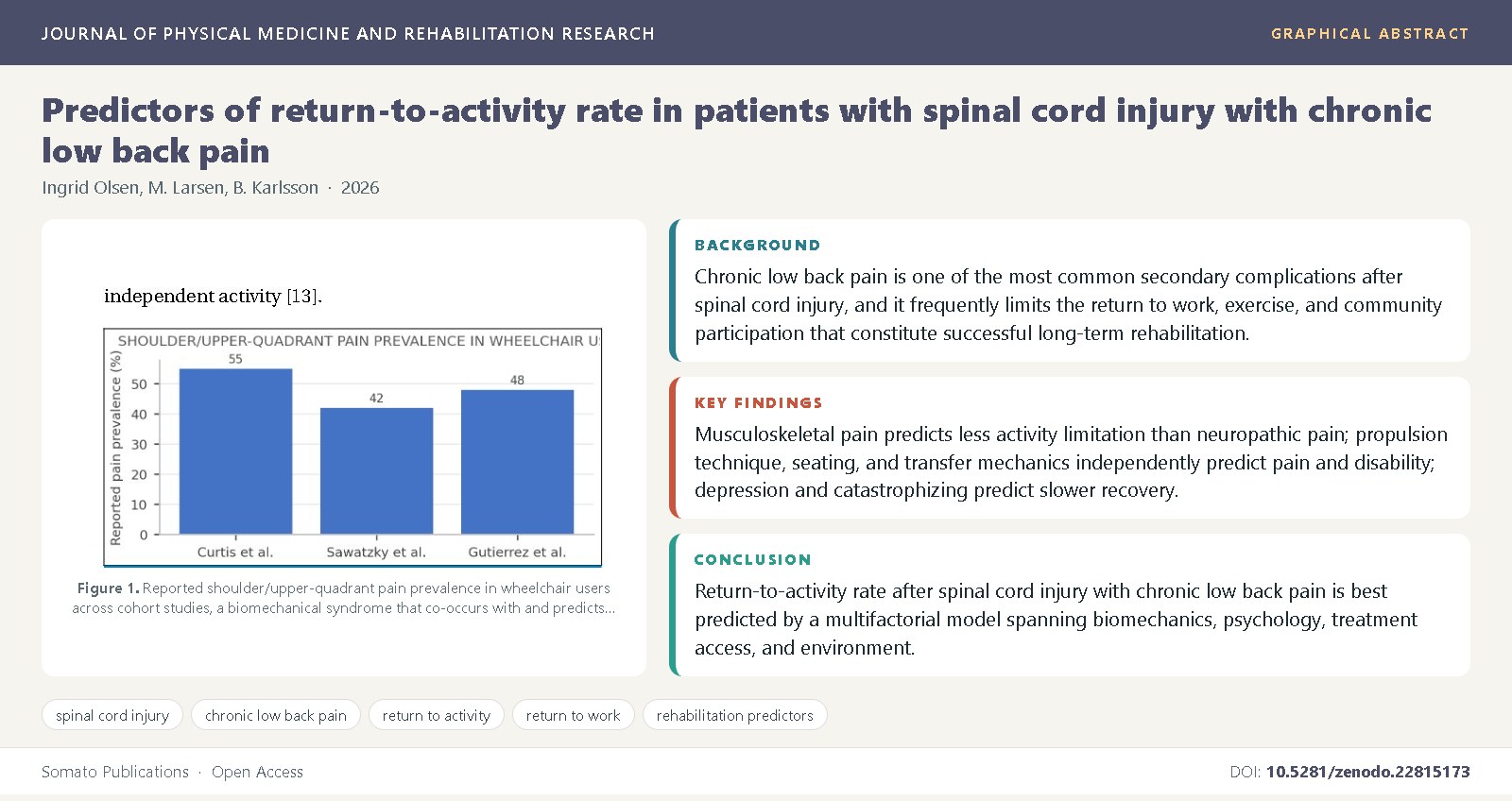
Background: Chronic low back pain is one of the most common secondary complications after spinal cord injury, and it frequently limits the return to work, exercise, and community participation that constitute successful long-term rehabilitation.
Objective: This review synthesizes the published evidence on biomechanical, injury-related, psychosocial, and treatment-related predictors of return-to-activity rate among patients with spinal cord injury who also have chronic low back pain.
Methods: We synthesized cohort studies, randomized behavioral trials, biomechanical investigations, and systematic reviews addressing pain phenotype, propulsion mechanics, psychological adjustment, vocational rehabilitation, and participation outcomes after spinal cord injury.
Findings: Musculoskeletal pain predicts less activity limitation than neuropathic pain; propulsion technique, seating, and transfer mechanics independently predict pain and disability; depression and catastrophizing predict slower recovery; and structured multidisciplinary pain management and vocational rehabilitation predict higher return-to-activity rates than usual care.
Conclusions: Return-to-activity rate after spinal cord injury with chronic low back pain is best predicted by a multifactorial model spanning biomechanics, psychology, treatment access, and environment, and rehabilitation strategies that address all of these domains together are more likely to restore work, exercise, and community participation than those targeting pain intensity alone.
References
Siddall, P.J., McClelland, J.M., Rutkowski, S.B., Cousins, M.J. (2003) A longitudinal study of the prevalence and characteristics of pain in the first 5 years following spinal cord injury. Pain, 103(3): 249-257.
Jensen, M.P., Hoffman, A.J., Cardenas, D.D. (2005) Chronic pain in individuals with spinal cord injury: a survey and longitudinal study. Spinal Cord, 43(12): 704-712.
Krause, J.S. (1997) Employment after spinal cord injury: transition and life adjustment. Rehabilitation Counseling Bulletin, 41(3): 198-205.
Whiteneck, G., Meade, M.A., Dijkers, M., Tate, D.G., Bushnik, T., Forchheimer, M.B. (2004) Environmental factors and their role in participation and life satisfaction after spinal cord injury. Archives of Physical Medicine and Rehabilitation, 85(11): 1793-1803.
Bryce, T.N., Biering-Sørensen, F., Finnerup, N.B., Cardenas, D.D., Defrin, R., Lundeberg, T., et al. (2012) International spinal cord injury pain classification. Spinal Cord, 50(6): 413-417.
Cardenas, D.D., Bryce, T.N., Shem, K., Richards, J.S., Elhefni, H. (2004) Gender and minority differences in the pain experience of people with spinal cord injury. Archives of Physical Medicine and Rehabilitation, 85(11): 1774-1781.
Widerström-Noga, E.G., Turk, D.C. (2003) Types and effectiveness of treatments used by people with chronic pain associated with spinal cord injury. Spinal Cord, 41(11): 600-609.
Boninger, M.L., Koontz, A.M., Sisto, S.A., Dyson-Hudson, T.A., Chang, M., Price, R., et al. (2003) Pushrim biomechanics and injury prevention in spinal cord injury: recommendations based on CULP-SCI investigations. Journal of Rehabilitation Research and Development, 40(3 Suppl 1): 49-61.
Mercer, J.L., Boninger, M., Koontz, A., Ren, D., Dyson-Hudson, T., Cooper, R. (2006) Shoulder joint kinetics and pathology in manual wheelchair users. Clinical Biomechanics, 21(8): 781-789.
Curtis, K.A., Drysdale, G.A., Lanza, R.D., Kolber, M., Vitolo, R.S., West, R. (1999) Shoulder pain in wheelchair users with tetraplegia and paraplegia. Archives of Physical Medicine and Rehabilitation, 80(4): 453-457.
Sawatzky, B.J., Slobogean, G.P., Reilly, C.W., Chambers, C.T., Hol, A.T. (2004) Prevalence of shoulder pain in adult wheelchair basketball players and comparison with the general wheelchair user population. Journal of Spinal Cord Medicine, 27(4): 289-293.
Gutierrez, D.D., Thompson, L., Kemp, B., Mulroy, S.J. (2007) The relationship of shoulder pain intensity to quality of life, physical activity, and community participation in persons with paraplegia. Journal of Spinal Cord Medicine, 30(3): 251-255.
Eriks-Hoogland, I., Hilfiker, R., Baumberger, M., Balk, S., Stucki, G., Perret, C. (2018) Clinical assessment of obstacles in shoulder movement for wheelchair users with spinal cord injury: associations with wheelchair transfer skills. Spinal Cord, 56(3): 244-251.
Martin Ginis, K.A., Hicks, A.L., Latimer, A.E., Warburton, D.E., Bourne, C., Ditor, D.S., et al. (2011) The development of evidence-informed physical activity guidelines for adults with spinal cord injury. Spinal Cord, 49(11): 1088-1096.
van der Scheer, J.W., Martin Ginis, K.A., Ditor, D.S., Goosey-Tolfrey, V.L., Hicks, A.L., West, C.R., et al. (2017) Effects of exercise on fitness and health of adults with spinal cord injury: a systematic review. Neurology, 89(7): 736-745.
Cairns, D.M., Adkins, R.H., Scott, M.D. (1996) Pain and depression in acute traumatic spinal cord injury: origins of chronic problematic pain? Archives of Physical Medicine and Rehabilitation, 77(4): 329-335.
Turner, J.A., Jensen, M.P., Warms, C.A., Cardenas, D.D. (2002) Catastrophizing is associated with pain intensity, psychological distress, and pain-related disability among individuals with chronic pain after spinal cord injury. Pain, 98(1-2): 127-134.
Hanley, M.A., Raichle, K., Jensen, M., Cardenas, D.D. (2008) Pain catastrophizing and beliefs predict changes in pain interference and psychological functioning in persons with spinal cord injury. Journal of Pain, 9(9): 863-871.
Vlaeyen, J.W., Linton, S.J. (2000) Fear-avoidance and its consequences in chronic musculoskeletal pain: a state of the art. Pain, 85(3): 317-332.
Craig, A., Tran, Y., Middleton, J. (2015) Psychological morbidity and spinal cord injury: a systematic review. Spinal Cord, 47(2): 108-114.
Migliorini, C., Tonge, B., Taleporos, G. (2008) Spinal cord injury and mental health. Australian and New Zealand Journal of Psychiatry, 42(4): 309-314.
Putzke, J.D., Richards, J.S., Hicken, B.L., DeVivo, M.J. (2002) Interference due to pain following spinal cord injury: important predictors and impact on quality of life. Pain, 100(3): 231-242.
Molton, I.R., Stoelb, B.L., Jensen, M.P., Ehde, D.M., Raichle, K.A., Cardenas, D.D. (2009) Psychosocial factors and adjustment to chronic pain in spinal cord injury: replication and cross-validation. Journal of Rehabilitation Research and Development, 46(1): 31-42.
Norrbrink Budh, C., Kowalski, J., Lundeberg, T. (2005) A comprehensive pain management programme comprising educational, cognitive and behavioural interventions for neuropathic pain following spinal cord injury. Journal of Rehabilitation Medicine, 38(3): 172-180.
Heutink, M., Post, M.W., Bongers-Janssen, H.M., Dijkstra, C.A., Snoek, G.J., Spijkerman, D.C., et al. (2012) The CONECSI trial: results of a randomized controlled trial of a multidisciplinary cognitive behavioral program for coping with chronic neuropathic pain after spinal cord injury. Pain, 153(1): 120-128.
Mehta, S., Guy, S.D., Bryce, T.N., Craven, B.C., Finnerup, N.B., Hitzig, S.L., et al. (2016) The CanPain SCI clinical practice guidelines for rehabilitation management of neuropathic pain after spinal cord injury: screening and diagnosis recommendations. Spinal Cord, 54(Suppl 1): S7-S13.
Consortium for Spinal Cord Medicine (2008) Preservation of upper limb function following spinal cord injury: a clinical practice guideline for health-care professionals. Journal of Spinal Cord Medicine, 28(5): 434-470.
Ottomanelli, L., Lind, L. (2009) Review of critical factors related to employment after spinal cord injury: implications for research and vocational services. Journal of Spinal Cord Medicine, 32(5): 503-531.
Lidal, I.B., Huynh, T.K., Biering-Sørensen, F. (2007) Return to work following spinal cord injury: a review. Disability and Rehabilitation, 29(17): 1341-1375.
Krause, J.S., Terza, J.V., Dismuke, C. (2011) Levels of working life among people with spinal cord injury: assessing the impact of gender, race and pre-injury employment status. Spinal Cord, 49(2): 253-259.
Meade, M.A., Lewis, A., Jackson, M.N., Hess, D.W. (2004) Race, employment, and quality of life among individuals with spinal cord injury. Archives of Physical Medicine and Rehabilitation, 85(11): 1782-1792.
Trenaman, L.M., Anderson, J.E., Bryan, S. (2007) Constructing an evidence base for the return-to-work decision: an integrative review of employment outcomes after spinal cord injury. Spinal Cord, 45(9): 578-587.
Sioka, E., Voulgaris, S., Sioka, C. (2010) Predictive factors for return to work following spinal cord injury: a narrative review. Disability and Rehabilitation, 32(20): 1618-1626.
Barclay, L., McDonald, R., Lentin, P. (2015) Social and community participation following spinal cord injury: a critical review. International Journal of Rehabilitation Research, 38(1): 1-19.
Noonan, V.K., Kopec, J.A., Zhang, H., Dvorak, M.F. (2008) Impact of associated conditions resulting from spinal cord injury on health status and quality of life in people with traumatic central cord syndrome. Archives of Physical Medicine and Rehabilitation, 89(6): 1074-1082.
Catz, A., Itzkovich, M., Agranov, E., Ring, H., Tamir, A. (1997) SCIM--spinal cord independence measure: a new disability scale for patients with spinal cord lesions. Spinal Cord, 35(12): 850-856.
National Spinal Cord Injury Statistical Center (2013) Spinal cord injury facts and figures at a glance. Journal of Spinal Cord Medicine, 36(1): 1-2.

Published
Issue
Section
License
Copyright (c) 2026 Ingrid Olsen, et al.

This work is licensed under a Creative Commons Attribution 4.0 International License.


