
Long-Term Follow-Up of multidisciplinary pain management for post-stroke hemiparesis
DOI:
https://doi.org/10.5281/zenodo.22815147Keywords:
hemiplegic shoulder pain, post-stroke spasticity, multidisciplinary rehabilitation, botulinum toxin, long-term follow-upAbstract
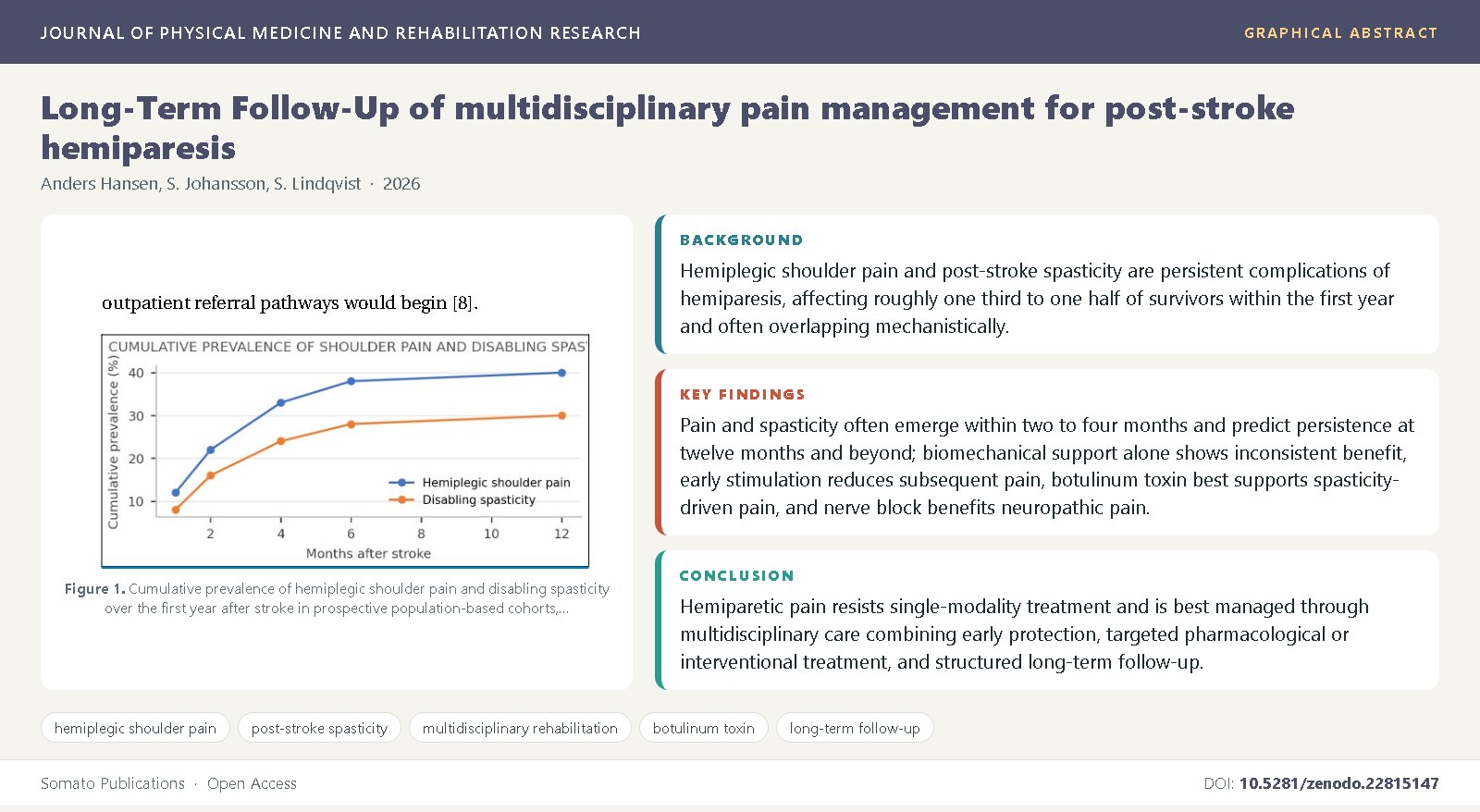
Background: Hemiplegic shoulder pain and post-stroke spasticity are persistent complications of hemiparesis, affecting roughly one third to one half of survivors within the first year and often overlapping mechanistically [1,3].
Objective: This review synthesizes evidence on multidisciplinary pain management for post-stroke hemiparesis, emphasizing shoulder pain and spasticity-related pain, and what long-term follow-up has shown about durability of treatment effects beyond one year.
Methods: We synthesized prospective epidemiological cohorts, randomized trials of biomechanical, pharmacological, interventional and stimulation treatments, and systematic reviews addressing pain and spasticity after hemiparetic stroke.
Findings: Pain and spasticity often emerge within two to four months and predict persistence at twelve months and beyond [7,38]; biomechanical support alone shows inconsistent benefit [24,26], early stimulation reduces subsequent pain [34], botulinum toxin best supports spasticity-driven pain [28,29,30], and nerve block benefits neuropathic pain [33].
Conclusions: Hemiparetic pain resists single-modality treatment and is best managed through multidisciplinary care combining early protection, targeted pharmacological or interventional treatment, and structured long-term follow-up [20,6].
References
Lindgren, I., Jonsson, A.C., Norrving, B., Lindgren, A. (2007) Shoulder pain after stroke: a prospective population-based study. Stroke, 38(2): 343-348.
Ratnasabapathy, Y., Broad, J., Baskett, J., Pledger, M., Marshall, J., Bonita, R. (2003) Shoulder pain in people with a stroke: a population-based study. Clinical Rehabilitation, 17(3): 304-311.
Lundstrom, E., Terent, A., Borg, J. (2008) Prevalence of disabling spasticity 1 year after first-ever stroke. European Journal of Neurology, 15(6): 533-539.
Sommerfeld, D.K., Eek, E.U., Svensson, A.K., Holmqvist, L.W., von Arbin, M.H. (2004) Spasticity after stroke: its occurrence and association with motor impairments and activity limitations. Stroke, 35(1): 134-139.
Turner-Stokes, L., Jackson, D. (2002) Shoulder pain after stroke: a review of the evidence base to inform the development of an integrated care pathway. Clinical Rehabilitation, 16(3): 276-298.
Teasell, R., Salbach, N.M., Foley, N., Mountain, A., Cameron, J.I., Jong, A., et al. (2020) Canadian stroke best practice recommendations: rehabilitation, recovery, and community participation following stroke. Part one: rehabilitation and recovery following stroke. International Journal of Stroke, 15(7): 763-788.
Roosink, M., Renzenbrink, G.J., Buitenweg, J.R., Van Dongen, R.T., Geurts, A.C., IJzerman, M.J. (2011) Persistent shoulder pain in the first 6 months after stroke: results of a prospective cohort study. Archives of Physical Medicine and Rehabilitation, 92(7): 1139-1145.
Dromerick, A.W., Edwards, D.F., Kumar, A. (2008) Hemiplegic shoulder pain syndrome: frequency and characteristics during inpatient stroke rehabilitation. Archives of Physical Medicine and Rehabilitation, 89(8): 1589-1593.
Bohannon, R.W., Smith, M.B. (1987) Interrater reliability of a modified Ashworth scale of muscle spasticity. Physical Therapy, 67(2): 206-207.
Wissel, J., Manack, A., Brainin, M. (2013) Toward an epidemiology of poststroke spasticity. Neurology, 80(3 Suppl 2): S13-S19.
Ikai, T., Tei, K., Yoshida, K., Miyano, S., Yonemoto, K. (1998) Evaluation and treatment of shoulder subluxation in hemiplegia: relationship between subluxation and pain. American Journal of Physical Medicine and Rehabilitation, 77(5): 421-426.
Kalichman, L., Ratmansky, M. (2011) Underlying pathology and associated factors of hemiplegic shoulder pain. American Journal of Physical Medicine and Rehabilitation, 90(9): 768-780.
Vasudevan, J.M., Browne, B.J. (2014) Hemiplegic shoulder pain: an approach to diagnosis and management. Physical Medicine and Rehabilitation Clinics of North America, 25(2): 411-437.
Zeilig, G., Rivel, M., Weingarden, H., Gaidoukov, E., Defrin, R. (2013) Hemiplegic shoulder pain: evidence of a neuropathic origin. Pain, 154(2): 263-271.
Klit, H., Finnerup, N.B., Jensen, T.S. (2009) Central post-stroke pain: clinical characteristics, pathophysiology, and management. Lancet Neurology, 8(9): 857-868.
Widar, M., Samuelsson, L., Karlsson-Tivenius, S., Ahlstrom, G. (2002) Long-term pain conditions after a stroke. Journal of Rehabilitation Medicine, 34(4): 165-170.
Bhakta, B.B. (2000) Management of spasticity in stroke. British Medical Bulletin, 56(2): 476-485.
Demeurisse, G., Demol, O., Robaye, E. (1980) Motor evaluation in vascular hemiplegia. European Neurology, 19(6): 382-389.
Jensen, M.P., Karoly, P., Braver, S. (1986) The measurement of clinical pain intensity: a comparison of six methods. Pain, 27(1): 117-126.
Turner-Stokes, L., Pick, A., Nair, A., Disler, P.B., Wade, D.T. (2015) Multi-disciplinary rehabilitation for acquired brain injury in adults of working age. Cochrane Database of Systematic Reviews, (12): CD004170.
Legg, L.A., Lewis, S.R., Schofield-Robinson, O.J., Drummond, A., Langhorne, P. (2017) Occupational therapy for adults with problems in activities of daily living after stroke. Cochrane Database of Systematic Reviews, (7): CD003585.
Pollock, A., Farmer, S.E., Brady, M.C., Langhorne, P., Mead, G.E., Mehrholz, J., et al. (2014) Interventions for improving upper limb function after stroke. Cochrane Database of Systematic Reviews, (11): CD010820.
Winstein, C.J., Stein, J., Arena, R., Bates, B., Cherney, L.R., Cramer, S.C., et al. (2016) Guidelines for adult stroke rehabilitation and recovery: a guideline for healthcare professionals from the American Heart Association/American Stroke Association. Stroke, 47(6): e98-e169.
Ada, L., Foongchomcheay, A., Canning, C. (2005) Supportive devices for preventing and treating subluxation of the shoulder after stroke. Cochrane Database of Systematic Reviews, (1): CD003863.
Griffin, A., Bernhardt, J. (2006) Strapping the hemiplegic shoulder prevents development of pain during rehabilitation: a randomized controlled trial. Clinical Rehabilitation, 20(4): 287-295.
Gustafsson, L., McKenna, K. (2006) A programme of static positional stretches does not reduce hemiplegic shoulder pain or maintain shoulder range of motion--a randomized controlled trial. Clinical Rehabilitation, 20(4): 277-286.
Anwer, S., Alghadir, A. (2014) Effects of shoulder taping in addition to physical therapy on pain, shoulder subluxation and physical impairment after stroke. Journal of Physical Therapy Science, 26(9): 1435-1439.
Yelnik, A.P., Colle, F.M., Bonan, I.V. (2007) Treatment of shoulder pain in spastic hemiplegia by injection of botulinum toxin type A: randomized, double blind, placebo controlled study. Journal of Neurology, Neurosurgery and Psychiatry, 78(8): 845-848.
Marco, E., Duarte, E., Santos, J.F., Munoz, L., Aguirrezabal, A., Belmonte, R., et al. (2007) Is botulinum toxin type A effective in the treatment of spastic shoulder pain in patients after stroke? A double-blind randomized clinical trial. Journal of Rehabilitation Medicine, 39(6): 440-447.
Lim, J.Y., Koh, J.H., Paik, N.J. (2008) Intramuscular botulinum toxin-A reduces hemiplegic shoulder pain: a randomized, double-blind, comparative study versus intraarticular triamcinolone acetonide. Stroke, 39(1): 126-131.
Snels, I.A., Beckerman, H., Twisk, J.W., Dekker, J.H., Peter, W.F., Koppe, P.A., et al. (2000) Effect of triamcinolone acetonide injections on hemiplegic shoulder pain: a randomized clinical trial. Stroke, 31(10): 2396-2401.
Turner-Stokes, L., Baguley, I.J., De Graaff, S., Katrak, P., Davies, L., McDonald, R., et al. (2010) Goal attainment scaling in the evaluation of treatment of upper limb spasticity with botulinum toxin: a secondary analysis from a double-blind placebo-controlled randomized clinical trial. Journal of Rehabilitation Medicine, 42(1): 81-89.
Adey-Wakeling, Z., Crotty, M., Shanahan, E.M. (2013) Suprascapular nerve block for shoulder pain in the first year after stroke: a randomized controlled trial. Stroke, 44(11): 3136-3141.
Church, C., Price, C., Pandyan, A.D., Huntley, S., Curless, R., Rodgers, H. (2006) Randomized controlled trial to evaluate the effect of surface neuromuscular electrical stimulation to the shoulder after acute stroke. Stroke, 37(12): 2995-3001.
Price, C.I., Pandyan, A.D. (2000) Electrical stimulation for preventing and treating post-stroke shoulder pain. Cochrane Database of Systematic Reviews, (4): CD001698.
Vuagnat, H., Chantraine, A. (2003) Shoulder pain in hemiplegia revisited: contribution of functional electrical stimulation and other therapies. Journal of Rehabilitation Medicine, 35(2): 49-56.
Wilson, R.D., Chae, J. (2015) Hemiplegic shoulder pain. Physical Medicine and Rehabilitation Clinics of North America, 26(4): 641-655.
Gillard, P.J., Sucharew, H., Kleindorfer, D., Belagaje, S., Varon, S., Alwell, K., et al. (2015) The negative impact of spasticity on the health-related quality of life of stroke survivors: a longitudinal cohort study. Health and Quality of Life Outcomes, 13: 159.
Langhorne, P., Coupar, F., Pollock, A. (2009) Motor recovery after stroke: a systematic review. Lancet Neurology, 8(8): 741-754.

Published
Issue
Section
License
Copyright (c) 2026 Anders Hansen, et al.

This work is licensed under a Creative Commons Attribution 4.0 International License.


