
Long-Term Follow-Up of prosthetic rehabilitation programs for spinal cord injury
DOI:
https://doi.org/10.5281/zenodo.22815159Keywords:
spinal cord injury, exoskeleton, gait rehabilitation, orthosis, long-term follow-upAbstract
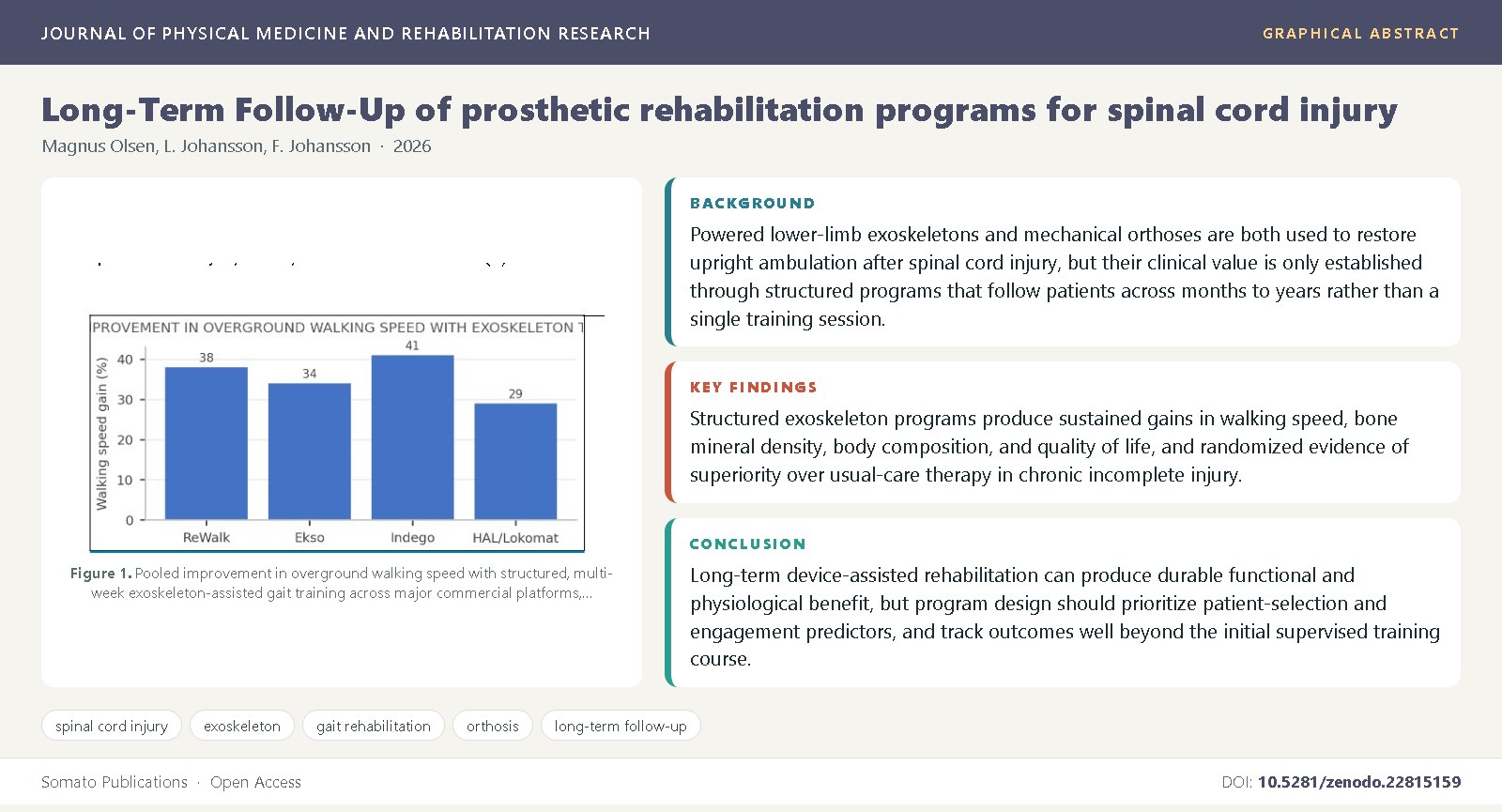
Background: Powered lower-limb exoskeletons and mechanical orthoses are both used to restore upright ambulation after spinal cord injury, but their clinical value is only established through structured programs that follow patients across months to years rather than a single training session.
Objective: This review synthesizes long-term follow-up evidence on prosthetic and orthotic rehabilitation programs for spinal cord injury, covering exoskeleton-assisted gait training, robotic treadmill systems, and mechanical orthoses.
Methods: We synthesized feasibility studies, systematic reviews, multicenter cohorts, and a randomized trial addressing walking speed, physiological outcomes, engagement, and device attrition in device-assisted ambulation.
Findings: Structured exoskeleton programs produce sustained gains in walking speed, bone mineral density, body composition, and quality of life, and randomized evidence of superiority over usual-care therapy in chronic incomplete injury; sustained use depends more on perceived independence than on gait metrics, while orthoses show markedly higher long-term attrition tied to their greater energy cost.
Conclusions: Long-term device-assisted rehabilitation can produce durable functional and physiological benefit, but program design should prioritize patient-selection and engagement predictors, and track outcomes well beyond the initial supervised training course.
References
Jain, N.B., Ayers, G.D., Peterson, E.N., Harris, M.B., Morse, L., O'Connor, K.C., et al. (2015) Traumatic spinal cord injury in the United States, 1993-2012. JAMA, 313(22): 2236-2243. DOI: 10.1001/jama.2015.6250
Kirshblum, S.C., Burns, S.P., Biering-Sorensen, F., Donovan, W., Graves, D.E., Jha, A., et al. (2011) International standards for neurological classification of spinal cord injury (revised 2011). Journal of Spinal Cord Medicine, 34(6): 535-546. DOI: 10.1179/107902611X13186000420242
Ditunno, J.F., Little, J.W., Tessler, A., Burns, A.S. (2004) Spinal shock revisited: a four-phase model. Spinal Cord, 42(7): 383-395. DOI: 10.1038/sj.sc.3101603
van Middendorp, J.J., Hosman, A.J., Donders, A.R., Pouw, M.H., Ditunno, J.F., Curt, A., et al. (2011) A clinical prediction rule for ambulation outcomes after traumatic spinal cord injury: a longitudinal cohort study. Lancet, 377(9770): 1004-1010. DOI: 10.1016/S0140-6736(10)62276-3
Esquenazi, A., Talaty, M., Packel, A., Saulino, M. (2012) The ReWalk powered exoskeleton to restore ambulatory function to individuals with thoracic-level motor-complete spinal cord injury. American Journal of Physical Medicine & Rehabilitation, 91(11): 911-921. DOI: 10.1097/PHM.0b013e318269d9a3
Zeilig, G., Weingarden, H., Zwecker, M., Dudkiewicz, I., Bloch, A., Esquenazi, A. (2012) Safety and tolerance of the ReWalk exoskeleton suit for ambulation by people with complete spinal cord injury: a pilot study. Journal of Spinal Cord Medicine, 35(2): 96-101. DOI: 10.1179/2045772312Y.0000000003
Kressler, J., Thomas, C.K., Field-Fote, E.C., Sanchez, J., Widerstrom-Noga, E., Cilien, D.C., et al. (2014) Understanding therapeutic benefits of overground bionic ambulation: exploratory case series in persons with chronic, complete spinal cord injury. Archives of Physical Medicine and Rehabilitation, 95(10): 1878-1887. DOI: 10.1016/j.apmr.2014.04.026
Miller, L.E., Zimmermann, A.K., Herbert, W.G. (2016) Clinical effectiveness and safety of powered exoskeleton-assisted walking in patients with spinal cord injury: systematic review with meta-analysis. Medical Devices: Evidence and Research, 9: 455-466. DOI: 10.2147/MDER.S103102
Louie, D.R., Eng, J.J., Lam, T. (2015) Gait speed using powered robotic exoskeletons after spinal cord injury: a systematic review and correlational study. Journal of NeuroEngineering and Rehabilitation, 12: 82. DOI:
1186/s12984-015-0074-9 10. Nam, K.Y., Kim, H.J., Kwon, B.S., Park, J.W., Lee, H.J., Yoo, A. (2017) Robot-assisted gait training (Lokomat) improves walking function and activity in people with spinal cord injury: a systematic review. Journal of NeuroEngineering and Rehabilitation, 14: 24. DOI: 10.1186/s12984-017-0232-3
Yang, A., Asselin, P., Knezevic, S., Kornfeld, S., Spungen, A.M. (2015) Assessment of in-hospital walking velocity and level of assistance in a powered exoskeleton in persons with spinal cord injury. Topics in Spinal Cord Injury Rehabilitation, 21(2): 100-109. DOI: 10.1310/sci2102-100
Fineberg, D.B., Asselin, P., Harel, N.Y., Agranova-Breyter, I., Kornfeld, S.D., Bauman, W.A., et al. (2013) Vertical ground reaction force-based analysis of powered exoskeleton-assisted walking in persons with motor-complete paraplegia. Journal of Spinal Cord Medicine, 36(4): 313-321. DOI: 10.1179/2045772313Y.0000000126
Asselin, P.K., Avedissian, M., Knezevic, S., Kornfeld, S., Spungen, A.M. (2016) Training persons with spinal cord injury to ambulate using a powered exoskeleton. Journal of Visualized Experiments, 112: e54071. DOI: 10.3791/54071
van Dijsseldonk, R.B., Rijken, H., van Nes, I.J.W., Geurts, A.C.H., Keijsers, N.L.W. (2017) Predictors of exoskeleton motivation among people with spinal cord injury. Journal of NeuroEngineering and Rehabilitation, 14: 64. DOI: 10.1186/s12984-017-0300-1
Cruciger, O., Schildhauer, T.A., Meindl, R.C., Tegenthoff, M., Schwenkreis, P., Citak, M., et al. (2016) Impact of locomotion training with a neurologic controlled hybrid assistive limb (HAL) exoskeleton on neuropathic pain and health related quality of life (HRQoL) in chronic SCI: a case study. Disability and Rehabilitation: Assistive Technology, 11(6): 529-534. DOI: 10.3109/17483107.2014.981874
Aach, M., Cruciger, O., Sczesny-Kaiser, M., Hoffken, O., Meindl, R.C., Tegenthoff, M., et al. (2014) Voluntary driven exoskeleton as a new tool for rehabilitation in chronic spinal cord injury: a pilot study. Spine Journal, 14(12): 2847-2853. DOI: 10.1016/j.spinee.2014.03.042
Contreras-Vidal, J.L., Bhagat, N.A., Brantley, J., Cruz-Garza, J.G., He, Y., Manns, M., et al. (2016) Powered exoskeletons for bipedal locomotion after spinal cord injury. Journal of Neural Engineering, 13(3): 031001. DOI: 10.1088/1741-2560/13/3/031001
Tefertiller, C., Hays, K., Jones, J., Jayaraman, A., Hartigan, C., Bushnik, T., et al. (2018) Initial outcomes from a multicenter study utilizing the Indego powered exoskeleton in spinal cord injury. Topics in Spinal Cord Injury Rehabilitation, 24(1): 78-85. DOI: 10.1310/sci17-00014
Kandilakis, C., Sasso-Lance, E. (2021) Exoskeletons for personal use after spinal cord injury. Archives of Physical Medicine and Rehabilitation, 102(2): 331-337. DOI: 10.1016/j.apmr.2019.05.028
Baunsgaard, C.B., Nissen, U.V., Brust, A.K., Frotzler, A., Ribeill, C., Kalke, Y.B., et al. (2018) Gait training after spinal cord injury: safety, feasibility and gait function following 8 weeks of training with the exoskeletons from Ekso Bionics. Spinal Cord, 56(2): 106-116. DOI: 10.1038/s41393-017-0013-7
Platz, T., Gillner, A., Borgwaldt, N., Kroll, S., Roschka, S. (2016) Device-training for individuals with thoracic and lumbar spinal cord injury using a powered exoskeleton for technically assisted mobility: achievements and user satisfaction. BioMed Research International, 2016: 8459018. DOI: 10.1155/2016/8459018
Karelis, A.D., Carvalho, L.P., Castillo, M.J., Gagnon, D.H., Aubertin-Leheudre, M. (2017) Effect on body composition and bone mineral density of walking with a robotic exoskeleton in adults with chronic spinal cord injury. Journal of Rehabilitation Medicine, 49(1): 84-87. DOI: 10.2340/16501977-2173
Gagnon, D.H., Escalona, M.J., Vermette, M., Carvalho, L.P., Karelis, A.D., Duclos, C., et al. (2018) Locomotor training using an overground robotic exoskeleton in long-term manual wheelchair users with a chronic spinal cord injury living in the community: does it improve functional exercise capacity and mobility? Journal of NeuroEngineering and Rehabilitation, 15: 12. DOI: 10.1186/s12984-018-0354-8
Edwards, D.J., Forrest, G.F., Cortes, M., Weightman, M.M., Sadowsky, C., Chang, S.H., et al. (2020) Walking improvement in chronic incomplete spinal cord injury with exoskeleton robotic training (WISE): a randomized controlled trial. Spinal Cord, 58(7): 1112-1121. DOI: 10.1038/s41393-020-0452-2
Chang, S.H., Afzal, T., Bianchi, J., Kim, K., Francisco, G.E., Contreras-Vidal, J.L., et al. (2020) Effect of exoskeleton-assisted overground gait training on spatiotemporal gait characteristics in individuals with chronic spinal cord injury. Neural Regeneration Research, 15(6): 1131-1138. DOI: 10.4103/1673-5374.269129
Bernardi, M., Canale, I., Castellano, V., Di Filippo, L., Felici, F., Marchetti, M. (1995) The efficiency of walking of paraplegic patients using a reciprocating gait orthosis. Paraplegia, 33(7): 409-415. DOI: 10.1038/sc.1995.91
Middleton, J.W., Yeo, J.D., Blanch, L., Vare, V., Peterson, K., Brigden, K. (1997) Clinical evaluation of a new orthosis, the "walkabout", for restoration of functional standing and short distance mobility in spinal cord injured ambulators. Paraplegia, 35(9): 574-579. DOI: 10.1038/sj.sc.3100437
Franceschini, M., Baratta, S., Zampolini, M., Loria, D., Lotta, S. (1997) Reciprocating gait orthoses: a multicenter study of their use by spinal cord injured patients. Archives of Physical Medicine and Rehabilitation, 78(6): 582-586. DOI: 10.1016/S0003-9993(97)90422-2
Merati, G., Sarchi, P., Ferrarin, M., Pedotti, A., Traversa, R., Cerri, C. (2000) Paraplegic adaptation to assisted-walking: energy expenditure during wheelchair versus orthosis use. Spinal Cord, 38(1): 37-44. DOI: 10.1038/sj.sc.3100958
Waters, R.L., Lunsford, B.R. (1985) Energy cost of paraplegic locomotion. Journal of Bone and Joint Surgery American, 67(8): 1245-1250.
Field-Fote, E.C., Roach, K.E. (2011) Influence of a locomotor training approach on walking speed and distance in people with chronic spinal cord injury: a randomized clinical trial. Physical Therapy, 91(1): 48-60. DOI: 10.2522/ptj.20090358
Wu, M., Landry, J.M., Kim, J., Schmit, B.D., Yen, S.C., Macdonald, J. (2014) Robotic resistance treadmill training improves locomotor function in human spinal cord injury: a pilot study. Archives of Physical Medicine and Rehabilitation, 93(5): 782-789. DOI: 10.1016/j.apmr.2012.02.023
Harkema, S.J., Schmidt-Read, M., Lorenz, D.J., Edgerton, V.R., Behrman, A.L. (2012) Balance and ambulation improvements in individuals with chronic incomplete spinal cord injury using locomotor training-based rehabilitation. Archives of Physical Medicine and Rehabilitation, 93(9): 1508-1517. DOI: 10.1016/j.apmr.2011.01.024
Scivoletto, G., Tamburella, F., Laurenza, L., Torre, M., Molinari, M. (2014) Who is going to walk? A review of the factors influencing walking recovery after spinal cord injury. Frontiers in Human Neuroscience, 8: 141. DOI: 10.3389/fnhum.2014.00141
Ditunno, P.L., Patrick, M., Stineman, M., Ditunno, J.F. (2008) Who wants to walk? Preferences for recovery after SCI: a longitudinal and cross-sectional study. Spinal Cord, 46(7): 500-506. DOI: 10.1038/sj.sc.3102172

Published
Issue
Section
License
Copyright (c) 2026 Magnus Olsen, et al.

This work is licensed under a Creative Commons Attribution 4.0 International License.


