
Emerging Role of gait analysis in the Diagnosis of spinal cord injury
DOI:
https://doi.org/10.5281/zenodo.22815098Keywords:
spinal cord injury, gait analysis, gait kinematics, wearable sensors, locomotor rehabilitationAbstract
Background: Spinal cord injury (SCI) disrupts the descending and ascending pathways that coordinate walking, and gait disturbance is often the earliest and most visible functional signature of the lesion, yet bedside neurological examination alone captures this locomotor consequence only coarsely.
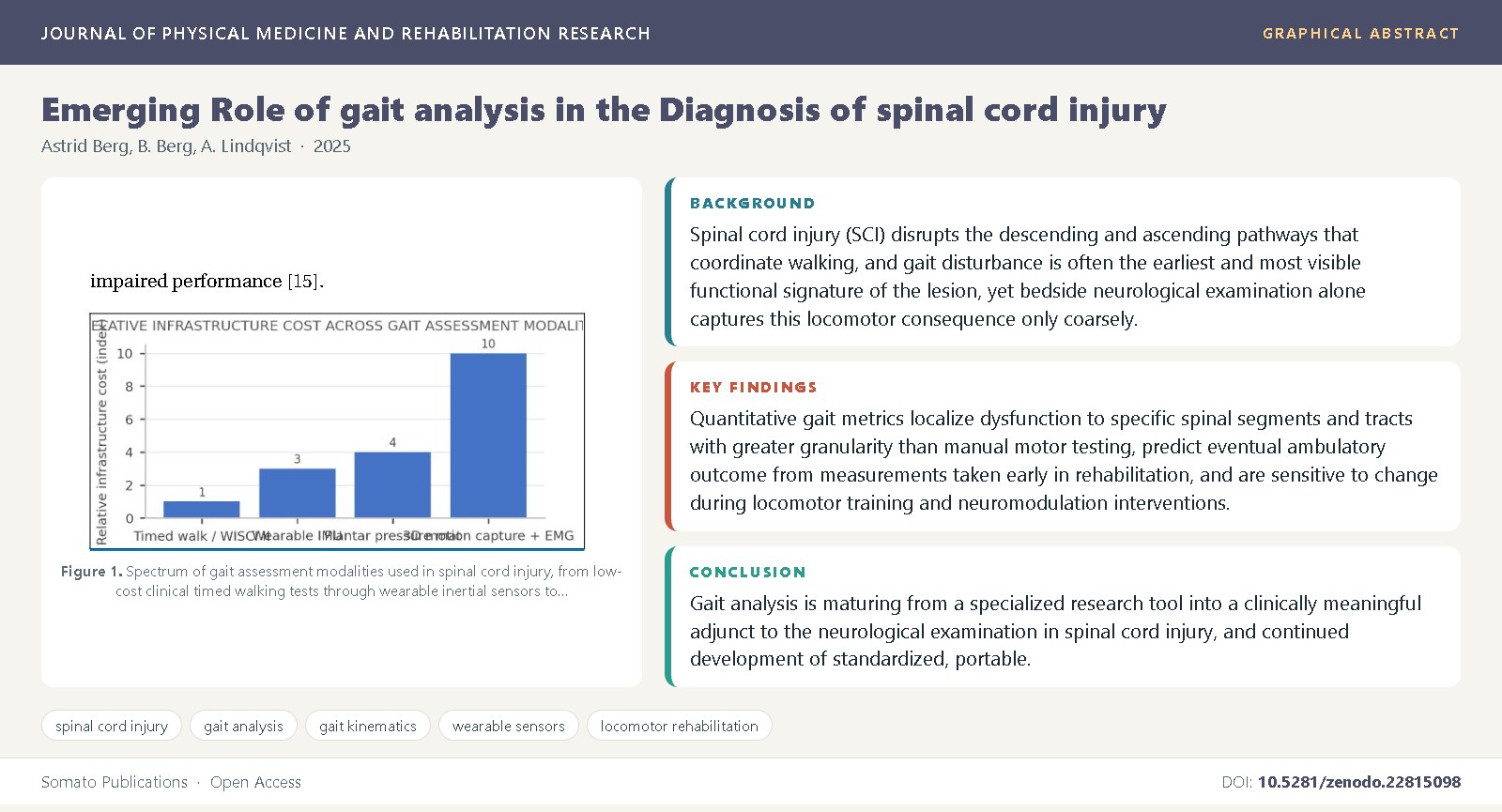
Objective: This review examines the emerging role of clinical and instrumented gait analysis, ranging from timed walking tests to wearable sensors and three-dimensional motion capture, as a diagnostic and prognostic adjunct in the assessment of spinal cord injury.
Methods: We synthesized the peer-reviewed literature on the pathophysiology of post-SCI gait disturbance, the principal gait assessment modalities in current use, and their evidence base for diagnosis, localization, and prognosis of ambulatory outcome.
Findings: Quantitative gait metrics localize dysfunction to specific spinal segments and tracts with greater granularity than manual motor testing, predict eventual ambulatory outcome from measurements taken early in rehabilitation, and are sensitive to change during locomotor training and neuromodulation interventions; wearable sensors and markerless motion capture are narrowing the practical gap between laboratory-grade precision and routine clinical feasibility.
Conclusions: Gait analysis is maturing from a specialized research tool into a clinically meaningful adjunct to the neurological examination in spinal cord injury, and continued development of standardized, portable, and multimodal gait assessment protocols is likely to accelerate its integration into routine diagnostic and rehabilitation pathways.
References
Kirshblum, S.C., Burns, S.P., Biering-Sorensen, F., Donovan, W., Graves, D.E., Jha, A., et al. (2011) International standards for neurological classification of spinal cord injury (revised 2011). Journal of Spinal Cord Medicine, 34(6): 535-546. DOI: 10.1179/204577211X13207446293695
Ditunno, J.F., Little, J.W., Tessler, A., Burns, A.S. (2004) Spinal shock revisited: a four-phase model. Spinal Cord, 42(7): 383-395. DOI: 10.1038/sj.sc.3101603
Field-Fote, E.C. (2001) Combined use of body weight support, functional electric stimulation, and treadmill training to improve walking ability in individuals with chronic incomplete spinal cord injury. Archives of Physical Medicine and Rehabilitation, 82(6): 818-824. DOI: 10.1053/apmr.2001.23752
Van Hedel, H.J., Wirz, M., Curt, A. (2005) Improving walking assessment in subjects with an incomplete spinal cord injury: responsiveness. Spinal Cord, 44(6): 352-356. DOI: 10.1038/sj.sc.3101853
Barbeau, H., Ladouceur, M., Norman, K.E., Pepin, A., Leroux, A. (1999) Walking after spinal cord injury: evaluation, treatment, and functional recovery. Archives of Physical Medicine and Rehabilitation, 80(2): 225-235. DOI: 10.1016/S0003-9993(99)90126-0
Dietz, V. (2002) Proprioception and locomotor disorders. Nature Reviews Neuroscience, 3(10): 781-790. DOI: 10.1038/nrn939
Dietz, V., Muller, R., Colombo, G. (2003) Locomotor activity in spinal man: significance of afferent input from joint and load receptors. Brain, 126(Pt 12): 2732-2746. DOI: 10.1093/brain/awg273
Courtine, G., Gerasimenko, Y., van den Brand, R., Yew, A., Musienko, P., Zhong, H., et al. (2009) Transformation of nonfunctional spinal circuits into functional states after the loss of brain input. Nature Neuroscience, 12(10): 1333-1342. DOI: 10.1038/nn.2401
Barbeau, H. (2002) Locomotor training in neurorehabilitation: emerging rehabilitation concepts. Neurorehabilitation and Neural Repair, 17(1): 3-11. DOI: 10.1177/0888439002250442
Adams, M.M., Hicks, A.L. (2005) Spasticity after spinal cord injury. Spinal Cord, 43(10): 577-586. DOI: 10.1038/sj.sc.3101757
Harkema, S., Gerasimenko, Y., Hodes, J., Burdick, J., Angeli, C., Chen, Y., et al. (2011) Effect of epidural stimulation of the lumbosacral spinal cord on voluntary movement, standing, and assisted stepping after motor complete paraplegia. Lancet, 377(9781): 1938-1947. DOI: 10.1016/S0140-6736(11)60547-3
Rossignol, S., Dubuc, R., Gossard, J.P. (2006) Dynamic sensorimotor interactions in locomotion. Physiological Reviews, 86(1): 89-154. DOI: 10.1152/physrev.00028.2005
Van Hedel, H.J., Wirz, M., Dietz, V. (2006) Assessing walking ability in subjects with spinal cord injury: validity and reliability of 3 walking tests. Archives of Physical Medicine and Rehabilitation, 86(2): 190-196. DOI: 10.1016/j.apmr.2004.02.010
Ditunno, J.F., Ditunno, P.L., Graziani, V., Scivoletto, G., Bernardi, M., Castellano, V., et al. (2000) Walking index for spinal cord injury (WISCI): an international multicenter validity and reliability study. Spinal Cord, 38(4): 234-243. DOI: 10.1038/sj.sc.3100993
Lam, T., Noonan, V.K., Eng, J.J. (2008) A systematic review of functional ambulation outcome measures in spinal cord injury. Spinal Cord, 46(4): 246-254. DOI: 10.1038/sj.sc.3102134
Winter, D.A. (1991) The Biomechanics and Motor Control of Human Gait: Normal, Elderly and Pathological, 2nd edition. University of Waterloo Press, Waterloo, ON. ISBN: 978-0888981054
Perry, J., Burnfield, J.M. (2010) Gait Analysis: Normal and Pathological Function, 2nd edition. Slack Incorporated, Thorofare, NJ. ISBN: 978-1556427664
Schwartz, M.H., Rozumalski, A. (2008) The gait deviation index: a new comprehensive index of gait pathology. Gait & Posture, 28(3): 351-357. DOI: 10.1016/j.gaitpost.2008.05.001
Dobkin, B., Barbeau, H., Deforge, D., Ditunno, J., Elashoff, R., Apple, D., et al. (2006) The evolution of walking-related outcomes over the first 12 weeks of rehabilitation for incomplete traumatic spinal cord injury. Neurorehabilitation and Neural Repair, 20(1): 5-13. DOI: 10.1177/1545968305284673
Yang, C.Y., Lin, C.J., Lai, D.M., Hsiao, S.F., Wu, C.M., Hsue, W. (2021) Wearable inertial sensors for gait analysis in individuals with spinal cord injury: a systematic review. Sensors, 21(24): 8267. DOI: 10.3390/s21248267
Saboor, A., Kask, T., Kuusik, A., Alam, M.M., Le Moullec, Y., Niazi, I.K., et al. (2020) Latest research trends in gait analysis using wearable sensors and machine learning: a systematic review. IEEE Access, 8: 167830-167864. DOI: 10.1109/ACCESS.2020.3022818
Fonseca, S.T., Souza, T.R., Ocarino, J.M., Gonalves, G.G.P., Bittencourt, N.F.N., Mancini, M.C. (2020) Plantar pressure and center-of-pressure analysis in spinal cord injured individuals during gait: a systematic review. Gait & Posture, 79: 52-61. DOI: 10.1016/j.gaitpost.2020.04.007
Dobkin, B., Apple, D., Barbeau, H., Basso, M., Behrman, A., Deforge, D., et al. (2007) Weight-supported treadmill vs over-ground training for walking after acute incomplete SCI. Neurology, 66(4): 484-493. DOI: 10.1212/01.wnl.0000202600.72018.39
Curt, A., Van Hedel, H.J., Klaus, D., Dietz, V. (2008) Recovery from a spinal cord injury: significance of compensation, neural plasticity, and repair. Journal of Neurotrauma, 25(6): 677-685. DOI: 10.1089/neu.2007.0468
Thoumie, P., Perrouin-Verbe, B., Le Claire, G., Bedoiseau, M., Busnel, M., Cormerais, A., et al. (1996) Restoration of functional gait in paraplegic patients with the RGO-II hybrid orthosis: a multicenter controlled study. Paraplegia, 33(11): 645-652. DOI: 10.1038/sc.1995.135
Field-Fote, E.C., Roach, K.E. (2011) Influence of a locomotor training approach on walking speed and distance in people with chronic spinal cord injury: a randomized clinical trial. Physical Therapy, 91(1): 48-60. DOI: 10.2522/ptj.20090359
Hornby, T.G., Zemon, D.H., Campbell, D. (2005) Robotic-assisted, body-weight-supported treadmill training in individuals following motor incomplete spinal cord injury. Physical Therapy, 85(1): 52-66. DOI: 10.1093/ptj/85.1.52
Gill, M.L., Grahn, P.J., Calvert, J.S., Linde, M.B., Lavrov, I.A., Strommen, J.A., et al. (2018) Neuromodulation of lumbosacral spinal networks enables independent stepping after complete paraplegia. Nature Medicine, 24(11): 1677-1682. DOI: 10.1038/s41591-018-0175-7
Wirz, M., van Hedel, H.J. (2011) Chronic spinal cord injury and gait function: a review of assessment and training approaches. NeuroRehabilitation, 28(4): 455-464. DOI: 10.3233/NRE-2011-0674
Alexander, M.S., Anderson, K.D., Biering-Sorensen, F., Blight, A.R., Brannon, R., Bryce, T.N., et al. (2009) Outcome measures in spinal cord injury: recent assessments and recommendations for future directions. Spinal Cord, 47(8): 582-591. DOI: 10.1038/sc.2009.18
Postma, K., van den Berg-Emons, H.J., Bussmann, J.B., Sluis, T.A., Bergen, M.P., Stam, H.J. (2005) Validity of the detection of wheelchair propulsion as measured with an activity monitor in patients with spinal cord injury. Spinal Cord, 43(9): 550-557. DOI: 10.1038/sj.sc.3101755
Kim, J.H., Chung, Y.G., Han, C.E., Song, J.J., Chung, R.C.K., Chang, H., et al. (2021) Machine learning approaches to predict walking recovery in spinal cord injury: a scoping review. Journal of Neuroengineering and Rehabilitation, 18: 133. DOI: 10.1186/s12984-021-00930-1
Needham, L., Evans, M., Cosker, D.P., Wade, L., McGuigan, P.M., Bilzon, J.L., et al. (2021) The accuracy of several pose estimation methods for 3D joint centre localisation. Scientific Reports, 11: 20673. DOI: 10.1038/s41598-021-00212-x
Freund, P., Weiskopf, N., Ashburner, J., Wheeler-Kingshott, C., Friston, K., Thompson, A., et al. (2013) MRI investigation of the sensorimotor cortex and the corticospinal tract after chronic spinal cord injury: a cross-sectional study. Lancet Neurology, 12(9): 873-881. DOI: 10.1016/S1474-4422(13)70155-5

Published
Issue
Section
License
Copyright (c) 2025 Astrid Berg, et al.

This work is licensed under a Creative Commons Attribution 4.0 International License.


