
Prevalence and Risk Factors of post-stroke hemiparesis in stroke survivors
DOI:
https://doi.org/10.5281/zenodo.22815091Keywords:
stroke, hemiparesis, motor impairment, prevalence, risk factorsAbstract
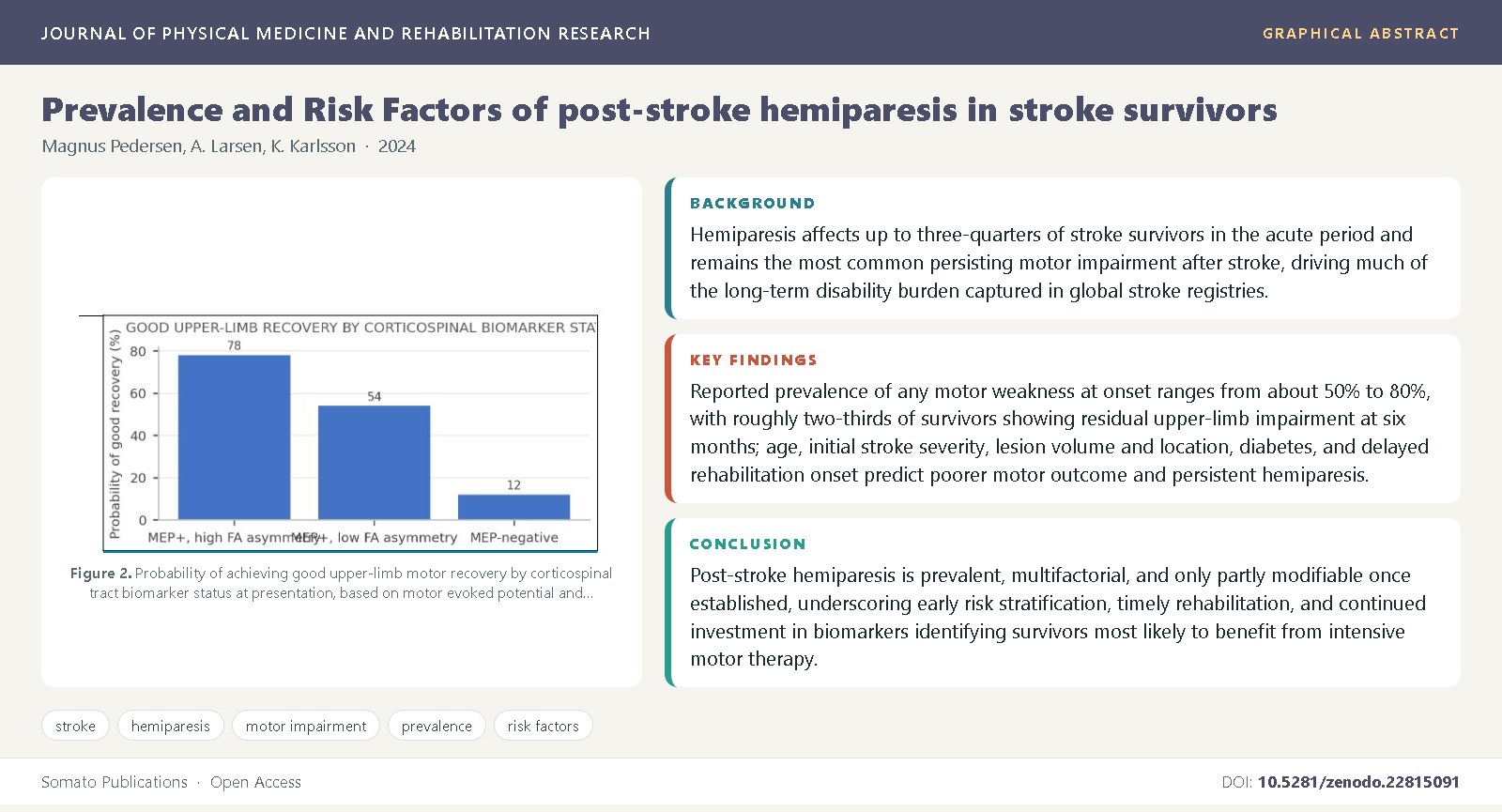
Background: Hemiparesis affects up to three-quarters of stroke survivors in the acute period and remains the most common persisting motor impairment after stroke, driving much of the long-term disability burden captured in global stroke registries.
Objective: This review synthesizes published evidence on the prevalence of post-stroke hemiparesis across the acute, subacute, and chronic phases of recovery, and on the demographic, clinical, neuroanatomical, and biochemical factors that predict its occurrence and persistence.
Methods: We synthesized population-based incidence studies, hospital and rehabilitation cohort studies, and systematic reviews addressing motor impairment prevalence, upper- and lower-limb weakness, spasticity, and recovery trajectories after ischemic and hemorrhagic stroke.
Findings: Reported prevalence of any motor weakness at onset ranges from about 50% to 80%, with roughly two-thirds of survivors showing residual upper-limb impairment at six months; age, initial stroke severity, lesion volume and location, diabetes, and delayed rehabilitation onset predict poorer motor outcome and persistent hemiparesis, while early intensive therapy and favorable corticospinal tract integrity favor more complete recovery.
Conclusions: Post-stroke hemiparesis is prevalent, multifactorial, and only partly modifiable once established, underscoring early risk stratification, timely rehabilitation, and continued investment in biomarkers identifying survivors most likely to benefit from intensive motor therapy.
References
Feigin, V.L., Stark, B.A., Johnson, C.O., Roth, G.A., Bisignano, C., Abady, G.G., et al. (2021) Global, regional, and national burden of stroke and its risk factors, 1990-2019: a systematic analysis for the Global Burden of Disease Study 2019. Lancet Neurology, 20(10): 795-820. DOI: 10.1016/S1474-4422(21)00252-0
GBD 2016 Neurology Collaborators (2019) Global, regional, and national burden of neurological disorders, 1990-2016: a systematic analysis for the Global Burden of Disease Study 2016. Lancet Neurology, 18(5): 459-480. DOI: 10.1016/S1474-4422(18)30499-X
Johnson, C.O., Nguyen, M., Roth, G.A., Nichols, E., Alam, T., Abate, D., et al. (2019) Global, regional, and national burden of stroke, 1990-2016: a systematic analysis for the Global Burden of Disease Study 2016. Lancet Neurology, 18(5): 439-458. DOI: 10.1016/S1474-4422(19)30034-1
Ward, N.S. (2004) Functional reorganization of the cerebral motor system after stroke. Current Opinion in Neurology, 17(6): 725-730. DOI: 10.1097/00019052-200412000-00013
Lawrence, E.S., Coshall, C., Dundas, R., Stewart, J., Rudd, A.G., Howard, R., et al. (2001) Estimates of the prevalence of acute stroke impairments and disability in a multiethnic population. Stroke, 32(6): 1279-1284. DOI: 10.1161/01.STR.32.6.1279
Kwakkel, G., Kollen, B.J., van der Grond, J., Prevo, A.J. (2003) Probability of regaining dexterity in the flaccid upper limb: impact of severity of paresis and time since onset in acute stroke. Stroke, 34(9): 2181-2186. DOI: 10.1161/01.STR.0000087172.16305.CD
Rathore, S.S., Hinn, A.R., Cooper, L.S., Tyroler, H.A., Rosamond, W.D. (2002) Characterization of incident stroke signs and symptoms: findings from the Atherosclerosis Risk in Communities study. Stroke, 33(11): 2718-2721. DOI: 10.1161/01.STR.0000035286.87503.31
Jorgensen, H.S., Reith, J., Nakayama, H., Kammersgaard, L.P., Raaschou, H.O., Olsen, T.S. (1999) What determines good recovery in patients with the most severe strokes? The Copenhagen Stroke Study. Stroke, 30(10): 2008-2012. DOI: 10.1161/01.STR.30.10.2008
Bamford, J., Sandercock, P., Dennis, M., Burn, J., Warlow, C. (1991) Classification and natural history of clinically identifiable subtypes of cerebral infarction. Lancet, 337(8756): 1521-1526. DOI: 10.1016/0140-6736(91)93206-O
Duncan, P.W., Goldstein, L.B., Matchar, D., Divine, G.W., Feussner, J. (1992) Measurement of motor recovery after stroke. Outcome assessment and sample size requirements. Stroke, 23(8): 1084-1089. DOI: 10.1161/01.STR.23.8.1084
Nakayama, H., Jorgensen, H.S., Raaschou, H.O., Olsen, T.S. (1994) Recovery of upper extremity function in stroke patients: the Copenhagen Stroke Study. Archives of Physical Medicine and Rehabilitation, 75(4): 394-398. DOI: 10.1016/0003-9993(94)90161-6
Langhorne, P., Bernhardt, J., Kwakkel, G. (2011) Stroke rehabilitation. Lancet, 377(9778): 1693-1702. DOI: 10.1016/S0140-6736(11)60325-5
Lai, S.M., Studenski, S., Duncan, P.W., Perera, S. (2002) Persisting consequences of stroke measured by the Stroke Impact Scale. Stroke, 33(7): 1840-1844. DOI: 10.1161/01.STR.0000019289.15440.F2
Wade, D.T., Wood, V.A., Hewer, R.L. (1985) Recovery after stroke--the first 3 months. Journal of Neurology, Neurosurgery, and Psychiatry, 48(1): 7-13. DOI: 10.1136/jnnp.48.1.7
Hendricks, H.T., van Limbeek, J., Geurts, A.C., Zwarts, M.J. (2002) Motor recovery after stroke: a systematic review of the literature. Archives of Physical Medicine and Rehabilitation, 83(11): 1629-1637. DOI: 10.1053/apmr.2002.35473
Kelly-Hayes, M., Beiser, A., Kase, C.S., Scaramucci, A., D'Agostino, R.B., Wolf, P.A. (2003) The influence of gender and age on disability following ischemic stroke: the Framingham study. Journal of Stroke and Cerebrovascular Diseases, 12(3): 119-126. DOI: 10.1016/S1052-3057(03)00042-9
Adams, H.P. Jr., Davis, P.H., Leira, E.C., Chang, K.C., Bendixen, B.H., Clarke, W.R., et al. (1999) Baseline NIH Stroke Scale score strongly predicts outcome after stroke: a report of the Trial of Org 10172 in Acute Stroke Treatment (TOAST). Neurology, 53(1): 126-131. DOI: 10.1212/WNL.53.1.126
Megherbi, S.E., Milan, C., Minier, D., Couvreur, G., Osseby, G.V., Tilling, K., et al. (2003) Association between diabetes and stroke subtype on survival and functional outcome 3 months after stroke: data from the European BIOMED Stroke Project. Stroke, 34(3): 688-694. DOI: 10.1161/01.STR.0000057975.15221.40
Sacco, R.L., Benjamin, E.J., Broderick, J.P., Dyken, M., Easton, J.D., Feinberg, W.M., et al. (1997) American Heart Association Prevention Conference IV: prevention and rehabilitation of stroke. Risk factors. Stroke, 28(7): 1507-1517. DOI: 10.1161/01.STR.28.7.1507
Petrea, R.E., Beiser, A.S., Seshadri, S., Kelly-Hayes, M., Kase, C.S., Wolf, P.A. (2009) Gender differences in stroke incidence and poststroke disability in the Framingham Heart Study. Stroke, 40(4): 1032-1037. DOI: 10.1161/STROKEAHA.108.542894
Gresham, G.E., Fitzpatrick, T.E., Wolf, P.A., McNamara, P.M., Kannel, W.B., Dawber, T.R. (1975) Residual disability in survivors of stroke--the Framingham study. New England Journal of Medicine, 293(19): 954-956. DOI: 10.1056/NEJM197511062931903
Schiemanck, S.K., Kwakkel, G., Post, M.W., Kappelle, L.J., Prevo, A.J. (2006) Predictive value of ischemic lesion volume assessed with magnetic resonance imaging for neurological deficits and functional outcome poststroke: a critical review of the literature. Neurorehabilitation and Neural Repair, 20(4): 492-502. DOI: 10.1177/1545968306289298
Stinear, C.M., Barber, P.A., Smale, P.R., Coxon, J.P., Fleming, M.K., Byblow, W.D. (2007) Functional potential in chronic stroke patients depends on corticospinal tract integrity. Brain, 130(1): 170-180. DOI: 10.1093/brain/awl333
Stinear, C.M., Byblow, W.D., Ackerley, S.J., Smith, M.C., Borges, V.M., Barber, P.A. (2017) PREP2: a biomarker-based algorithm for predicting upper limb function after stroke. Annals of Clinical and Translational Neurology, 4(11): 811-820. DOI: 10.1002/acn3.488
Byblow, W.D., Stinear, C.M., Barber, P.A., Petoe, M.A., Ackerley, S.J. (2015) Proportional recovery after stroke depends on corticomotor integrity. Annals of Neurology, 78(6): 848-859. DOI: 10.1002/ana.24472
Wissel, J., Manack, A., Brainin, M. (2013) Toward an epidemiology of poststroke spasticity. Neurology, 80(3 Suppl 2): S13-S19. DOI: 10.1212/WNL.0b013e3182762448
Sommerfeld, D.K., Eek, E.U., Svensson, A.K., Holmqvist, L.W., von Arbin, M.H. (2004) Spasticity after stroke: its occurrence and association with motor impairments and activity limitations. Stroke, 35(1): 134-139. DOI: 10.1161/01.STR.0000105386.05173.5E
Ada, L., Foongchomcheay, A., Canning, C. (2005) Supportive devices for preventing and treating subluxation of the shoulder after stroke. Cochrane Database of Systematic Reviews, (1): CD003863. DOI: 10.1002/14651858.CD003863.pub2
Weerdesteyn, V., de Niet, M., van Duijnhoven, H.J., Geurts, A.C. (2008) Falls in individuals with stroke. Journal of Rehabilitation Research and Development, 45(8): 1195-1213.
Langhorne, P., Coupar, F., Pollock, A. (2009) Motor recovery after stroke: a systematic review. Lancet Neurology, 8(8): 741-754. DOI: 10.1016/S1474-4422(09)70150-4
Coupar, F., Pollock, A., Rowe, P., Weir, C., Langhorne, P. (2012) Predictors of upper limb recovery after stroke: a systematic review and meta-analysis. Clinical Rehabilitation, 26(4): 291-313. DOI: 10.1177/0269215511420305
Wolf, S.L., Winstein, C.J., Miller, J.P., Taub, E., Uswatte, G., Morris, D., et al. (2006) Effect of constraint-induced movement therapy on upper extremity function 3 to 9 months after stroke: the EXCITE randomized clinical trial. JAMA, 296(17): 2095-2104. DOI: 10.1001/jama.296.17.2095
Pollock, A., Farmer, S.E., Brady, M.C., Langhorne, P., Mead, G.E., Mehrholz, J., et al. (2014) Interventions for improving upper limb function after stroke. Cochrane Database of Systematic Reviews, (11): CD010820. DOI: 10.1002/14651858.CD010820.pub2

Published
Issue
Section
License
Copyright (c) 2024 Magnus Pedersen, et al.

This work is licensed under a Creative Commons Attribution 4.0 International License.


