
Emerging Role of gait analysis in the Diagnosis of traumatic brain injury
DOI:
https://doi.org/10.5281/zenodo.22815080Keywords:
traumatic brain injury, gait analysis, dual-task gait, wearable sensors, balanceAbstract
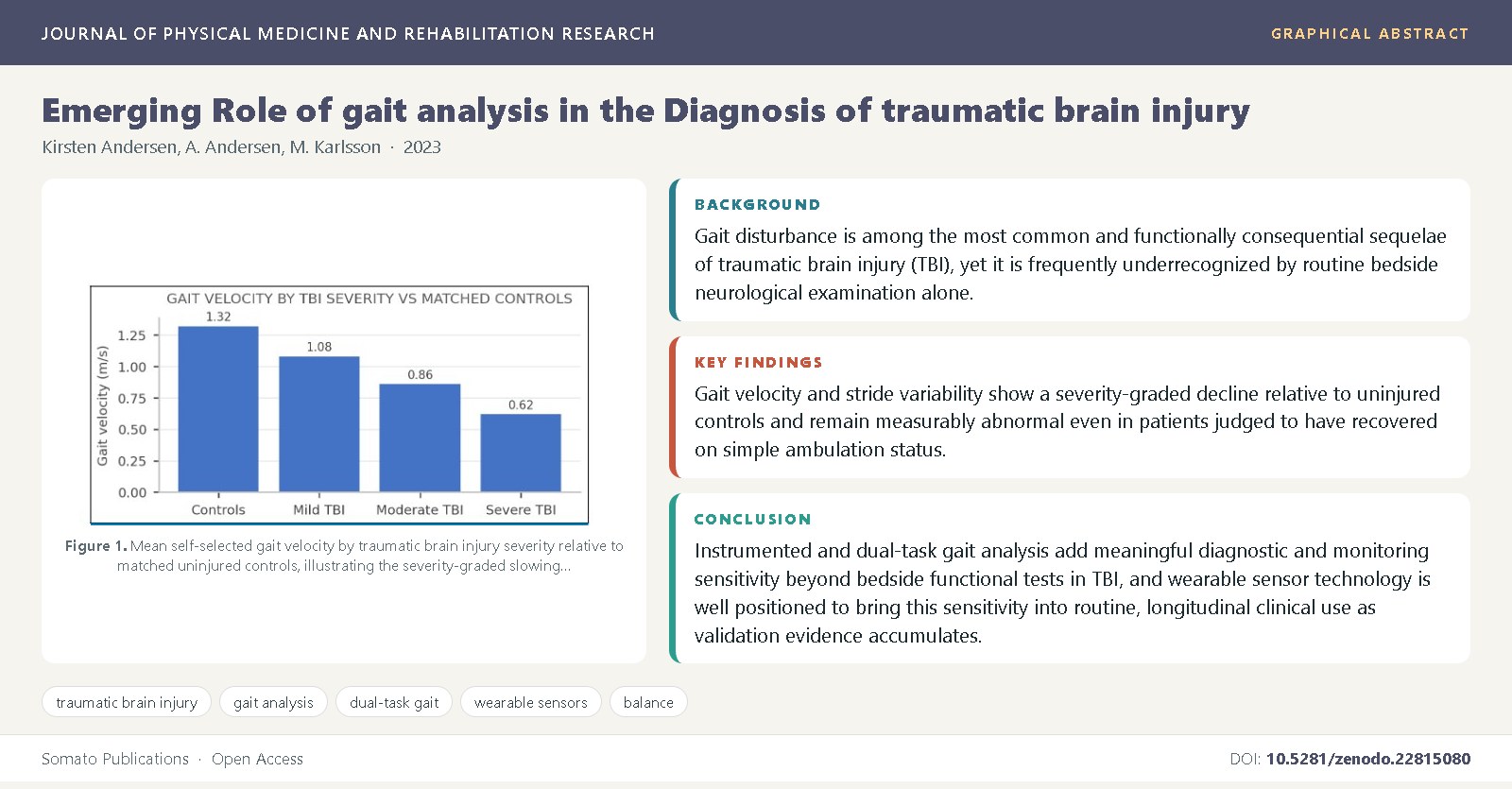
Background: Gait disturbance is among the most common and functionally consequential sequelae of traumatic brain injury (TBI), yet it is frequently underrecognized by routine bedside neurological examination alone [5,6].
Objective: This review synthesizes the evidence on gait disturbance after TBI and evaluates the diagnostic and monitoring value of clinical and instrumented gait analysis across the injury severity spectrum.
Methods: We synthesized observational cohort studies, instrumented gait analysis validation studies, dual-task paradigm research, and wearable sensor literature addressing gait assessment in TBI and closely related neurological populations.
Findings: Gait velocity and stride variability show a severity-graded decline relative to uninjured controls and remain measurably abnormal even in patients judged to have recovered on simple ambulation status; dual-task paradigms reveal cognitive-motor interference that single-task testing misses, and wearable inertial sensors are extending quantitative assessment beyond the gait laboratory, though TBI-specific validation of these devices remains comparatively limited.
Conclusions: Instrumented and dual-task gait analysis add meaningful diagnostic and monitoring sensitivity beyond bedside functional tests in TBI, and wearable sensor technology is well positioned to bring this sensitivity into routine, longitudinal clinical use as validation evidence accumulates.
References
Faul, M., Xu, L., Wald, M.M., Coronado, V.G. (2010) Traumatic Brain Injury in the United States: Emergency Department Visits, Hospitalizations, and Deaths 2002-2006. Centers for Disease Control and Prevention, National Center for Injury Prevention and Control, Atlanta.
Menon, D.K., Schwab, K., Wright, D.W., Maas, A.I. (2010) Position statement: definition of traumatic brain injury. Archives of Physical Medicine and Rehabilitation, 91(11): 1637-1640. DOI: 10.1016/j.apmr.2010.05.017
Shumway-Cook, A., Woollacott, M.H. (2012) Motor Control: Translating Research into Clinical Practice, 4th edition. Lippincott Williams & Wilkins, Philadelphia.
Perry, J., Burnfield, J.M. (2010) Gait Analysis: Normal and Pathological Function, 2nd edition. SLACK Incorporated, Thorofare.
Basford, J.R., Chou, L.S., Kaufman, K.R., Brey, R.H., Walker, A., Malec, J.F., et al. (2003) An assessment of gait and balance deficits after traumatic brain injury. Archives of Physical Medicine and Rehabilitation, 84(3): 343-349. DOI: 10.1053/apmr.2003.50034
Williams, G., Morris, M.E., Schache, A., McCrory, P.R. (2009) Incidence of gait abnormalities after traumatic brain injury. Archives of Physical Medicine and Rehabilitation, 90(4): 587-593. DOI: 10.1016/j.apmr.2008.10.013
Yogev-Seligmann, G., Hausdorff, J.M., Giladi, N. (2008) The role of executive function and attention in gait. Movement Disorders, 23(3): 329-342. DOI: 10.1002/mds.21720
Ganesan, M., Pal, P.K., Gupta, A., Sathyaprabha, T.N. (2015) Vestibular and oculomotor dysfunction following traumatic brain injury and its influence on postural control during gait. Journal of Vestibular Research, 25(3-4): 143-150.
Konrad, H.R., Girardi, M., Helfert, R. (1999) Balance and aging. Laryngoscope, 109(9): 1454-1460.
Katz-Leurer, M., Rotem, H., Keren, O., Meyer, S. (2009) Balance abilities and gait characteristics in post-traumatic brain injury, cerebral palsy and typically developed children. Developmental Neurorehabilitation, 12(2): 100-105.
Podsiadlo, D., Richardson, S. (1991) The timed "Up & Go": a test of basic functional mobility for frail elderly persons. Journal of the American Geriatrics Society, 39(2): 142-148. DOI: 10.1111/j.1532-5415.1991.tb01616.x
Tinetti, M.E. (1986) Performance-oriented assessment of mobility problems in elderly patients. Journal of the American Geriatrics Society, 34(2): 119-126. DOI: 10.1111/j.1532-5415.1986.tb05480.x
Berg, K.O., Wood-Dauphinee, S.L., Williams, J.I., Maki, B. (1992) Measuring balance in the elderly: validation of an instrument. Canadian Journal of Public Health, 83(Suppl 2): S7-S11.
Powell, L.E., Myers, A.M. (1995) The Activities-specific Balance Confidence (ABC) Scale. Journals of Gerontology Series A: Biological Sciences and Medical Sciences, 50A(1): M28-M34.
Whitney, S.L., Marchetti, G.F., Morris, L.O., Sparto, P.J. (2007) The reliability and validity of the Four Square Step Test for people with balance deficits secondary to a vestibular disorder. Archives of Physical Medicine and Rehabilitation, 88(1): 99-104.
Csuka, M., McCarty, D.J. (1985) Simple method for measurement of lower extremity muscle strength. American Journal of Medicine, 78(1): 77-81.
Wren, T.A., Gorton, G.E. 3rd, Ounpuu, S., Tucker, C.A. (2011) Efficacy of clinical gait analysis: a systematic review. Gait & Posture, 34(2): 149-153. DOI: 10.1016/j.gaitpost.2011.03.027
Baker, R. (2006) Gait analysis methods in rehabilitation. Journal of NeuroEngineering and Rehabilitation, 3: 4. DOI: 10.1186/1743-0003-3-4
Cimolin, V., Galli, M. (2014) Summary measures for clinical gait analysis: a literature review. Gait & Posture, 39(4): 1005-1010. DOI: 10.1016/j.gaitpost.2014.02.001
McFadyen, B.J., Swaine, B., Dumas, D., Durand, A. (2009) Modality-specific, multi-task locomotor deficits persist despite good recovery after a traumatic brain injury. Archives of Physical Medicine and Rehabilitation, 90(9): 1596-1606. DOI: 10.1016/j.apmr.2009.02.021
Williams, G.P., Morris, M.E., Schache, A., McCrory, P. (2009) Observational gait analysis in traumatic brain injury: accuracy of clinical judgement. Physical Therapy, 89(11): 1273-1283.
Williams, G., Galna, B., Morris, M.E., Olds, T. (2009) Repeatability of performance-based clinical measures of walking and turning following traumatic brain injury. Journal of Head Trauma Rehabilitation, 24(5): 393-400.
Kuys, S.S., Morrison, S.C., Nayyar, S., Saxby, D.J. (2011) Gait speed after traumatic brain injury during inpatient rehabilitation: recovery pattern and predictors. NeuroRehabilitation, 29(4): 405-411.
Katz, D.I., Alexander, M.P. (1994) Traumatic brain injury: predicting course of recovery and outcome for patients admitted to rehabilitation. Archives of Neurology, 51(7): 661-670.
Parihar, R., Mahoney, J.R., Verghese, J. (2013) Relationship of gait and cognition in the elderly: a review. Current Translational Geriatrics and Experimental Gerontology Reports, 2(3): 167-173.
Muir-Hunter, S.W., Wittwer, J.E. (2016) Dual-task testing to predict falls in community-dwelling older adults: a systematic review. Physiotherapy, 102(1): 29-40.
Muro-de-la-Herran, A., Garcia-Zapirain, B., Mendez-Zorrilla, A. (2014) Gait analysis methods: an overview of wearable and non-wearable systems, highlighting clinical applications. Sensors, 14(2): 3362-3394. DOI: 10.3390/s140203362
Tao, W., Liu, T., Zheng, R., Feng, H. (2012) Gait analysis using wearable sensors. Sensors, 12(2): 2255-2283. DOI: 10.3390/s120202255
Iosa, M., Picerno, P., Paolucci, S., Morone, G. (2016) Wearable inertial sensors for human movement analysis. Expert Review of Medical Devices, 13(7): 641-659. DOI: 10.1080/17434440.2016.1198694
Howcroft, J., Kofman, J., Lemaire, E.D. (2013) Review of fall risk assessment in geriatric populations using inertial sensors. Journal of NeuroEngineering and Rehabilitation, 10: 91. DOI: 10.1186/1743-0003-10-91
Kleiner, A.F.R., Pacifici, I., Vagnini, A., Camerota, F., Celletti, C., Stocchi, F., et al. (2013) Timed Up and Go evaluation with wearable devices: validation in Parkinson's disease and extension to acquired brain injury populations. Journal of NeuroEngineering and Rehabilitation, 10(Suppl 1): P1.
Lamontagne, A., Fung, J. (2004) Faster is better: implications for speed-intensive gait training after stroke. Stroke, 35(11): 2543-2548. DOI: 10.1161/01.STR.0000127249.30768.03
Vasudevan, E.V., Bastian, A.J. (2010) Split-belt treadmill adaptation shows different functional networks for fast and slow human walking. Journal of Neurophysiology, 103(1): 183-191. DOI: 10.1152/jn.00501.2009
Williams, G.P., Schache, A.G. (2010) Evaluation of a conceptual framework for retraining high-level mobility following traumatic brain injury. Journal of Head Trauma Rehabilitation, 25(6): 442-450.
Dikmen, S.S., Machamer, J.E., Powell, J.M., Temkin, N.R. (2003) Outcome 3 to 5 years after moderate to severe traumatic brain injury. Archives of Physical Medicine and Rehabilitation, 84(10): 1449-1457. DOI: 10.1016/S0003-9993(03)00287-9

Published
Issue
Section
License
Copyright (c) 2023 Kirsten Andersen, et al.

This work is licensed under a Creative Commons Attribution 4.0 International License.


