
functional independence measure scoring in the Management of traumatic brain injury among stroke survivors
DOI:
https://doi.org/10.5281/zenodo.22815056Keywords:
Functional Independence Measure, traumatic brain injury, stroke rehabilitation, outcome measurement, cognitive impairmentAbstract
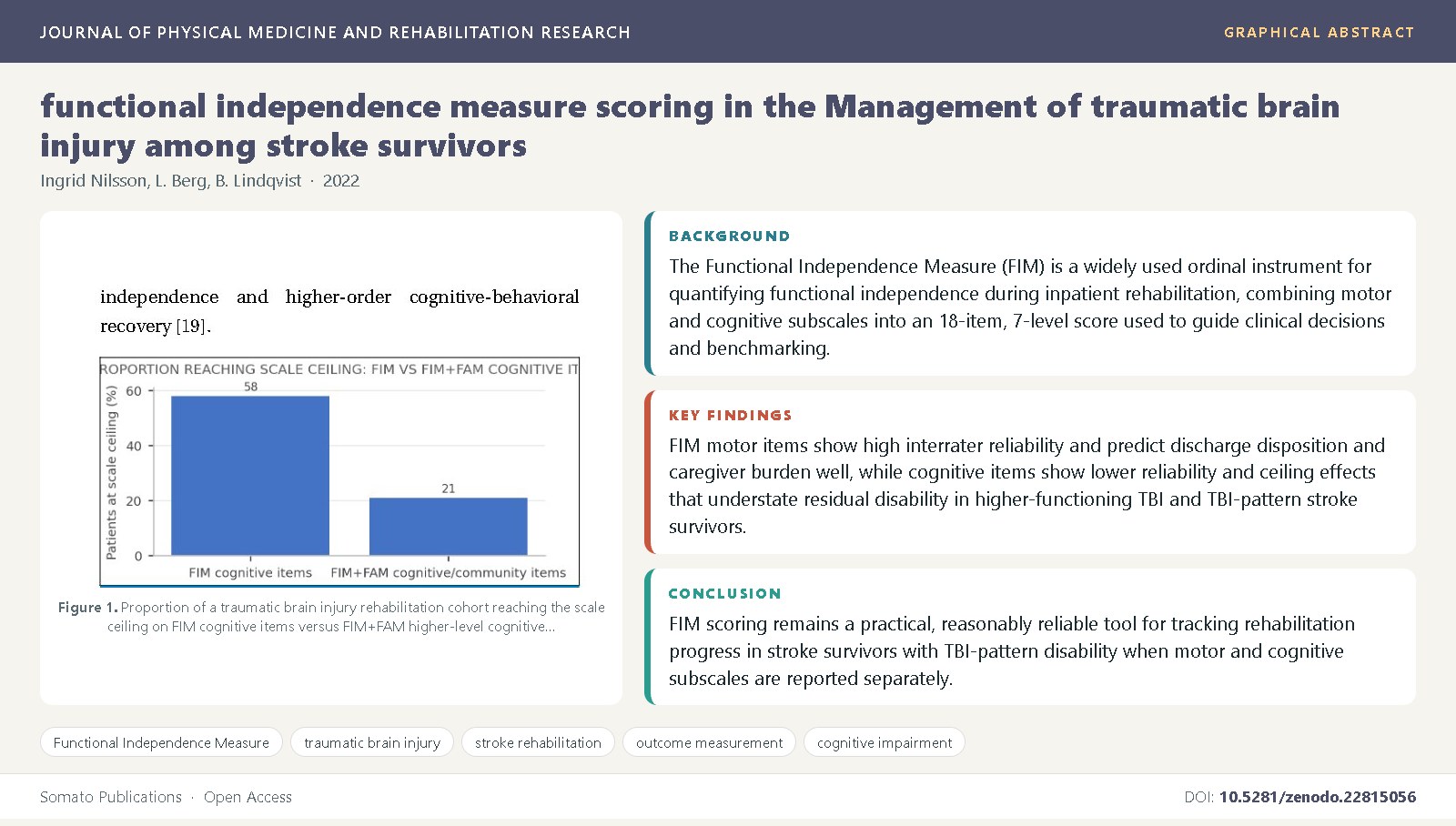
Background: The Functional Independence Measure (FIM) is a widely used ordinal instrument for quantifying functional independence during inpatient rehabilitation, combining motor and cognitive subscales into an 18-item, 7-level score used to guide clinical decisions and benchmarking.
Objective: This review synthesizes the psychometric evidence for FIM scoring and its performance in traumatic brain injury (TBI) rehabilitation and stroke rehabilitation, with attention to stroke survivors whose presentation includes a TBI-like cognitive component.
Methods: We synthesized peer-reviewed reliability and validity studies, comparisons against the Barthel Index, and outcome studies relating FIM scores to rehabilitation intensity, care setting, and discharge disposition.
Findings: FIM motor items show high interrater reliability and predict discharge disposition and caregiver burden well, while cognitive items show lower reliability and ceiling effects that understate residual disability in higher-functioning TBI and TBI-pattern stroke survivors; responsiveness is broadly comparable to the Barthel Index for self-care domains.
Conclusions: FIM scoring remains a practical, reasonably reliable tool for tracking rehabilitation progress in stroke survivors with TBI-pattern disability when motor and cognitive subscales are reported separately and supplemented by instruments extending measurement into higher-level cognitive domains.
References
Keith, R.A., Granger, C.V., Hamilton, B.B., Sherwin, F.S. (1987) The Functional Independence Measure: a new tool for rehabilitation. Advances in Clinical Rehabilitation, 1: 6-18.
Granger, C.V., Hamilton, B.B., Linacre, J.M., Heinemann, A.W., Wright, B.D. (1993) Performance profiles of the Functional Independence Measure. American Journal of Physical Medicine and Rehabilitation, 72(2): 84-89. DOI: 10.1097/00002060-199304000-00005
Hamilton, B.B., Granger, C.V., Sherwin, F.S., Zielezny, M., Tashman, J.S. (1987) A uniform national data system for medical rehabilitation. In: Fuhrer, M.J. (Ed.), Rehabilitation Outcomes: Analysis and Measurement. Paul H. Brookes Publishing, Baltimore, pp. 137-147.
Granger, C.V., Hamilton, B.B. (1992) The Uniform Data System for Medical Rehabilitation report of first admissions for 1990. American Journal of Physical Medicine and Rehabilitation, 71(2): 108-113.
Hamilton, B.B., Laughlin, J.A., Fiedler, R.C., Granger, C.V. (1994) Interrater reliability of the 7-level functional independence measure (FIM). Scandinavian Journal of Rehabilitation Medicine, 26(3): 115-119.
Ottenbacher, K.J., Hsu, Y., Granger, C.V., Fiedler, R.C. (1996) The reliability of the functional independence measure: a quantitative review. Archives of Physical Medicine and Rehabilitation, 77(12): 1226-1232. DOI: 10.1016/S0003-9993(96)90184-7
Linacre, J.M., Heinemann, A.W., Wright, B.D., Granger, C.V., Hamilton, B.B. (1994) The structure and stability of the Functional Independence Measure. Archives of Physical Medicine and Rehabilitation, 75(2): 127-132. DOI: 10.1016/0003-9993(94)90384-0
Stineman, M.G., Shea, J.A., Jette, A., Tassoni, C.J., Ottenbacher, K.J., Fiedler, R., Granger, C.V. (1996) The Functional Independence Measure: tests of scaling assumptions, structure, and reliability across 20 diverse impairment categories. Archives of Physical Medicine and Rehabilitation, 77(11): 1101-1108. DOI: 10.1016/S0003-9993(96)90130-6
Heinemann, A.W., Linacre, J.M., Wright, B.D., Hamilton, B.B., Granger, C.V. (1993) Relationships between impairment and physical disability as measured by the functional independence measure. Archives of Physical Medicine and Rehabilitation, 74(6): 566-573. DOI:
1016/0003-9993(93)90153-2 10. Dodds, T.A., Martin, D.P., Stolov, W.C., Deyo, R.A. (1993) A validation of the functional independence measurement and its performance among rehabilitation inpatients. Archives of Physical Medicine and Rehabilitation, 74(5): 531-536. DOI: 10.1016/0003-9993(93)90119-U
Ottenbacher, K.J., Mann, W.C., Granger, C.V., Tomita, M., Hurren, D., Charvat, B. (1994) Inter-rater agreement and stability of functional assessment in the community-based elderly. Archives of Physical Medicine and Rehabilitation, 75(12): 1297-1301. DOI: 10.1016/0003-9993(94)90279-X
Kidd, D., Stewart, G., Baldry, J., Johnson, J., Rossiter, D., Petruckevitch, A., Thompson, A.J. (1995) The Functional Independence Measure: a comparative validity and reliability study. Disability and Rehabilitation, 17(1): 10-14. DOI: 10.3109/09638289509166622
Hall, K.M., Mann, N., High, W.M. Jr, Wright, J., Kreutzer, J.S., Wood, D. (1996) Functional measures after traumatic brain injury: ceiling effects of FIM, FIM+FAM, DRS, and CIQ. Journal of Head Trauma Rehabilitation, 11(5): 27-39. DOI: 10.1097/00001199-199610000-00004
Hall, K.M., Hamilton, B.B., Gordon, W.A., Zasler, N.D. (1993) Characteristics and comparisons of functional assessment indices: Disability Rating Scale, Functional Independence Measure, and Functional Assessment Measure. Journal of Head Trauma Rehabilitation, 8(2): 60-74.
Corrigan, J.D., Smith-Knapp, K., Granger, C.V. (1997) Outcomes in the first 5 years after traumatic brain injury. Archives of Physical Medicine and Rehabilitation, 78(3): 298-305. DOI: 10.1016/S0003-9993(97)90038-1
Cifu, D.X., Kreutzer, J.S., Marwitz, J.H., Rosenthal, M., Englander, J., High, W. (1996) Functional outcomes of older adults with traumatic brain injury: a prospective, multicenter analysis. Archives of Physical Medicine and Rehabilitation, 77(9): 883-888. DOI: 10.1016/S0003-9993(96)90274-9
Hall, K.M., Cope, D.N. (1995) The benefit of rehabilitation in traumatic brain injury: a literature review. Journal of Head Trauma Rehabilitation, 10(1): 1-13. DOI: 10.1097/00001199-199502000-00003
Rappaport, M., Hall, K.M., Hopkins, K., Belleza, T., Cope, D.N. (1982) Disability rating scale for severe head trauma: coma to community. Archives of Physical Medicine and Rehabilitation, 63(3): 118-123.
Cohen, M.E., Marino, R.J. (2000) The tools of disability outcomes research functional status measures. Archives of Physical Medicine and Rehabilitation, 81(12 Suppl 2): S21-S29. DOI: 10.1053/apmr.2000.20620
Granger, C.V., Hamilton, B.B., Fiedler, R.C. (1992) Discharge outcome after stroke rehabilitation. Stroke, 23(7): 978-982. DOI: 10.1161/01.STR.23.7.978
Oczkowski, W.J., Barreca, S. (1993) The Functional Independence Measure: its use to identify rehabilitation needs in stroke survivors. Archives of Physical Medicine and Rehabilitation, 74(12): 1291-1294. DOI: 10.1016/0003-9993(93)90081-K
Jorgensen, H.S., Nakayama, H., Raaschou, H.O., Vive-Larsen, J., Stoier, M., Olsen, T.S. (1995) Outcome and time course of recovery in stroke. Part II: Time course of recovery. The Copenhagen Stroke Study. Archives of Physical Medicine and Rehabilitation, 76(5): 406-412. DOI: 10.1016/S0003-9993(95)80568-0
Heinemann, A.W., Roth, E.J., Cichowski, K., Betts, H.B. (1987) Multivariate analysis of improvement and outcome following stroke rehabilitation. Archives of Neurology, 44(11): 1167-1172. DOI: 10.1001/archneur.1987.00520230031012
Ozdemir, F., Birtane, M., Tabatabaei, R., Ekuklu, G., Kokino, S. (2001) Comparing stroke rehabilitation outcomes between acute inpatient and nonintensive home settings. Archives of Physical Medicine and Rehabilitation, 82(10): 1375-1379. DOI: 10.1053/apmr.2001.25971
Kwakkel, G., Kollen, B.J., Wagenaar, R.C. (2002) Long term effects of intensity of upper and lower limb training after stroke: a randomised trial. Journal of Neurology, Neurosurgery and Psychiatry, 72(4): 473-479. DOI: 10.1136/jnnp.72.4.473
Kwakkel, G., Kollen, B.J., van der Grond, J., Prevo, A.J. (2003) Probability of regaining dexterity in the flaccid upper limb: impact of severity of paresis and time since onset in acute stroke. Stroke, 34(9): 2181-2186. DOI: 10.1161/01.STR.0000087172.16305.CD
Kwakkel, G., Kollen, B., Lindeman, E. (2004) Understanding the pattern of functional recovery after stroke: facts and theories. Restorative Neurology and Neuroscience, 22(3-5): 281-299.
Hsueh, I.P., Lin, J.H., Jeng, J.S., Hsieh, C.L. (2002) Comparison of the psychometric characteristics of the functional independence measure, 5 item Barthel index, and 10 item Barthel index in patients with stroke. Journal of Neurology, Neurosurgery and Psychiatry, 73(2): 188-190. DOI: 10.1136/jnnp.73.2.188
van der Putten, J.J., Hobart, J.C., Freeman, J.A., Thompson, A.J. (1999) Measuring change in disability after inpatient rehabilitation: comparison of the responsiveness of the Barthel index and the Functional Independence Measure. Journal of Neurology, Neurosurgery and Psychiatry, 66(4): 480-484. DOI: 10.1136/jnnp.66.4.480
Wallace, D., Duncan, P.W., Lai, S.M. (2002) Comparison of the responsiveness of the Barthel Index and the motor component of the Functional Independence Measure in stroke: the impact of using different methods for measuring responsiveness. Journal of Clinical Epidemiology, 55(9): 922-928. DOI: 10.1016/S0895-4356(02)00434-8
Segal, M.E., Ditunno, J.F., Staas, W.E. (1993) Interinstitutional agreement of individual functional independence measure (FIM) items measured at two sites on one sample of SCI patients. Paraplegia, 31(10): 622-631. DOI: 10.1038/sc.1993.100
Jette, D.U., Warren, R.L., Wirtalla, C. (2005) The relation between therapy intensity and outcomes of rehabilitation in skilled nursing facilities. Archives of Physical Medicine and Rehabilitation, 86(3): 373-379. DOI: 10.1016/j.apmr.2004.10.018
Turner-Stokes, L. (2008) Evidence for the effectiveness of multi-disciplinary rehabilitation following acquired brain injury: a synthesis of two systematic approaches. Journal of Rehabilitation Medicine, 40(9): 691-701. DOI: 10.2340/16501977-0265
Grill, E., Stucki, G. (2011) Criterion validity of outcome measures for stroke rehabilitation based on the international classification of functioning, disability and health. Journal of Rehabilitation Medicine, 43(4): 297-304. DOI: 10.2340/16501977-0654

Published
Issue
Section
License
Copyright (c) 2022 Ingrid Nilsson, et al.

This work is licensed under a Creative Commons Attribution 4.0 International License.


