
Emerging Role of gait analysis in the Diagnosis of post-stroke hemiparesis
DOI:
https://doi.org/10.5281/zenodo.22815049Keywords:
gait analysis, post-stroke hemiparesis, hemiplegic gait, gait asymmetry, wearable sensorsAbstract
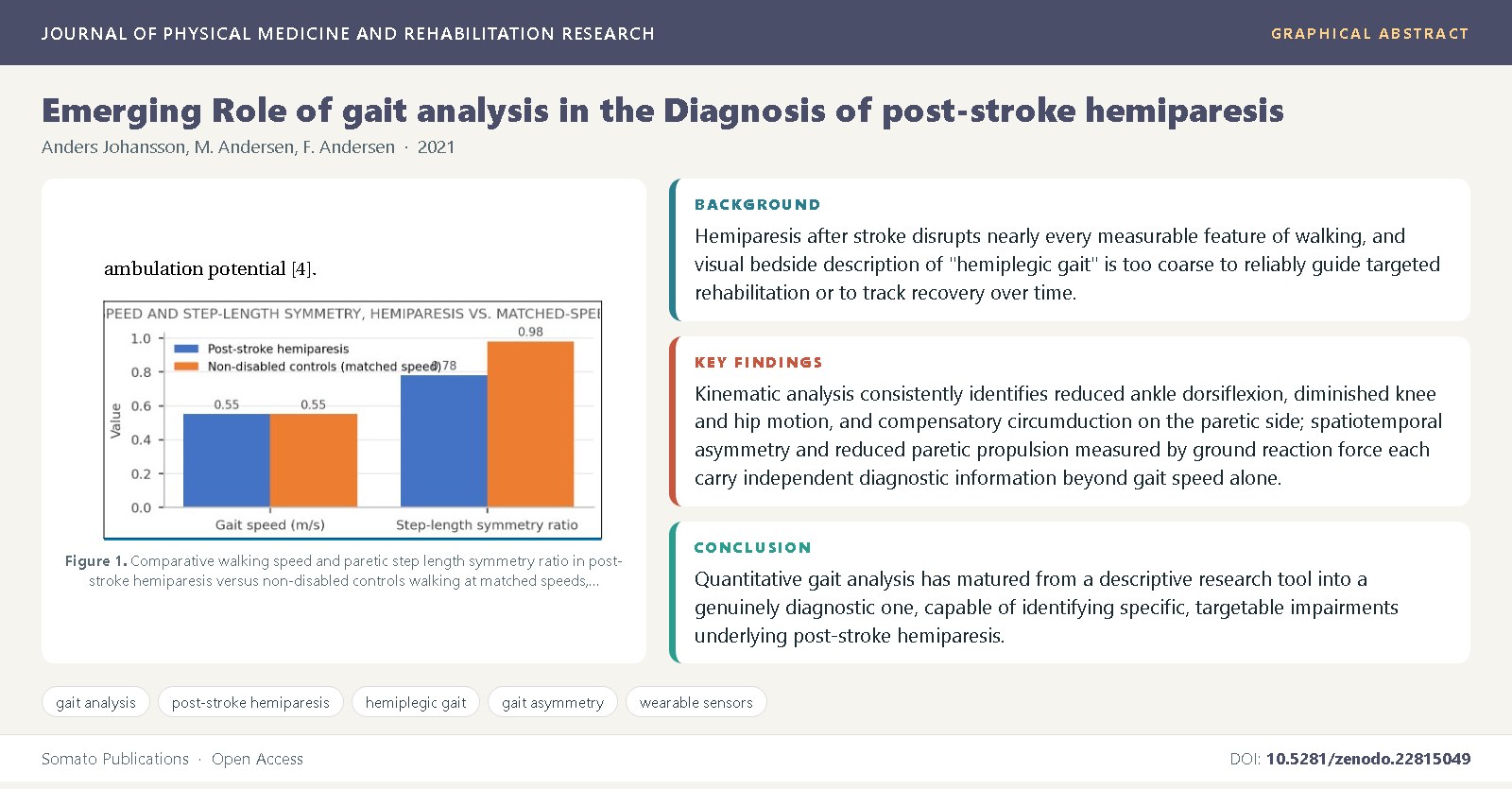
Background: Hemiparesis after stroke disrupts nearly every measurable feature of walking, and visual bedside description of "hemiplegic gait" is too coarse to reliably guide targeted rehabilitation or to track recovery over time.
Objective: This review synthesizes the published evidence on gait analysis as a diagnostic and classification tool in post-stroke hemiparesis, spanning kinematic, kinetic, electromyographic, spatiotemporal, and wearable sensor-based methods.
Methods: We reviewed laboratory-based motion capture and force-plate studies, electromyographic investigations, wearable and accelerometer-based monitoring studies, and cluster-analysis classification work addressing hemiparetic gait after stroke.
Findings: Kinematic analysis consistently identifies reduced ankle dorsiflexion, diminished knee and hip motion, and compensatory circumduction on the paretic side; spatiotemporal asymmetry and reduced paretic propulsion measured by ground reaction force each carry independent diagnostic information beyond gait speed alone; cluster-based classification of kinematic and kinetic data separates patients into clinically distinct subgroups; and wearable inertial sensors extend assessment from brief laboratory sessions into everyday community walking.
Conclusions: Quantitative gait analysis has matured from a descriptive research tool into a genuinely diagnostic one, capable of identifying specific, targetable impairments underlying post-stroke hemiparesis, and continued integration of wearable sensing with laboratory-derived classification schemes is likely to bring this capability into routine clinical use.
References
Perry, J., Garrett, M., Gronley, J.K., Mulroy, S.J. (1995) Classification of walking handicap in the stroke population. Stroke, 26(6): 982-989. DOI: 10.1161/01.STR.26.6.982
Kollen, B., Kwakkel, G., Lindeman, E. (2006) Longitudinal robustness of variables predicting independent gait following severe middle cerebral artery stroke: a prospective cohort study. Clinical Rehabilitation, 20(3): 262-268. DOI: 10.1191/0269215506cr937oa
Kwakkel, G., Kollen, B., Lindeman, E. (2004) Understanding the pattern of functional recovery after stroke: facts and theories. Restorative Neurology and Neuroscience, 22(3-5): 281-299.
Lord, S.E., McPherson, K., McNaughton, H.K., Rochester, L., Weatherall, M. (2004) Community ambulation after stroke: how important and obtainable is it and what measures appear predictive? Archives of Physical Medicine and Rehabilitation, 85(2): 234-239. DOI: 10.1016/j.apmr.2003.05.002
Wren, T.A.L., Gorton, G.E., Ounpuu, S., Tucker, C.A. (2011) Efficacy of clinical gait analysis: A systematic review. Gait & Posture, 34(2): 149-153. DOI: 10.1016/j.gaitpost.2011.03.027
Olney, S.J., Richards, C. (1996) Hemiplegic gait following stroke. Part I: Characteristics. Gait & Posture, 4(2): 136-148. DOI: 10.1016/0966-6362(96)82849-4
Chen, G., Patten, C., Kothari, D.H., Zajac, F.E. (2005) Gait differences between individuals with post-stroke hemiparesis and non-disabled controls at matched speeds. Gait & Posture, 22(1): 51-56. DOI: 10.1016/j.gaitpost.2004.06.009
Van Criekinge, T., Saeys, W., Hallemans, A., Velghe, S., Viskens, P.J., Vereeck, L., et al. (2017) Trunk biomechanics during hemiplegic gait after stroke: A systematic review. Gait & Posture, 54: 133-143. DOI: 10.1016/j.gaitpost.2017.03.004
Boudarham, J., Roche, N., Pradon, D., Bonnyaud, C., Bensmail, D., Zory, R. (2013) Variations in kinematics during clinical gait analysis in stroke patients with hemiplegia. PLoS ONE, 8(6): e66421. DOI: 10.1371/journal.pone.0066421
Olney, S.J., Griffin, M.P., McBride, I.D. (1994) Temporal, kinematic, and kinetic variables related to gait speed in subjects with hemiplegia: a regression approach. Physical Therapy, 74(9): 872-885. DOI: 10.1093/ptj/74.9.872
Hsu, A.L., Tang, P.F., Jan, M.H. (2003) Analysis of impairments influencing gait velocity and asymmetry of hemiplegic patients after mild to moderate stroke. Archives of Physical Medicine and Rehabilitation, 84(8): 1185-1193. DOI: 10.1016/S0003-9993(03)00030-3
Balasubramanian, C.K., Bowden, M.G., Neptune, R.R., Kautz, S.A. (2007) Relationship between step length asymmetry and walking performance in subjects with chronic hemiparesis. Archives of Physical Medicine and Rehabilitation, 88(1): 43-49. DOI: 10.1016/j.apmr.2006.10.004
Patterson, K.K., Parafianowicz, I., Danells, C.J., Closson, V., Verrier, M.C., Staines, W.R., et al. (2008) Gait asymmetry in community-ambulating stroke survivors. Archives of Physical Medicine and Rehabilitation, 89(2): 304-310. DOI: 10.1016/j.apmr.2007.08.142
Roerdink, M., Beek, P.J. (2011) Understanding inconsistent step-length asymmetries across hemiplegic stroke patients: impact of paretic leg vs. non-paretic leg swing. Neurorehabilitation and Neural Repair, 25(3): 253-258. DOI: 10.1177/1545968310380687
Wall, J.C., Turnbull, G.I. (1986) Gait asymmetries in residual hemiplegia. Archives of Physical Medicine and Rehabilitation, 67(8): 550-553.
Titianova, E.B., Tarkka, I.M. (1995) Asymmetry in walking performance and postural sway in patients with chronic unilateral cerebral infarction. Journal of Rehabilitation Research and Development, 32(3): 236-244.
Wonsetler, E.C., Bowden, M.G. (2017) A systematic review of mechanisms of gait speed change post-stroke. Part 1: Spatiotemporal parameters and asymmetry ratios. Topics in Stroke Rehabilitation, 24(6): 435-446. DOI: 10.1080/10749357.2017.1285746
Kim, C.M., Eng, J.J. (2003) Symmetry in vertical ground reaction force is accompanied by symmetry in temporal but not distance variables of gait in persons with stroke. Gait & Posture, 18(1): 23-28. DOI: 10.1016/S0966-6362(02)00122-4
Bowden, M.G., Balasubramanian, C.K., Neptune, R.R., Kautz, S.A. (2006) Anterior-posterior ground reaction forces as a measure of paretic leg contribution in hemiparetic walking. Stroke, 37(3): 872-876. DOI: 10.1161/01.STR.0000204063.75779.8d
Nadeau, S., Gravel, D., Arsenault, A.B., Bourbonnais, D. (1999) Plantarflexor weakness as a limiting factor of gait speed in stroke subjects and the compensating role of hip flexors. Clinical Biomechanics, 14(2): 125-135. DOI: 10.1016/S0268-0033(98)00062-X
den Otter, A.R., Geurts, A.C., Mulder, T., Duysens, J. (2004) Speed related changes in muscle activity from normal to very slow walking speeds. Gait & Posture, 19(3): 270-278. DOI: 10.1016/S0966-6362(03)00071-7
Chen, C.L., Chen, H.C., Tang, S.F., Wu, C.Y., Cheng, P.T., Hong, W.H. (2003) Gait performance with compensatory adaptations in stroke patients with different degrees of motor recovery. American Journal of Physical Medicine & Rehabilitation, 82(12): 925-935. DOI: 10.1097/01.PHM.0000098040.13355.B5
Buurke, J.H., Nene, A.V., Kwakkel, G., Erren-Wolters, V., Ijzerman, M.J., Hermens, H.J. (2008) Recovery of gait after stroke: what changes? Neurorehabilitation and Neural Repair, 22(6): 676-683. DOI: 10.1177/1545968308317972
Tao, W., Liu, T., Zheng, R., Feng, H. (2012) Gait analysis using wearable sensors. Sensors, 12(2): 2255-2283. DOI: 10.3390/s120202255
Mizuike, C., Ohgi, S., Morita, S. (2009) Analysis of stroke patient walking dynamics using a tri-axial accelerometer. Gait & Posture, 30(1): 60-64. DOI: 10.1016/j.gaitpost.2009.02.017
Muro-de-la-Herran, A., Garcia-Zapirain, B., Mendez-Zorrilla, A. (2014) Gait analysis methods: An overview of wearable and non-wearable systems, highlighting clinical applications. Sensors, 14(2): 3362-3394. DOI: 10.3390/s140203362
Prajapati, S.K., Gage, W.H., Brooks, D., Black, S.E., McIlroy, W.E. (2011) A novel approach to ambulatory monitoring: investigation into the quantity and control of everyday walking in patients with subacute stroke. Neurorehabilitation and Neural Repair, 25(1): 6-14. DOI: 10.1177/1545968310374189
Kesar, T.M., Binder-Macleod, S.A., Hicks, G.E., Reisman, D.S. (2011) Minimal detectable change for gait variables collected during treadmill walking in individuals post-stroke. Gait & Posture, 33(2): 314-317. DOI: 10.1016/j.gaitpost.2010.11.024
Mulroy, S., Gronley, J., Weiss, W., Newsam, C., Perry, J. (2003) Use of cluster analysis for gait pattern classification of patients in the early and late recovery phases following stroke. Gait & Posture, 18(1): 114-125. DOI: 10.1016/S0966-6362(02)00165-0
Flansbjer, U.B., Holmback, A.M., Downham, D., Patten, C., Lexell, J. (2005) Reliability of gait performance tests in men and women with hemiparesis after stroke. Journal of Rehabilitation Medicine, 37(2): 75-82. DOI: 10.1080/16501970410017215
Jonsdottir, J., Cattaneo, D. (2007) Reliability and validity of the dynamic gait index in persons with chronic stroke. Archives of Physical Medicine and Rehabilitation, 88(11): 1410-1415. DOI: 10.1016/j.apmr.2007.08.109
Peters, D.M., Fritz, S.L., Krotish, D.E. (2013) Assessing the reliability and validity of a shorter walk test compared with the 10-meter walk test for measurements of gait speed in healthy, older adults. Journal of Geriatric Physical Therapy, 36(1): 24-30. DOI: 10.1519/JPT.0b013e318248e20d
Tyson, S.F., Hanley, M., Chillala, J., Selley, A., Tallis, R.C. (2006) Balance disability after stroke. Physical Therapy, 86(1): 30-38. DOI: 10.1093/ptj/86.1.30
Cheng, P.T., Wu, S.H., Liaw, M.Y., Wong, A.M., Tang, F.T. (2001) Symmetrical body-weight distribution training in stroke patients and its effect on fall prevention. Archives of Physical Medicine and Rehabilitation, 82(12): 1650-1654. DOI: 10.1053/apmr.2001.26256
Richards, C.L., Malouin, F., Dean, C. (1999) Gait in stroke: assessment and rehabilitation. Clinics in Geriatric Medicine, 15(4): 833-855.

Published
Issue
Section
License
Copyright (c) 2021 Anders Johansson, et al.

This work is licensed under a Creative Commons Attribution 4.0 International License.


