
Predictors of return-to-activity rate in stroke survivors with spinal cord injury
DOI:
https://doi.org/10.5281/zenodo.22815032Keywords:
stroke, spinal cord injury, return to activity, rehabilitation outcomes, functional recoveryAbstract
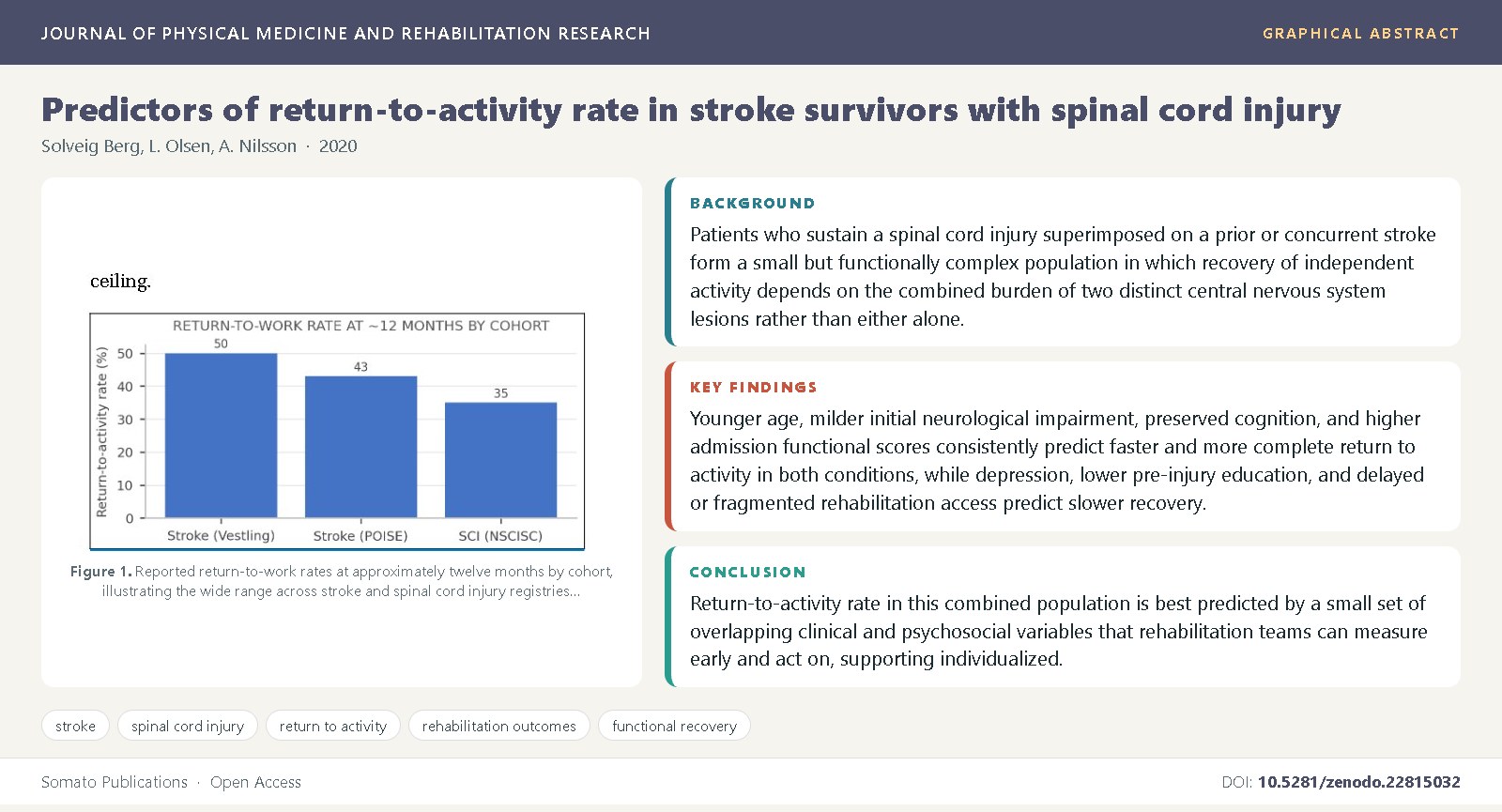
Background: Patients who sustain a spinal cord injury superimposed on a prior or concurrent stroke form a small but functionally complex population in which recovery of independent activity depends on the combined burden of two distinct central nervous system lesions rather than either alone [9,6].
Objective: This review synthesizes the published evidence on demographic, clinical, functional, and psychosocial predictors of return-to-activity rate in stroke survivors who also live with spinal cord injury, drawing on the separate but overlapping stroke and spinal cord injury outcomes literatures.
Methods: We synthesized cohort studies, registry analyses, and systematic reviews addressing return to work, community reintegration, and activities-of-daily-living recovery after stroke and after traumatic or non-traumatic spinal cord injury, focusing on predictors transferable to the combined-diagnosis population.
Findings: Younger age, milder initial neurological impairment, preserved cognition, and higher admission functional scores consistently predict faster and more complete return to activity in both conditions, while depression, lower pre-injury education, and delayed or fragmented rehabilitation access predict slower recovery [6,14,22].
Conclusions: Return-to-activity rate in this combined population is best predicted by a small set of overlapping clinical and psychosocial variables that rehabilitation teams can measure early and act on, supporting individualized, multidisciplinary planning rather than a single-diagnosis rehabilitation pathway.
References
Wolfe, C.D.A. (2000) The impact of stroke. British Medical Bulletin, 56(2): 275-286. DOI: 10.1258/0007142001903120
de Jong, G., Post, M.W., van Asbeck, F.W.A. (2013) Complications and associated factors after spinal cord injury: a cross-sectional study. Spinal Cord, 51(1): 60-64. DOI: 10.1038/sc.2012.116
Feigin, V.L., Stark, B.A., Johnson, C.O., Roth, G.A., Bisignano, C., Abady, G.G., et al. (2021) Global, regional, and national burden of stroke and its risk factors, 1990-2019. Lancet Neurology, 20(10): 795-820. DOI: 10.1016/S1474-4422(21)00252-0
DeVivo, M.J. (2012) Epidemiology of traumatic spinal cord injury: trends and future implications. Spinal Cord, 50(5): 365-372. DOI: 10.1038/sc.2011.178
National Spinal Cord Injury Statistical Center (2019) Spinal Cord Injury Facts and Figures at a Glance. Birmingham, AL: University of Alabama at Birmingham.
Kwakkel, G., Kollen, B. (2015) Predicting activities after stroke: what is clinically relevant? International Journal of Stroke, 8(1): 25-32. DOI: 10.1111/j.1747-4949.2012.00967.x
Anderson, C.S., Jamrozik, K.D., Burvill, P.W., Chakera, T.M., Johnson, G.A., Stewart-Wynne, E.G. (1991) Determinants of the length of stay in hospital and disability at discharge in patients with acute cerebral ischaemia and hemorrhage: a multivariate analysis. Cerebrovascular Diseases, 1(4): 200-207. DOI: 10.1159/000108840
Marino, R.J., Barros, T., Biering-Sorensen, F., Burns, S.P., Donovan, W.H., Graves, D.E., et al. (2003) International standards for neurological classification of spinal cord injury. Journal of Spinal Cord Medicine, 26(sup1): S50-S56. DOI: 10.1080/10790268.2003.11754575
Krause, J.S., Terza, J.V. (2006) Injury and demographic factors predictive of disability and life satisfaction after spinal cord injury. Archives of Physical Medicine and Rehabilitation, 87(11): 1503-1508. DOI: 10.1016/j.apmr.2006.08.339
Wozniak, M.A., Kittner, S.J. (1999) Return to work after ischemic stroke: a methodological review. Neuroepidemiology, 18(4): 159-166. DOI: 10.1159/000026207
Treger, I., Shames, J., Giaquinto, S., Ring, H. (2007) Return to work in stroke patients. Disability and Rehabilitation, 29(17): 1397-1403. DOI: 10.1080/09638280701314923
Vestling, M., Tufvesson, B., Iwarsson, S. (2003) Indicators for return to work after stroke and the importance of work for subjective well-being and life satisfaction. Journal of Rehabilitation Medicine, 35(3): 127-131. DOI: 10.1080/16501970310010475
Hackett, M.L., Glozier, N., Jan, S., Lindley, R. (2012) Returning to paid employment after stroke: the Psychosocial Outcomes In StrokE (POISE) cohort study. PLoS ONE, 7(7): e41795. DOI: 10.1371/journal.pone.0041795
Krause, J.S., Saunders, L.L. (2009) Risk of hospitalizations after spinal cord injury: relationship with biographical, injury, education, and employment characteristics. Spinal Cord, 47(9): 692-697. DOI: 10.1038/sc.2009.13
Ottomanelli, L., Lind, L. (2010) Review of critical factors related to employment after spinal cord injury: implications for research and vocational services. Journal of Spinal Cord Medicine, 33(5): 503-531. DOI: 10.1080/10790268.2010.11689738
Kirshblum, S., Waring, W. III (2014) Updates for the International Standards for Neurological Classification of Spinal Cord Injury. Physical Medicine and Rehabilitation Clinics of North America, 25(3): 505-517. DOI: 10.1016/j.pmr.2014.04.001
van Middendorp, J.J., Hosman, A.J., Donders, A.R.T., Pouw, M.H., Ditunno, J.F., Curt, A., et al. (2011) A clinical prediction rule for ambulation outcomes after traumatic spinal cord injury: a longitudinal cohort study. Lancet, 377(9770): 1004-1010. DOI: 10.1016/S0140-6736(10)62276-3
Whiteneck, G.G., Charlifue, S.W., Gerhart, K.A., Overholser, J.D., Richardson, G.N. (1992) Quantifying handicap: a new measure of long-term rehabilitation outcomes. Archives of Physical Medicine and Rehabilitation, 73(6): 519-526.
Dijkers, M.P. (1997) Quality of life after spinal cord injury: a meta analysis of the effects of disablement components. Spinal Cord, 35(12): 829-840. DOI: 10.1038/sj.sc.3100571
Kapoor, A., Lanctot, K.L., Bayley, M., Kiss, A., Herrmann, N., Murray, B.J., et al. (2017) Screening for post-stroke depression and cognitive impairment at baseline predicts long-term patient-centered outcomes after stroke. Journal of Geriatric Psychiatry and Neurology, 30(3): 155-161. DOI: 10.1177/0891988717700509
Meyer, S., De Bruyn, N., Krumlinde-Sundholm, L., Peeters, A., Feys, H., Thijs, V., et al. (2015) Associations between sensorimotor impairments in the upper limb at 1 week and 6 months after stroke. Journal of Neurologic Physical Therapy, 40(3): 186-195.
Craig, A., Tran, Y., Middleton, J. (2015) Psychological morbidity and spinal cord injury: a systematic review. Spinal Cord, 53(4): 259-263. DOI: 10.1038/sc.2014.222
Post, M.W.M., van Leeuwen, C.M.C. (2012) Psychosocial issues in spinal cord injury: a review. Spinal Cord, 50(5): 382-389. DOI: 10.1038/sc.2011.182
van Velzen, J.M., de Groot, S., Post, M.W., Slootman, H.J., van Bennekom, C.A. (2009) Return to work after spinal cord injury: is it related to wheelchair capacity at discharge from clinical rehabilitation? American Journal of Physical Medicine and Rehabilitation, 88(1): 47-56. DOI: 10.1097/PHM.0b013e31818f16dc
Duncan, P.W., Zorowitz, R., Bates, B., Choi, J.Y., Glasberg, J.J., Graham, G.D., et al. (2005) Management of adult stroke rehabilitation care: a clinical practice guideline. Stroke, 36(9): e100-e143. DOI: 10.1161/01.STR.0000180861.54180.FF
Legg, L., Drummond, A., Langhorne, P. (2006) Occupational therapy for patients with problems in activities of daily living after stroke. Cochrane Database of Systematic Reviews, 4: CD003585. DOI: 10.1002/14651858.CD003585.pub2
Saunders, D.H., Sanderson, M., Hayes, S., Johnson, L., Kramer, S., Carter, D.D., et al. (2020) Physical fitness training for stroke patients. Cochrane Database of Systematic Reviews, 3: CD003316. DOI: 10.1002/14651858.CD003316.pub7
Franceschini, M., Di Clemente, B., Rampello, A., Nora, M., Spizzichino, L. (2014) Longitudinal outcome 6 years after spinal cord injury. Spinal Cord, 52(1): 35-38. DOI: 10.1038/sc.2013.132
Middleton, J.W., Truman, G., Geraghty, T.J. (2004) Neurological level effect on the discharge outcome of patients with acute spinal cord injury. Archives of Physical Medicine and Rehabilitation, 79(11): 1428-1432.
Cieza, A., Geyh, S., Chatterji, S., Kostanjsek, N., Ustun, B., Stucki, G. (2004) ICF Core Sets for stroke. Journal of Rehabilitation Medicine, 36(44 Suppl): 135-141. DOI: 10.1080/16501960410016776
Bushnik, T., Englander, J., Wright, J. (2004) Patterns of return to work after traumatic brain injury: a longitudinal analysis of the return-to-work trajectory. Journal of Head Trauma Rehabilitation, 19(1): 33-44.
Radomski, M.V., Anheluk, M., Bartzen, M.P., Zola, J. (2016) Effectiveness of interventions to address cognitive impairments and improve occupational performance after traumatic brain injury: a systematic review. American Journal of Occupational Therapy, 70(3): 7003390010.
Lindsay, M.P., Norrving, B., Sacco, R.L., Brainin, M., Hacke, W., Martins, S., et al. (2014) World Stroke Organization (WSO): global stroke services guidelines and action plan. International Journal of Stroke, 9(Suppl A100): 4-13. DOI: 10.1111/ijs.12371

Published
Issue
Section
License
Copyright (c) 2020 Solveig Berg, et al.

This work is licensed under a Creative Commons Attribution 4.0 International License.


