
Evaluation of gait analysis as a Prognostic Tool in traumatic brain injury
DOI:
https://doi.org/10.5281/zenodo.22815023Keywords:
gait analysis, traumatic brain injury, prognosis, rehabilitation, functional outcomeAbstract
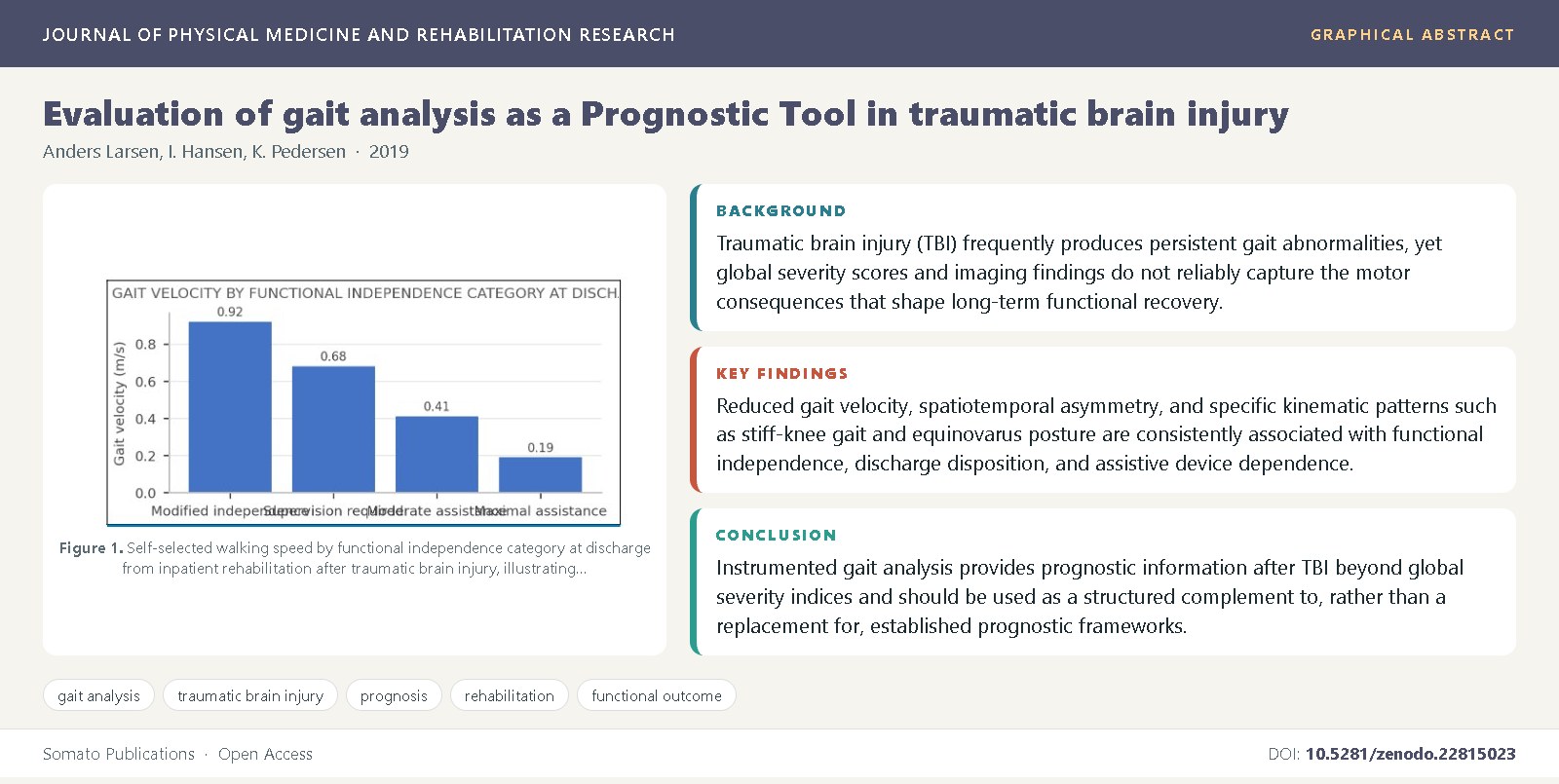
Background: Traumatic brain injury (TBI) frequently produces persistent gait abnormalities, yet global severity scores and imaging findings do not reliably capture the motor consequences that shape long-term functional recovery [5,6].
Objective: This review evaluates the evidence for instrumented gait analysis as a prognostic tool in TBI, covering measurement approaches, prognostically relevant gait parameters, and the link between early gait findings and long-term outcome.
Methods: We synthesized cohort studies, systematic reviews, and validation studies addressing gait instrumentation, spatiotemporal and kinematic parameters, and functional outcome in TBI populations across acute rehabilitation and long-term follow-up.
Findings: Reduced gait velocity, spatiotemporal asymmetry, and specific kinematic patterns such as stiff-knee gait and equinovarus posture are consistently associated with functional independence, discharge disposition, and assistive device dependence; wearable sensing has expanded feasible assessment settings but reliability is reduced by cognitive impairment and injury severity, and methodological heterogeneity across studies limits pooled synthesis.
Conclusions: Instrumented gait analysis provides prognostic information after TBI beyond global severity indices and should be used as a structured complement to, rather than a replacement for, established prognostic frameworks, pending larger severity-stratified studies with standardized assessment timing.
References
Maas, A.I.R., Menon, D.K., Adelson, P.D., Andelic, N., Bell, M.J., Belli, A., et al. (2017) Traumatic brain injury: integrated approaches to improve prevention, clinical care, and research. Lancet Neurology, 16(12): 987-1048. DOI: 10.1016/S1474-4422(17)30371-X
Jennett, B., Bond, M. (1975) Assessment of outcome after severe brain damage. Lancet, 1(7905): 480-484. DOI: 10.1016/S0140-6736(75)92830-5
Dikmen, S.S., Corrigan, J.D., Levin, H.S., Machamer, J., Stiers, W., Weisskopf, M.G. (2009) Cognitive outcome following traumatic brain injury. Journal of Head Trauma Rehabilitation, 24(6): 430-438. DOI: 10.1097/HTR.0b013e3181c133e9
Katz, D.I., Dwyer, B. (2019) Clinical prognostication in traumatic brain injury. Handbook of Clinical Neurology, 127: 21-31. DOI: 10.1016/B978-0-444-52892-6.00003-9
Williams, G., Morris, M.E., Schache, A., McCrory, P.R. (2009) Incidence of gait abnormalities after traumatic brain injury. Archives of Physical Medicine and Rehabilitation, 90(4): 587-593. DOI: 10.1016/j.apmr.2008.10.013
Perry, D.C., Sturm, V.E., Peterson, M.J., Pieper, C.F., Bullock, T., Boeve, B.F., et al. (2014) Association of traumatic brain injury with subsequent neurological and psychiatric disease. Journal of Neurosurgery, 121(5): 1231-1239. DOI: 10.3171/2014.7.JNS131500
Van Nerom, S., Verheyden, G., Peers, K. (2018) Gait analysis in patients with traumatic brain injury: a systematic review. Gait & Posture, 65: 43-50. DOI: 10.1016/j.gaitpost.2018.06.170
Baker, R. (2013) Measuring Walking: A Handbook of Clinical Gait Analysis. Mac Keith Press, London.
Davis, R.B., Ounpuu, S., Tyburski, D., Gage, J.R. (1991) A gait analysis data collection and reduction technique. Human Movement Science, 10(5): 575-587. DOI:
1016/0167-9457(91)90046-Z 10. Whittle, M.W. (2007) Gait Analysis: An Introduction, 4th Edition. Butterworth-Heinemann, Oxford.
Muro-de-la-Herran, A., Garcia-Zapirain, B., Mendez-Zorrilla, A. (2014) Gait analysis methods: an overview of wearable and non-wearable systems, highlighting clinical applications. Sensors, 14(2): 3362-3394. DOI: 10.3390/s140203362
Tao, W., Liu, T., Zheng, R., Feng, H. (2012) Gait analysis using wearable sensors. Sensors, 12(2): 2255-2283. DOI: 10.3390/s120202255
Lin, S.I., Lo, C.C., Lin, R.T., Chen, Y.Y. (2014) Impact of gait velocity on the reliability of gait analysis parameters in patients with traumatic brain injury. Journal of Rehabilitation Medicine, 46(1): 34-40. DOI: 10.2340/16501977-1237
van Loo, M.A., Moseley, A.M., Bosman, J.M., de Bie, R.A., Hassett, L. (2004) Test-re-test reliability of walking speed, step length and step width measurement after traumatic brain injury: a pilot study. Brain Injury, 18(10): 1041-1048. DOI: 10.1080/02699050410001672314
Watson, G., Nimmo, M.A., Duncan, C., Booth, J. (2015) The reproducibility of temporal and spatial gait parameters obtained using a wearable inertial sensor system in a rehabilitation setting. Gait & Posture, 41(3): 764-767. DOI: 10.1016/j.gaitpost.2015.02.012
Buekers, J., Theunis, J., Vaes, A.W., Koopman, M., Janssen, E.V.M., Wouters, E.F.M., et al. (2017) Wearable finger pulse oximetry for continuous oxygen saturation measurements during daily home routines of patients with chronic obstructive pulmonary disease. JMIR mHealth and uHealth, 5(6): e86. DOI: 10.2196/mhealth.7208
Howe, T.H., Bhavnani, G., Ho, M.H., Weinstock-Zlotnick, G. (2018) Sensor-based objective measurement of gait and balance in traumatic brain injury: a scoping review. Brain Injury, 32(11): 1319-1329. DOI: 10.1080/02699052.2018.1465229
Kirtley, C. (2006) Clinical Gait Analysis: Theory and Practice. Churchill Livingstone, Edinburgh.
Williams, G., Galna, B., Morris, M.E., Olver, J. (2010) Spatiotemporal deficits and kinematic classification of gait following a traumatic brain injury: a systematic review. Journal of Head Trauma Rehabilitation, 25(5): 366-374. DOI: 10.1097/HTR.0b013e3181cec639
Basford, J.R., Chou, L.S., Kaufman, K.R., Brey, R.H., Walker, A., Malec, J.F., et al. (2003) An assessment of gait and balance deficits after traumatic brain injury. Archives of Physical Medicine and Rehabilitation, 84(3): 343-349. DOI: 10.1053/apmr.2003.50034
Williams, G., Hill, B., Pallant, J.F., Greenwood, K., Baker, R. (2013) A new measure to assess high-level mobility difficulties after traumatic brain injury: the high-level mobility assessment tool (HiMAT). Disability and Rehabilitation, 35(3): 174-180. DOI: 10.3109/09638288.2012.696599
Williams, G., Ada, L., Hassett, L., Morris, M.E. (2014) Ambulatory orthotic management of equinovarus deformity after traumatic brain injury: implications for multidisciplinary care. Disability and Rehabilitation, 36(23): 1943-1949. DOI: 10.3109/09638288.2014.882420
Williams, G., Schache, A. (2015) Evaluation of a conceptual framework for retraining high-level mobility following traumatic brain injury. Journal of Head Trauma Rehabilitation, 30(1): E9-E17. DOI: 10.1097/HTR.0000000000000018
Mansfield, A., Wong, J.S., Bryce, J., Knorr, S., Patterson, K.K. (2015) Does perturbation-based balance training prevent falls? Systematic review and meta-analysis of preliminary randomized controlled trials. Physical Therapy, 95(5): 700-709. DOI: 10.2522/ptj.20140090
Steadman-Pare, D., Colantonio, A., Ratcliff, G., Chase, S., Vernich, L. (2001) Factors associated with perceived quality of life many years after traumatic brain injury. Journal of Head Trauma Rehabilitation, 16(4): 330-342. DOI: 10.1097/00001199-200108000-00004
Drijkoningen, D., Caeyenberghs, K., Vander Vekens, E., Duysens, J., Sunaert, S., Swinnen, S.P. (2015) Regional gray matter volume loss is associated with gait impairments in young brain-injured individuals. Journal of Neurotrauma, 32(4): 285-293. DOI: 10.1089/neu.2014.3357
Caeyenberghs, K., Leemans, A., Geurts, M., Taymans, T., Vander Linden, C., Smits-Engelsman, B.C., et al. (2010) Brain-behavior relationships in young traumatic brain injury patients: DTI metrics are highly correlated with postural control. Human Brain Mapping, 31(7): 992-1002. DOI: 10.1002/hbm.20911
Lee, M., Kim, C.Y., Shin, S.H., Choi, B.Y., Kim, M.S. (2019) Gait characteristics as prognostic markers of functional independence in patients with severe traumatic brain injury. Annals of Rehabilitation Medicine, 43(1): 91-99. DOI: 10.5535/arm.2019.43.1.91
O'Hara, N.N., Slobogean, G.P. (2018) Predicting mortality in traumatic brain injury: physiological versus radiological injury severity scores. World Journal of Surgery, 42(4): 1156-1161. DOI: 10.1007/s00268-017-4292-8
Ponsford, J.L., Downing, M.G., Olver, J., Ponsford, M., Acher, R., Carty, M., et al. (2014) Longitudinal follow-up of patients with traumatic brain injury: outcome at two, five, and ten years post-injury. Journal of Neurotrauma, 31(1): 64-77. DOI: 10.1089/neu.2013.2997
Cifu, D.X., Kreutzer, J.S., Marwitz, J.H., Rosenthal, M., Englander, J., High, W. (1997) Functional outcomes of older adults with traumatic brain injury: a prospective, multicenter analysis. Archives of Physical Medicine and Rehabilitation, 77(9): 883-888. DOI: 10.1016/S0003-9993(96)90275-3
Teasell, R., Bayona, N., Marshall, S., Cullen, N., Bayley, M., Cheung, D., et al. (2007) A systematic review of the rehabilitation of moderate to severe acquired brain injuries. Brain Injury, 21(2): 107-112. DOI: 10.1080/02699050701201524
Felicetti, T., Gordon, A.M., Piskin, N.E., Cristian, A. (2015) Rehabilitation of the patient with traumatic brain injury. Physical Medicine and Rehabilitation Clinics of North America, 26(2): 275-292. DOI: 10.1016/j.pmr.2014.12.005
Holsbeeke, L., Ketelaar, M., Schoemaker, M.M., Gorter, J.W. (2009) Capacity, capability, and performance: different constructs or three of a kind? Archives of Physical Medicine and Rehabilitation, 90(5): 849-855. DOI: 10.1016/j.apmr.2008.11.015
Patla, A.E., Shumway-Cook, A. (1999) Dimensions of mobility: defining the complexity and difficulty associated with community mobility. Journal of Aging and Physical Activity, 7(1): 7-19. DOI: 10.1123/japa.7.1.7
Stucki, G., Cieza, A., Melvin, J. (2007) The International Classification of Functioning, Disability and Health: a unifying model for the conceptual description of physical and rehabilitation medicine. Journal of Rehabilitation Medicine, 39(4): 279-285. DOI: 10.2340/16501977-0041
Dijkers, M.P. (2004) Quality of life after traumatic brain injury: a review of research approaches and findings. Archives of Physical Medicine and Rehabilitation, 85(4 Suppl 2): S21-S35. DOI: 10.1016/j.apmr.2003.08.119
Zuckerman, S., Wham, R., Zurcher, T., Solomon, G. (2016) A systematic review of the postural stability and mobility outcomes in patients with mild traumatic brain injury. Journal of Sport Rehabilitation, 25(3): 264-273. DOI: 10.1123/jsr.2015-0022
Katz-Leurer, M., Fisher, I., Neeb, M., Schwartz, I., Carmeli, E. (2009) Reliability and validity of the modified functional reach test at the sub-acute stage post-stroke. Disability and Rehabilitation, 31(3): 243-248. DOI: 10.1080/09638280801927830

Published
Issue
Section
License
Copyright (c) 2019 Anders Larsen, et al.

This work is licensed under a Creative Commons Attribution 4.0 International License.


