
Treatment of lower limb movement disorder in complete paraplegia caused by spinal cord injury with spinal neuromodulation: A case report
Keywords:
Traumatic complete paraplegia, Lower extremities, Spinal cord injury, Spinal neuromodulationAbstract
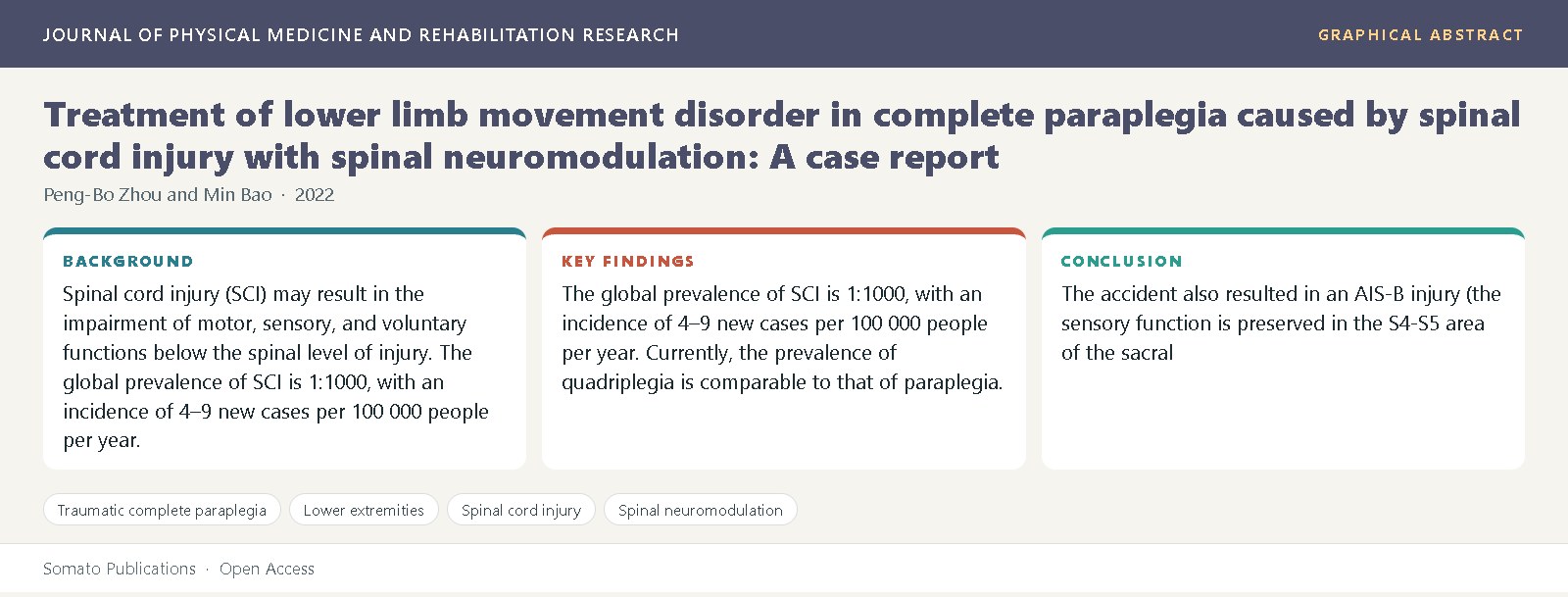
Spinal cord injury (SCI) may result in the impairment of motor, sensory, and voluntary functions below the spinal level of injury.
The global prevalence of SCI is 1:1000, with an incidence of 4–9 new cases per 100 000 people per year. The most common causes
of traumatic SCI are traffic accidents, falls, and acts of violence. Currently, the prevalence of quadriplegia is comparable to that of
paraplegia [1]. To the best of our knowledge, this case report highlights the use of spinal cord stimulation for the first time to treat
traumatic complete paraplegia of the lower extremities, with substantial efficacy. We present the case of a 38-year-old Asian male,
a truck driver by profession. He had suffered a complete loss of motor and sensory functions in both lower extremities in a traffic accident 3 years ago. The accident also resulted in an AIS-B injury (the sensory function is preserved in the S4-S5 area of the sacral
References
Rupp, R. (2020) Spinal cord lesions. Handb Clin Neurol, 168:51–65.
van den Brand, R., Heutschi, J., Barraud, Q., DiGiovanna, J., Bartholdi, K., Huerlimann, M,, et al. (2012) Restoring voluntary control of locomotion after paralyzing spinal cord injury. Science, 336:1182–1185.
Asboth, L., Friedli, L., Beauparlant, J., Martinez-Gonzalez, C., Anil, S., Rey, E., et al. (2018) Cortico-reticulo-spinal circuit reorganization enables functional recovery after severe spinal cord contusion. Nat Neurosci, 21:576–588.
Rowald, A., Komi, S., Demesmaeker, R., Baaklini, E., Hernandez-Charpak, SD., Paoles, E., et al. (2022) Activity-dependent spinal cord neuromodulation rapidly restores trunk and leg motor functions after complete paraplegia. Nat Med, 28:260–271.




