
Prevalence and Risk Factors of neonatal jaundice in low-birth-weight infants
DOI:
https://doi.org/10.5281/zenodo.22814756Keywords:
neonatal jaundice, low birth weight, hyperbilirubinemia, preterm infants, risk factorsAbstract
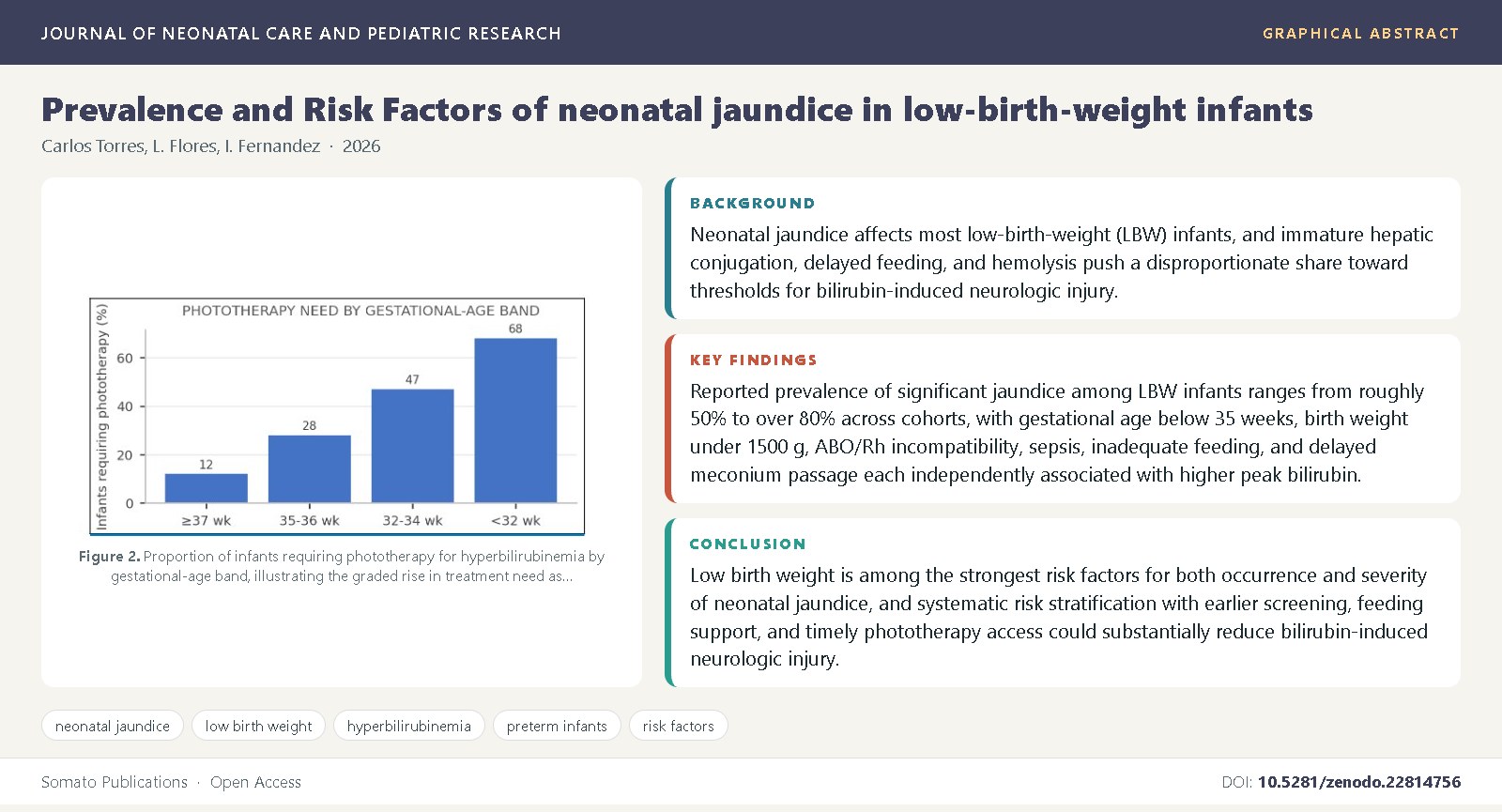
Background: Neonatal jaundice affects most low-birth-weight (LBW) infants, and immature hepatic conjugation, delayed feeding, and hemolysis push a disproportionate share toward thresholds for bilirubin-induced neurologic injury.
Objective: This review synthesizes evidence on the prevalence of neonatal jaundice among LBW and preterm infants and the risk factors most consistently linked to severe or prolonged hyperbilirubinemia.
Methods: We synthesized observational cohorts, hospital-based prevalence surveys, and systematic reviews addressing bilirubin kinetics, phototherapy thresholds, risk-factor stratification, and kernicterus outcomes in LBW and preterm neonates.
Findings: Reported prevalence of significant jaundice among LBW infants ranges from roughly 50% to over 80% across cohorts, with gestational age below 35 weeks, birth weight under 1500 g, ABO/Rh incompatibility, sepsis, inadequate feeding, and delayed meconium passage each independently associated with higher peak bilirubin and greater treatment need; low- and middle-income settings show disproportionately higher rates of severe hyperbilirubinemia and encephalopathy.
Conclusions: Low birth weight is among the strongest risk factors for both occurrence and severity of neonatal jaundice, and systematic risk stratification with earlier screening, feeding support, and timely phototherapy access could substantially reduce bilirubin-induced neurologic injury.
References
Maisels, M.J., Bhutani, V.K., Bogen, D., Newman, T.B., Stark, A.R., Watchko, J.F. (2009) Hyperbilirubinemia in the newborn infant >/=35 weeks' gestation: an update with clarifications. Pediatrics, 124(4): 1193-1198. DOI: 10.1542/peds.2009-0329
Bhutani, V.K., Johnson, L., Sivieri, E.M. (1999) Predischarge screening for severe neonatal hyperbilirubinemia identifies infants who need photherapy. Pediatrics, 103(1): 6-14. DOI: 10.1542/peds.103.1.6
Watchko, J.F., Tiribelli, C. (2013) Bilirubin-induced neurologic damage--mechanisms and management approaches. New England Journal of Medicine, 369(21): 2021-2030. DOI: 10.1056/NEJMra1308124
Shapiro, S.M. (2005) Definition of the clinical spectrum of kernicterus and bilirubin-induced neurologic dysfunction (BIND). Journal of Perinatology, 25(1): 54-59. DOI: 10.1038/sj.jp.7211157
Bhutani, V.K., Johnson, L.H., Keren, R. (2004) Diagnosis and management of hyperbilirubinemia in the term neonate: for a safer first week. Pediatric Clinics of North America, 51(4): 843-861. DOI: 10.1016/j.pcl.2004.03.011
Amin, S.B. (2011) Clinical assessment of bilirubin-induced neurotoxicity in premature infants. Seminars in Perinatology, 35(3): 135-141. DOI: 10.1053/j.semperi.2011.02.007
Wusthoff, C.J., Loe, I.M. (2015) Impact of bilirubin-induced neurologic dysfunction on neurodevelopmental outcomes. Seminars in Fetal and Neonatal Medicine, 20(1): 52-57. DOI: 10.1016/j.siny.2014.12.003
Dennery, P.A., Seidman, D.S., Stevenson, D.K. (2001) Neonatal hyperbilirubinemia. New England Journal of Medicine, 344(8): 581-590. DOI: 10.1056/NEJM200102223440807
Blencowe, H., Cousens, S., Oestergaard, M.Z., Chou, D., Moller, A.B., Narwal, R., et al. (2012) National, regional, and worldwide estimates of preterm birth rates in the year 2010 with time trends since 1990 for selected countries. Lancet, 379(9832): 2162-2172. DOI: 10.1016/S0140-6736(12)60820-4
Kaplan, M., Wong, R.J., Sibley, E., Stevenson, D.K. (2011) Neonatal jaundice and disorders of bilirubin metabolism. In: Christensen, R.D., Fanaroff and Martin's Neonatal-Perinatal Medicine, 9th ed. Elsevier, Philadelphia.
Gartner, L.M. (2001) Breastfeeding and jaundice. Journal of Perinatology, 21(Suppl 1): S25-S29. DOI: 10.1038/sj.jp.7210629
Ahlfors, C.E. (2001) Predicting bilirubin neurotoxicity in jaundiced newborns: Free bilirubin versus bilirubin-albumin binding. Current Opinion in Pediatrics, 13(2): 129-133. DOI: 10.1097/00008480-200104000-00006
Iskander, I., Gamaleldin, R., El Houchi, S., El Shenawy, A., Seoud, I., El Gharbawi, N., et al. (2014) Serum bilirubin and bilirubin/albumin ratio as predictors of bilirubin encephalopathy. Pediatrics, 134(5): e1330-e1339. DOI: 10.1542/peds.2013-1764
Hansen, T.W.R. (2011) Pathophysiology of kernicterus. Seminars in Fetal and Neonatal Medicine, 15(3): 174-179.
Olusanya, B.O., Ogunlesi, T.A., Slusher, T.M. (2015) Why is kernicterus still a major cause of death and disability in low-income and middle-income countries? Archives of Disease in Childhood, 99(12): 1117-1121. DOI: 10.1136/archdischild-2013-305506
Rasul, C.H., Hasan, M.A., Yasmin, F. (2010) Outcome of neonatal hyperbilirubinemia in a tertiary care hospital in Bangladesh. Malaysian Journal of Medical Sciences, 17(2): 40-44.
Mitra, S., Rennie, J. (2017) Neonatal jaundice: aetiology, diagnosis and treatment. British Journal of Hospital Medicine, 78(12): 699-704. DOI: 10.12968/hmed.2017.78.12.699
Ogunlesi, T.A., Dedeke, I.O., Adekanmbi, A.F., Fetuga, M.B., Ogunfowora, O.B. (2007) The incidence and outcome of bilirubin encephalopathy in Nigeria: a bi-centre study. Nigerian Journal of Medicine, 16(4): 354-359. DOI: 10.4314/njm.v16i4.37337
Slusher, T.M., Zamora, T.G., Appiah, D., Stanke, J.U., Strand, M.A., Lee, B.W., et al. (2017) Burden of severe neonatal jaundice: a systematic review and meta-analysis. BMJ Paediatrics Open, 1(1): e000105. DOI: 10.1136/bmjpo-2017-000105
Sgro, M., Campbell, D., Shah, V. (2006) Incidence and causes of severe neonatal hyperbilirubinemia in Canada. Canadian Medical Association Journal, 175(6): 587-590. DOI: 10.1503/cmaj.060328
Kaplan, M., Muraca, M., Vreman, H.J., Hammerman, C., Vilei, M.T., Rubaltelli, F.F., et al. (2002) Imbalance between production and conjugation of bilirubin: a fundamental concept in the mechanism of neonatal jaundice. Pediatrics, 110(4): e47.
Newman, T.B., Xiong, B., Gonzales, V.M., Escobar, G.J. (2000) Prediction and prevention of extreme neonatal hyperbilirubinemia in a mature health maintenance organization. Archives of Pediatrics and Adolescent Medicine, 154(11): 1140-1147. DOI: 10.1001/archpedi.154.11.1140
Keren, R., Luan, X., Friedman, S., Saddlemire, S., Cnaan, A., Bhutani, V.K. (2008) A comparison of alternative risk-assessment strategies for predicting significant neonatal hyperbilirubinemia in term and near-term infants. Pediatrics, 121(1): e170-e179. DOI: 10.1542/peds.2006-3499
Kaplan, M., Hammerman, C. (2004) Glucose-6-phosphate dehydrogenase deficiency: a hidden risk for kernicterus. Seminars in Perinatology, 28(5): 356-364. DOI: 10.1053/j.semperi.2004.09.001
Christensen, R.D., Yaish, H.M. (2013) Hemolytic disorders causing severe neonatal hyperbilirubinemia. Clinics in Perinatology, 42(3): 515-527. DOI: 10.1016/j.clp.2015.04.007
Olusanya, B.O., Kaplan, M., Hansen, T.W.R. (2018) Neonatal hyperbilirubinaemia: a global perspective. Lancet Child and Adolescent Health, 2(8): 610-620. DOI: 10.1016/S2352-4642(18)30139-1
Kuzniewicz, M.W., Wickremasinghe, A.C., Wu, Y.W., McCulloch, C.E., Walsh, E.M., Wi, S., et al. (2014) Incidence, etiology, and outcomes of hazardous hyperbilirubinemia in newborns. Pediatrics, 134(3): 504-509. DOI: 10.1542/peds.2014-0987
World Health Organization (2013) Pocket Book of Hospital Care for Children: Guidelines for the Management of Common Childhood Illnesses, 2nd ed. WHO, Geneva.
Ip, S., Chung, M., Kulig, J., O'Brien, R., Sege, R., Glicken, S., et al. (2004) An evidence-based review of important issues concerning neonatal hyperbilirubinemia. Pediatrics, 114(1): e130-e153. DOI: 10.1542/peds.114.1.e130
Rennie, J., Burman-Roy, S., Murphy, M.S. (2016) Neonatal jaundice: summary of NICE guidance. BMJ, 340: c2409. DOI: 10.1136/bmj.c2409

Published
Issue
Section
License
Copyright (c) 2026 Carlos Torres, et al.

This work is licensed under a Creative Commons Attribution 4.0 International License.


