
Comparative Analysis of early surfactant administration versus Standard Care in neonatal sepsis
DOI:
https://doi.org/10.5281/zenodo.22814803Keywords:
neonatal sepsis, pulmonary surfactant, respiratory distress, surfactant inactivation, mechanical ventilationAbstract
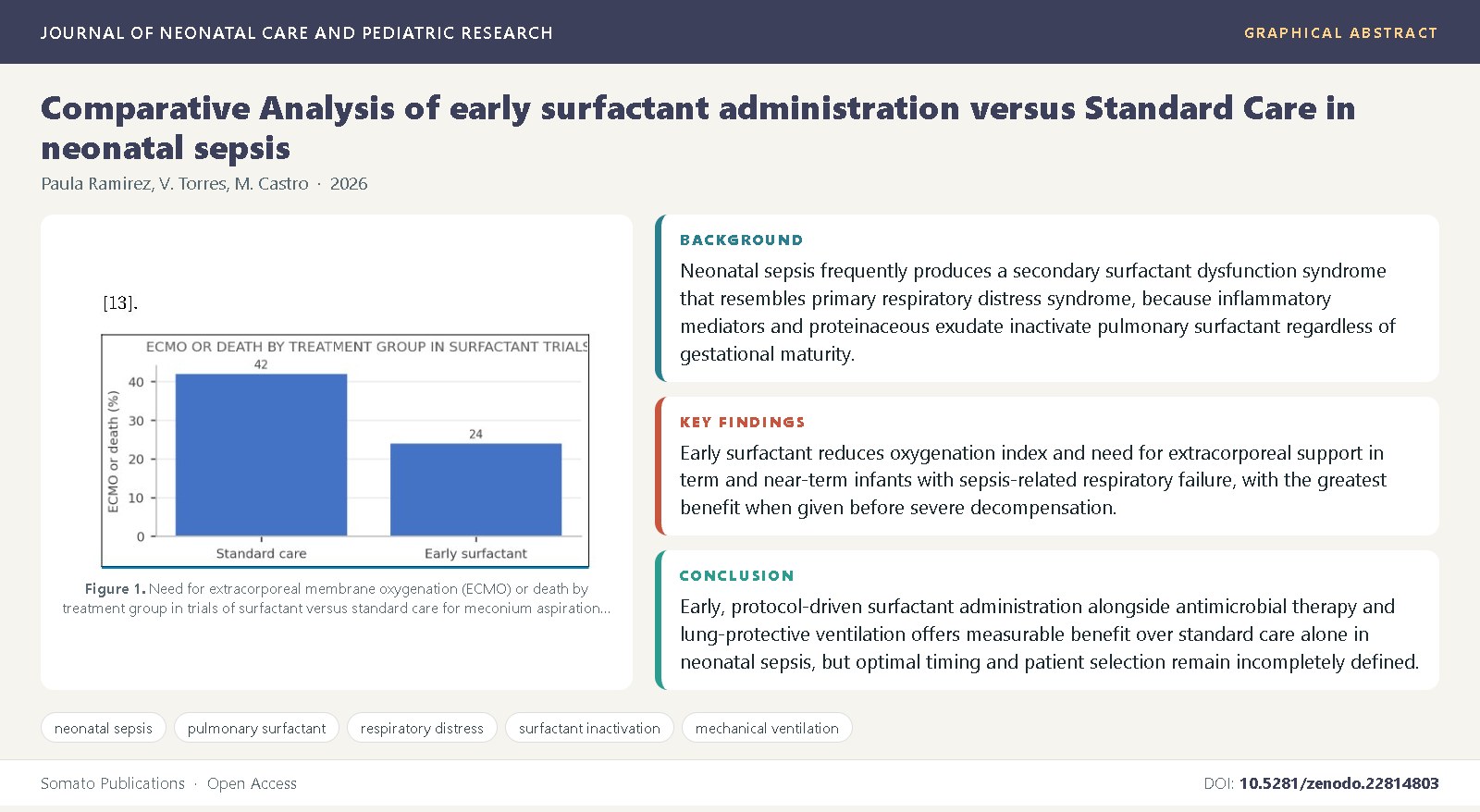
Background: Neonatal sepsis frequently produces a secondary surfactant dysfunction syndrome that resembles primary respiratory distress syndrome, because inflammatory mediators and proteinaceous exudate inactivate pulmonary surfactant regardless of gestational maturity.
Objective: This review synthesizes evidence comparing early exogenous surfactant administration with standard supportive care alone in neonates with sepsis-associated respiratory failure.
Methods: We synthesized randomized trials, multicenter cohorts, and Cochrane reviews addressing surfactant timing, delivery technique, and respiratory outcomes in septic and infection-associated neonatal respiratory failure.
Findings: Early surfactant reduces oxygenation index and need for extracorporeal support in term and near-term infants with sepsis-related respiratory failure, with the greatest benefit when given before severe decompensation; less invasive delivery extends this advantage to spontaneously breathing preterm infants, though surfactant inactivation by serum proteins blunts the response compared with primary respiratory distress syndrome.
Conclusions: Early, protocol-driven surfactant administration alongside antimicrobial therapy and lung-protective ventilation offers measurable benefit over standard care alone in neonatal sepsis, but optimal timing and patient selection remain incompletely defined.
References
Gregory, G.A., Kitterman, J.A., Phibbs, R.H., Tooley, W.H., Hamilton, W.K. (1971) Treatment of the idiopathic respiratory-distress syndrome with continuous positive airway pressure. New England Journal of Medicine, 284(24): 1333-1340.
Fujiwara, T., Chida, S., Watabe, Y., Maeta, H., Morita, T., Abe, T. (1980) Artificial surfactant therapy in hyaline-membrane disease. Lancet, 315(8159): 55-59.
Halliday, H.L. (2008) Surfactants: past, present and future. Journal of Perinatology, 28(Suppl 1): S47-S56.
Jobe, A.H. (1993) Pulmonary surfactant therapy. New England Journal of Medicine, 328(12): 861-868.
Wynn, J.L., Wong, H.R. (2010) Pathophysiology and treatment of septic shock in neonates. Clinics in Perinatology, 37(2): 439-479.
Shane, A.L., Sanchez, P.J., Stoll, B.J. (2017) Neonatal sepsis. Lancet, 390(10104): 1770-1780.
Stoll, B.J., Hansen, N.I., Sanchez, P.J., Faix, R.G., Poindexter, B.B., Van Meurs, K.P., et al. (2011) Early onset neonatal sepsis: the burden of group B streptococcal and E. coli disease continues. Pediatrics, 127(5): 817-826.
Ikegami, M., Jobe, A.H. (1993) Surfactant protein metabolism in vivo. Biochimica et Biophysica Acta, 1168(2): 123-131.
Jobe, A.H., Ikegami, M. (2001) Biology of surfactant. Clinics in Perinatology, 28(3): 655-669.
Been, J.V., Rours, I.G., Kornelisse, R.F., Jonkers, F., de Krijger, R.R., Zimmermann, L.J. (2009) Chorioamnionitis alters the response to surfactant in preterm infants. Journal of Pediatrics, 154(4): 512-517.
Speer, C.P. (2003) Inflammation and bronchopulmonary dysplasia. Seminars in Neonatology, 8(1): 29-38.
Auten, R.L., Notter, R.H., Kendig, J.W., Davis, J.M., Shapiro, D.L. (1991) Surfactant treatment of full-term newborns with respiratory failure. Pediatrics, 87(1): 101-107.
Lotze, A., Mitchell, B.R., Bulas, D.I., Zola, E.M., Shalwitz, R.A., Gunkel, J.H. (1998) Multicenter study of surfactant (beractant) use in the treatment of term infants with severe respiratory failure. Journal of Pediatrics, 132(1): 40-47.
Findlay, R.D., Taeusch, H.W., Walther, F.J. (1996) Surfactant replacement therapy for meconium aspiration syndrome. Pediatrics, 97(1): 48-52.
El Shahed, A.I., Dargaville, P.A., Ohlsson, A., Soll, R. (2014) Surfactant for meconium aspiration syndrome in term and late preterm infants. Cochrane Database of Systematic Reviews, 2014(12): CD002054.
Wiswell, T.E., Knight, G.R., Finer, N.N., Donn, S.M., Desai, H., Walsh, W.F., et al. (2002) A multicenter, randomized, controlled trial comparing Surfaxin (lucinactant) lavage with standard care for treatment of meconium aspiration syndrome. Pediatrics, 109(6): 1081-1087.
Verder, H., Robertson, B., Greisen, G., Ebbesen, F., Albertsen, P., Lundstrom, K., et al. (1994) Surfactant therapy and nasal continuous positive airway pressure for newborns with respiratory distress syndrome. New England Journal of Medicine, 331(16): 1051-1055.
Stevens, T.P., Harrington, E.W., Blennow, M., Soll, R.F. (2007) Early surfactant administration with brief ventilation versus selective surfactant and continued mechanical ventilation for preterm infants with or at risk for respiratory distress syndrome. Cochrane Database of Systematic Reviews, 2007(4): CD003063.
Gopel, W., Kribs, A., Ziegler, A., Laux, R., Hoehn, T., Wieg, C., et al. (2011) Avoidance of mechanical ventilation by surfactant treatment of spontaneously breathing preterm infants (AMV): an open-label, randomised, controlled trial. Lancet, 378(9803): 1627-1634.
Kribs, A., Roll, C., Gopel, W., Wieg, C., Groneck, P., Laux, R., et al. (2015) Nonintubated surfactant application vs conventional therapy in extremely preterm infants: a randomized clinical trial. JAMA Pediatrics, 169(8): 723-730.
Dargaville, P.A., Aiyappan, A., De Paoli, A.G., Kuschel, C.A., Kamlin, C.O., Carlin, J.B., et al. (2013) Minimally-invasive surfactant therapy in preterm infants on continuous positive airway pressure. Archives of Disease in Childhood Fetal and Neonatal Edition, 98(2): F122-F126.
Herting, E., Hartel, C., Gopel, W. (2017) Less invasive surfactant administration: best practices and unanswered questions. Current Opinion in Pediatrics, 28(2): 354-359.
Ramanathan, R. (2010) Choice of surfactant for respiratory distress syndrome: beractant, poractant alfa, or calfactant. Journal of Perinatology, 30(Suppl): S51-S57.
Cogo, P.E., Facco, M., Simonato, M., Verlato, G., Rondina, C., Baritussio, A., et al. (2009) Dosing of porcine surfactant: effect on kinetics and gas exchange in respiratory distress syndrome. Pediatrics, 124(5): e950-e957.
Kattwinkel, J., Bloom, B.T., Delmore, P., Davis, C.L., Farrell, E., Friss, H., et al. (2000) High- versus low-threshold surfactant retreatment for neonatal respiratory distress syndrome. Pediatrics, 106(2): 282-288.
Speer, C.P., Gefeller, O., Groneck, P., Laufkotter, E., Roll, C., Hanssler, L., et al. (1995) Randomised clinical trial of two treatment regimens of natural surfactant preparations in neonatal respiratory distress syndrome. Archives of Disease in Childhood Fetal and Neonatal Edition, 72(1): F8-F13.
Soll, R.F. (1998) Synthetic surfactant for respiratory distress syndrome in preterm infants. Cochrane Database of Systematic Reviews, 1998(3): CD001149.
Soll, R.F., Blanco, F. (2001) Natural surfactant extract versus synthetic surfactant for neonatal respiratory distress syndrome. Cochrane Database of Systematic Reviews, 2001(2): CD000144.
Seger, N., Soll, R. (2009) Animal derived surfactant extract for treatment of respiratory distress syndrome. Cochrane Database of Systematic Reviews, 2009(2): CD007836.
Engle, W.A. and the Committee on Fetus and Newborn (2008) Surfactant-replacement therapy for respiratory distress in the preterm and term neonate. Pediatrics, 121(2): 419-432.
Polin, R.A., Carlo, W.A. and the Committee on Fetus and Newborn (2014) Surfactant replacement therapy for preterm and term neonates with respiratory distress. Pediatrics, 133(1): 156-163.
Sweet, D.G., Carnielli, V., Greisen, G., Hallman, M., Ozek, E., Te Pas, A., et al. (2019) European Consensus Guidelines on the Management of Respiratory Distress Syndrome - 2019 Update. Neonatology, 115(4): 432-450.
Stoll, B.J., Hansen, N., Fanaroff, A.A., Wright, L.L., Carlo, W.A., Ehrenkranz, R.A., et al. (2002) Late-onset sepsis in very low birth weight neonates: the experience of the NICHD Neonatal Research Network. Pediatrics, 110(2): 285-291.

Published
Issue
Section
License
Copyright (c) 2026 Paula Ramirez, et al.

This work is licensed under a Creative Commons Attribution 4.0 International License.


