
Comparative Analysis of cardiac rehabilitation programs versus Standard Care in resistant hypertension
DOI:
https://doi.org/10.5281/zenodo.22814628Keywords:
resistant hypertension, cardiac rehabilitation, exercise training, blood pressure control, standard careAbstract
Background: Resistant hypertension, blood pressure above goal despite three or more optimally dosed antihypertensive agents, affects a substantial minority of treated hypertensive adults and carries elevated cardiovascular risk.
Objective: This review compares structured cardiac rehabilitation programs against standard pharmacological care alone for blood pressure reduction and risk-factor control in resistant hypertension.
Methods: We synthesized randomized trials, systematic reviews, and major scientific statements on exercise-based rehabilitation, lifestyle intervention, pharmacological escalation, and device-based therapy in hypertensive and resistant hypertensive populations.
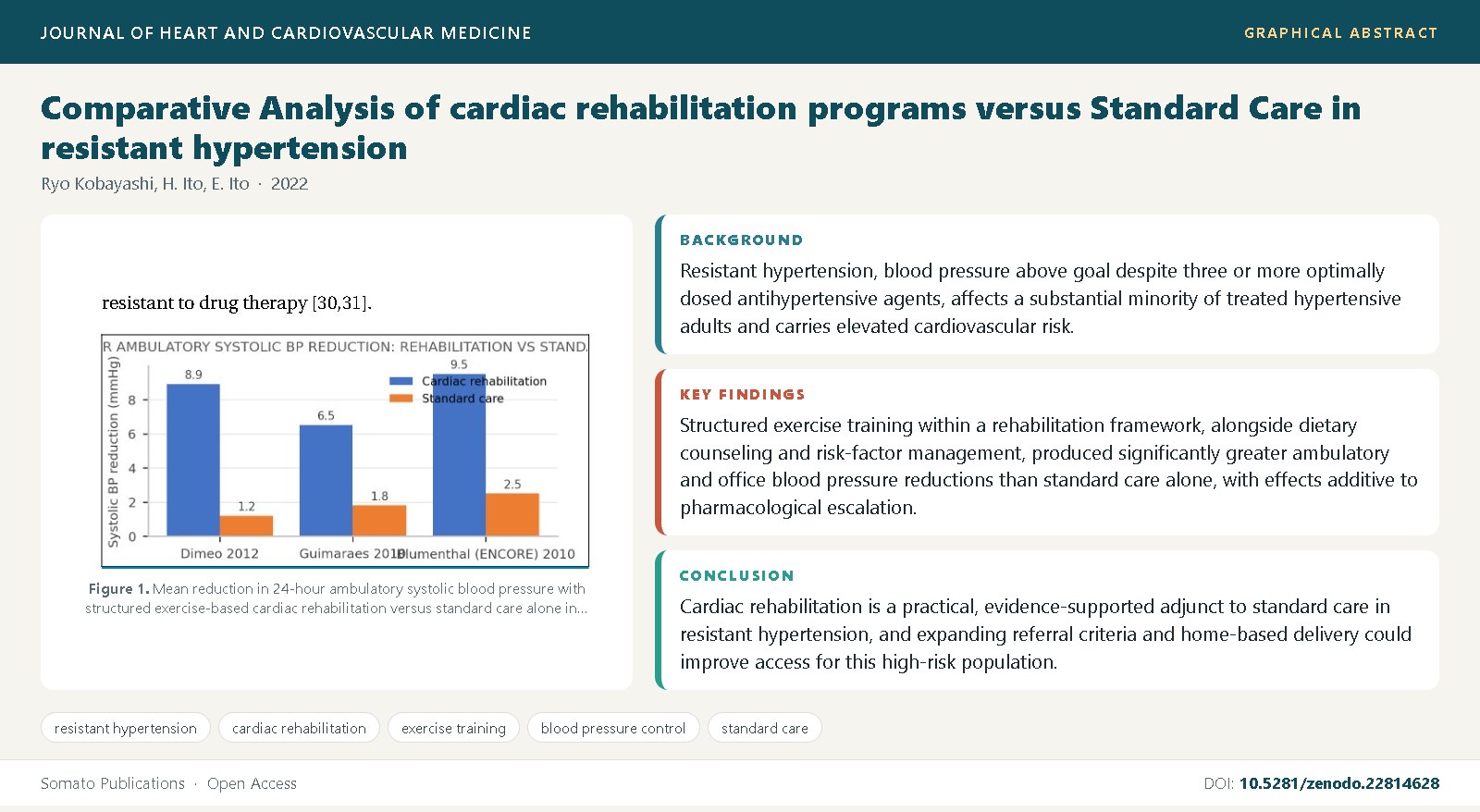
Findings: Structured exercise training within a rehabilitation framework, alongside dietary counseling and risk-factor management, produced significantly greater ambulatory and office blood pressure reductions than standard care alone, with effects additive to pharmacological escalation and device-based approaches via improved baroreflex sensitivity and reduced sympathetic activation.
Conclusions: Cardiac rehabilitation is a practical, evidence-supported adjunct to standard care in resistant hypertension, and expanding referral criteria and home-based delivery could improve access for this high-risk population.
References
Kearney, P.M., Whelton, M., Reynolds, K., Muntner, P., Whelton, P.K., He, J. (2005) Global burden of hypertension: analysis of worldwide data. Lancet, 365(9455): 217-223. DOI: 10.1016/S0140-6736(05)17741-1
Calhoun, D.A., Jones, D., Textor, S., Goff, D.C., Murphy, T.P., Toto, R.D., et al. (2008) Resistant hypertension: diagnosis, evaluation, and treatment: a scientific statement from the American Heart Association Professional Education Committee. Hypertension, 51(6): 1403-1419. DOI: 10.1161/HYPERTENSIONAHA.108.189141
Whelton, P.K., Carey, R.M., Aronow, W.S., Casey, D.E., Collins, K.J., Dennison Himmelfarb, C., et al. (2018) 2017 ACC/AHA/ AAPA/ABC/ACPM/AGS/APhA/ASH/ASPC/NMA/PCNA guideline for the prevention, detection, evaluation, and management of high blood pressure in adults. Hypertension, 71(6): e13-e115. DOI: 10.1161/HYP.0000000000000065
Persell, S.D. (2011) Prevalence of resistant hypertension in the United States, 2003-2008. Hypertension, 57(6): 1076-1080. DOI: 10.1161/HYPERTENSIONAHA.111.170308
Daugherty, S.L., Powers, J.D., Magid, D.J., Tavel, H.M., Masoudi, F.A., Margolis, K.L., et al. (2012) Incidence and prognosis of resistant hypertension in hypertensive patients. Circulation, 125(13): 1635-1642. DOI: 10.1161/CIRCULATIONAHA.111.068064
Judd, E., Calhoun, D.A. (2014) Apparent and true resistant hypertension: definition, prevalence and outcomes. Journal of Human Hypertension, 28(8): 463-468. DOI: 10.1038/jhh.2013.140
Pimenta, E., Calhoun, D.A. (2012) Resistant hypertension: incidence, prevalence, and prognosis. Circulation, 125(13): 1594-1596. DOI: 10.1161/CIRCULATIONAHA.112.097345
Jung, O., Gechter, J.L., Wunder, C., Paulke, A., Bartel, C., Geiger, H., et al. (2013) Resistant hypertension? Assessment of adherence by toxicological urine analysis. Journal of Hypertension, 31(4): 766-774. DOI: 10.1097/HJH.0b013e32835e2286
Williams, B., MacDonald, T.M., Morant, S., Webb, D.J., Sever, P., McInnes, G., et al. (2015) Spironolactone versus placebo, bisoprolol, and doxazosin to determine the optimal treatment for drug-resistant hypertension (PATHWAY-2). Lancet, 386(10008): 2059-2068. DOI:
1016/S0140-6736(15)00257-3 10. Bhatt, D.L., Kandzari, D.E., O'Neill, W.W., D'Agostino, R., Flack, J.M., Katzen, B.T., et al. (2014) A controlled trial of renal denervation for resistant hypertension. New England Journal of Medicine, 370(15): 1393-1401. DOI: 10.1056/NEJMoa1402670
Kandzari, D.E., Böhm, M., Mahfoud, F., Townsend, R.R., Weber, M.A., Pocock, S., et al. (2018) Effect of renal denervation on blood pressure in the presence of antihypertensive drugs: 6-month efficacy and safety results from the SPYRAL HTN-ON MED trial. Lancet, 391(10137): 2346-2355. DOI: 10.1016/S0140-6736(18)30951-6
Townsend, R.R., Mahfoud, F., Kandzari, D.E., Kario, K., Pocock, S., Weber, M.A., et al. (2017) Catheter-based renal denervation in patients with uncontrolled hypertension in the absence of antihypertensive medications (SPYRAL HTN-OFF MED). Lancet, 390(10108): 2160-2170. DOI: 10.1016/S0140-6736(17)32281-X
Logan, A.G., Perlikowski, S.M., Mente, A., Tisler, A., Tkacova, R., Niroumand, M., et al. (2001) High prevalence of unrecognized sleep apnoea in drug-resistant hypertension. Journal of Hypertension, 19(12): 2271-2277. DOI: 10.1097/00004872-200112000-00022
Landsberg, L., Aronne, L.J., Beilin, L.J., Burke, V., Igel, L.I., Lloyd-Jones, D., et al. (2013) Obesity-related hypertension: pathogenesis, cardiovascular risk, and treatment: a position paper of The Obesity Society and The American Society of Hypertension. Journal of Clinical Hypertension, 15(1): 14-33. DOI: 10.1111/jch.12049
Laterza, M.C., de Matos, L.D., Trombetta, I.C., Braga, A.M., Roveda, F., Alves, M.J., et al. (2007) Exercise training restores baroreflex sensitivity in never-treated hypertensive patients. Hypertension, 49(6): 1298-1306. DOI: 10.1161/HYPERTENSIONAHA.107.111310
Myers, J., McAuley, P., Lavie, C.J., Despres, J.P., Arena, R., Kokkinos, P. (2015) Physical activity and cardiorespiratory fitness as major markers of cardiovascular risk: their independent and interwoven importance to health status. Progress in Cardiovascular Diseases, 57(4): 306-314. DOI: 10.1016/j.pcad.2014.09.011
Kokkinos, P. (2014) Cardiorespiratory fitness, exercise, and blood pressure. Hypertension, 64(6): 1160-1164. DOI: 10.1161/HYPERTENSIONAHA.114.03616
Balady, G.J., Williams, M.A., Ades, P.A., Bittner, V., Comoss, P., Foody, J.M., et al. (2007) Core components of cardiac rehabilitation/secondary prevention programs: 2007 update. Circulation, 115(20): 2675-2682. DOI: 10.1161/CIRCULATIONAHA.106.180945
Piepoli, M.F., Corrà, U., Adamopoulos, S., Benzer, W., Bjarnason-Wehrens, B., Cupples, M., et al. (2014) Secondary prevention in the clinical management of patients with cardiovascular diseases: core components, standards and outcome measures for referral and delivery. European Journal of Preventive Cardiology, 21(6): 664-681. DOI: 10.1177/2047487312449597
Whelton, S.P., Chin, A., Xin, X., He, J. (2002) Effect of aerobic exercise on blood pressure: a meta-analysis of randomized, controlled trials. Annals of Internal Medicine, 136(7): 493-503. DOI: 10.7326/0003-4819-136-7-200204020-00006
Cornelissen, V.A., Smart, N.A. (2013) Exercise training for blood pressure: a systematic review and meta-analysis. Journal of the American Heart Association, 2(1): e004473. DOI: 10.1161/JAHA.112.004473
Fagard, R.H., Cornelissen, V.A. (2007) Effect of exercise on blood pressure control in hypertensive patients. European Journal of Cardiovascular Prevention and Rehabilitation, 14(1): 12-17. DOI: 10.1097/HJR.0b013e3280128bbb
Cornelissen, V.A., Fagard, R.H. (2005) Effect of resistance training on resting blood pressure: a meta-analysis of randomized controlled trials. Journal of Hypertension, 23(2): 251-259. DOI: 10.1097/00004872-200502000-00003
Carlson, D.J., Dieberg, G., Hess, N.C., Millar, P.J., Smart, N.A. (2014) Isometric exercise training for blood pressure management: a systematic review and meta-analysis. Mayo Clinic Proceedings, 89(3): 327-334. DOI: 10.1016/j.mayocp.2013.10.030
Pescatello, L.S., Franklin, B.A., Fagard, R., Farquhar, W.B., Kelley, G.A., Ray, C.A. (2004) American College of Sports Medicine position stand: exercise and hypertension. Medicine and Science in Sports and Exercise, 36(3): 533-553. DOI: 10.1249/01.MSS.0000115224.88514.3A
Sacks, F.M., Svetkey, L.P., Vollmer, W.M., Appel, L.J., Bray, G.A., Harsha, D., et al. (2001) Effects on blood pressure of reduced dietary sodium and the Dietary Approaches to Stop Hypertension (DASH) diet. New England Journal of Medicine, 344(1): 3-10. DOI: 10.1056/NEJM200101043440101
Blumenthal, J.A., Babyak, M.A., Hinderliter, A., Watkins, L.L., Craighead, L., Lin, P.H., et al. (2010) Effects of the DASH diet alone and in combination with exercise and weight loss on blood pressure and cardiovascular biomarkers in men and women with high blood pressure: the ENCORE study. Archives of Internal Medicine, 170(2): 126-135. DOI: 10.1001/archinternmed.2009.470
Dimeo, F., Pagonas, N., Seibert, F., Arndt, R., Zidek, W., Westhoff, T.H. (2012) Aerobic exercise reduces blood pressure in resistant hypertension. Hypertension, 60(3): 653-658. DOI: 10.1161/HYPERTENSIONAHA.112.197780
Guimaraes, G.V., Ciolac, E.G., Carvalho, V.O., D'Avila, V.M., Bortolotto, L.A., Bocchi, E.A. (2010) Effects of continuous vs. interval exercise training on blood pressure and arterial stiffness in treated hypertension. Hypertension Research, 33(6): 627-632. DOI: 10.1038/hr.2010.42
Anderson, L., Oldridge, N., Thompson, D.R., Zwisler, A.D., Rees, K., Martin, N., et al. (2016) Exercise-based cardiac rehabilitation for coronary heart disease: Cochrane systematic review and meta-analysis. Journal of the American College of Cardiology, 67(1): 1-12. DOI: 10.1016/j.jacc.2015.10.044
Taylor, R.S., Brown, A., Ebrahim, S., Jolliffe, J., Noorani, H., Rees, K., et al. (2004) Exercise-based rehabilitation for patients with coronary heart disease: systematic review and meta-analysis of randomized controlled trials. American Journal of Medicine, 116(10): 682-692. DOI: 10.1016/j.amjmed.2004.01.009
Oliveras, A., Armario, P., Clara, A., Sans-Atxer, L., Vazquez, S., Pascual, J., et al. (2016) Spironolactone versus sympathetic renal denervation to treat true resistant hypertension: results from the DENERVHTA study. Journal of Hypertension, 34(9): 1863-1871. DOI: 10.1097/HJH.0000000000001007
Beatty, A.L., Truong, M., Schopfer, D.W., Shen, H., Bachmann, J.M., Whooley, M.A. (2018) Geographic variation in cardiac rehabilitation participation in Medicare and Veterans Affairs populations. Circulation, 137(18): 1899-1908. DOI: 10.1161/CIRCULATIONAHA.117.029471
Sandesara, P.B., Lambert, C.T., Gordon, N.F., Fletcher, G.F., Franklin, B.A., Wenger, N.K., et al. (2015) Cardiac rehabilitation and risk reduction: time to "rebrand and reinvigorate". Journal of the American College of Cardiology, 65(4): 389-395. DOI: 10.1016/j.jacc.2014.10.059
Thomas, R.J., Beatty, A.L., Beckie, T.M., Brewer, L.C., Brown, T.M., Forman, D.E., et al. (2019) Home-based cardiac rehabilitation: a scientific statement from the American Association of Cardiovascular and Pulmonary Rehabilitation, the American Heart Association, and the American College of Cardiology. Circulation, 140(1): e69-e89. DOI: 10.1161/CIR.0000000000000663
Fletcher, G.F., Ades, P.A., Kligfield, P., Arena, R., Balady, G.J., Bittner, V.A., et al. (2013) Exercise standards for testing and training: a scientific statement from the American Heart Association. Circulation, 128(8): 873-934. DOI: 10.1161/CIR.0b013e31829b5b44

Published
Issue
Section
License
Copyright (c) 2022 Ryo Kobayashi, et al.

This work is licensed under a Creative Commons Attribution 4.0 International License.


