
Predictors of major adverse cardiac events in elderly cardiac patients with heart failure with reduced ejection fraction
DOI:
https://doi.org/10.5281/zenodo.22814539Keywords:
heart failure, reduced ejection fraction, elderly, major adverse cardiac events, risk predictionAbstract
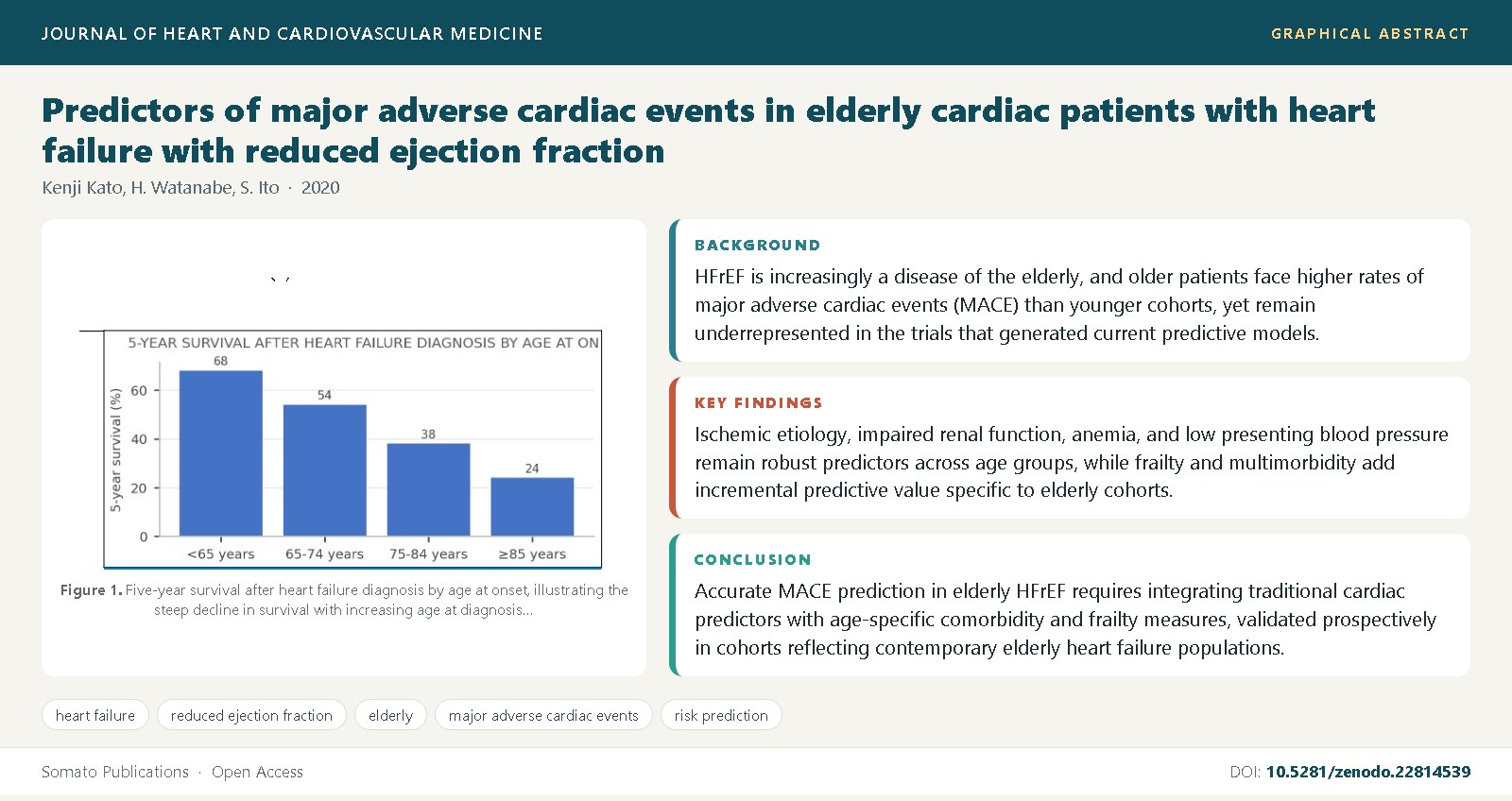
Background: HFrEF is increasingly a disease of the elderly, and older patients face higher rates of major adverse cardiac events (MACE) than younger cohorts, yet remain underrepresented in the trials that generated current predictive models [1,6].
Objective: This review synthesizes published evidence on predictors of MACE, defined as cardiovascular death, heart failure hospitalization, and recurrent ischemic events, in elderly HFrEF patients, and evaluates how well general-cohort predictors generalize to this subgroup.
Methods: We reviewed cohort studies, trial subgroup analyses, and risk-model validation studies addressing clinical, biomarker, comorbidity, and frailty-based predictors of MACE in HFrEF patients aged 65 years and older.
Findings: Ischemic etiology, impaired renal function, anemia, and low presenting blood pressure remain robust predictors across age groups [21,23], while frailty and multimorbidity add incremental predictive value specific to elderly cohorts [26,27]; natriuretic peptides and pooled risk scores retain prognostic value but show attenuated discrimination outside trial populations [12,34].
Conclusions: Accurate MACE prediction in elderly HFrEF requires integrating traditional cardiac predictors with age-specific comorbidity and frailty measures, validated prospectively in cohorts reflecting contemporary elderly heart failure populations.
References
Gerber, Y., Weston, S.A., Redfield, M.M., Chamberlain, A.M., Manemann, S.M., Jiang, R., et al. (2015) A contemporary appraisal of the heart failure epidemic in Olmsted County, Minnesota, 2000 to 2010. JAMA Internal Medicine, 175(6): 996-1004. DOI: 10.1001/jamainternmed.2015.0924
Owan, T.E., Hodge, D.O., Herges, R.M., Jacobsen, S.J., Roger, V.L., Redfield, M.M. (2006) Trends in prevalence and outcome of heart failure with preserved ejection fraction. New England Journal of Medicine, 355(3): 251-259. DOI: 10.1056/NEJMoa052256
Ponikowski, P., Voors, A.A., Anker, S.D., Bueno, H., Cleland, J.G.F., Coats, A.J.S., et al. (2016) 2016 ESC Guidelines for the diagnosis and treatment of acute and chronic heart failure. European Heart Journal, 37(27): 2129-2200. DOI: 10.1093/eurheartj/ehw128
Yancy, C.W., Jessup, M., Bozkurt, B., Butler, J., Casey, D.E., Colvin, M.M., et al. (2017) 2017 ACC/AHA/HFSA focused update of the 2013 ACCF/AHA guideline for the management of heart failure. Circulation, 136(6): e137-e161. DOI: 10.1161/CIR.0000000000000509
Benjamin, E.J., Muntner, P., Alonso, A., Bittencourt, M.S., Callaway, C.W., Carson, A.P., et al. (2019) Heart disease and stroke statistics-2019 update: a report from the American Heart Association. Circulation, 139(10): e56-e528. DOI: 10.1161/CIR.0000000000000659
Forman, D.E., Maurer, M.S., Boyd, C., Brindis, R., Salive, M.E., Horne, F.M., et al. (2018) Multimorbidity in older adults with cardiovascular disease. Journal of the American College of Cardiology, 71(19): 2149-2161. DOI: 10.1016/j.jacc.2018.03.022
Rich, M.W. (1997) Heart failure in the oldest patients: the impact of comorbid conditions. American Journal of Geriatric Cardiology, 6(5): 26-37.
Dokainish, H., Teo, K., Zhu, J., Roy, A., AlHabib, K.F., ElSayed, A., et al. (2017) Global mortality variations in patients with heart failure: results from the International Congestive Heart Failure (INTER-CHF) prospective cohort study. Lancet Global Health, 5(7): e665-e672. DOI: 10.1016/S2214-109X(17)30196-1
Ambrosy, A.P., Fonarow, G.C., Butler, J., Chioncel, O., Greene, S.J., Vaduganathan, M., et al. (2014) The global health and economic burden of hospitalizations for heart failure. Journal of the American College of Cardiology, 63(12): 1123-1133. DOI: 10.1016/j.jacc.2013.11.053
Savarese, G., Lund, L.H. (2017) Global public health burden of heart failure. Cardiac Failure Review, 3(1): 7-11. DOI: 10.15420/cfr.2016:25:2
Levy, W.C., Mozaffarian, D., Linker, D.T., Sutradhar, S.C., Anker, S.D., Cropp, A.B., et al. (2006) The Seattle Heart Failure Model: prediction of survival in heart failure. Circulation, 113(11): 1424-1433. DOI: 10.1161/CIRCULATIONAHA.105.584102
Pocock, S.J., Ariti, C.A., McMurray, J.J.V., Maggioni, A., Kober, L., Squire, I.B., et al. (2013) Predicting survival in heart failure: a risk score based on 39,372 patients from 30 studies. European Heart Journal, 34(19): 1404-1413. DOI: 10.1093/eurheartj/ehs337
Stewart, S., MacIntyre, K., Capewell, S., McMurray, J.J.V. (2003) Heart failure and the aging population: an increasing burden in the 21st century? Heart, 89(1): 49-53. DOI: 10.1136/heart.89.1.49
Dunlay, S.M., Roger, V.L., Redfield, M.M. (2017) Epidemiology of heart failure with preserved ejection fraction. Nature Reviews Cardiology, 14(10): 591-602. DOI: 10.1038/nrcardio.2017.65
Ho, K.K.L., Anderson, K.M., Kannel, W.B., Grossman, W., Levy, D. (1993) Survival after the onset of congestive heart failure in Framingham Heart Study subjects. Circulation, 88(1): 107-115. DOI: 10.1161/01.CIR.88.1.107
Shah, K.S., Xu, H., Matsouaka, R.A., Bhatt, D.L., Heidenreich, P.A., Hernandez, A.F., et al. (2017) Heart failure with preserved, borderline, and reduced ejection fraction: 5-year outcomes. Journal of the American College of Cardiology, 70(20): 2476-2486. DOI: 10.1016/j.jacc.2017.08.074
Fonarow, G.C., Adams, K.F., Abraham, W.T., Yancy, C.W., Boscardin, W.J. (2005) Risk stratification for in-hospital mortality in acutely decompensated heart failure. JAMA, 293(5): 572-580. DOI: 10.1001/jama.293.5.572
Lee, D.S., Austin, P.C., Rouleau, J.L., Liu, P.P., Naimark, D., Tu, J.V. (2003) Predicting mortality among patients hospitalized for heart failure: derivation and validation of a clinical model. JAMA, 290(19): 2581-2587. DOI: 10.1001/jama.290.19.2581
Felker, G.M., Shaw, L.K., O'Connor, C.M. (2000) A standardized definition of ischemic cardiomyopathy for use in clinical research. Journal of the American College of Cardiology, 39(2): 210-218. DOI: 10.1016/S0735-1097(01)01738-7
Gheorghiade, M., Larson, C.J., Shah, S.J., Greene, S.J., Cleland, J.G.F., Colucci, W.S., et al. (2013) Developing new treatments for heart failure: focus on the heart. Circulation: Heart Failure, 6(1): 134-145. DOI: 10.1161/CIRCHEARTFAILURE.112.000005
Damman, K., Valente, M.A.E., Voors, A.A., O'Connor, C.M., van Veldhuisen, D.J., Hillege, H.L. (2014) Renal impairment, worsening renal function, and outcome in patients with heart failure. European Heart Journal, 35(7): 455-469. DOI: 10.1093/eurheartj/eht386
Smith, G.L., Lichtman, J.H., Bracken, M.B., Shlipak, M.G., Phillips, C.O., DiCapua, P., et al. (2006) Renal impairment and outcomes in heart failure: systematic review and meta-analysis. Journal of the American College of Cardiology, 47(10): 1987-1996. DOI: 10.1016/j.jacc.2005.11.084
Groenveld, H.F., Januzzi, J.L., Damman, K., van Wijngaarden, J., Hillege, H.L., van Veldhuisen, D.J., et al. (2008) Anemia and mortality in heart failure patients: a systematic review and meta-analysis. Journal of the American College of Cardiology, 52(10): 818-827. DOI: 10.1016/j.jacc.2008.04.061
Filippatos, G., Farmakis, D., Parissis, J. (2011) Renal dysfunction and anemia in chronic heart failure. Current Heart Failure Reports, 8(1): 15-21. DOI: 10.1007/s11897-010-0038-6
Fried, L.P., Tangen, C.M., Walston, J., Newman, A.B., Hirsch, C., Gottdiener, J., et al. (2001) Frailty in older adults: evidence for a phenotype. Journals of Gerontology Series A, 56(3): M146-M157. DOI: 10.1093/gerona/56.3.M146
Afilalo, J., Alexander, K.P., Mack, M.J., Maurer, M.S., Green, P., Allen, L.A., et al. (2014) Frailty assessment in the cardiovascular care of older adults. Journal of the American College of Cardiology, 63(8): 747-762. DOI: 10.1016/j.jacc.2013.09.070
Vidan, M.T., Blaya-Novakova, V., Sanchez, E., Ortiz, J., Serra-Rexach, J.A., Bueno, H. (2016) Prevalence and prognostic impact of frailty and its components in non-dependent elderly patients with heart failure. European Journal of Heart Failure, 18(7): 869-875. DOI: 10.1002/ejhf.518
Flint, K.M., Matlock, D.D., Lindenfeld, J., Allen, L.A. (2012) Frailty and the selection of patients for destination therapy left ventricular assist device. Circulation: Heart Failure, 5(2): 286-293. DOI: 10.1161/CIRCHEARTFAILURE.111.963215
Maisel, A.S., Krishnaswamy, P., Nowak, R.M., McCord, J., Hollander, J.E., Duc, P., et al. (2002) Rapid measurement of B-type natriuretic peptide in the emergency diagnosis of heart failure. New England Journal of Medicine, 347(3): 161-167. DOI: 10.1056/NEJMoa020233
Januzzi, J.L., Camargo, C.A., Anwaruddin, S., Baggish, A.L., Chen, A.A., Krauser, D.G., et al. (2005) The N-terminal Pro-BNP investigation of dyspnea in the emergency department (PRIDE) study. American Journal of Cardiology, 95(8): 948-954. DOI: 10.1016/j.amjcard.2004.12.032
Felker, G.M., Anstrom, K.J., Adams, K.F., Ezekowitz, J.A., Fiuzat, M., Houston-Miller, N., et al. (2017) Effect of natriuretic peptide-guided therapy on hospitalization or cardiovascular mortality in high-risk patients with heart failure. JAMA, 318(8): 713-720. DOI: 10.1001/jama.2017.10565
de Berardinis, B., Magrini, L., Zampini, G., Zancla, B., Salerno, G., Cardelli, P., et al. (2018) Usefulness of combining galectin-3 and BNP in prognostication of heart failure patients. Clinica Chimica Acta, 479: 46-52. DOI: 10.1016/j.cca.2018.01.006
Deswal, A., Petersen, N.J., Feldman, A.M., Young, J.B., White, B.G., Mann, D.L. (2001) Cytokines and cytokine receptors in advanced heart failure. Circulation, 103(16): 2055-2059. DOI: 10.1161/01.CIR.103.16.2055
Allen, L.A., Matlock, D.D., Shetterly, S.M., Xu, S., Levy, W.C., Portalupi, L.B., et al. (2017) Use of risk models to predict death in the next year among individual ambulatory patients with heart failure. JAMA Cardiology, 2(4): 435-441. DOI: 10.1001/jamacardio.2017.0021
Zannad, F., McMurray, J.J.V., Krum, H., van Veldhuisen, D.J., Swedberg, K., Shi, H., et al. (2011) Eplerenone in patients with systolic heart failure and mild symptoms. New England Journal of Medicine, 364(1): 11-21. DOI: 10.1056/NEJMoa1009492
McMurray, J.J.V., Packer, M., Desai, A.S., Gong, J., Lefkowitz, M.P., Rizkala, A.R., et al. (2014) Angiotensin-neprilysin inhibition versus enalapril in heart failure. New England Journal of Medicine, 371(11): 993-1004. DOI: 10.1056/NEJMoa1409077
Packer, M., Anker, S.D., Butler, J., Filippatos, G., Pocock, S.J., Carson, P., et al. (2020) Cardiovascular and renal outcomes with empagliflozin in heart failure. New England Journal of Medicine, 383(15): 1413-1424. DOI: 10.1056/NEJMoa2022190
Cleland, J.G.F., Daubert, J.C., Erdmann, E., Freemantle, N., Gras, D., Kappenberger, L., et al. (2005) The effect of cardiac resynchronization on morbidity and mortality in heart failure. New England Journal of Medicine, 352(15): 1539-1549. DOI: 10.1056/NEJMoa050496
Moss, A.J., Hall, W.J., Cannom, D.S., Klein, H., Brown, M.W., Daubert, J.P., et al. (2009) Cardiac-resynchronization therapy for the prevention of heart-failure events. New England Journal of Medicine, 361(14): 1329-1338. DOI: 10.1056/NEJMoa0906431
Swedberg, K., Komajda, M., Bohm, M., Borer, J.S., Ford, I., Dubost-Brama, A., et al. (2010) Ivabradine and outcomes in chronic heart failure (SHIFT). Lancet, 376(9744): 875-885. DOI: 10.1016/S0140-6736(10)61198-1
Rich, M.W., Beckham, V., Wittenberg, C., Leven, C.L., Freedland, K.E., Carney, R.M. (1995) A multidisciplinary intervention to prevent the readmission of elderly patients with congestive heart failure. New England Journal of Medicine, 333(18): 1190-1195. DOI: 10.1056/NEJM199511023331806

Published
Issue
Section
License
Copyright (c) 2020 Kenji Kato, et al.

This work is licensed under a Creative Commons Attribution 4.0 International License.


