
ambulatory ECG monitoring in the Management of atrial fibrillation among post-myocardial infarction patients
DOI:
https://doi.org/10.5281/zenodo.22814523Keywords:
atrial fibrillation, ambulatory ECG monitoring, myocardial infarction, stroke prevention, implantable loop recorderAbstract
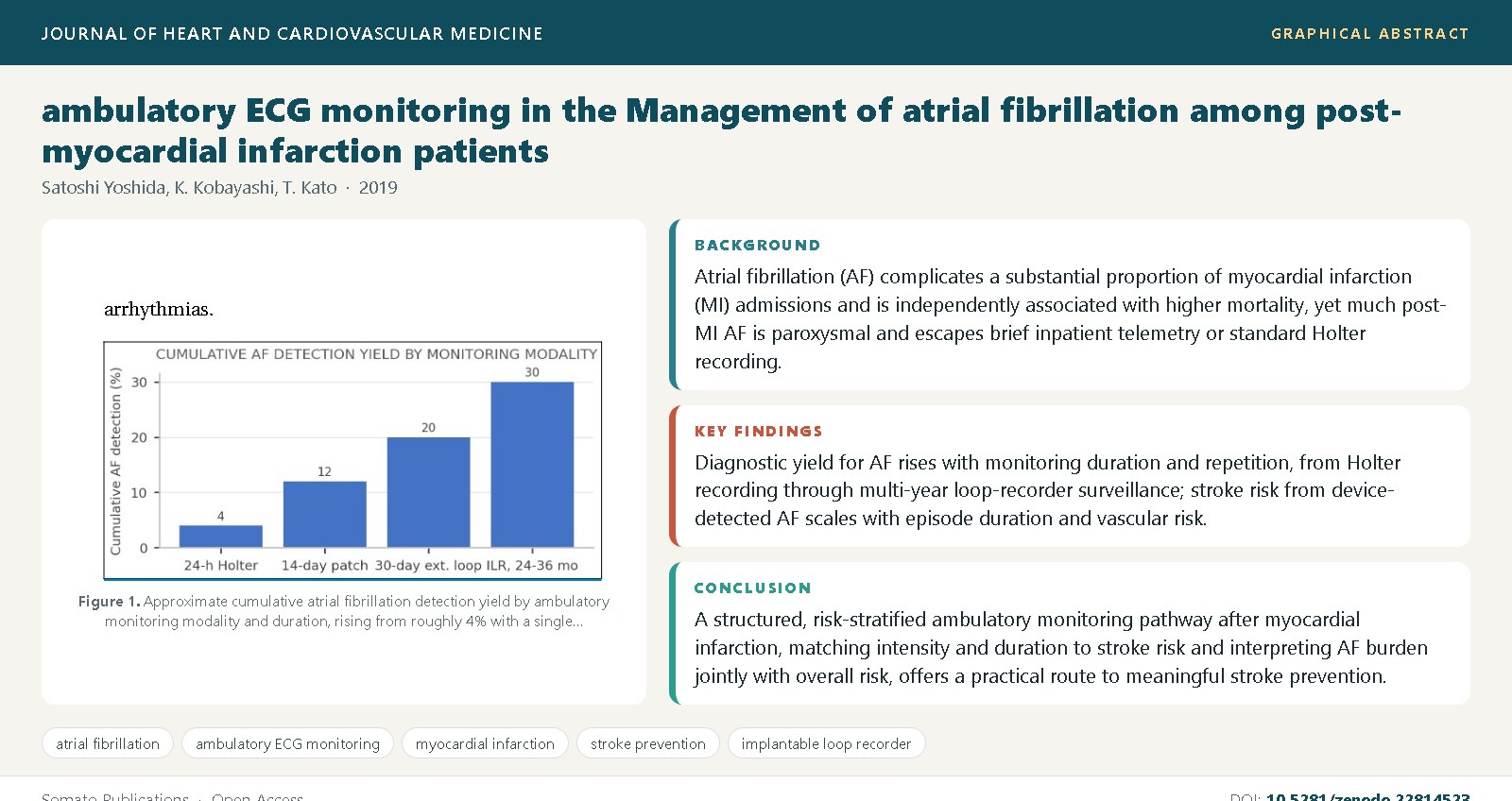
Background: Atrial fibrillation (AF) complicates a substantial proportion of myocardial infarction (MI) admissions and is independently associated with higher mortality, yet much post-MI AF is paroxysmal and escapes brief inpatient telemetry or standard Holter recording.
Objective: This review synthesizes evidence on ambulatory ECG monitoring for detecting and managing AF after myocardial infarction, and how findings should translate into anticoagulation and rhythm-control decisions.
Methods: We reviewed cohort data on post-MI AF epidemiology, comparative studies of Holter, patch, and loop-recorder monitoring, plus randomized evidence on AF duration, stroke risk, and guideline recommendations.
Findings: Diagnostic yield for AF rises with monitoring duration and repetition, from Holter recording through multi-year loop-recorder surveillance; stroke risk from device-detected AF scales with episode duration and vascular risk, and post-MI patients typically already carry an elevated CHA2DS2-VASc score that makes detected AF more actionable than in lower-risk screening.
Conclusions: A structured, risk-stratified ambulatory monitoring pathway after myocardial infarction, matching intensity and duration to stroke risk and interpreting AF burden jointly with overall risk, offers a practical route to meaningful stroke prevention.
References
Crenshaw, B.S., Ward, S.R., Granger, C.B., Stebbins, A.L., Topol, E.J., Califf, R.M. (1997) Atrial fibrillation in the setting of acute myocardial infarction: the GUSTO-I experience. Journal of the American College of Cardiology, 30(2): 406-413. DOI: 10.1016/S0735-1097(97)00194-0
Pizzetti, F., Turazza, F.M., Franzosi, M.G., Barlera, S., Ledda, A., Maggioni, A.P., et al. (2001) Incidence and prognostic significance of atrial fibrillation in acute myocardial infarction: the GISSI-3 data. Heart, 86(5): 527-532. DOI: 10.1136/heart.86.5.527
Rathore, S.S., Berger, A.K., Weinfurt, K.P., Schulman, K.A., Oetgen, W.J., Gersh, B.J., et al. (2000) Acute myocardial infarction complicated by atrial fibrillation in the elderly: prevalence and outcomes. Circulation, 101(9): 969-974. DOI: 10.1161/01.CIR.101.9.969
Jabre, P., Roger, V.L., Murad, M.H., Chamberlain, A.M., Prokop, L., Adnet, F., et al. (2011) Mortality associated with atrial fibrillation in patients with myocardial infarction: a systematic review and meta-analysis. Circulation, 123(15): 1587-1593. DOI: 10.1161/CIRCULATIONAHA.110.986661
Lehto, M., Snapinn, S., Dickstein, K., Swedberg, K., Nieminen, M.S. (2005) Prognostic risk of atrial fibrillation in acute myocardial infarction complicated by left ventricular dysfunction: the OPTIMAAL experience. European Heart Journal, 26(4): 350-356. DOI: 10.1093/eurheartj/ehi064
Schmitt, J., Duray, G., Gersh, B.J., Hohnloser, S.H. (2009) Atrial fibrillation in acute myocardial infarction: a systematic review of the incidence, clinical features and prognostic implications. European Heart Journal, 30(9): 1038-1045. DOI: 10.1093/eurheartj/ehn579
Wolf, P.A., Abbott, R.D., Kannel, W.B. (1991) Atrial fibrillation as an independent risk factor for stroke: the Framingham Study. Stroke, 22(8): 983-988. DOI: 10.1161/01.STR.22.8.983
Go, A.S., Hylek, E.M., Phillips, K.A., Chang, Y., Henault, L.E., Selby, J.V., et al. (2001) Prevalence of diagnosed atrial fibrillation in adults: national implications for rhythm management and stroke prevention. JAMA, 285(18): 2370-2375. DOI: 10.1001/jama.285.18.2370
Sanna, T., Diener, H.C., Passman, R.S., Di Lazzaro, V., Bernstein, R.A., Morillo, C.A., et al. (2014) Cryptogenic stroke and underlying atrial fibrillation. New England Journal of Medicine, 370(26): 2478-2486. DOI: 10.1056/NEJMoa1313600
Gladstone, D.J., Spring, M., Dorian, P., Panzov, V., Thorpe, K.E., Hall, J., et al. (2014) Atrial fibrillation in patients with cryptogenic stroke. New England Journal of Medicine, 370(26): 2467-2477. DOI: 10.1056/NEJMoa1311376
Kishore, A., Vail, A., Majid, A., Dawson, J., Lees, K.R., Tyrrell, P.J., et al. (2014) Detection of atrial fibrillation after ischemic stroke or transient ischemic attack: a systematic review and meta-analysis. Stroke, 45(2): 520-526. DOI: 10.1161/STROKEAHA.113.003433
Kaplan, R.M., Koehler, J., Ziegler, P.D., Sarkar, S., Zweibel, S., Passman, R.S. (2019) Stroke risk as a function of atrial fibrillation duration and CHA2DS2-VASc score. Circulation, 140(20): 1639-1646. DOI: 10.1161/CIRCULATIONAHA.119.041303
Freedman, B., Camm, J., Calkins, H., Healey, J.S., Rosenqvist, M., Wang, J., et al. (2017) Screening for atrial fibrillation: a report of the AF-SCREEN international collaboration. Circulation, 135(19): 1851-1867. DOI: 10.1161/CIRCULATIONAHA.116.026693
Svennberg, E., Engdahl, J., Al-Khalili, F., Friberg, L., Frykman, V., Rosenqvist, M. (2015) Mass screening for untreated atrial fibrillation: the STROKESTOP study. Circulation, 131(25): 2176-2184. DOI: 10.1161/CIRCULATIONAHA.114.014343
Steinhubl, S.R., Waalen, J., Edwards, A.M., Ariniello, L.M., Mehta, R.R., Ebner, G.S., et al. (2018) Effect of a home-based wearable continuous ECG monitoring patch on detection of undiagnosed atrial fibrillation: the mSToPS randomized clinical trial. JAMA, 320(2): 146-155. DOI: 10.1001/jama.2018.8102
Barrett, P.M., Komatireddy, R., Haaser, S., Topol, S., Sheard, J., Encinas, J., et al. (2014) Comparison of 24-hour Holter monitoring with 14-day novel adhesive patch electrocardiographic monitoring. American Journal of Medicine, 127(1): 95.e11-95.e17. DOI: 10.1016/j.amjmed.2013.10.003
Rosenberg, M.A., Samuel, M., Thosani, A., Zimetbaum, P.J. (2013) Use of a noninvasive continuous monitoring device in the management of atrial fibrillation: a pilot study. Pacing and Clinical Electrophysiology, 36(3): 328-333. DOI: 10.1111/pace.12065
Reiffel, J.A., Verma, A., Kowey, P.R., Halperin, J.L., Gersh, B.J., Wachter, R., et al. (2017) Incidence of previously undiagnosed atrial fibrillation using insertable cardiac monitors in a high-risk population: the REVEAL AF study. JAMA Cardiology, 2(10): 1120-1127. DOI: 10.1001/jamacardio.2017.3180
Svendsen, J.H., Diederichsen, S.Z., Hojberg, S., Krieger, D.W., Graff, C., Kronborg, C., et al. (2021) Implantable loop recorder detection of atrial fibrillation to prevent stroke (The LOOP Study): a randomised controlled trial. Lancet, 398(10310): 1507-1516. DOI: 10.1016/S0140-6736(21)01698-6
Perez, M.V., Mahaffey, K.W., Hedlin, H., Rumsfeld, J.S., Garcia, A., Ferris, T., et al. (2019) Large-scale assessment of a smartwatch to identify atrial fibrillation. New England Journal of Medicine, 381(20): 1909-1917. DOI: 10.1056/NEJMoa1901183
Guo, Y., Wang, H., Zhang, H., Liu, T., Liang, Z., Xia, Y., et al. (2019) Mobile photoplethysmographic technology to detect atrial fibrillation. Journal of the American College of Cardiology, 74(19): 2365-2375. DOI: 10.1016/j.jacc.2019.08.019
Lubitz, S.A., Faranesh, A.Z., Selvaggi, C., Atlas, S.J., McManus, D.D., Singer, D.E., et al. (2022) Detection of atrial fibrillation in a large population using wearable devices: the Fitbit Heart Study. Circulation, 146(19): 1415-1424. DOI: 10.1161/CIRCULATIONAHA.122.060291
Healey, J.S., Connolly, S.J., Gold, M.R., Israel, C.W., Van Gelder, I.C., Capucci, A., et al. (2012) Subclinical atrial fibrillation and the risk of stroke. New England Journal of Medicine, 366(2): 120-129. DOI: 10.1056/NEJMoa1105575
Van Gelder, I.C., Healey, J.S., Crijns, H.J.G.M., Wang, J., Hohnloser, S.H., Gold, M.R., et al. (2017) Duration of device-detected subclinical atrial fibrillation and occurrence of stroke in ASSERT. European Heart Journal, 38(17): 1339-1344. DOI: 10.1093/eurheartj/ehx042
Boriani, G., Glotzer, T.V., Santini, M., West, T.M., De Melis, M., Sepsi, M., et al. (2014) Device-detected atrial fibrillation and risk for stroke: an analysis of >10,000 patients from the SOS AF project. European Heart Journal, 35(8): 508-516. DOI: 10.1093/eurheartj/eht491
Connolly, S.J., Ezekowitz, M.D., Yusuf, S., Eikelboom, J., Oldgren, J., Parekh, A., et al. (2009) Dabigatran versus warfarin in patients with atrial fibrillation. New England Journal of Medicine, 361(12): 1139-1151. DOI: 10.1056/NEJMoa0905561
Patel, M.R., Mahaffey, K.W., Garg, J., Pan, G., Singer, D.E., Hacke, W., et al. (2011) Rivaroxaban versus warfarin in nonvalvular atrial fibrillation. New England Journal of Medicine, 365(10): 883-891. DOI: 10.1056/NEJMoa1009638
Granger, C.B., Alexander, J.H., McMurray, J.J.V., Lopes, R.D., Hylek, E.M., Hanna, M., et al. (2011) Apixaban versus warfarin in patients with atrial fibrillation. New England Journal of Medicine, 365(11): 981-992. DOI: 10.1056/NEJMoa1107039
Hindricks, G., Potpara, T., Dagres, N., Arbelo, E., Bax, J.J., Blomstrom-Lundqvist, C., et al. (2021) 2020 ESC Guidelines for the diagnosis and management of atrial fibrillation. European Heart Journal, 42(5): 373-498. DOI: 10.1093/eurheartj/ehaa612
Kirchhof, P., Benussi, S., Kotecha, D., Ahlsson, A., Atar, D., Casadei, B., et al. (2016) 2016 ESC Guidelines for the management of atrial fibrillation developed in collaboration with EACTS. European Heart Journal, 37(38): 2893-2962. DOI: 10.1093/eurheartj/ehw210
January, C.T., Wann, L.S., Calkins, H., Chen, L.Y., Cigarroa, J.E., Cleveland, J.C., et al. (2019) 2019 AHA/ACC/HRS focused update of the 2014 AHA/ACC/HRS guideline for the management of patients with atrial fibrillation. Circulation, 140(2): e125-e151. DOI: 10.1161/CIR.0000000000000665
Kirchhof, P., Camm, A.J., Goette, A., Brandes, A., Eckardt, L., Elvan, A., et al. (2020) Early rhythm-control therapy in patients with atrial fibrillation. New England Journal of Medicine, 383(14): 1305-1316. DOI: 10.1056/NEJMoa2019422

Published
Issue
Section
License
Copyright (c) 2019 Satoshi Yoshida, et al.

This work is licensed under a Creative Commons Attribution 4.0 International License.


