
Emerging Role of ambulatory ECG monitoring in the Diagnosis of resistant hypertension
DOI:
https://doi.org/10.5281/zenodo.22814502Keywords:
resistant hypertension, ambulatory blood pressure monitoring, masked hypertension, white-coat effect, ambulatory ECGAbstract
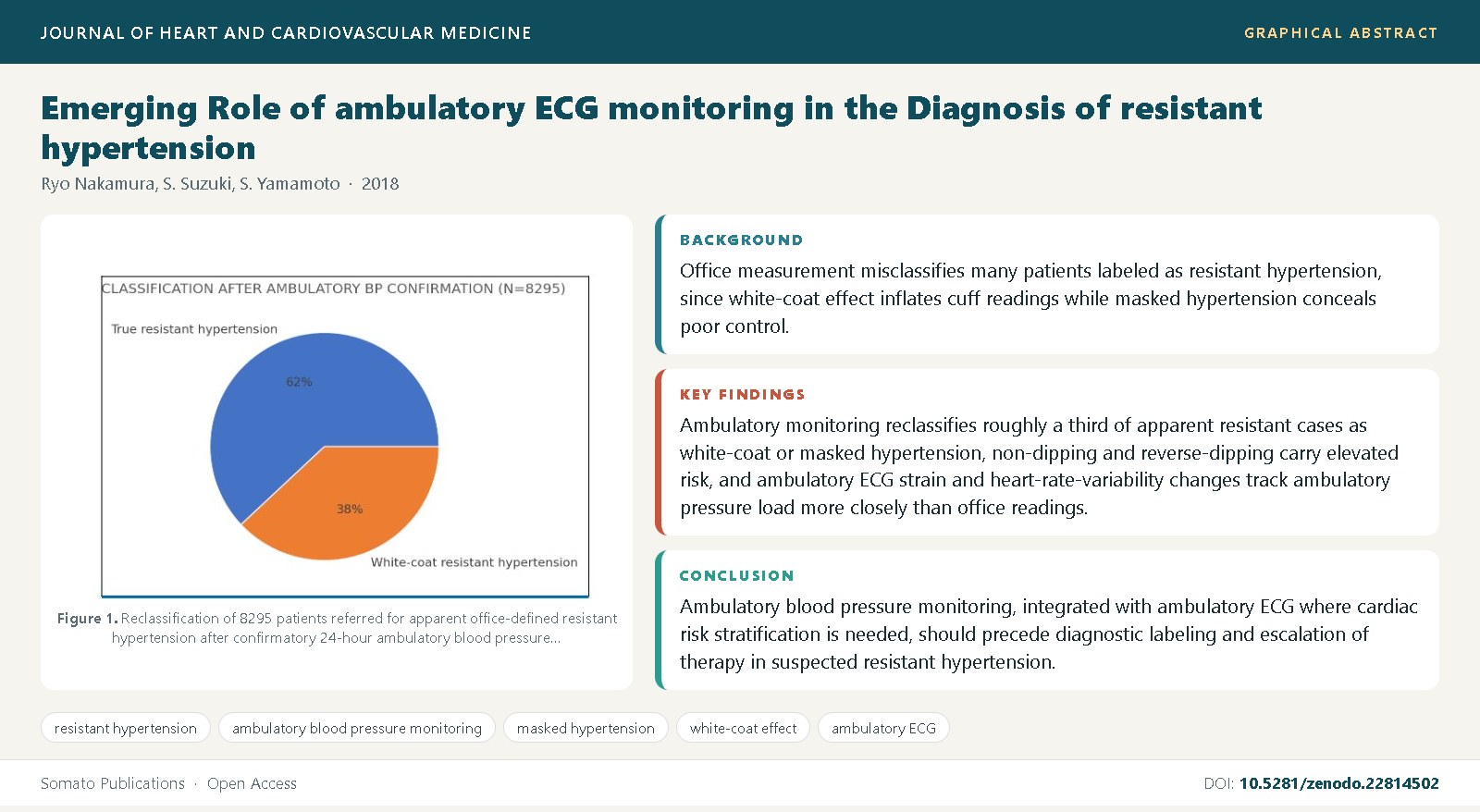
Background: Office measurement misclassifies many patients labeled as resistant hypertension, since white-coat effect inflates cuff readings while masked hypertension conceals poor control.
Objective: This review examines ambulatory blood pressure monitoring, paired with ambulatory ECG surveillance, in confirming true treatment-resistant hypertension and identifying candidates for escalation.
Methods: We synthesized outcome cohorts, diagnostic-accuracy studies, and guidelines addressing ambulatory monitoring, white-coat and masked phenomena, dipping patterns, and ambulatory ECG correlates in resistant hypertension.
Findings: Ambulatory monitoring reclassifies roughly a third of apparent resistant cases as white-coat or masked hypertension, non-dipping and reverse-dipping carry elevated risk, and ambulatory ECG strain and heart-rate-variability changes track ambulatory pressure load more closely than office readings.
Conclusions: Ambulatory blood pressure monitoring, integrated with ambulatory ECG where cardiac risk stratification is needed, should precede diagnostic labeling and escalation of therapy in suspected resistant hypertension.
References
Calhoun, D.A., Jones, D., Textor, S., Goff, D.C., Murphy, T.P., Toto, R.D., et al. (2008) Resistant hypertension: diagnosis, evaluation, and treatment: a scientific statement from the American Heart Association Professional Education Committee. Circulation, 117(25): e510-e526. DOI: 10.1161/CIRCULATIONAHA.108.189141
Pickering, T.G., Gerin, W., Schwartz, A.R. (2002) What is the white-coat effect and how should it be measured? Blood Pressure Monitoring, 7(6): 293-300.
Verdecchia, P., Porcellati, C., Schillaci, G., Borgioni, C., Ciucci, A., Battistelli, M., et al. (1994) Ambulatory blood pressure. An independent predictor of prognosis in essential hypertension. Hypertension, 24(6): 793-801. DOI: 10.1161/01.HYP.24.6.793
Staessen, J.A., Thijs, L., Fagard, R., O'Brien, E.T., Clement, D., de Leeuw, P.W., et al. (1999) Predicting cardiovascular risk using conventional vs ambulatory blood pressure in older patients with systolic hypertension. JAMA, 282(6): 539-546. DOI: 10.1001/jama.282.6.539
Dolan, E., Stanton, A., Thijs, L., Hinedi, K., Atkins, N., McClory, S., et al. (2005) Superiority of ambulatory over clinic blood pressure measurement in predicting mortality: the Dublin Outcome Study. Hypertension, 46(1): 156-161. DOI: 10.1161/01.HYP.0000170138.56903.7a
de la Sierra, A., Segura, J., Banegas, J.R., Gorostidi, M., de la Cruz, J.J., Armario, P., et al. (2011) Clinical features of 8295 patients with resistant hypertension classified on the basis of ambulatory blood pressure monitoring. Hypertension, 57(5): 898-902. DOI: 10.1161/HYPERTENSIONAHA.110.168948
Pierdomenico, S.D., Lapenna, D., Bucci, A., Di Tommaso, R., Di Mascio, R., Manente, B.M., et al. (2005) Cardiovascular outcome in treated hypertensive patients with responder, masked, false resistant, and true resistant hypertension. American Journal of Hypertension, 18(11): 1422-1428. DOI: 10.1016/j.amjhyper.2005.05.014
Judd, E., Calhoun, D.A. (2014) Apparent and true resistant hypertension: definition, prevalence and outcomes. Journal of Human Hypertension, 28(8): 463-468. DOI: 10.1038/jhh.2013.140
Franklin, S.S., Thijs, L., Hansen, T.W., O'Brien, E., Staessen, J.A. (2013) White-coat hypertension: new insights from recent studies. Hypertension, 62(6): 982-987. DOI:
1161/HYPERTENSIONAHA.113.01275 10. Fagard, R.H., Cornelissen, V.A. (2007) Incidence of cardiovascular events in white-coat, masked and sustained hypertension versus true normotension: a meta-analysis. Journal of Hypertension, 25(11): 2193-2198. DOI: 10.1097/HJH.0b013e3282ef6185
Bobrie, G., Chatellier, G., Genes, N., Clerson, P., Vaur, L., Vaisse, B., et al. (2004) Cardiovascular prognosis of masked hypertension detected by blood pressure self-measurement in elderly treated hypertensive patients. JAMA, 291(11): 1342-1349. DOI: 10.1001/jama.291.11.1342
Bangash, F., Agarwal, R. (2009) Masked hypertension and white-coat hypertension in chronic kidney disease: a meta-analysis. Clinical Journal of the American Society of Nephrology, 4(3): 656-664. DOI: 10.2215/CJN.05391008
Sega, R., Facchetti, R., Bombelli, M., Cesana, G., Corrao, G., Grassi, G., et al. (2005) Prognostic value of ambulatory and home blood pressures compared with office blood pressure in the general population: follow-up results from the PAMELA study. Circulation, 111(14): 1777-1783. DOI: 10.1161/01.CIR.0000160923.04524.5B
Hansen, T.W., Jeppesen, J., Rasmussen, S., Ibsen, H., Torp-Pedersen, C. (2007) Ambulatory blood pressure and mortality: a population-based study. Hypertension, 45(4): 499-504. DOI: 10.1161/01.HYP.0000160402.39597.3b
Fagard, R.H., Celis, H., Thijs, L., Staessen, J.A., Clement, D.L., De Buyzere, M.L., et al. (2008) Daytime and nighttime blood pressure as predictors of death and cause-specific cardiovascular events in hypertension. Hypertension, 51(1): 55-61. DOI: 10.1161/HYPERTENSIONAHA.107.100727
O'Brien, E., Parati, G., Stergiou, G., Asmar, R., Beilin, L., Bilo, G., et al. (2013) European Society of Hypertension position paper on ambulatory blood pressure monitoring. Journal of Hypertension, 31(9): 1731-1768. DOI: 10.1097/HJH.0b013e328363e964
Parati, G., Stergiou, G.S., Asmar, R., Bilo, G., de Leeuw, P., Imai, Y., et al. (2014) European Society of Hypertension practice guidelines for ambulatory blood pressure monitoring. European Heart Journal, 35(24): 1590-1597.
Mancia, G., Fagard, R., Narkiewicz, K., Redon, J., Zanchetti, A., Bohm, M., et al. (2013) 2013 ESH/ESC guidelines for the management of arterial hypertension. European Heart Journal, 34(28): 2159-2219. DOI: 10.1093/eurheartj/eht151
Whelton, P.K., Carey, R.M., Aronow, W.S., Casey, D.E., Collins, K.J., Dennison Himmelfarb, C., et al. (2018) 2017 ACC/AHA/ AAPA/ABC/ACPM/AGS/APhA/ASH/ASPC/NMA/PCNA guideline for the prevention, detection, evaluation, and management of high blood pressure in adults. Hypertension, 71(6): e13-e115. DOI: 10.1161/HYP.0000000000000065
Redon, J., Campos, C., Narciso, M.L., Rodicio, J.L., Pascual, J.M., Ruilope, L.M. (1998) Prognostic value of ambulatory blood pressure monitoring in refractory hypertension: a prospective study. Hypertension, 31(2): 712-718. DOI: 10.1161/01.HYP.31.2.712
Muxfeldt, E.S., Cardoso, C.R., Dias, V.B., Nascimento, A.C., Salles, G.F. (2013) Prognostic value of nocturnal blood pressure reduction in resistant hypertension. Archives of Internal Medicine, 169(9): 874-880.
Rimoldi, S.F., Scherrer, U., Messerli, F.H. (2014) Secondary arterial hypertension: when, who, and how to screen? European Heart Journal, 35(19): 1245-1254. DOI: 10.1093/eurheartj/eht534
Ohkubo, T., Hozawa, A., Yamaguchi, J., Kikuya, M., Ohmori, K., Michimata, M., et al. (2002) Prognostic significance of the nocturnal decline in blood pressure in individuals with and without high 24-h blood pressure: the Ohasama study. Journal of Hypertension, 20(11): 2183-2189. DOI: 10.1097/00004872-200211000-00017
Salles, G.F., Reboldi, G., Fagard, R.H., Cardoso, C.R., Pierdomenico, S.D., Verdecchia, P., et al. (2016) Prognostic effect of the nocturnal blood pressure fall in hypertensive patients: the ambulatory blood pressure collaboration in patients with hypertension (ABC-H) meta-analysis. Hypertension, 67(4): 693-700. DOI: 10.1161/HYPERTENSIONAHA.115.06981
Ben-Dov, I.Z., Kark, J.D., Ben-Ishay, D., Mekler, J., Ben-Arie, L., Bursztyn, M. (2007) Predictors of all-cause mortality in clinical ambulatory monitoring: unique aspects of blood pressure during sleep. Hypertension, 49(6): 1235-1241. DOI: 10.1161/HYPERTENSIONAHA.107.087262
Kario, K., Pickering, T.G., Umeda, Y., Hoshide, S., Hoshide, Y., Morinari, M., et al. (2001) Morning surge in blood pressure as a predictor of silent and clinical cerebrovascular disease in elderly hypertensives: a prospective study. Circulation, 107(10): 1401-1406. DOI: 10.1161/01.CIR.0000056521.67546.AA
Kario, K., Pickering, T.G. (2003) Morning hypertension: the strongest independent risk factor for stroke in elderly hypertensive patients. Hypertension Research, 27(2): 95-97.
Kabutoya, T., Ishikawa, J., Hoshide, S., Eguchi, K., Shimada, K., Kario, K. (2010) The relationship of morning blood pressure surge with autonomic nervous activity and cardiac remodeling in hypertensive patients. American Journal of Hypertension, 23(1): 62-67.
Verdecchia, P., Porcellati, C., Reboldi, G., Gattobigio, R., Borgioni, C., Pearson, T.A., et al. (2001) Left ventricular hypertrophy as an independent predictor of acute cerebrovascular events in essential hypertension. Circulation, 104(17): 2039-2044. DOI: 10.1161/hc4201.097944
Verdecchia, P., Angeli, F., Borgioni, C., Gattobigio, R., de Simone, G., Devereux, R.B., et al. (2003) Changes in cardiovascular risk by reduction of left ventricular mass in hypertension: a meta-analysis. American Journal of Hypertension, 16(11 Pt 1): 895-899.
Kikuya, M., Hozawa, A., Ohokubo, T., Tsuji, I., Michimata, M., Matsubara, M., et al. (2000) Prognostic significance of blood pressure and heart rate variabilities: the Ohasama study. Hypertension, 36(5): 901-906. DOI: 10.1161/01.HYP.36.5.901
Palatini, P., Thijs, L., Staessen, J.A., Fagard, R.H., Bulpitt, C.J., Clement, D.L., et al. (2006) Predictive value of clinic and ambulatory heart rate for mortality in elderly subjects with systolic hypertension. Archives of Internal Medicine, 162(20): 2313-2321.
Williams, B., MacDonald, T.M., Morant, S., Webb, D.J., Sever, P., McInnes, G., et al. (2015) Spironolactone versus placebo, bisoprolol, and doxazosin to determine the optimal treatment for drug-resistant hypertension (PATHWAY-2). Lancet, 386(10008): 2059-2068. DOI: 10.1016/S0140-6736(15)00257-3
Bhatt, D.L., Kandzari, D.E., O'Neill, W.W., D'Agostino, R., Flack, J.M., Katzen, B.T., et al. (2014) A controlled trial of renal denervation for resistant hypertension. New England Journal of Medicine, 370(15): 1393-1401. DOI: 10.1056/NEJMoa1402670
Azizi, M., Schmieder, R.E., Mahfoud, F., Weber, M.A., Daemen, J., Davies, J., et al. (2018) Endovascular ultrasound renal denervation to treat hypertension (RADIANCE-HTN SOLO): a multicentre, international, single-blind, randomised, sham-controlled trial. Lancet, 391(10137): 2335-2345. DOI: 10.1016/S0140-6736(18)31082-1

Published
Issue
Section
License
Copyright (c) 2018 Ryo Nakamura, et al.

This work is licensed under a Creative Commons Attribution 4.0 International License.


