
Clinical Outcomes of fractional laser resurfacing in Patients with facial hyperpigmentation
DOI:
https://doi.org/10.5281/zenodo.22814379Keywords:
fractional laser resurfacing, facial hyperpigmentation, melasma, post-inflammatory hyperpigmentation, ablative laserAbstract
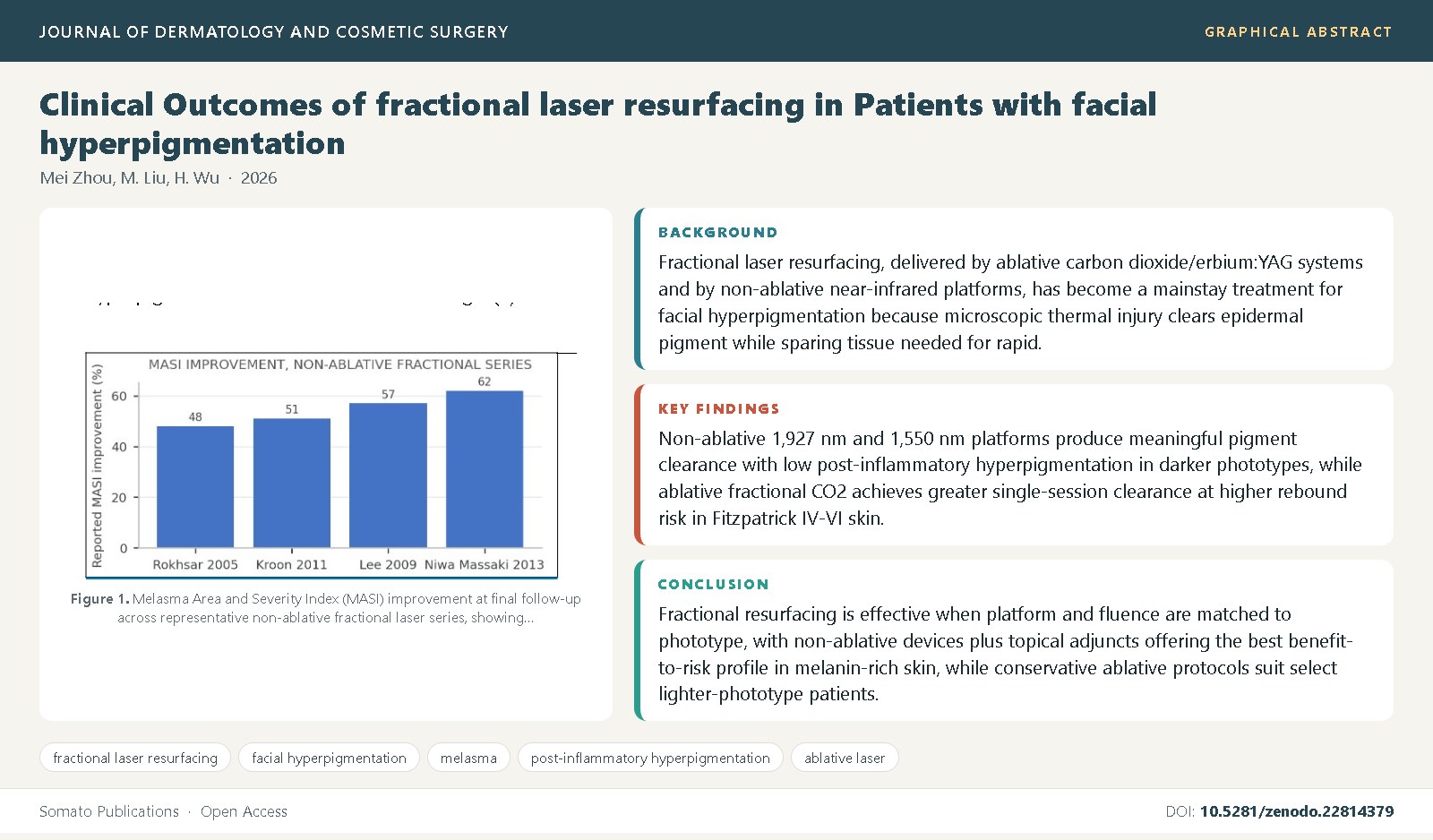
Background: Fractional laser resurfacing, delivered by ablative carbon dioxide/erbium:YAG systems and by non-ablative near-infrared platforms, has become a mainstay treatment for facial hyperpigmentation because microscopic thermal injury clears epidermal pigment while sparing tissue needed for rapid healing.
Objective: This review synthesizes clinical evidence on fractional laser outcomes in facial hyperpigmentation, comparing ablative and non-ablative platforms, wavelength-dependent efficacy, phototype-specific adverse events, and combination strategies.
Methods: We synthesized randomized trials, prospective cohorts, and split-face comparisons evaluating fractional resurfacing for post-inflammatory hyperpigmentation, melasma, and solar lentigines, with attention to outcome measures, energy parameters, and complication rates.
Findings: Non-ablative 1,927 nm and 1,550 nm platforms produce meaningful pigment clearance with low post-inflammatory hyperpigmentation in darker phototypes, while ablative fractional CO2 achieves greater single-session clearance at higher rebound risk in Fitzpatrick IV-VI skin; combination protocols with tranexamic acid, hydroquinone, or platelet-rich plasma outperform monotherapy.
Conclusions: Fractional resurfacing is effective when platform and fluence are matched to phototype, with non-ablative devices plus topical adjuncts offering the best benefit-to-risk profile in melanin-rich skin, while conservative ablative protocols suit select lighter-phototype patients.
References
Fitzpatrick, T.B. (1988) The validity and practicality of sun-reactive skin types I through VI. Archives of Dermatology, 124(6): 869-871. DOI: 10.1001/archderm.1988.01670060015008
Ortonne, J.P., Arellano, I., Berneburg, M., Cestari, T., Chan, H., Grimes, P., et al. (2009) A global survey of the role of ultraviolet radiation and hormonal influences in the development of melasma. Journal of the European Academy of Dermatology and Venereology, 23(11): 1254-1262. DOI: 10.1111/j.1468-3083.2009.03295.x
Manstein, D., Herron, G.S., Sink, R.K., Tanner, H., Anderson, R.R. (2004) Fractional photothermolysis: a new concept for cutaneous remodeling using microscopic patterns of thermal injury. Lasers in Surgery and Medicine, 34(5): 426-438. DOI: 10.1002/lsm.20048
Davis, E.C., Callender, V.D. (2010) Postinflammatory hyperpigmentation: a review of the epidemiology, clinical features, and treatment options in skin of color. Journal of Clinical and Aesthetic Dermatology, 3(7): 20-31.
Chan, H.H., Manstein, D., Yu, C.S., Shek, S., Kono, T., Wei, W.I. (2007) The prevalence and risk factors of post-inflammatory hyperpigmentation after fractional resurfacing in Asians. Lasers in Surgery and Medicine, 39(5): 381-385. DOI: 10.1002/lsm.20512
Hantash, B.M., Bedi, V.P., Kapadia, B., Rahman, Z., Jiang, K., Tanner, H., et al. (2007) In vivo histological evaluation of a novel ablative fractional resurfacing device. Lasers in Surgery and Medicine, 39(2): 96-107. DOI: 10.1002/lsm.20468
Hantash, B.M., Bedi, V.P., Chan, K.F., Zachary, C.B. (2007) Ex vivo histological characterization of a novel ablative fractional resurfacing device. Lasers in Surgery and Medicine, 39(2): 87-95. DOI: 10.1002/lsm.20438
Goldberg, D.J., Berlin, A.L., Phelps, R. (2008) Histologic and ultrastructural analysis of melasma after fractional resurfacing. Lasers in Surgery and Medicine, 40(2): 134-138. DOI: 10.1002/lsm.20591
Saedi, N., Jalian, H.R., Petelin, A., Zachary, C. (2012) Fractionated lasers: theory and practice. Clinics in Dermatology, 30(5): 562-570. DOI:
1016/j.clindermatol.2011.08.036 10. Wanitphakdeedecha, R., Manuskiatti, W., Siriphukpong, S., Chen, T.M. (2009) Treatment of melasma using variable square pulse Er:YAG laser resurfacing. Dermatologic Surgery, 35(3): 475-481. DOI: 10.1111/j.1524-4725.2009.01072.x
Manuskiatti, W., Triwongwaranat, D., Varothai, S., Eimpunth, S., Wanitphakdeedecha, R. (2010) Efficacy and safety of a carbon-dioxide ablative fractional resurfacing device for treatment of atrophic acne scars in Asians. Journal of the American Academy of Dermatology, 63(2): 274-283. DOI: 10.1016/j.jaad.2009.08.051
Tierney, E.P., Hanke, C.W. (2011) Fractionated carbon dioxide laser treatment of photoaging: prospective study in 45 patients and review of the literature. Dermatologic Surgery, 37(9): 1279-1290. DOI: 10.1111/j.1524-4725.2011.02069.x
Trelles, M.A., Velez, M., Gold, M.H. (2010) The treatment of melasma with topical creams alone, CO2 fractional ablative resurfacing alone, or a combination of the two: a comparative study. Journal of Drugs in Dermatology, 9(4): 315-322.
Rokhsar, C.K., Fitzpatrick, R.E. (2005) The treatment of melasma with fractional photothermolysis: a pilot study. Dermatologic Surgery, 31(12): 1645-1650. DOI: 10.2310/6350.2005.31251
Kroon, M.W., Wind, B.S., Beek, J.F., van der Veen, J.P., Nieuweboer-Krobotova, L., Bos, J.D., et al. (2011) Nonablative 1550-nm fractional laser therapy versus triple topical therapy for the treatment of melasma: a randomized controlled pilot study. Journal of the American Academy of Dermatology, 64(3): 516-523. DOI: 10.1016/j.jaad.2010.04.033
Lee, H.S., Won, C.H., Lee, D.H., An, J.S., Chang, H.W., Lee, J.H., et al. (2009) Treatment of melasma in Asian skin using a fractional 1,550-nm laser: an open clinical study. Dermatologic Surgery, 35(10): 1499-1504. DOI: 10.1111/j.1524-4725.2009.01264.x
Niwa Massaki, A.B., Eimpunth, S., Fabi, S.G., Guiha, I., Groff, W., Fitzpatrick, R. (2013) Treatment of melasma with the 1,927-nm fractional thulium fiber laser: a retrospective analysis of 20 cases with long-term follow-up. Lasers in Surgery and Medicine, 45(2): 95-101. DOI: 10.1002/lsm.22118
Bae, Y.S., Rettig, S., Weiss, E., Bernstein, L., Geronemus, R. (2020) Treatment of post-inflammatory hyperpigmentation in patients with darker skin types using a low energy 1,927 nm non-ablative fractional laser: a retrospective photographic review analysis. Journal of Drugs in Dermatology, 19(1): 45-48.
Saluja, S.S., Walker, M.L., Summerlin, J., Elliott, J., Emer, J.J., Barr, J. (2017) A split-face, rater-blinded evaluation of two fractionated 1,927 nm and 1,565 nm nonablative lasers for the treatment of photodamage and melasma. Journal of Drugs in Dermatology, 16(11): 1108-1112.
Chan, J.C., Shek, S.Y., Kono, T., Yeung, C.K., Chan, H.H. (2019) Fractional 1,927 nm nonablative laser: a targeted treatment for melasma. Lasers in Surgery and Medicine, 51(1): 33-40. DOI: 10.1002/lsm.23018
Jalaly, N.Y., Valizadeh, N., Barikbin, B., Yousefi, M. (2014) Low-fluence Q-switched Nd:YAG laser versus low-fluence Q-switched Nd:YAG laser plus fractional laser for treatment of melasma: a randomized controlled trial. Indian Journal of Dermatology, 59(4): 361-366. DOI: 10.4103/0019-5154.135486
Karsai, S., Fischer, T., Pohl, L., Raulin, C. (2011) Is Q-switched ruby laser treatment effective in melasma? A prospective analysis. Journal of the European Academy of Dermatology and Venereology, 25(6): 733-738. DOI: 10.1111/j.1468-3083.2010.03895.x
Wang, C.C., Hui, C.Y., Sue, Y.M., Wong, W.R., Hong, H.S. (2004) Intense pulsed light for the treatment of refractory melasma in Asian persons. Dermatologic Surgery, 30(9): 1196-1200. DOI: 10.1111/j.1524-4725.2004.30360.x
Polnikorn, N. (2010) Treatment of refractory melasma with the MedLite C6 Q-switched Nd:YAG laser and alpha arbutin: a prospective study. Journal of Cosmetic and Laser Therapy, 12(3): 126-131. DOI: 10.3109/14764172.2010.487910
Sarkar, R., Arora, P., Garg, K.V., Sonthalia, S., Gokhale, N. (2014) Melasma update. Indian Dermatology Online Journal, 5(4): 426-435. DOI: 10.4103/2229-5178.142484
Arora, P., Sarkar, R., Garg, V.K., Arya, L. (2012) Lasers for treatment of melasma and post-inflammatory hyperpigmentation. Journal of Cutaneous and Aesthetic Surgery, 5(2): 93-103. DOI: 10.4103/0974-2077.99436
Taylor, S.C. (2002) Skin of color: biology, structure, function, and implications for dermatologic disease. Journal of the American Academy of Dermatology, 46(2 Suppl Understanding): S41-62. DOI: 10.1067/mjd.2002.120790
Lupton, J.R., Alster, T.S. (2002) Laser resurfacing: pearls and problems. Dermatologic Clinics, 20(1): 129-136. DOI: 10.1016/S0733-8635(03)00048-3
Chan, H.H., Kono, T. (2004) The use of lasers and intense pulsed light sources for the treatment of pigmentary lesions. Skin Therapy Letter, 9(8): 5-7.
Tannous, Z.S., Astner, S. (2005) Utilizing fractional resurfacing in the treatment of therapy-resistant melasma. Journal of Cosmetic and Laser Therapy, 7(1): 39-43. DOI: 10.1080/14764170510037778
Kauvar, A.N. (2012) Successful treatment of hyperpigmentation using a fractional erbium-doped 1,550 nm laser and topical hydroquinone. Journal of Drugs in Dermatology, 11(9): e14-e17.
Kim, H.J., Moon, S.H., Cho, S.H., Lee, J.D., Kim, H.S. (2017) Efficacy and safety of tranexamic acid in melasma: a meta-analysis and systematic review. Acta Dermato-Venereologica, 97(7): 776-781. DOI: 10.2340/00015555-2668
Gawdat, H.I., Hegazy, R.A., Fawzy, M.M., Fathy, M. (2014) Autologous platelet-rich plasma: topical versus intradermal after fractional ablative carbon dioxide laser resurfacing for atrophic acne scars. Dermatologic Surgery, 40(2): 152-161. DOI: 10.1111/dsu.12392
Behroozan, D.S., Goldberg, L.H., Dai, T., Geronemus, R.G., Friedman, P.M. (2006) Fractional photothermolysis for the treatment of hyperpigmented lower extremity ulcer scars: a pilot study. Journal of the American Academy of Dermatology, 55(1): 85-90. DOI: 10.1016/j.jaad.2006.02.033

Published
Issue
Section
License
Copyright (c) 2026 Mei Zhou, et al.

This work is licensed under a Creative Commons Attribution 4.0 International License.


