
Clinical Outcomes of botulinum toxin injection in Patients with acne vulgaris
DOI:
https://doi.org/10.5281/zenodo.22814399Keywords:
botulinum toxin, acne vulgaris, sebum reduction, microbotox, facial poresAbstract
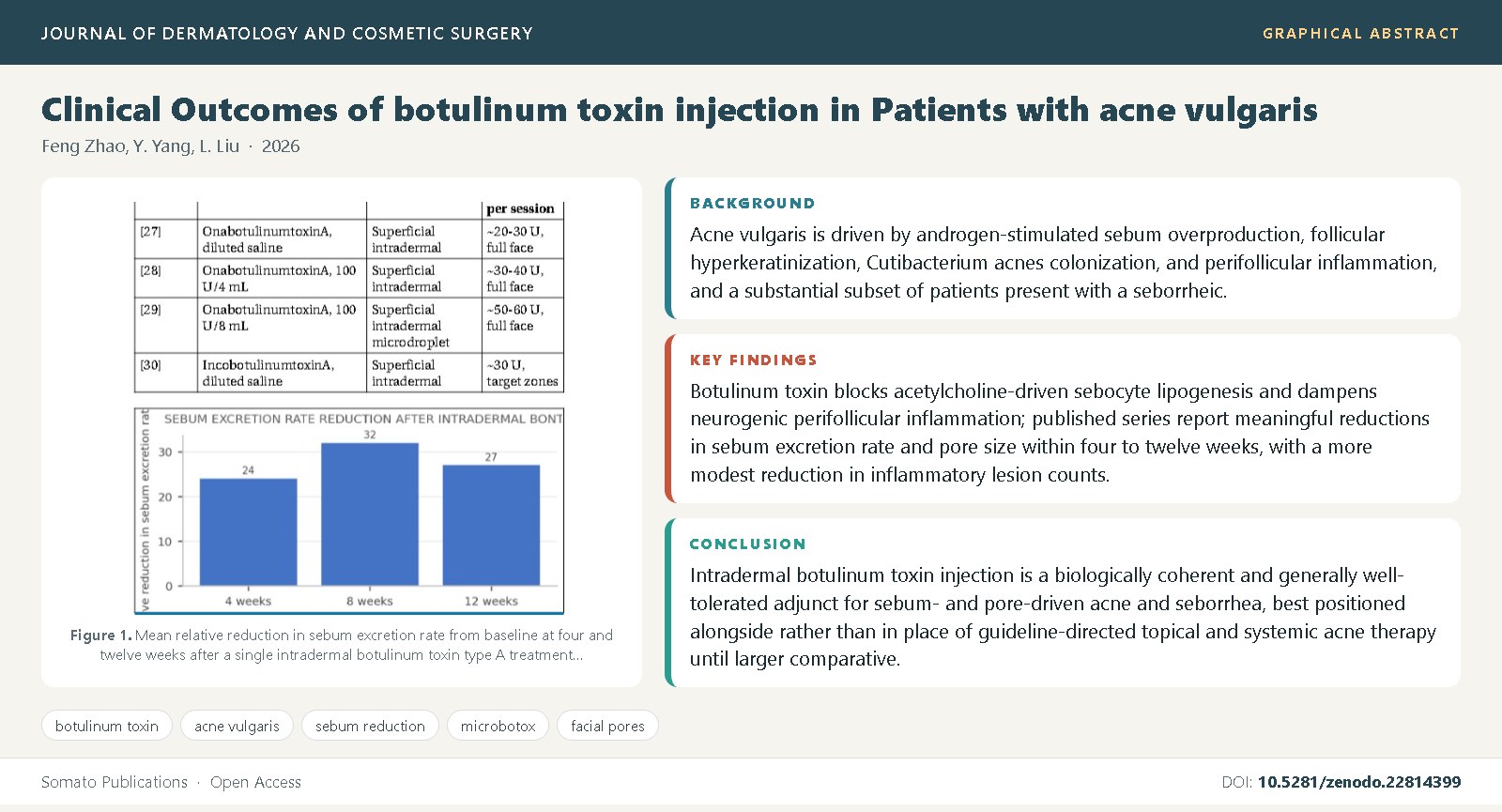
Background: Acne vulgaris is driven by androgen-stimulated sebum overproduction, follicular hyperkeratinization, Cutibacterium acnes colonization, and perifollicular inflammation, and a substantial subset of patients present with a seborrheic, enlarged-pore phenotype that responds poorly to conventional comedolytic and antimicrobial regimens.
Objective: This review examines the rationale for, and the clinical evidence supporting, superficial intradermal botulinum toxin type A injection as a treatment for acne vulgaris, focusing on sebum output, pore size, and inflammatory lesion counts.
Methods: We synthesized mechanistic, in vitro, and clinical studies addressing cholinergic regulation of the pilosebaceous unit, intradermal botulinum toxin injection technique, and reported outcomes in patients with acne vulgaris or seborrhea-predominant oily skin.
Findings: Botulinum toxin blocks acetylcholine-driven sebocyte lipogenesis and dampens neurogenic perifollicular inflammation; published series report meaningful reductions in sebum excretion rate and pore size within four to twelve weeks, with a more modest reduction in inflammatory lesion counts, while adverse events are dominated by transient bruising, with motor complications rare when depth is controlled.
Conclusions: Intradermal botulinum toxin injection is a biologically coherent and generally well-tolerated adjunct for sebum- and pore-driven acne and seborrhea, best positioned alongside rather than in place of guideline-directed topical and systemic acne therapy until larger comparative and long-term trials clarify its role in inflammatory lesion and scarring outcomes.
References
Zouboulis, C.C. (2004) Acne and sebaceous gland function. Clinics in Dermatology, 22(5): 360-366. DOI: 10.1016/j.clindermatol.2004.03.004
Kurokawa, I., Danby, F.W., Ju, Q., Wang, X., Xiang, L.F., Xia, L., et al. (2009) New developments in our understanding of acne pathogenesis and treatment. Experimental Dermatology, 18(10): 821-832. DOI: 10.1111/j.1600-0625.2009.00890.x
Thiboutot, D. (2004) Regulation of human sebaceous glands. Journal of Investigative Dermatology, 123(1): 1-12. DOI: 10.1111/j.0022-202X.2004.23417.x
Zaenglein, A.L., Pathy, A.L., Schlosser, B.J., Alikhan, A., Baldwin, H.E., Berson, D.S., et al. (2016) Guidelines of care for the management of acne vulgaris. Journal of the American Academy of Dermatology, 74(5): 945-973. DOI: 10.1016/j.jaad.2015.12.037
Gollnick, H., Cunliffe, W., Berson, D., Dreno, B., Finlay, A., Leyden, J.J., et al. (2003) Management of acne: a report from a Global Alliance to Improve Outcomes in Acne. Journal of the American Academy of Dermatology, 49(1 Suppl): S1-S37. DOI: 10.1067/mjd.2003.618
Tan, J.K., Bhate, K. (2015) A global perspective on the epidemiology of acne. British Journal of Dermatology, 172(Suppl 1): 3-12. DOI: 10.1111/bjd.13462
Costa, C.S., Bagatin, E. (2017) Evidence on acne therapy. Sao Paulo Medical Journal, 135(2): 154-161. DOI: 10.1590/1516-3180.2016.0298010217
Carruthers, A., Carruthers, J. (2004) Botulinum toxin type A: history and current cosmetic use in the upper face. Seminars in Cutaneous Medicine and Surgery, 20(2): 71-84.
Small, R. (2014) Botulinum toxin injection for facial wrinkles. American Family Physician, 90(3): 168-175.
Nigam, P.K., Nigam, A. (2010) Botulinum toxin. Indian Journal of Dermatology, 55(1): 8-14. DOI: 10.4103/0019-5154.60343
Wu, W.T.L. (2015) Microbotox of the lower face and neck: evolution of a personal technique and its clinical effects. Plastic and Reconstructive Surgery, 136(5 Suppl): 92S-100S. DOI: 10.1097/PRS.0000000000001739
Wu, W.T.L. (2010) Botox facial slimming/facial sculpting: the role of botulinum toxin-A in the treatment of hypertrophic masseteric muscle and parotid gland enlargement to narrow the lower facial width. Facial Plastic Surgery Clinics of North America, 18(1): 133-140. DOI: 10.1016/j.fsc.2009.11.007
Li, Z.J., Park, S.B., Sohn, K.C., Lee, Y., Seo, Y.J., Kim, C.D., et al. (2013) Regulation of lipid production by acetylcholine signalling in human sebaceous glands. Journal of Dermatological Science, 72(2): 116-122. DOI: 10.1016/j.jdermsci.2013.06.009
Roh, M., Han, M., Kim, D., Chung, K. (2006) Sebum output as a factor contributing to the size of facial pores. British Journal of Dermatology, 155(5): 890-894. DOI: 10.1111/j.1365-2133.2006.07465.x
Sato, K., Fujita, S., Kanke, Y., Matsumoto, K. (2007) Facial pore size reduction with topical treatment: correlation with sebum excretion rate and follicular casts. Skin Research and Technology, 13(3): 250-254. DOI: 10.1111/j.1600-0846.2007.00238.x
Dreno, B., Pecastaings, S., Corvec, S., Veraldi, S., Khammari, A., Roques, C. (2018) Cutibacterium acnes (Propionibacterium acnes) and acne vulgaris: a brief look at the latest updates. Journal of the European Academy of Dermatology and Venereology, 32(Suppl 2): 5-14. DOI: 10.1111/jdv.15043
Tanghetti, E.A. (2013) The role of inflammation in the pathology of acne. Journal of Clinical and Aesthetic Dermatology, 6(9): 27-35.
Smith, R.N., Mann, N.J., Braue, A., Makelainen, H., Varigos, G.A. (2008) The effect of a high-protein, low glycemic-load diet versus a conventional, high glycemic-load diet on biochemical parameters associated with acne vulgaris. Journal of the American Academy of Dermatology, 58(5): 787-793. DOI: 10.1016/j.jaad.2007.05.004
Lolis, M.S., Bowe, W.P., Shalita, A.R. (2013) Acne and systemic disease. Medical Clinics of North America, 93(6): 1161-1181. DOI: 10.1016/j.mcna.2009.08.008
Bagatin, E., Freitas, T.H.P., Rivitti-Machado, M.C., Machado, M.C.R., Ribeiro, B.M., Nunes, S., et al. (2019) Adult female acne: a guide to clinical practice. Anais Brasileiros de Dermatologia, 94(1): 62-75. DOI: 10.1590/abd1806-4841.20198203
Dessinioti, C., Katsambas, A. (2017) Difficult and rare forms of acne. Clinics in Dermatology, 35(2): 138-146. DOI: 10.1016/j.clindermatol.2016.10.005
Cong, T.X., Hao, D., Wen, X., Li, X.H., He, G., Jiang, X. (2019) From pathogenesis of acne vulgaris to anti-acne agents. Archives of Dermatological Research, 311(5): 337-349. DOI: 10.1007/s00403-019-01908-x
Park, J.M., Han, S.J., Suh, H.S., Choi, G.S. (2011) Botulinum toxin: clinical usages in dermatology focusing on the applications for hyperhidrosis. Journal of the European Academy of Dermatology and Venereology, 25(9): 1005-1015. DOI: 10.1111/j.1468-3083.2010.03929.x
Choi, J.E., Werbel, T., Wang, Z., Wu, C.C., Yaksh, T.L., Huang, E.J. (2013) Botulinum toxin blocks the release of neuropeptides from mouse dorsal root ganglion neurons. Neuroscience, 254: 377-389. DOI: 10.1016/j.neuroscience.2013.09.002
Georgescu, S.R., Mitran, C.I., Mitran, M.I., Caruntu, C., Sarbu, M.I., Matei, C., et al. (2022) Capitalizing on the anti-inflammatory effects of botulinum toxin. International Journal of Molecular Sciences, 23(16): 9315. DOI: 10.3390/ijms23169315
Rho, N.K., Gil, Y.C. (2021) Botulinum neurotoxin type A for the treatment of facial seborrhea and acne: evidence and a proposed mechanism. Toxins, 13(11): 817. DOI: 10.3390/toxins13110817
Shah, A.R. (2008) Use of intradermal botulinum toxin to reduce sebum production and facial pore size. Journal of Drugs in Dermatology, 7(9): 847-850.
Rose, A.E., Goldberg, D.J. (2013) Safety and efficacy of intradermal injection of botulinum toxin for the treatment of oily skin. Dermatologic Surgery, 39(3 Pt 1): 443-448. DOI: 10.1111/dsu.12097
Sayed, K.S., Hegazy, R., Gawdat, H.I., Abdel Hay, R.M., Ahmed, D.M. (2022) Intradermal injection of botulinum toxin type A for the management of oily skin, enlarged facial pores and mild to moderate acne vulgaris. Journal of Cosmetic Dermatology, 21(9): 3776-3783. DOI: 10.1111/jocd.14649
Kang, I.J., Lew, B.L., Sim, W.Y. (2016) Botulinum toxin type A for the treatment of enlarged facial pores and seborrhea: a pilot study. Journal of Cosmetic Dermatology, 15(4): 486-491. DOI: 10.1111/jocd.12244
Dayan, S.H., Arkins, J.P., Sadeghi, C.D., Brody, H.J., Reed, R.J. (2015) Botulinum toxin A for facial rejuvenation. Facial Plastic Surgery Clinics of North America, 23(3): 253-264. DOI: 10.1016/j.fsc.2015.04.001
Klein, A.W. (2003) Complications, adverse reactions, and insights with the use of botulinum toxin. Dermatologic Surgery, 29(5): 549-556. DOI: 10.1046/j.1524-4725.2003.29129.x
Erickson, B.P., Lee, W.W., Cohen, J., Grunebaum, L.D. (2016) The role of neurotoxins in the periorbital and midfacial areas. Facial Plastic Surgery Clinics of North America, 24(2): 133-144. DOI: 10.1016/j.fsc.2016.01.001
Signorini, M., Liew, S., Sundaram, H., De Boulle, K.L., Goodman, G.J., Monheit, G., et al. (2016) Global aesthetics consensus: avoidance and management of complications from hyaluronic acid fillers-evidence- and opinion-based review and consensus recommendations. Plastic and Reconstructive Surgery, 137(6): 961e-971e. DOI: 10.1097/PRS.0000000000002184
Jung, G.W., Spelman, L., Yoon, M.S. (2015) A split-face study of the effect of botulinum toxin on facial sebum production and pore size. Journal of Cosmetic and Laser Therapy, 17(2): 96-98. DOI: 10.3109/14764172.2014.968576
Layton, A.M. (2016) Top ten list of clinical pearls in the treatment of acne vulgaris. Dermatologic Clinics, 34(2): 147-157. DOI: 10.1016/j.det.2015.11.008
Jansen, T., Grabbe, S. (2010) Acne inversa. Deutsches Arzteblatt International, 107(28-29): 501-510. DOI: 10.3238/arztebl.2010.0501

Published
Issue
Section
License
Copyright (c) 2026 Feng Zhao, et al.

This work is licensed under a Creative Commons Attribution 4.0 International License.


