
Predictors of lesion clearance rate in adult dermatology patients with acne vulgaris
DOI:
https://doi.org/10.5281/zenodo.22814476Keywords:
acne vulgaris, lesion clearance, isotretinoin, adult acne, treatment responseAbstract
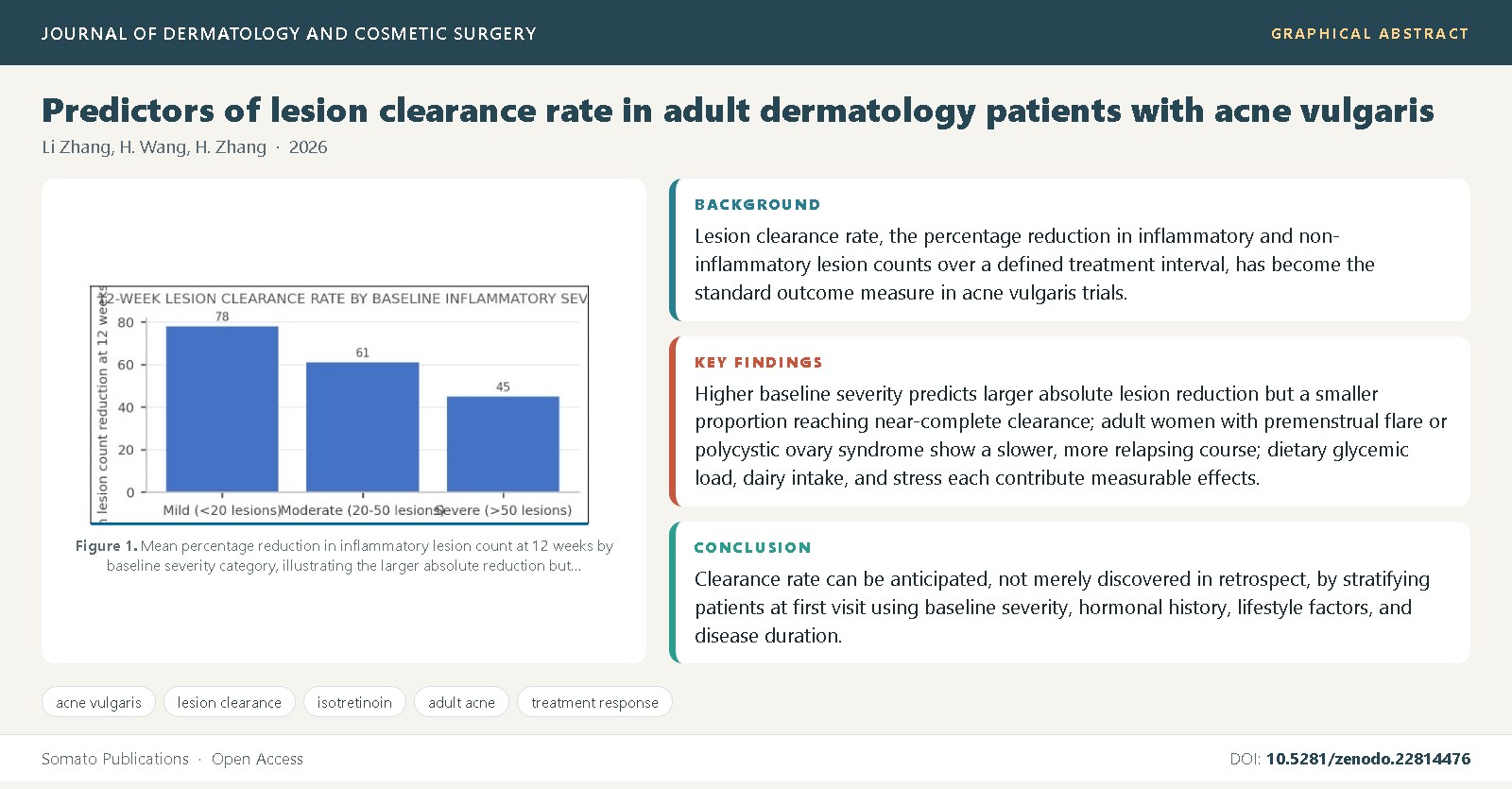
Background: Lesion clearance rate, the percentage reduction in inflammatory and non-inflammatory lesion counts over a defined treatment interval, has become the standard outcome measure in acne vulgaris trials, yet patients started on identical regimens at identical baseline severity often diverge sharply in how quickly they clear.
Objective: This review synthesizes the published evidence on patient-level, disease-level, and treatment-level predictors of lesion clearance rate in adult dermatology patients with acne vulgaris.
Methods: We synthesized epidemiological cohorts, randomized treatment trials, and consensus guideline literature addressing baseline severity, hormonal and sex-related factors, lifestyle and psychosocial contributors, and treatment regimen intensity as determinants of clearance trajectory.
Findings: Higher baseline severity predicts larger absolute lesion reduction but a smaller proportion reaching near-complete clearance; adult women with premenstrual flare or polycystic ovary syndrome show a slower, more relapsing course; dietary glycemic load, dairy intake, and stress each contribute measurable effects; and combination topical therapy, adequate cumulative isotretinoin dosing, and early follow-up are the strongest clinician-modifiable predictors of faster clearance.
Conclusions: Clearance rate can be anticipated, not merely discovered in retrospect, by stratifying patients at first visit using baseline severity, hormonal history, lifestyle factors, and disease duration, allowing earlier regimen intensification for patients on a predictably slower-clearing trajectory.
References
Williams, H.C., Dellavalle, R.P., Garner, S. (2012) Acne vulgaris. Lancet, 379(9813): 361-372. DOI: 10.1016/S0140-6736(11)60321-8
Tan, J.K.L., Bhate, K. (2015) A global perspective on the epidemiology of acne. British Journal of Dermatology, 172(Suppl 1): 3-12. DOI: 10.1111/bjd.13462
Goulden, V., Clark, S.M., Cunliffe, W.J. (1997) Post-adolescent acne: a review of clinical features. British Journal of Dermatology, 136(1): 66-70.
Dreno, B., Thiboutot, D., Layton, A.M., Berson, D., Perez, M., Kang, S. (2015) Large-scale international study enhances understanding of an emerging acne population: adult females. Journal of the European Academy of Dermatology and Venereology, 29(6): 1096-1106. DOI: 10.1111/jdv.12757
Zaenglein, A.L., Pathy, A.L., Schlosser, B.J., Alikhan, A., Baldwin, H.E., Berson, D.S., et al. (2016) Guidelines of care for the management of acne vulgaris. Journal of the American Academy of Dermatology, 74(5): 945-973.e33. DOI: 10.1016/j.jaad.2015.12.037
Gollnick, H., Cunliffe, W., Berson, D., Dreno, B., Finlay, A., Leyden, J.J., et al. (2003) Management of acne: a report from a Global Alliance to Improve Outcomes in Acne. Journal of the American Academy of Dermatology, 49(1 Suppl): S1-S37. DOI: 10.1067/mjd.2003.618
Thiboutot, D.M., Dreno, B., Abanmi, A., Alexis, A.F., Araviiskaia, E., Barona Cabal, M.I., et al. (2018) Practical management of acne for clinicians: an international consensus from the Global Alliance to Improve Outcomes in Acne. Journal of the American Academy of Dermatology, 78(2 Suppl 1): S1-S23. DOI: 10.1016/j.jaad.2017.09.078
Goodman, G.J., Baron, J.A. (2006) Postacne scarring: a qualitative global scarring grading system. Dermatologic Surgery, 32(12): 1458-1466. DOI: 10.1111/j.1524-4725.2006.32354.x
Layton, A.M., Henderson, C.A., Cunliffe, W.J. (1994) A clinical evaluation of acne scarring and its incidence. Clinical and Experimental Dermatology, 19(4): 303-308. DOI:
1111/j.1365-2230.1994.tb01200.x 10. Zouboulis, C.C. (2004) Acne and sebaceous gland function. Clinics in Dermatology, 22(5): 360-366. DOI: 10.1016/j.clindermatol.2004.03.004
Dumont-Wallon, G., Dreno, B. (2008) Specificity of acne in women older than 25 years. Presse Medicale, 37(4 Pt 2): 585-591. DOI: 10.1016/j.lpm.2007.10.023
Perkins, A.C., Cheng, C.E., Hillebrand, G.G., Miyamoto, K., Kimball, A.B. (2011) Comparison of the epidemiology of acne vulgaris among Caucasian, Asian, Continental Indian and African American women. Journal of the European Academy of Dermatology and Venereology, 25(9): 1054-1060. DOI: 10.1111/j.1468-3083.2010.03919.x
Lucky, A.W., Biro, F.M., Huster, G.A., Leach, A.D., Morrison, J.A., Ratterman, J. (1994) Acne vulgaris in premenarchal girls: an early sign of puberty associated with rising levels of dehydroepiandrosterone. Archives of Dermatology, 130(3): 308-314.
Housman, E., Reynolds, R.V. (2014) Polycystic ovary syndrome: a review for dermatologists: Part I. Diagnosis and manifestations. Journal of the American Academy of Dermatology, 71(5): 847.e1-847.e10. DOI: 10.1016/j.jaad.2014.05.007
Bataille, V., Snieder, H., MacGregor, A.J., Sasieni, P., Spector, T.D. (2002) The influence of genetics and environmental factors in the pathogenesis of acne: a twin study of acne in women. Journal of Investigative Dermatology, 119(6): 1317-1322. DOI: 10.1046/j.1523-1747.2002.19621.x
Di Landro, A., Cazzaniga, S., Parazzini, F., Ingordo, V., Cusano, F., Atzori, L., et al. (2012) Family history, body mass index, selected dietary factors, menstrual history, and risk of moderate to severe acne in adolescents and young adults. Journal of the American Academy of Dermatology, 67(6): 1129-1135. DOI: 10.1016/j.jaad.2012.02.018
Smith, R.N., Mann, N.J., Braue, A., Makelainen, H., Varigos, G.A. (2007) The effect of a high-protein, low glycemic-load diet versus a conventional, high glycemic-load diet on biochemical parameters associated with acne vulgaris: a randomized, investigator-masked, controlled trial. Journal of the American Academy of Dermatology, 57(2): 247-256. DOI: 10.1016/j.jaad.2007.01.046
Melnik, B.C. (2015) Linking diet to acne metabolomics, inflammation, and comedogenesis: an update. Clinical, Cosmetic and Investigational Dermatology, 8: 371-388. DOI: 10.2147/CCID.S69135
Adebamowo, C.A., Spiegelman, D., Danby, F.W., Frazier, A.L., Willett, W.C., Holmes, M.D. (2005) High school dietary dairy intake and teenage acne. Journal of the American Academy of Dermatology, 52(2): 207-214. DOI: 10.1016/j.jaad.2004.08.007
Bowe, W.P., Joshi, S.S., Shalita, A.R. (2010) Diet and acne. Journal of the American Academy of Dermatology, 63(1): 124-141. DOI: 10.1016/j.jaad.2009.07.043
Schafer, T., Nienhaus, A., Vieluf, D., Berger, J., Ring, J. (2001) Epidemiology of acne in the general population: the risk of smoking. British Journal of Dermatology, 145(1): 100-104. DOI: 10.1046/j.1365-2133.2001.04290.x
Capitanio, B., Sinagra, J.L., Ottaviani, M., Bordignon, V., Amantea, A., Picardo, M. (2009) Acne and smoking. Dermato-Endocrinology, 1(3): 129-135. DOI: 10.4161/derm.1.3.9638
Chiu, A., Chon, S.Y., Kimball, A.B. (2003) The response of skin disease to stress: changes in the severity of acne vulgaris as affected by examination stress. Archives of Dermatology, 139(7): 897-900. DOI: 10.1001/archderm.139.7.897
Yosipovitch, G., Tang, M., Dawn, A.G., Chen, M., Goh, C.L., Chan, Y.H., et al. (2007) Study of psychological stress, sebum production and acne vulgaris in adolescents. Acta Dermato-Venereologica, 87(2): 135-139. DOI: 10.2340/00015555-0231
Leyden, J.J., Hickman, J.G., Jarratt, M.T., Stewart, D.M., Levy, S.F. (2001) The efficacy and safety of a combination benzoyl peroxide/clindamycin topical gel compared with benzoyl peroxide alone and a benzoyl peroxide/erythromycin combination product. Journal of Cutaneous Medicine and Surgery, 5(1): 37-42.
Ozolins, M., Eady, E.A., Avery, A.J., Cunliffe, W.J., Po, A.L., O'Neill, C., et al. (2004) Comparison of five antimicrobial regimens for treatment of mild to moderate inflammatory facial acne vulgaris in the community: randomised controlled trial. Lancet, 364(9452): 2188-2195. DOI: 10.1016/S0140-6736(04)17591-0
Simonart, T., Dramaix, M. (2005) Treatment of acne with topical antibiotics: lessons from clinical studies. British Journal of Dermatology, 153(2): 395-403. DOI: 10.1111/j.1365-2133.2005.06614.x
Garner, S.E., Eady, A., Bennett, C., Newton, J.N., Thomas, K., Popescu, C.M. (2012) Minocycline for acne vulgaris: efficacy and safety. Cochrane Database of Systematic Reviews, (8): CD002086. DOI: 10.1002/14651858.CD002086.pub2
Layton, A.M., Knaggs, H., Taylor, J., Cunliffe, W.J. (1993) Isotretinoin for acne vulgaris--10 years later: a safe and successful treatment. British Journal of Dermatology, 129(3): 292-296. DOI: 10.1111/j.1365-2133.1993.tb11853.x
Rademaker, M. (2013) Isotretinoin: dose, duration and relapse. What does 30 years of usage tell us? Australasian Journal of Dermatology, 54(3): 157-162. DOI: 10.1111/ajd.12024
Lee, J.W., Yoo, K.H., Park, K.Y., Han, T.Y., Li, K., Seo, S.J., et al. (2011) Effectiveness of conventional, low-dose and intermittent oral isotretinoin in the treatment of acne: a randomized, controlled comparative study. British Journal of Dermatology, 164(6): 1369-1375. DOI: 10.1111/j.1365-2133.2011.10253.x
Blasiak, R.C., Stamey, C.R., Burkhart, C.N., Lugo-Somolinos, A., Morrell, D.S. (2013) High-dose isotretinoin treatment and the rate of retrial, relapse, and adverse effects in patients with acne vulgaris. JAMA Dermatology, 149(12): 1392-1398. DOI: 10.1001/jamadermatol.2013.6746
Kraft, J., Freiman, A. (2011) Management of acne. CMAJ, 183(7): E430-E435. DOI: 10.1503/cmaj.090374
Dessinioti, C., Katsambas, A.D. (2010) The role of Propionibacterium acnes in acne pathogenesis: facts and controversies. Clinics in Dermatology, 28(1): 2-7. DOI: 10.1016/j.clindermatol.2009.03.012
Dreno, B., Gollnick, H.P., Kang, S., Thiboutot, D., Bettoli, V., Torres, V., et al. (2018) Understanding innate immunity and inflammation in acne: implications for management. Journal of the European Academy of Dermatology and Venereology, 29(Suppl 4): 3-11. DOI: 10.1111/jdv.13190
Lee, Y.B., Byun, E.J., Kim, H.S. (2019) Potential role of the microbiome in acne: a comprehensive review. Journal of Clinical Medicine, 8(7): 987. DOI: 10.3390/jcm8070987
Cunliffe, W.J., Gould, D.J. (1979) Prevalence of facial acne vulgaris in late adolescence and in adults. British Medical Journal, 1(6171): 1109-1110. DOI: 10.1136/bmj.1.6171.1109

Published
Issue
Section
License
Copyright (c) 2026 Li Zhang, et al.

This work is licensed under a Creative Commons Attribution 4.0 International License.


