
Comparative Analysis of fractional laser resurfacing versus Standard Care in acne vulgaris
DOI:
https://doi.org/10.5281/zenodo.22814325Keywords:
acne vulgaris, fractional laser resurfacing, atrophic scarring, isotretinoin, skin resurfacingAbstract
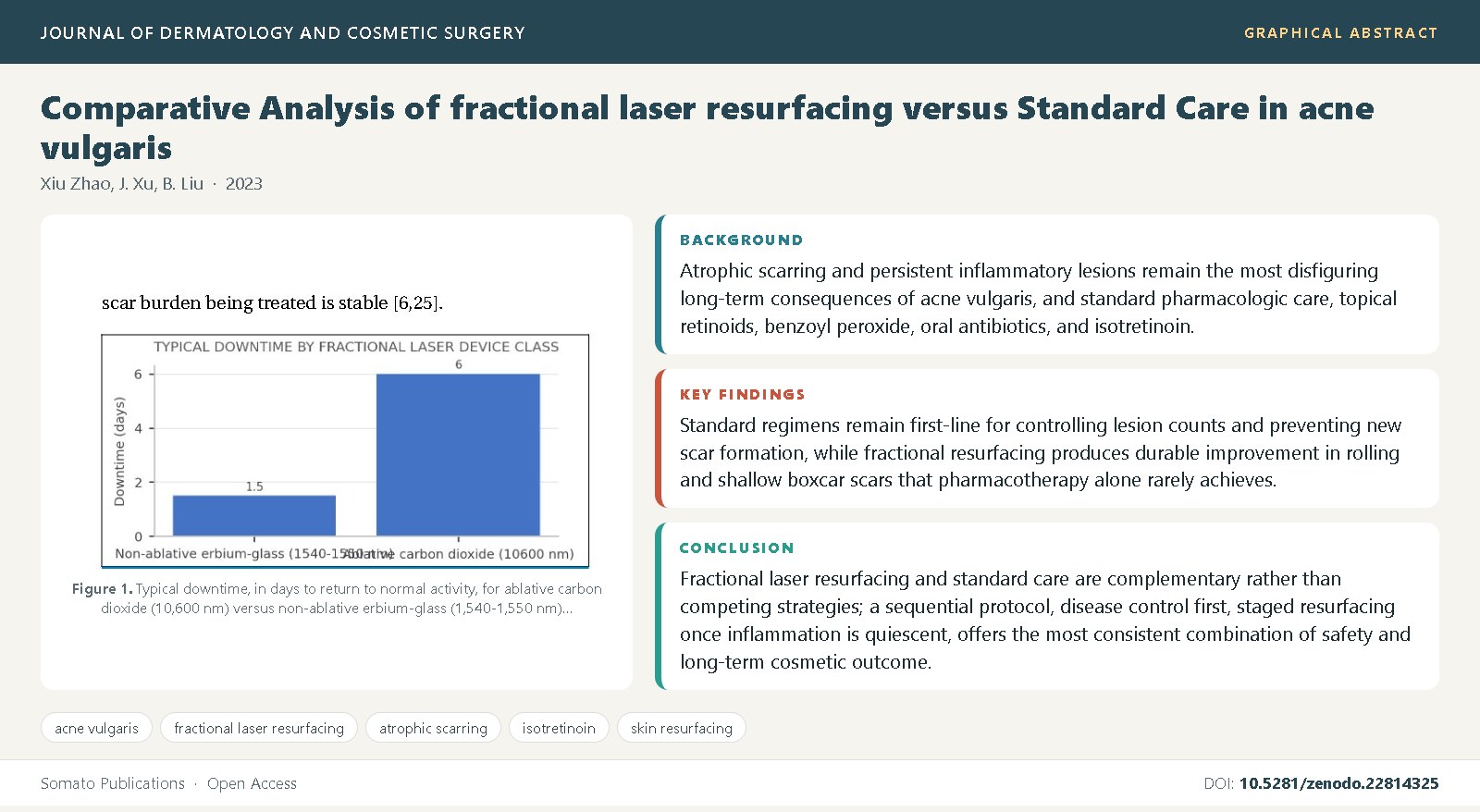
Background: Atrophic scarring and persistent inflammatory lesions remain the most disfiguring long-term consequences of acne vulgaris, and standard pharmacologic care, topical retinoids, benzoyl peroxide, oral antibiotics, and isotretinoin, treats active disease more reliably than it reverses established dermal damage.
Objective: This review compares fractional laser resurfacing with standard pharmacologic care for acne vulgaris and post-acne scarring, evaluating efficacy for active lesions, efficacy for atrophic scarring, safety, and the role of combined regimens.
Methods: We synthesized randomized and split-face trials, prospective cohorts, and consensus guidelines addressing ablative and non-ablative fractional laser resurfacing, topical and systemic acne pharmacotherapy, and comparative or combination protocols in acne vulgaris and acne scarring.
Findings: Standard regimens remain first-line for controlling lesion counts and preventing new scar formation, while fractional resurfacing produces durable improvement in rolling and shallow boxcar scars that pharmacotherapy alone rarely achieves; non-ablative erbium-glass devices offer shorter recovery than ablative carbon dioxide systems with comparable improvement, and sequencing acne control before staged resurfacing outperforms either modality alone.
Conclusions: Fractional laser resurfacing and standard care are complementary rather than competing strategies; a sequential protocol, disease control first, staged resurfacing once inflammation is quiescent, offers the most consistent combination of safety and long-term cosmetic outcome.
References
Bhate, K., Williams, H.C. (2013) Epidemiology of acne vulgaris. British Journal of Dermatology, 168(3): 474-485. DOI: 10.1111/bjd.12149
Tan, J.K., Bhate, K. (2015) A global perspective on the epidemiology of acne. British Journal of Dermatology, 172(Suppl 1): 3-12. DOI: 10.1111/bjd.13462
Layton, A.M., Henderson, C.A., Cunliffe, W.J. (1994) A clinical evaluation of acne scarring and its incidence. Clinical and Experimental Dermatology, 19(4): 303-308.
Jacob, C.I., Dover, J.S., Kaminer, M.S. (2001) Acne scarring: a classification system and review of treatment options. Journal of the American Academy of Dermatology, 45(1): 109-117. DOI: 10.1067/mjd.2001.113451
Gollnick, H., Cunliffe, W., Berson, D., Dreno, B., Finlay, A., Leyden, J.J., et al. (2003) Management of acne: a report from a Global Alliance to Improve Outcomes in Acne. Journal of the American Academy of Dermatology, 49(1 Suppl): S1-S37. DOI: 10.1067/mjd.2003.618
Zaenglein, A.L., Pathy, A.L., Schlosser, B.J., Alikhan, A., Baldwin, H.E., Berson, D.S., et al. (2016) Guidelines of care for the management of acne vulgaris. Journal of the American Academy of Dermatology, 74(5): 945-973. DOI: 10.1016/j.jaad.2015.12.037
Thiboutot, D.M., Dreno, B., Abanmi, A., Alexis, A.F., Araviiskaia, E., Barona Cabal, M.I., et al. (2018) Practical management of acne for clinicians: an international consensus from the Global Alliance to Improve Outcomes in Acne. Journal of the American Academy of Dermatology, 78(2 Suppl 1): S1-S23. DOI: 10.1016/j.jaad.2017.09.078
Fabbrocini, G., Annunziata, M.C., D'Arco, V., De Vita, V., Lodi, G., Mauriello, M.C., et al. (2010) Acne scars: pathogenesis, classification and treatment. Dermatology Research and Practice, 2010: 893080. DOI: 10.1155/2010/893080
Rivera, A.E. (2008) Acne scarring: a review and current treatment modalities. Journal of the American Academy of Dermatology, 59(4): 659-676. DOI: 10.1016/j.jaad.2008.05.029
Manstein, D., Herron, G.S., Sink, R.K., Tanner, H., Anderson, R.R. (2004) Fractional photothermolysis: a new concept for cutaneous remodeling using microscopic patterns of thermal injury. Lasers in Surgery and Medicine, 34(5): 426-438. DOI: 10.1002/lsm.20048
Hantash, B.M., Bedi, V.P., Kapadia, B., Rahman, Z., Jiang, K., Tanner, H., et al. (2007) In vivo histological evaluation of a novel ablative fractional resurfacing device. Lasers in Surgery and Medicine, 39(2): 96-107. DOI: 10.1002/lsm.20468
Kang, S., Cho, S., Chung, J.H., Hammerberg, C., Fisher, G.J., Voorhees, J.J. (2005) Inflammation and extracellular matrix degradation mediated by activator protein-1 activation in acne lesions. American Journal of Pathology, 166(6): 1691-1699. DOI: 10.1016/S0002-9440(10)62479-0
Holland, D.B., Jeremy, A.H. (2005) The role of inflammation in the pathogenesis of acne and acne scarring. Seminars in Cutaneous Medicine and Surgery, 24(2): 79-83.
Goodman, G.J., Baron, J.A. (2006) Postacne scarring: a qualitative global scarring grading system. Dermatologic Surgery, 32(12): 1458-1466. DOI: 10.1111/j.1524-4725.2006.32354.x
Connolly, D., Vu, H.L., Mariwalla, K., Saedi, N. (2017) Acne scarring-pathogenesis, evaluation, and treatment options. Journal of Clinical and Aesthetic Dermatology, 10(9): 12-23.
Dreno, B. (2004) Topical antibacterial therapy for acne vulgaris. Drugs, 64(21): 2389-2397. DOI: 10.2165/00003495-200464210-00002
Eichenfield, L.F., Krakowski, A.C., Piggott, C., Del Rosso, J., Baldwin, H., Friedlander, S.F., et al. (2013) Evidence-based recommendations for the diagnosis and treatment of pediatric acne. Pediatrics, 131(Suppl 3): S163-186. DOI: 10.1542/peds.2013-0490B
Leyden, J.J., Del Rosso, J.Q., Baum, E.W. (2014) The use of isotretinoin in the treatment of acne vulgaris: clinical considerations and future directions. Journal of Clinical and Aesthetic Dermatology, 7(2 Suppl): S3-S21.
Gozali, M.V., Zhou, B. (2015) Effective treatments of atrophic acne scars. Journal of Clinical and Aesthetic Dermatology, 8(5): 33-40.
Sherling, M., Friedman, P.M., Adrian, R., Burns, A.J., Conn, H., Fitzpatrick, R., et al. (2010) Consensus recommendations on the use of an erbium-doped 1,550-nm fractionated laser and its applications in dermatologic laser surgery. Dermatologic Surgery, 36(4): 461-469. DOI: 10.1111/j.1524-4725.2010.01466.x
Behroozan, D.S., Goldberg, L.H., Dai, T., Geronemus, R.G., Friedman, P.M. (2006) Fractional photothermolysis for the treatment of surgical scars. Lasers in Surgery and Medicine, 38(2): 142-149. DOI: 10.1002/lsm.20268
Ong, M.W., Bashir, S.J. (2012) Fractional laser resurfacing for acne scars: a review. British Journal of Dermatology, 166(6): 1160-1169. DOI: 10.1111/j.1365-2133.2012.10870.x
Sardana, K., Manjhi, M., Garg, V.K., Sagar, V. (2014) Which type of atrophic acne scar (ice-pick, boxcar, or rolling) responds to nonablative fractional laser therapy? Dermatologic Surgery, 40(3): 288-300. DOI: 10.1111/dsu.12428
Seo, K.Y., Kim, D.H., Lee, S.E., Yoon, M.S., Lee, H.J. (2012) Skin rejuvenation by microneedle fractional radiofrequency and a possible mechanism for microneedle fractional radiofrequency: histological and molecular analysis. Lasers in Surgery and Medicine, 44(8): 631-638. DOI: 10.1002/lsm.22069
Metelitsa, A.I., Alster, T.S. (2010) Fractionated laser skin resurfacing treatment complications: a review. Dermatologic Surgery, 36(3): 299-306. DOI: 10.1111/j.1524-4725.2009.01434.x
Chapas, A.M., Brightman, L., Sukal, S., Hale, E., Daniel, D., Bernstein, L.J., et al. (2008) Successful treatment of acneiform scarring with CO2 ablative fractional resurfacing. Lasers in Surgery and Medicine, 40(6): 381-386. DOI: 10.1002/lsm.20659
Walgrave, S.E., Ortiz, A.E., MacFalls, H.T., Elkeeb, L., Truitt, A.K., Tournas, J.A., et al. (2009) Evaluation of a nonablative fractional laser for the treatment of acne scarring. Dermatologic Surgery, 35(8): 1216-1225. DOI: 10.1111/j.1524-4725.2009.01213.x
Alster, T.S., Tanzi, E.L., Lazarus, M. (2007) The use of fractional laser photothermolysis for the treatment of atrophic scars. Dermatologic Surgery, 33(3): 295-299.
Cho, S.B., Lee, S.J., Cho, S., Oh, S.H., Chung, W.S., Kang, J.M., et al. (2010) Non-ablative 1550-nm erbium-glass and ablative 10,600-nm carbon dioxide fractional lasers for acne scars: a randomized split-face study. Journal of the European Academy of Dermatology and Venereology, 24(8): 921-925. DOI: 10.1111/j.1468-3083.2009.03535.x
Manuskiatti, W., Iamphonrat, T., Wanitphakdeedecha, R., Eimpunth, S. (2013) Comparison of fractional erbium-doped yttrium aluminum garnet and carbon dioxide lasers in resurfacing of atrophic acne scars in Asians. Dermatologic Surgery, 39(1 Pt 1): 111-120. DOI: 10.1097/DSS.0b013e3182734827
Nirmal, B., Pai, S.B., Sori, T., Rai, R., Baisakhiya, N., Kumaresan, M., et al. (2013) Efficacy and safety of erbium-doped 1550 nm fractional laser vs microneedling in acne scars. Indian Journal of Dermatology, Venereology and Leprology, 79(2): 193-198. DOI: 10.4103/0378-6323.107635
Cachafeiro, T., Escobar, G., Maldonado, G., Cestari, T., Corleta, O. (2016) Comparison of nonablative fractional erbium laser 1340 nm and microneedling for the treatment of atrophic acne scars: a randomized clinical trial. Dermatologic Surgery, 42(2): 232-241. DOI: 10.1097/DSS.0000000000000584
Chan, H.H. (2010) Fractional laser resurfacing in Asian skin: our experience and update. Journal of Cosmetic and Laser Therapy, 12(1): 8-14.
Isarasak, S., Kanokrungsee, S., Udompataikul, M. (2016) Fractional carbon dioxide laser treatment for acne scars in Asian skin. Journal of Cosmetic and Laser Therapy, 18(5): 246-250.
Kim, B.J., Lee, D.H., Kim, M.N., Song, K.Y., Cho, W.I., Lee, C.K., et al. (2009) Fractional photothermolysis for the treatment of acne scars: a report of 27 Korean patients. Journal of Dermatological Treatment, 20(3): 159-163.
Setyadi, H.G., Jacobs, A.A., Markus, R.F. (2008) Side effects and complications of fractional laser photothermolysis: experience with 32 patients and review of the literature. Dermatologic Surgery, 34(11): 1421-1426. DOI: 10.1111/j.1524-4725.2008.34364.x
Bencini, P.L., Tourlaki, A., Galimberti, M., Longo, C. (2012) Nonablative fractional photothermolysis for acne scars: clinical and in vivo microscopic documentation of treatment efficacy. Dermatologic Therapy, 25(5): 463-467.

Published
Issue
Section
License
Copyright (c) 2023 Xiu Zhao, et al.

This work is licensed under a Creative Commons Attribution 4.0 International License.


