
Impact of fractional laser resurfacing on Quality of Life in Patients with acne vulgaris
DOI:
https://doi.org/10.5281/zenodo.22814311Keywords:
fractional laser resurfacing, acne vulgaris, atrophic scarring, quality of life, dermatologyAbstract
Background: Acne vulgaris leaves atrophic scarring in a large majority of patients with moderate to severe disease, and this scarring, more than active inflammatory lesions, drives much of the long-term psychosocial burden associated with the condition.
Objective: This review examines how fractional laser resurfacing affects quality of life in patients with acne vulgaris and post-acne atrophic scarring, integrating objective clinical efficacy data with validated patient-reported outcome measures.
Methods: We synthesized case series, randomized and split-face controlled trials, and comparative reviews addressing non-ablative and ablative fractional laser platforms for acne scar remodeling and their associated quality-of-life outcomes.
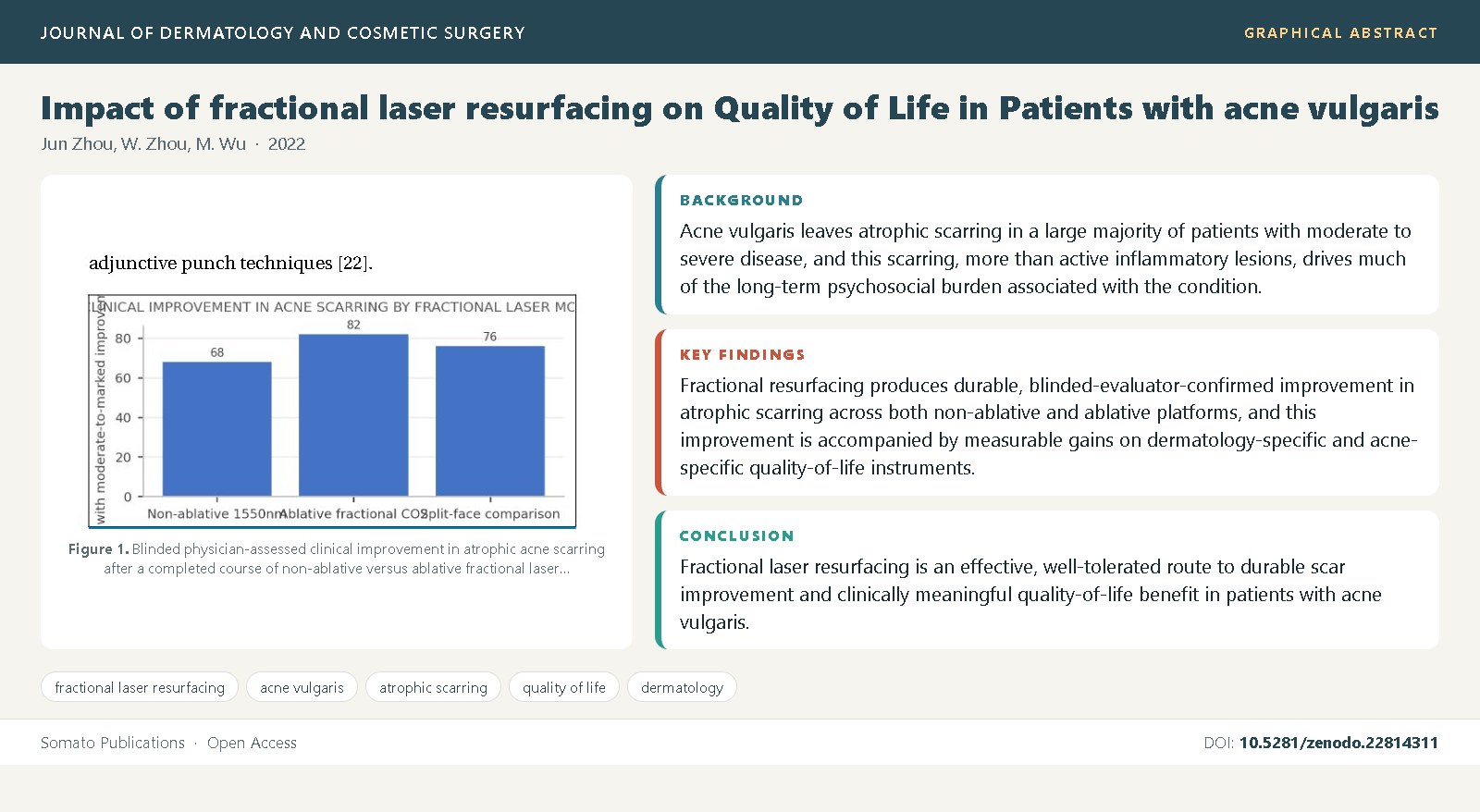
Findings: Fractional resurfacing produces durable, blinded-evaluator-confirmed improvement in atrophic scarring across both non-ablative and ablative platforms, and this improvement is accompanied by measurable gains on dermatology-specific and acne-specific quality-of-life instruments, with benefit tracking most closely with reduction in scar visibility at ordinary social distance; treatment burden, including downtime and risk of post-inflammatory hyperpigmentation, meaningfully shapes overall patient satisfaction.
Conclusions: Fractional laser resurfacing is an effective, well-tolerated route to durable scar improvement and clinically meaningful quality-of-life benefit in patients with acne vulgaris, and future trials should incorporate validated quality-of-life instruments as standard co-primary outcomes alongside objective scar grading.
References
Tan, J., Bhate, K. (2017) A global perspective on the epidemiology of acne. British Journal of Dermatology, 172(Suppl 1): 3-12. DOI: 10.1111/bjd.13462
Layton, A.M., Henderson, C.A., Cunliffe, W.J. (1994) A clinical evaluation of acne scarring and its incidence. Clinical and Experimental Dermatology, 19(4): 303-308. DOI: 10.1111/j.1365-2230.1994.tb01200.x
Fabbrocini, G., Annunziata, M.C., D'Arco, V., De Vita, V., Lodi, G., Mauriello, M.C., et al. (2010) Acne scars: pathogenesis, classification and treatment. Dermatology Research and Practice, 2010: 893080. DOI: 10.1155/2010/893080
Dreno, B., Tan, J., Kang, S., Rueda, M.J., Torres Lozada, V., Bettoli, V., et al. (2015) How people with facial acne scars are perceived in social settings: a randomized controlled trial in three countries. Journal of the European Academy of Dermatology and Venereology, 30(9): 1470-1475. DOI: 10.1111/jdv.13446
Niemeier, V., Kupfer, J., Demmelbauer-Ebner, M., Stangier, U., Effendy, I., Gieler, U. (1998) Coping with acne vulgaris. Dermatology, 196(1): 108-115. DOI: 10.1159/000017848
Tan, J.K., Tang, J., Fung, K., Gupta, A.K., Thomas, D.R., Sapra, S., et al. (2001) Development and validation of a Cardiff Acne Disability Index for use in Chinese patients. British Journal of Dermatology, 145(1): 27-35.
Martin, A.R., Lookingbill, D.P., Botek, A., Light, J., Thiboutot, D., Girman, C.J. (2001) Health-related quality of life among patients with facial acne--assessment of a new acne-specific questionnaire. Clinical and Experimental Dermatology, 26(5): 380-385. DOI: 10.1046/j.1365-2230.2001.00840.x
Mallon, E., Newton, J.N., Klassen, A., Stewart-Brown, S.L., Ryan, T.J., Finlay, A.Y. (1999) The quality of life in acne: a comparison with general medical conditions using generic questionnaires. British Journal of Dermatology, 140(4): 672-676. DOI: 10.1046/j.1365-2133.1999.02768.x
Finlay, A.Y., Khan, G.K. (1994) Dermatology Life Quality Index (DLQI)--a simple practical measure for routine clinical use. Clinical and Experimental Dermatology, 19(3): 210-216. DOI:
1111/j.1365-2230.1994.tb01167.x 10. Manstein, D., Herron, G.S., Sink, R.K., Tanner, H., Anderson, R.R. (2004) Fractional photothermolysis: a new concept for cutaneous remodeling using microscopic patterns of thermal injury. Lasers in Surgery and Medicine, 34(5): 426-438. DOI: 10.1002/lsm.20048
Alster, T.S., Tanzi, E.L., Lazarus, M. (2007) The use of fractional laser photothermolysis for the treatment of atrophic scars. Dermatologic Surgery, 33(3): 295-299. DOI: 10.1111/j.1524-4725.2007.33066.x
Chrastil, B., Glaich, A.S., Goldberg, L.H., Friedman, P.M. (2008) Second-generation 1,550-nm fractional photothermolysis for the treatment of acne scars. Dermatologic Surgery, 34(10): 1327-1332. DOI: 10.1111/j.1524-4725.2008.34285.x
Jacob, C.I., Dover, J.S., Kaminer, M.S. (2001) Acne scarring: a classification system and review of treatment options. Journal of the American Academy of Dermatology, 45(1): 109-117. DOI: 10.1067/mjd.2001.113451
Goodman, G.J., Baron, J.A. (2006) Postacne scarring: a qualitative global scarring grading system. Dermatologic Surgery, 32(12): 1458-1466. DOI: 10.1111/j.1524-4725.2006.32354.x
Lasek, R.J., Chren, M.M. (1998) Acne vulgaris and the quality of life of adult dermatology patients. Archives of Dermatology, 134(4): 454-458. DOI: 10.1001/archderm.134.4.454
Tan, J.K., Vasey, K., Fung, K.Y. (2001) Beliefs and perceptions of patients with acne. Journal of the American Academy of Dermatology, 44(3): 439-445. DOI: 10.1067/mjd.2001.111340
Walgrave, S.E., Ortiz, A.E., MacFalls, H.T., Elkeeb, L., Truitt, A.K., Tournas, J.A., et al. (2009) Evaluation of a fractional resurfacing device for treatment of acne scarring. Lasers in Surgery and Medicine, 41(2): 122-127. DOI: 10.1002/lsm.20740
Chapas, A.M., Brightman, L., Sukal, S., Hale, E., Daniel, D., Bernstein, L.J., et al. (2008) Successful treatment of acneiform scarring with CO2 ablative fractional resurfacing. Lasers in Surgery and Medicine, 40(6): 381-386. DOI: 10.1002/lsm.20659
Hedelund, L., Haak, C.S., Togsverd-Bo, K., Bogh, M.K., Bjerring, P., Haedersdal, M. (2010) Fractional CO2 laser resurfacing for atrophic acne scars: a randomized controlled trial with blinded response evaluation. Lasers in Medical Science, 27(2): 401-407. DOI: 10.1007/s10103-011-0956-x
Cho, S.B., Lee, S.J., Cho, S., Oh, S.H., Chung, W.S., Kang, J.M., et al. (2010) Non-ablative 1550-nm erbium-glass and ablative 10 600-nm carbon dioxide fractional lasers for acne scars: a randomized split-face study with blinded response evaluation. Journal of the European Academy of Dermatology and Venereology, 24(8): 921-926. DOI: 10.1111/j.1468-3083.2009.03551.x
Lee, S.J., Kang, J.M., Chung, W.S., Kim, Y.K., Kim, H.S. (2017) Ablative and fractional carbon dioxide lasers for the treatment of acne scars: a comparative split-face study. Dermatologic Surgery, 43(7): 942-949. DOI: 10.1097/DSS.0000000000001108
Sardana, K., Manjhi, M., Garg, V.K., Sagar, V. (2014) Which type of atrophic acne scar (ice-pick, boxcar, or rolling) responds to nonablative fractional laser therapy? Dermatologic Surgery, 40(3): 288-300. DOI: 10.1111/dsu.12428
Kim, S., Cho, K.H. (2009) Clinical trial of dual treatment with an ablative fractional laser and a nonablative laser for the treatment of acne scars in Asian patients. Dermatologic Surgery, 35(11): 1729-1736. DOI: 10.1111/j.1524-4725.2009.01285.x
Gozali, M.V., Zhou, B. (2015) Effective treatments of atrophic acne scars. Journal of Clinical and Aesthetic Dermatology, 8(5): 33-40.
Ortiz, A.E., Tremaine, A.M., Zachary, C.B. (2011) Long-term efficacy of a fractional resurfacing device. Lasers in Surgery and Medicine, 43(2): 168-173. DOI: 10.1002/lsm.21027
Shin, J.W., Kim, J.H., Ko, E.J., Kim, W.S., Yoo, K.H., Kim, B.J., et al. (2013) Repeated treatment with the 1550 nm erbium-glass fractional laser for acne scars in Asian skin. American Journal of Clinical Dermatology, 15(1): 27-34. DOI: 10.1007/s40257-013-0053-1
Sobanko, J.F., Sarwer, D.B. (2015) Aesthetic outcomes of common cosmetic dermatologic procedures on patient-reported quality of life. Dermatologic Surgery, 41(11): 1246-1252. DOI: 10.1097/DSS.0000000000000488
Connolly, D., Vu, H.L., Mariwalla, K., Saedi, N. (2017) Acne scarring--pathogenesis, evaluation, and treatment options. Journal of Clinical and Aesthetic Dermatology, 10(9): 12-23.
Ong, M.W., Bashir, S.J. (2012) Fractional laser resurfacing for acne scars: a review. British Journal of Dermatology, 166(6): 1160-1169. DOI: 10.1111/j.1365-2133.2012.10870.x
Waibel, J.S., Wulkan, A.J., Rudnick, A., Daoud, A. (2016) Fractional ablative laser resurfacing outcomes and complications. Journal of Drugs in Dermatology, 15(4): 442-447.
Alster, T.S., Li, M.K. (2020) Dermatologic laser side effects and complications: prevention and management. American Journal of Clinical Dermatology, 21(2): 173-180. DOI: 10.1007/s40257-019-00483-7
Rahman, Z., MacFalls, H., Jiang, K., Chan, K.F., Kelly, K., Tournas, J., et al. (2009) Fractional deep dermal ablation induces tissue tightening. Lasers in Surgery and Medicine, 41(2): 78-86. DOI: 10.1002/lsm.20736

Published
Issue
Section
License
Copyright (c) 2022 Jun Zhou, et al.

This work is licensed under a Creative Commons Attribution 4.0 International License.


