
skin barrier function testing in the Management of plaque psoriasis among adult dermatology patients
DOI:
https://doi.org/10.5281/zenodo.22814299Keywords:
skin barrier function, transepidermal water loss, plaque psoriasis, stratum corneum, corneometryAbstract
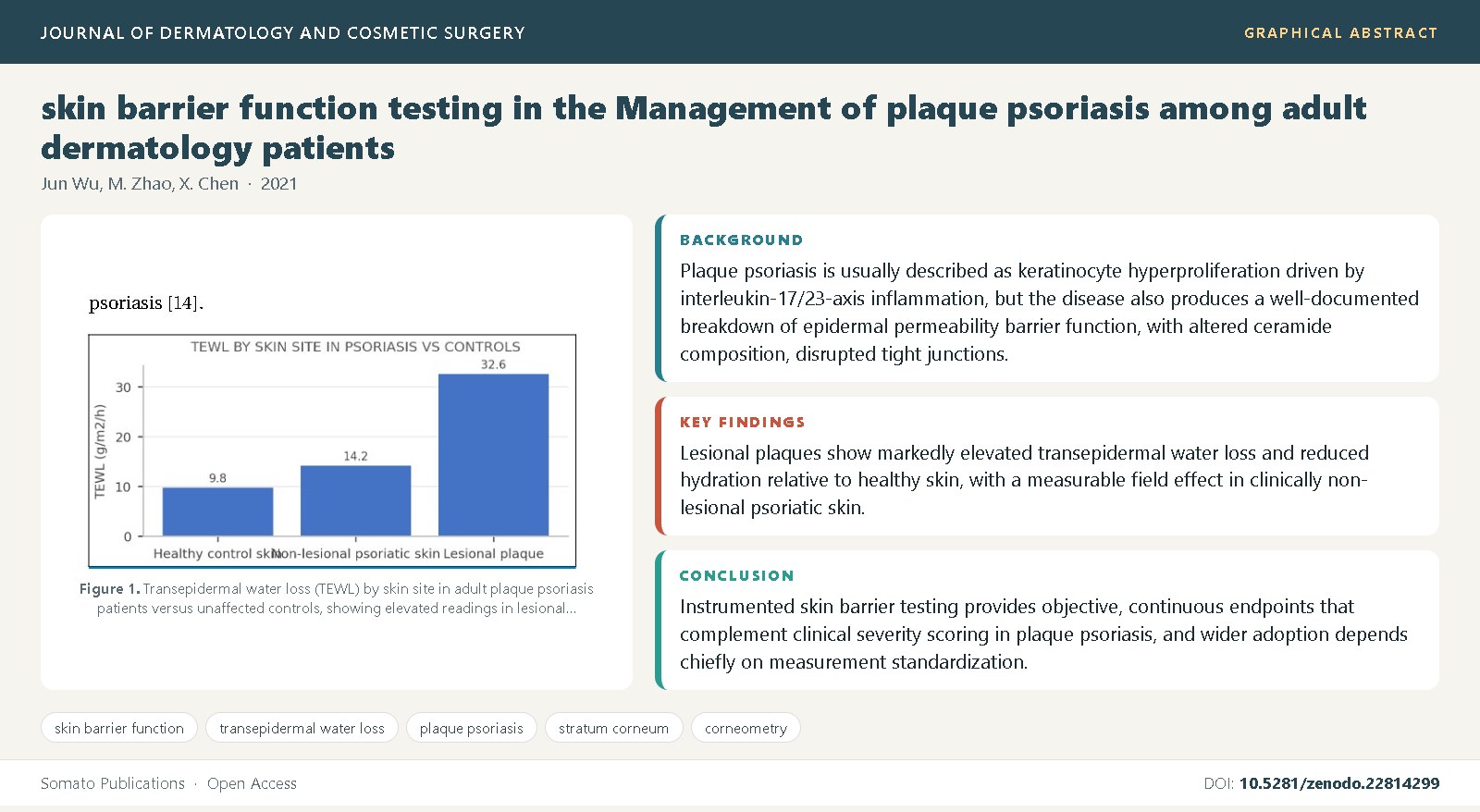
Background: Plaque psoriasis is usually described as keratinocyte hyperproliferation driven by interleukin-17/23-axis inflammation, but the disease also produces a well-documented breakdown of epidermal permeability barrier function, with altered ceramide composition, disrupted tight junctions, and elevated surface pH in lesional and non-lesional skin.
Objective: This review examines instrumented methods for assessing barrier function in adult psoriasis patients, evidence linking barrier parameters to disease severity and treatment response, and obstacles limiting routine barrier testing in practice.
Methods: We synthesized mechanistic studies of psoriatic stratum corneum lipid and structural biology, methodological consensus documents for TEWL, corneometry, and pH measurement, and clinical studies correlating barrier parameters with disease extent and therapeutic response.
Findings: Lesional plaques show markedly elevated transepidermal water loss and reduced hydration relative to healthy skin, with a measurable field effect in clinically non-lesional psoriatic skin; ceramide deficits and tight junction alterations underlie this impairment, and barrier parameters improve with topical and systemic therapy, though measurement standardization remains inconsistent.
Conclusions: Instrumented skin barrier testing provides objective, continuous endpoints that complement clinical severity scoring in plaque psoriasis, and wider adoption depends chiefly on measurement standardization and psoriasis-specific normative ranges rather than on uncertainty about the underlying barrier pathophysiology.
References
Lowes, M.A., Suárez-Fariñas, M., Krueger, J.G. (2014) Immunology of psoriasis. Annual Review of Immunology, 32: 227-255. DOI: 10.1146/annurev-immunol-032713-120225
Griffiths, C.E.M., Barker, J.N.W.N. (2007) Pathogenesis and clinical features of psoriasis. Lancet, 370(9583): 263-271. DOI: 10.1016/S0140-6736(07)61128-3
Elias, P.M. (2008) Skin barrier function. Current Allergy and Asthma Reports, 8(4): 299-305. DOI: 10.1007/s11882-008-0048-0
Proksch, E., Brandner, J.M., Jensen, J.M. (2008) The skin: an indispensable barrier. Experimental Dermatology, 17(12): 1063-1072. DOI: 10.1111/j.1600-0625.2008.00786.x
Madison, K.C. (2003) Barrier function of the skin: "la raison d'être" of the epidermis. Journal of Investigative Dermatology, 121(2): 231-241. DOI: 10.1046/j.1523-1747.2003.12359.x
Boehncke, W.H., Schön, M.P. (2015) Psoriasis. Lancet, 386(9997): 983-994. DOI: 10.1016/S0140-6736(14)61909-7
Armstrong, A.W., Read, C. (2020) Pathophysiology, clinical presentation, and treatment of psoriasis: a review. JAMA, 323(19): 1945-1960. DOI: 10.1001/jama.2020.4006
Menon, G.K., Feingold, K.R., Elias, P.M. (1992) Lamellar body secretory response to barrier disruption. Journal of Investigative Dermatology, 98(3): 279-289. DOI: 10.1111/1523-1747.ep12497866
Ghadially, R., Reed, J.T., Elias, P.M. (1996) Stratum corneum structure and function correlates with phenotype in psoriasis. Journal of Investigative Dermatology, 107(4): 558-564. DOI: 10.1111/1523-1747.ep12582813
Motta, S., Monti, M., Sesana, S., Caputo, R., Carelli, S., Ghidoni, R. (1993) Ceramide composition of the psoriatic scale. Biochimica et Biophysica Acta, 1182(2): 147-151. DOI: 10.1016/0925-4439(93)90135-N
Schäfer, L., Kragballe, K. (1991) Abnormalities in epidermal lipid metabolism in psoriasis. Journal of Investigative Dermatology, 96(1): 10-15. DOI: 10.1111/1523-1747.ep12514653
Motta, S., Sesana, S., Monti, M., Giuliani, A., Caputo, R. (1994) Abnormality of water barrier function in psoriasis. Role of ceramide fractions. Archives of Dermatology, 130(4): 452-456.
van Smeden, J., Bouwstra, J.A. (2016) Stratum corneum lipids: their role for the skin barrier function in healthy subjects and atopic dermatitis patients. Current Problems in Dermatology, 49: 8-26. DOI: 10.1159/000441540
Cork, M.J., Danby, S.G., Vasilopoulos, Y., Hadgraft, J., Lane, M.E., Moustafa, M., et al. (2009) Epidermal barrier dysfunction in atopic dermatitis. Journal of Investigative Dermatology, 129(8): 1892-1908. DOI: 10.1038/jid.2009.133
Kirschner, N., Poetzl, C., von den Driesch, P., Wladykowski, E., Moll, I., Behne, M.J., et al. (2009) Alteration of tight junction proteins is an early event in psoriasis: putative involvement of proinflammatory cytokines. American Journal of Pathology, 175(3): 1095-1106. DOI: 10.2353/ajpath.2009.080973
Danby, S.G., Cork, M.J. (2016) pH in atopic dermatitis. Current Problems in Dermatology, 49: 95-107. DOI: 10.1159/000441550
Levin, J., Maibach, H. (2008) Human skin buffering capacity: an overview. Skin Research and Technology, 14(2): 121-126. DOI: 10.1111/j.1600-0846.2007.00271.x
Jensen, J.M., Fölster-Holst, R., Baranowsky, A., Schunck, M., Winoto-Morbach, S., Neumann, C., et al. (2004) Impaired sphingomyelinase activity and epidermal differentiation in atopic dermatitis. Journal of Investigative Dermatology, 122(6): 1423-1431. DOI: 10.1111/j.0022-202X.2004.22621.x
Nickoloff, B.J. (1999) Skin innate immune system in psoriasis: friend or foe? Journal of Clinical Investigation, 104(9): 1161-1164. DOI: 10.1172/JCI8633
Pasparakis, M., Haase, I., Nestle, F.O. (2014) Mechanisms regulating skin immunity and inflammation. Nature Reviews Immunology, 14(5): 289-301. DOI: 10.1038/nri3646
Gutowska-Owsiak, D., Ogg, G.S. (2012) The epidermis as an adjuvant. Journal of Investigative Dermatology, 132(3 Pt 2): 940-948. DOI: 10.1038/jid.2011.398
Pinnagoda, J., Tupker, R.A., Agner, T., Serup, J. (1990) Guidelines for transepidermal water loss (TEWL) measurement. Contact Dermatitis, 22(3): 164-178. DOI: 10.1111/j.1600-0536.1990.tb01553.x
Rogiers, V. (2001) EEMCO guidance for the assessment of transepidermal water loss in cosmetic sciences. Skin Pharmacology and Applied Skin Physiology, 14(2): 117-128. DOI: 10.1159/000056341
Fluhr, J.W., Feingold, K.R., Elias, P.M. (2006) Transepidermal water loss reflects permeability barrier status: validation in human and rodent in vivo and ex vivo models. Experimental Dermatology, 15(7): 483-492. DOI: 10.1111/j.1600-0625.2006.00437.x
Akdeniz, M., Gabriel, S., Lichterfeld-Kottner, A., Blume-Peytavi, U., Kottner, J. (2018) Transepidermal water loss in healthy adults: a systematic review and meta-analysis update. British Journal of Dermatology, 179(5): 1049-1055. DOI: 10.1111/bjd.17025
Berardesca, E. (1997) EEMCO guidance for the assessment of stratum corneum hydration: electrical methods. Skin Research and Technology, 3(2): 126-132. DOI: 10.1111/j.1600-0846.1997.tb00174.x
Sator, P.G., Schmidt, J.B., Hönigsmann, H. (2003) Comparison of epidermal hydration and skin surface lipids in healthy individuals and in patients with atopic dermatitis. Journal of the American Academy of Dermatology, 48(3): 352-358. DOI: 10.1067/mjd.2003.105
Seidenari, S., Giusti, G. (1995) Objective assessment of the skin of children affected by atopic dermatitis: a study of pH, capacitance and TEWL in eczematous and clinically uninvolved skin. Acta Dermato-Venereologica, 75(6): 429-433. DOI: 10.2340/0001555575429433
Kezic, S., Kammeyer, A., Calkoen, F., Fluhr, J.W., Bos, J.D. (2009) Natural moisturizing factor components in the stratum corneum as biomarkers of filaggrin genotype. British Journal of Dermatology, 161(5): 1098-1104. DOI: 10.1111/j.1365-2133.2009.09342.x
Kim, B.E., Leung, D.Y.M. (2018) Significance of skin barrier dysfunction in atopic dermatitis. Allergy, Asthma & Immunology Research, 10(3): 207-215. DOI: 10.4168/aair.2018.10.3.207
Guttman-Yassky, E., Nograles, K.E., Krueger, J.G. (2011) Contrasting pathogenesis of atopic dermatitis and psoriasis--part I: clinical and pathologic concepts. Journal of Allergy and Clinical Immunology, 127(5): 1110-1118. DOI: 10.1016/j.jaci.2011.01.053
Lavrijsen, A.P.M., Bouwstra, J.A., Gooris, G.S., Weerheim, A., Boddé, H.E., Ponec, M. (1993) Barrier function parameters in various keratinization disorders: transepidermal water loss and vascular response to hexyl nicotinate. British Journal of Dermatology, 129(5): 547-553. DOI: 10.1111/j.1365-2133.1993.tb00485.x
Takahashi, H., Tsuji, H., Honma, M., Ishida-Yamamoto, A., Iizuka, H. (2014) Increased serum levels of interleukin-6, interleukin-22 and interleukin-17A in patients with psoriasis. Journal of Dermatology, 41(4): 341-343. DOI: 10.1111/1346-8138.12496
Kao, J.S., Fluhr, J.W., Man, M.Q., Fowler, A.J., Hachem, J.P., Crumrine, D., et al. (2003) Short-term glucocorticoid treatment compromises both permeability barrier homeostasis and stratum corneum integrity. Journal of Investigative Dermatology, 120(3): 456-464. DOI: 10.1046/j.1523-1747.2003.12053.x
Lodén, M. (2003) Role of topical emollients and moisturizers in the treatment of dry skin barrier disorders. American Journal of Clinical Dermatology, 4(11): 771-788. DOI: 10.2165/00128071-200304110-00005
Draelos, Z.D. (2008) The effect of ceramide-containing skin care products on eczema resolution duration. Cutis, 81(1): 87-91.
Choi, E.H., Man, M.Q., Wang, F., Zhang, X., Brown, B.E., Feingold, K.R., et al. (2005) Is endogenous glycerol a determinant of stratum corneum hydration in humans? Journal of Investigative Dermatology, 125(2): 288-293. DOI: 10.1111/j.0022-202X.2005.23799.x

Published
Issue
Section
License
Copyright (c) 2021 Jun Wu, et al.

This work is licensed under a Creative Commons Attribution 4.0 International License.


