
Comparative Analysis of biologic therapy for psoriasis versus Standard Care in plaque psoriasis
DOI:
https://doi.org/10.5281/zenodo.22814266Keywords:
plaque psoriasis, biologic therapy, TNF-alpha inhibitors, IL-17/IL-23 inhibitors, PASI responseAbstract
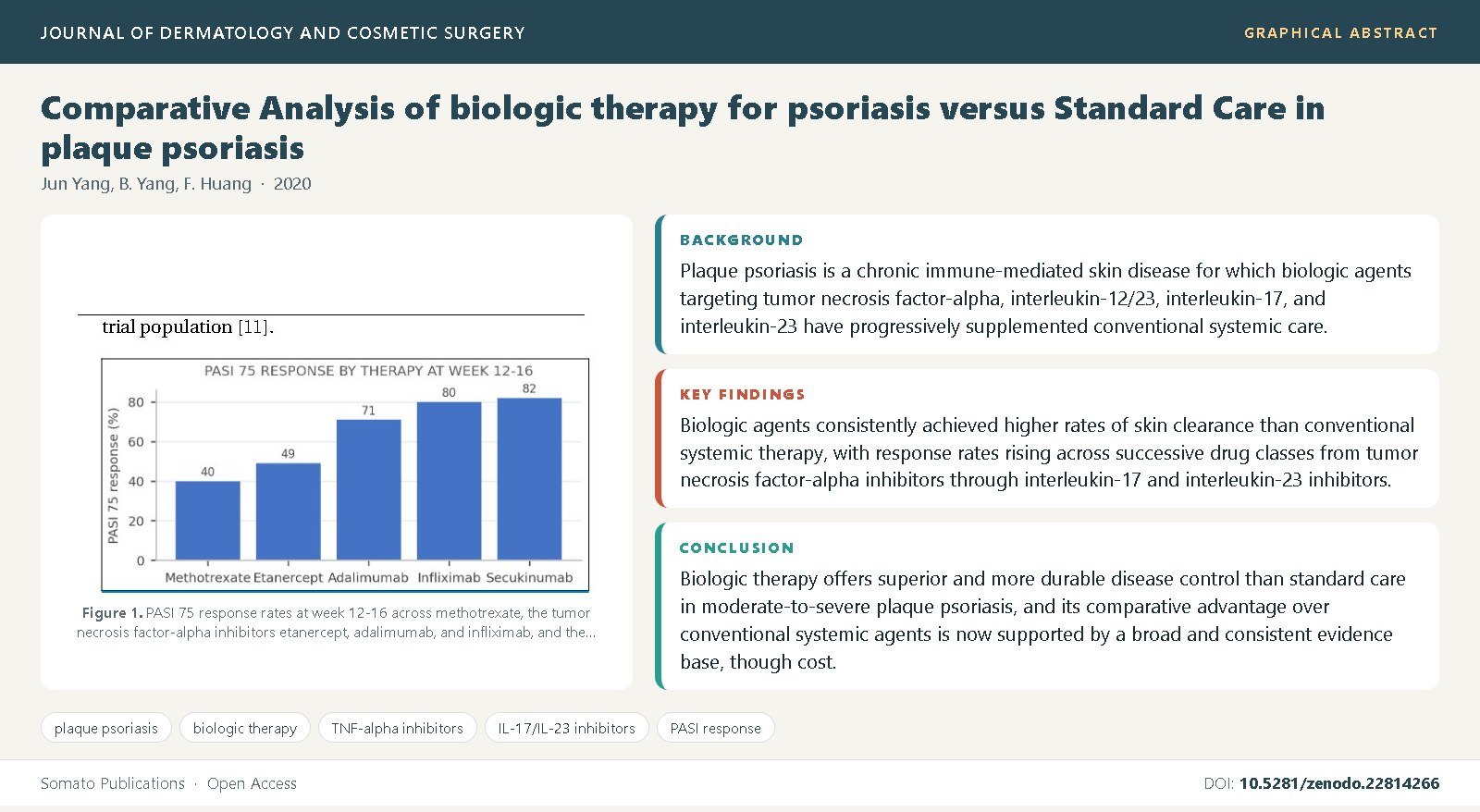
Background: Plaque psoriasis is a chronic immune-mediated skin disease for which biologic agents targeting tumor necrosis factor-alpha, interleukin-12/23, interleukin-17, and interleukin-23 have progressively supplemented conventional systemic care.
Objective: This review compares the efficacy, safety, and practical positioning of biologic therapy against standard care, including phototherapy, methotrexate, and cyclosporine, in adults with moderate-to-severe plaque psoriasis.
Methods: We synthesized pivotal randomized controlled trials, head-to-head biologic comparisons, network meta-analyses, and long-term registry studies reporting Psoriasis Area and Severity Index response, drug survival, safety outcomes, and cost-effectiveness.
Findings: Biologic agents consistently achieved higher rates of skin clearance than conventional systemic therapy, with response rates rising across successive drug classes from tumor necrosis factor-alpha inhibitors through interleukin-17 and interleukin-23 inhibitors; long-term registry data showed comparable or better tolerability and longer treatment persistence for biologic agents relative to conventional therapy, while acquisition cost remained the principal factor favoring standard care.
Conclusions: Biologic therapy offers superior and more durable disease control than standard care in moderate-to-severe plaque psoriasis, and its comparative advantage over conventional systemic agents is now supported by a broad and consistent evidence base, though cost and access continue to shape real-world treatment sequencing.
References
Parisi, R., Symmons, D.P., Griffiths, C.E., Ashcroft, D.M. (2013) Global epidemiology of psoriasis: a systematic review of incidence and prevalence. Journal of Investigative Dermatology, 133(2): 377-385.
Gelfand, J.M., Weinstein, R., Porter, S.B., Neimann, A.L., Berlin, J.A., Margolis, D.J. (2005) Prevalence and treatment of psoriasis in the United Kingdom: a population-based study. Archives of Dermatology, 141(12): 1537-1541.
Finlay, A.Y., Khan, G.K. (1994) Dermatology Life Quality Index (DLQI): a simple practical measure for routine clinical use. Clinical and Experimental Dermatology, 19(3): 210-216.
Mrowietz, U., Kragballe, K., Reich, K., Spuls, P., Griffiths, C.E., Nast, A., et al. (2011) Definition of treatment goals for moderate to severe psoriasis: a European consensus. Archives of Dermatological Research, 303(1): 1-10.
Griffiths, C.E., Barker, J.N. (2007) Pathogenesis and clinical features of psoriasis. Lancet, 370(9583): 263-271.
Lowes, M.A., Suarez-Farinas, M., Krueger, J.G. (2014) Immunology of psoriasis. Annual Review of Immunology, 32: 227-255.
Di Cesare, A., Di Meglio, P., Nestle, F.O. (2009) The IL-23/Th17 axis in the immunopathogenesis of psoriasis. Journal of Investigative Dermatology, 129(6): 1339-1350.
Nast, A., Smith, C., Spuls, P.I., Avila Valle, G., Bata-Csorgo, Z., Boonen, H., et al. (2020) EuroGuiDerm guideline on the systemic treatment of psoriasis vulgaris. Journal of the European Academy of Dermatology and Venereology, 34(11): 2461-2498.
Menter, A., Korman, N.J., Elmets, C.A., Feldman, S.R., Gelfand, J.M., Gordon, K.B., et al. (2010) Guidelines of care for the management of psoriasis and psoriatic arthritis: section 5, guidelines of care for the treatment of psoriasis with phototherapy and photochemotherapy. Journal of the American Academy of Dermatology, 62(1): 114-135.
Nast, A., Jacobs, A., Rosumeck, S., Werner, R.N. (2015) Efficacy and safety of systemic long-term treatments for moderate-to-severe psoriasis: a systematic review and meta-analysis. Journal of Investigative Dermatology, 135(11): 2641-2648.
Schmitt, J., Rosumeck, S., Thomaschewski, G., Sporbeck, B., Haufe, E., Nast, A. (2014) Efficacy and safety of systemic treatments for moderate-to-severe psoriasis: meta-analysis of randomized controlled trials. British Journal of Dermatology, 170(2): 274-303.
Leonardi, C.L., Powers, J.L., Matheson, R.T., Goffe, B.S., Zitnik, R., Wang, A., et al. (2003) Etanercept as monotherapy in patients with psoriasis. New England Journal of Medicine, 349(21): 2014-2022.
Menter, A., Tyring, S.K., Gordon, K., Kimball, A.B., Leonardi, C.L., Langley, R.G., et al. (2008) Adalimumab therapy for moderate to severe psoriasis: a randomized, controlled phase III trial. Journal of the American Academy of Dermatology, 58(1): 106-115.
Reich, K., Nestle, F.O., Papp, K., Ortonne, J.P., Evans, R., Guzzo, C., et al. (2005) Infliximab induction and maintenance therapy for moderate-to-severe psoriasis: a phase III, multicentre, double-blind trial. Lancet, 366(9494): 1367-1374.
Leonardi, C.L., Kimball, A.B., Papp, K.A., Yeilding, N., Guzzo, C., Wang, Y., et al. (2008) Efficacy and safety of ustekinumab, a human interleukin-12/23 monoclonal antibody, in patients with psoriasis: 76-week results from a randomised, double-blind, placebo-controlled trial (PHOENIX 1). Lancet, 371(9625): 1665-1674.
Papp, K.A., Langley, R.G., Lebwohl, M., Krueger, G.G., Szapary, P., Yeilding, N., et al. (2008) Efficacy and safety of ustekinumab, a human interleukin-12/23 monoclonal antibody, in patients with psoriasis: 52-week results from a randomised, double-blind, placebo-controlled trial (PHOENIX 2). Lancet, 371(9625): 1675-1684.
Kimball, A.B., Gordon, K.B., Fakharzadeh, S., Yeilding, N., Szapary, P.O., Schenkel, B., et al. (2012) Long-term efficacy of ustekinumab in patients with moderate-to-severe psoriasis: results from the PHOENIX 1 trial through up to 3 years. British Journal of Dermatology, 166(4): 861-872.
Langley, R.G., Elewski, B.E., Lebwohl, M., Reich, K., Griffiths, C.E., Papp, K., et al. (2014) Secukinumab in plaque psoriasis: results of two phase 3 trials. New England Journal of Medicine, 371(4): 326-338.
Blauvelt, A., Reich, K., Tsai, T.F., Tyring, S., Vanaclocha, F., Kingo, K., et al. (2017) Secukinumab is superior to ustekinumab in clearing skin of subjects with moderate-to-severe plaque psoriasis: 52-week results from CLEAR, a randomized controlled trial. Journal of the American Academy of Dermatology, 76(1): 60-69.
Gordon, K.B., Blauvelt, A., Papp, K.A., Langley, R.G., Luger, T., Ohtsuki, M., et al. (2016) Phase 3 trials of ixekizumab in moderate-to-severe plaque psoriasis. New England Journal of Medicine, 375(4): 345-356.
Lebwohl, M., Strober, B., Menter, A., Gordon, K., Weglowska, J., Puig, L., et al. (2015) Phase 3 studies comparing brodalumab with ustekinumab in psoriasis. New England Journal of Medicine, 373(14): 1318-1328.
Blauvelt, A., Papp, K.A., Griffiths, C.E., Randazzo, B., Wasfi, Y., Shen, Y.K., et al. (2017) Efficacy and safety of guselkumab, an anti-interleukin-23 monoclonal antibody, compared with adalimumab for the continuous treatment of patients with moderate to severe psoriasis: results from the phase III, double-blinded, placebo- and active comparator-controlled VOYAGE 1 trial. Journal of the American Academy of Dermatology, 76(3): 405-417.
Reich, K., Armstrong, A.W., Foley, P., Song, M., Wasfi, Y., Randazzo, B., et al. (2017) Efficacy and safety of guselkumab compared with adalimumab for the treatment of patients with moderate to severe psoriasis with randomized withdrawal and retreatment: results from the phase III, double-blind, placebo- and active comparator-controlled VOYAGE 2 trial. Journal of the American Academy of Dermatology, 76(3): 418-431.
Reich, K., Gooderham, M., Thaci, D., Crowley, J.J., Ryan, C., Krueger, J.G., et al. (2019) Risankizumab compared with adalimumab in patients with moderate-to-severe plaque psoriasis (IMMvent): a randomised, double-blind, active-comparator-controlled phase 3 trial. Lancet, 394(10198): 576-586.
Gordon, K.B., Strober, B., Lebwohl, M., Augustin, M., Blauvelt, A., Poulin, Y., et al. (2018) Efficacy and safety of risankizumab in moderate-to-severe plaque psoriasis (UltIMMa-1 and UltIMMa-2): results from two double-blind, randomised, placebo-controlled and ustekinumab-controlled phase 3 trials. Lancet, 392(10148): 650-661.
Papp, K., Reich, K., Leonardi, C.L., Kircik, L., Chimenti, S., Langley, R.G., et al. (2017) Tildrakizumab (MK-3222), an anti-interleukin-23p19 monoclonal antibody, in patients with moderate to severe psoriasis: results from two randomised controlled, phase 3 trials (reSURFACE 1 and reSURFACE 2). Lancet, 390(10091): 276-288.
Sbidian, E., Chaimani, A., Garcia-Doval, I., Do, G., Hua, C., Mazaud, C., et al. (2020) Systemic pharmacological treatments for chronic plaque psoriasis: a network meta-analysis. Cochrane Database of Systematic Reviews, 1: CD011535.
Armstrong, A.W., Puig, L., Joshi, A., Skup, M., Williams, D., Li, J., et al. (2020) Comparison of biologics and oral treatments for plaque psoriasis: a meta-analysis. JAMA Dermatology, 156(3): 258-269.
Papp, K.A., Griffiths, C.E., Gordon, K., Lebwohl, M., Szapary, P.O., Wasfi, Y., et al. (2013) Long-term safety of ustekinumab in patients with moderate-to-severe psoriasis: final results from 5 years of follow-up. British Journal of Dermatology, 168(4): 844-854.
Gniadecki, R., Bang, B., Bryld, L.E., Iversen, L., Lasthein, S., Skov, L. (2015) Comparison of long-term drug survival and safety of biologic agents in patients with psoriasis vulgaris. British Journal of Dermatology, 172(1): 244-252.
Yiu, Z.Z., Mason, K.J., Hampton, P.J., Reynolds, N.J., Smith, C.H., Owen, C.M., et al. (2020) Drug survival of adalimumab, ustekinumab and secukinumab in patients with psoriasis: a prospective cohort study from the British Association of Dermatologists Biologics and Immunomodulators Register (BADBIR). British Journal of Dermatology, 183(2): 294-302.
van den Reek, J.M., van Lumig, P.P., Otero, M.E., Zweegers, J., Driessen, R.J., Njoo, M.D., et al. (2014) Satisfaction of treatment with biologics is high in patients with psoriasis: results from the BioCAPTURE registry. British Journal of Dermatology, 170(5): 1091-1099.
D'Souza, L.S., Payette, M.J. (2017) Estimated cost efficacy of systemic treatments that are approved by the US Food and Drug Administration for the treatment of moderate to severe psoriasis. Journal of the American Academy of Dermatology, 77(6): 1111-1117.
Feldman, S.R., Malakouti, M., Koo, J.Y. (2014) Social impact of the burden of psoriasis: effects on patients and practice. Dermatology Online Journal, 20(8): 13030.
Kimball, A.B., Leonardi, C., Stahle, M., Gulliver, W., Chevrier, M., Fakharzadeh, S., et al. (2010) Demography, baseline disease characteristics and treatment history of patients with psoriasis enrolled in a multicentre, prospective, disease-based registry (PSOLAR). British Journal of Dermatology, 172(6): 1701-1710.
Strober, B., Ryan, C., van de Kerkhof, P., van der Walt, J., Kimball, A.B., Barker, J., et al. (2020) Recategorization of psoriasis severity: delphi consensus from the International Psoriasis Council. Journal of the American Academy of Dermatology, 82(1): 117-122.

Published
Issue
Section
License
Copyright (c) 2020 Jun Yang, et al.

This work is licensed under a Creative Commons Attribution 4.0 International License.


