
Evaluation of PET-CT imaging as a Prognostic Tool in pulmonary nodules
DOI:
https://doi.org/10.5281/zenodo.22814229Keywords:
PET-CT, pulmonary nodule, SUVmax, prognosis, non-small cell lung cancerAbstract
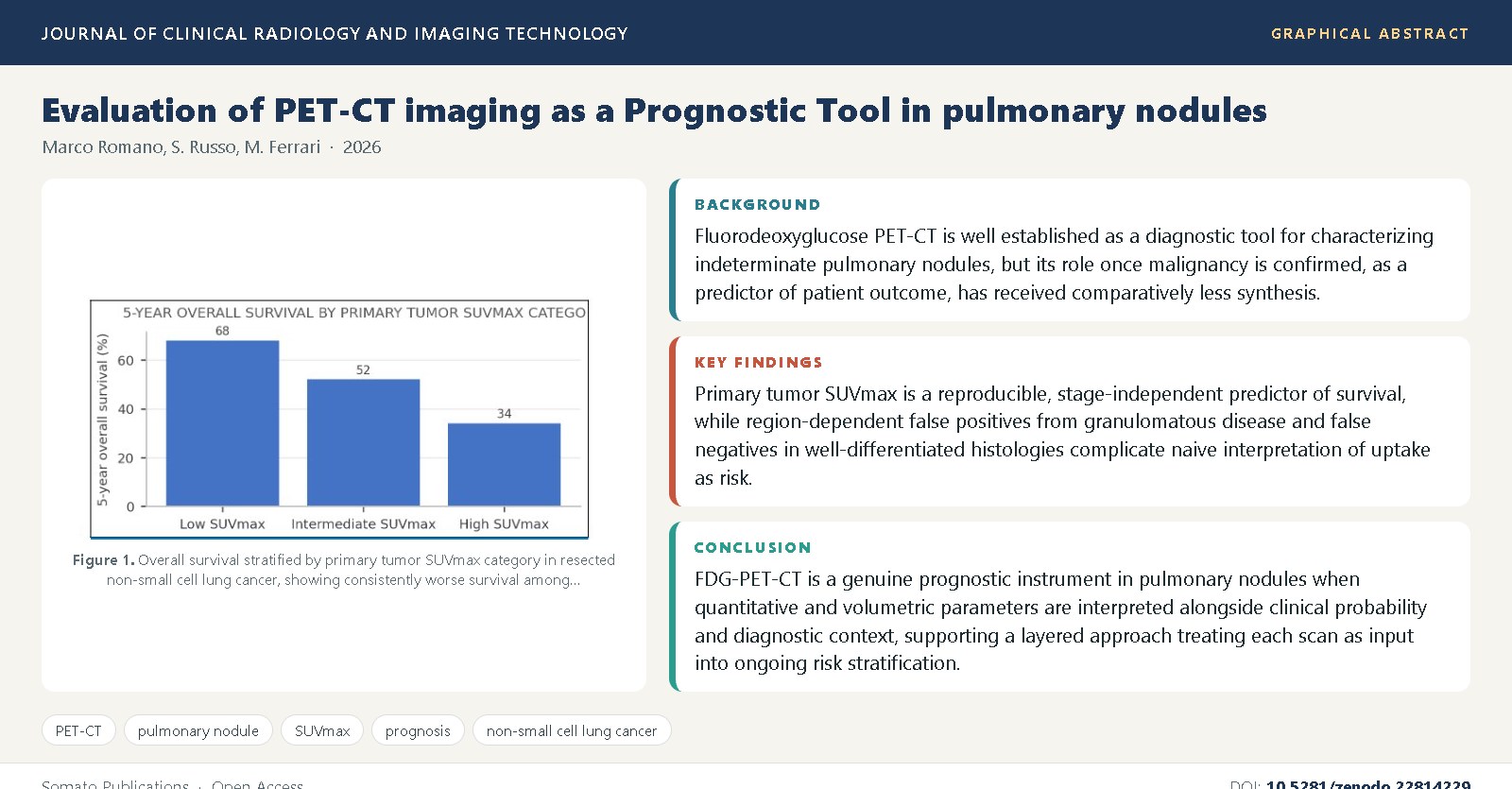
Background: Fluorodeoxyglucose PET-CT is well established as a diagnostic tool for characterizing indeterminate pulmonary nodules, but its role once malignancy is confirmed, as a predictor of patient outcome, has received comparatively less synthesis.
Objective: This review synthesizes the published evidence on FDG-PET-CT as a prognostic tool in pulmonary nodules and early-stage lung cancer, focusing on standardized uptake value, volumetric and radiomic parameters, diagnostic pitfalls that complicate prognostic interpretation, and serial imaging during treatment.
Methods: We synthesized diagnostic-accuracy meta-analyses, surgical and multicenter cohort studies, systematic reviews from the European Lung Cancer Working Party, and treatment-response imaging trials addressing FDG-PET-CT in pulmonary nodule and non-small cell lung cancer prognosis.
Findings: Primary tumor SUVmax is a reproducible, stage-independent predictor of survival, while region-dependent false positives from granulomatous disease and false negatives in well-differentiated histologies complicate naive interpretation of uptake as risk; volumetric and radiomic signatures add discrimination beyond SUVmax alone, and serial imaging during treatment extends prognostic assessment through therapy.
Conclusions: FDG-PET-CT is a genuine prognostic instrument in pulmonary nodules when quantitative and volumetric parameters are interpreted alongside clinical probability and diagnostic context, supporting a layered approach treating each scan as input into ongoing risk stratification.
References
Gould, M.K., Maclean, C.C., Kuschner, W.G., Rydzak, C.E., Owens, D.K. (2001) Accuracy of positron emission tomography for diagnosis of pulmonary nodules and mass lesions: a meta-analysis. JAMA, 285(7): 914-924.
Higashi, K., Ueda, Y., Yagishita, M., Arisaka, Y., Sakurai, A., Oguchi, M., et al. (2000) FDG PET measurement of the proliferative potential of non-small cell lung cancer. Journal of Nuclear Medicine, 41(1): 85-92.
Vesselle, H., Salskov, A., Turcotte, E., Wiens, L., Schmidt, R., Jordan, C.D., et al. (2004) Relationship between non-small cell lung cancer FDG uptake at PET, tumor histology, and Ki-67 proliferation index. Journal of Thoracic Oncology, 2(1): 61-67.
Lardinois, D., Weder, W., Hany, T.F., Kamel, E.M., Korom, S., Seifert, B., et al. (2003) Staging of non-small-cell lung cancer with integrated positron-emission tomography and computed tomography. New England Journal of Medicine, 348(25): 2500-2507.
MacManus, M.P., Hicks, R.J., Matthews, J.P., McKenzie, A., Rischin, D., Salminen, E.K., et al. (2001) High rate of detection of unsuspected distant metastases by PET in apparent stage III non-small-cell lung cancer: implications for radical radiation therapy. International Journal of Radiation Oncology Biology Physics, 50(2): 287-293.
Halpenny, D.F., Riely, G.J., Hayes, S., Yu, H., Zheng, J., Moskowitz, C.S., et al. (2014) Are there imaging characteristics associated with lepidic predominant lesions in lung adenocarcinoma that predict response on FDG-PET? Clinical Imaging, 38(6): 855-858.
Fletcher, J.W., Djulbegovic, B., Soares, H.P., Siegel, B.A., Lowe, V.J., Lyman, G.H., et al. (2008) Recommendations on the use of 18F-FDG PET in oncology. Journal of Nuclear Medicine, 49(3): 480-508.
Downey, R.J., Akhurst, T., Gonen, M., Vincent, A., Bains, M.S., Larson, S., et al. (2004) Preoperative F-18 fluorodeoxyglucose-positron emission tomography maximal standardized uptake value predicts survival after lung cancer resection. Journal of Clinical Oncology, 22(16): 3255-3260.
Vansteenkiste, J.F., Stroobants, S.G., Dupont, P.J., De Leyn, P.R., Verbeken, E.K., Deneffe, G.J., et al. (1999) Prognostic importance of the standardized uptake value on 18F-fluoro-2-deoxy-glucose positron emission tomography scan in non-small-cell lung cancer: an analysis of 125 cases. Journal of Clinical Oncology, 17(10): 3201-3206.
Vansteenkiste, J.F., Stroobants, S.G. (2001) The role of positron emission tomography with 18F-fluoro-2-deoxy-D-glucose in respiratory oncology. European Respiratory Journal, 17(4): 802-820.
Sasaki, R., Komaki, R., Macapinlac, H., Erasmus, J., Allen, P., Forster, K., et al. (2001) [18F]fluorodeoxyglucose uptake by positron emission tomography predicts outcome of non-small-cell lung carcinoma. Journal of Clinical Oncology, 23(6): 1136-1143.
Berghmans, T., Dusart, M., Paesmans, M., Hossein-Foucher, C., Buvat, I., Castaigne, C., et al. (2008) Primary tumor standardized uptake value (SUVmax) measured on fluorodeoxyglucose positron emission tomography is of prognostic value for survival in non-small cell lung cancer: update of a systematic review and meta-analysis by the European Lung Cancer Working Party. Journal of Thoracic Oncology, 3(1): 6-12.
Paesmans, M., Berghmans, T., Dusart, M., Garcia, C., Hossein-Foucher, C., Lafitte, J.J., et al. (2010) Primary tumor standardized uptake value measured on fluorodeoxyglucose positron emission tomography is of prognostic value for survival in non-small cell lung cancer: update of a systematic review and meta-analysis by the European Lung Cancer Working Party for the International Association for the Study of Lung Cancer Staging Project. Journal of Thoracic Oncology, 5(5): 612-619.
Cerfolio, R.J., Bryant, A.S., Ohja, B., Bartolucci, A.A. (2005) The maximum standardized uptake values on positron emission tomography of a non-small cell lung cancer predict stage, recurrence, and survival. Journal of Thoracic and Cardiovascular Surgery, 130(1): 151-159.
Ohtsuka, T., Nomori, H., Watanabe, K., Kaji, M., Naruke, T., Suemasu, K. (2006) Prognostic significance of [18F]fluorodeoxyglucose uptake on positron emission tomography in patients with pathologic stage I lung adenocarcinoma. Lung Cancer, 54(1): 91-95.
Al-Sarraf, N., Gately, K., Lucey, J., Wilson, L., McGoldrick, R., Rai, J., et al. (2008) Clinical implication and prognostic significance of standardised uptake value of primary non-small cell lung cancer on positron emission tomography: analysis of 176 cases. European Journal of Cardio-Thoracic Surgery, 34(4): 892-897.
Deppen, S.A., Blume, J.D., Kensinger, C.D., Morgan, A.M., Aldrich, M.C., Massion, P.P., et al. (2014) Accuracy of FDG-PET to diagnose lung cancer in areas with infectious lung disease: a meta-analysis. JAMA, 312(12): 1227-1236.
Cheran, S.K., Nielsen, N.D., Patz, E.F. (2004) False-negative findings for primary lung tumors on FDG positron emission tomography: staging and prognostic implications. American Journal of Roentgenology, 182(5): 1129-1132.
Christensen, J.A., Nathan, M.A., Mullan, B.P., Hartman, T.E., Swensen, S.J., Lowe, V.J. (2006) Characterization of the solitary pulmonary nodule: 18F-FDG PET versus nodule-enhancement CT. American Journal of Roentgenology, 187(5): 1361-1367.
Matthies, A., Hickeson, M., Cuchiara, A., Alavi, A. (2002) Dual time point 18F-FDG PET for the evaluation of pulmonary nodules. Journal of Nuclear Medicine, 43(7): 871-875.
Erasmus, J.J., McAdams, H.P., Patz, E.F., Coleman, R.E., Ahuja, V., Goodman, P.C. (2000) Evaluation of primary pulmonary carcinoid tumors using FDG PET. American Journal of Roentgenology, 175(5): 1369-1373.
Herder, G.J., van Tinteren, H., Golding, R.P., Kostense, P.J., Comans, E.F., Smit, E.F., et al. (2005) Clinical prediction model to characterize pulmonary nodules: validation and added value of 18F-fluorodeoxyglucose positron emission tomography. Chest, 128(4): 2490-2496.
Swensen, S.J., Silverstein, M.D., Ilstrup, D.M., Schleck, C.D., Edell, E.S. (1997) The probability of malignancy in solitary pulmonary nodules: application to small radiologically indeterminate nodules. Archives of Internal Medicine, 157(8): 849-855.
Grgic, A., Yuksel, Y., Groschel, A., Schafers, H.J., Sybrecht, G.W., Kirsch, C.M., et al. (2010) Risk stratification of solitary pulmonary nodules by means of PET using (18)F-fluorodeoxyglucose and SUV quantification. European Journal of Nuclear Medicine and Molecular Imaging, 37(6): 1087-1094.
Lowe, V.J., Fletcher, J.W., Gobar, L., Lawson, M., Kirchner, P., Valk, P., et al. (1998) Prospective investigation of positron emission tomography in lung nodules. Journal of Clinical Oncology, 16(3): 1075-1084.
Nomori, H., Watanabe, K., Ohtsuka, T., Naruke, T., Suemasu, K., Uno, K. (2004) Visual and semiquantitative analyses for F-18 fluorodeoxyglucose PET scanning in pulmonary nodules 1 cm to 3 cm in size. Annals of Thoracic Surgery, 79(3): 984-988.
Chin, R. Jr, Ward, R., Keyes, J.W., Choplin, R.H., Reed, J.C., Wallenhaupt, S., et al. (1995) Mediastinal staging of non-small-cell lung cancer with positron emission tomography. American Journal of Respiratory and Critical Care Medicine, 152(6 Pt 1): 2090-2096.
Gould, M.K., Donington, J., Lynch, W.R., Mazzone, P.J., Midthun, D.E., Naidich, D.P., et al. (2013) Evaluation of individuals with pulmonary nodules: when is it lung cancer? Diagnosis and management of lung cancer, 3rd ed: American College of Chest Physicians evidence-based clinical practice guidelines. Chest, 143(5 Suppl): e93S-e120S.
Cronin, P., Dwamena, B.A., Kelly, A.M., Carlos, R.C. (2008) Solitary pulmonary nodules: meta-analytic comparison of cross-sectional imaging modalities for diagnosis of malignancy. Radiology, 246(3): 772-782.
Ost, D., Fein, A.M., Feinsilver, S.H. (2003) Clinical practice. The solitary pulmonary nodule. New England Journal of Medicine, 348(25): 2535-2542.
Kim, S.J., Kim, I.J., Kim, Y.K., Kim, Y.D., Lee, M.K. (2007) Standardized uptake value and metabolic tumour volume of 18F-FDG PET/CT can predict survival in oesophageal cancer patients treated by neoadjuvant chemoradiotherapy followed by surgery. European Journal of Nuclear Medicine and Molecular Imaging, 34(2): 205-213.
Hoekstra, C.J., Stroobants, S.G., Smit, E.F., Vansteenkiste, J., van Tinteren, H., Postmus, P.E., et al. (2005) Prognostic relevance of response evaluation using [18F]-2-fluoro-2-deoxy-D-glucose positron emission tomography in patients with locally advanced non-small-cell lung cancer. Journal of Clinical Oncology, 23(33): 8362-8370.
Kirienko, M., Cozzi, L., Antunovic, L., Voulaz, E., Sollini, M., Rossi, A., et al. (2018) Prediction of disease-free survival by the PET/CT radiomic signature in non-small cell lung cancer patients undergoing surgery. European Journal of Nuclear Medicine and Molecular Imaging, 45(2): 207-217.
de Geus-Oei, L.F., van der Heijden, H.F., Corstens, F.H., Oyen, W.J. (2007) Predictive and prognostic value of FDG-PET in nonsmall-cell lung cancer: a systematic review. Cancer, 110(8): 1654-1664.
Weber, W.A., Petersen, V., Schmidt, B., Tyndale-Hines, L., Link, T., Peschel, C., et al. (2003) Positron emission tomography in non-small-cell lung cancer: prediction of response to chemotherapy by quantitative assessment of glucose use. Journal of Clinical Oncology, 21(14): 2651-2657.
Eschmann, S.M., Friedel, G., Paulsen, F., Reimold, M., Hehr, T., Budach, W., et al. (2007) Repeat 18F-FDG PET for monitoring neoadjuvant chemotherapy in patients with stage III non-small cell lung cancer. Lung Cancer, 55(2): 165-171.
Bryant, A.S., Cerfolio, R.J., Klemm, K.M., Ojha, B. (2006) Maximum standard uptake value of mediastinal lymph nodes on integrated FDG-PET-CT predicts pathology in patients with non-small cell lung cancer. Annals of Thoracic Surgery, 82(2): 417-423.

Published
Issue
Section
License
Copyright (c) 2026 Marco Romano, et al.

This work is licensed under a Creative Commons Attribution 4.0 International License.


