
Prevalence and Risk Factors of rheumatoid arthritis in pediatric rheumatology patients
DOI:
https://doi.org/10.5281/zenodo.22813966Keywords:
juvenile idiopathic arthritis, pediatric rheumatology, prevalence, risk factors, seropositivityAbstract
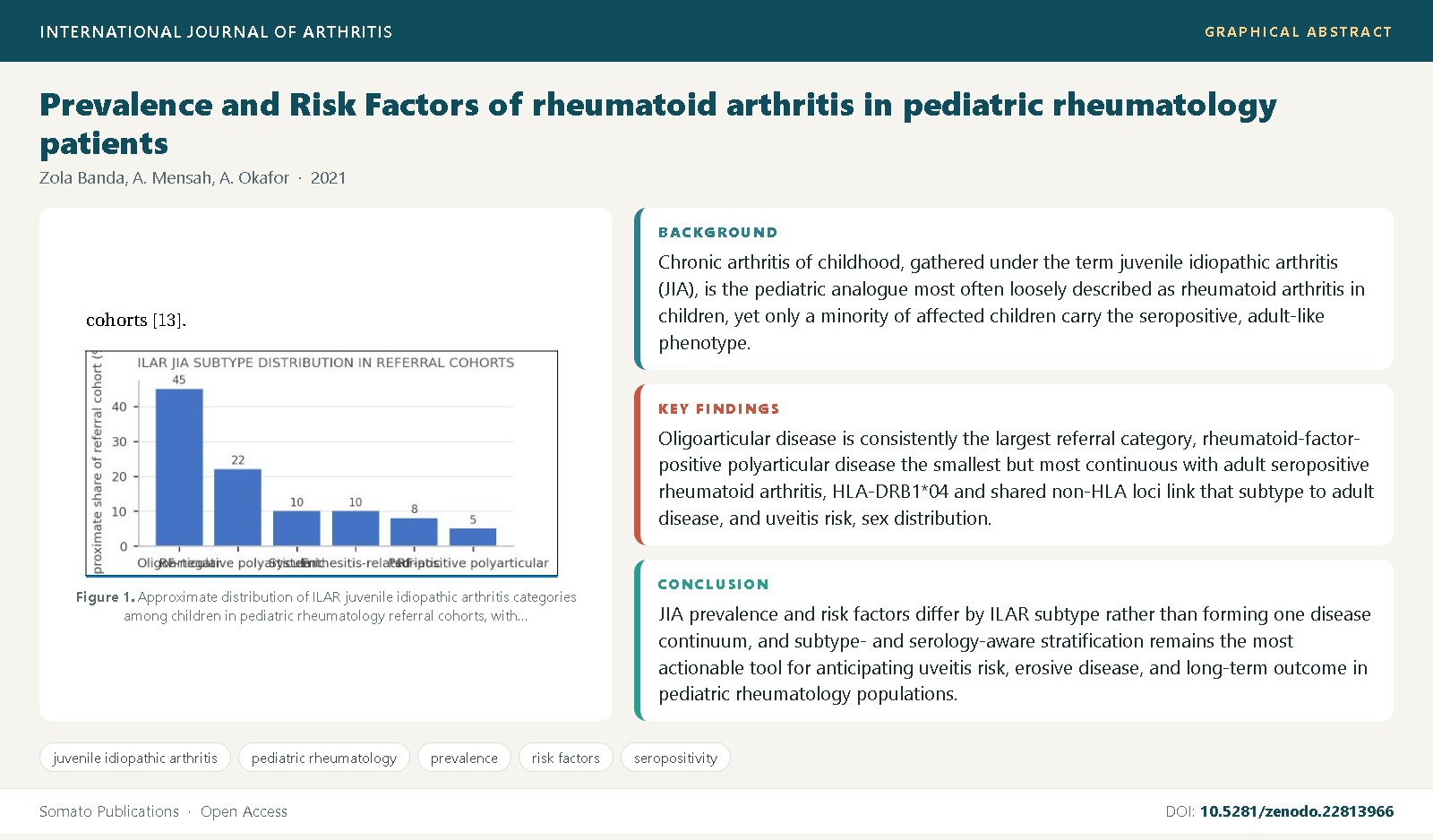
Background: Chronic arthritis of childhood, gathered under the term juvenile idiopathic arthritis (JIA), is the pediatric analogue most often loosely described as rheumatoid arthritis in children, yet only a minority of affected children carry the seropositive, adult-like phenotype.
Objective: This review synthesizes published evidence on the prevalence and distribution of JIA subtypes, including rheumatoid-factor-positive polyarticular disease, among children seen in pediatric rheumatology settings, and summarizes the genetic, immunological, environmental, and demographic risk factors associated with subtype susceptibility.
Methods: We synthesized population-based epidemiological studies, multicenter registry cohorts including CARRA and the Nordic JIA cohort, immunogenetic association studies, and case-control literature addressing environmental and perinatal exposures in JIA.
Findings: Oligoarticular disease is consistently the largest referral category, rheumatoid-factor-positive polyarticular disease the smallest but most continuous with adult seropositive rheumatoid arthritis, HLA-DRB1*04 and shared non-HLA loci link that subtype to adult disease, and uveitis risk, sex distribution, and age at onset vary systematically by subtype.
Conclusions: JIA prevalence and risk factors differ by ILAR subtype rather than forming one disease continuum, and subtype- and serology-aware stratification remains the most actionable tool for anticipating uveitis risk, erosive disease, and long-term outcome in pediatric rheumatology populations.
References
Petty, R.E., Southwood, T.R., Manners, P., Baum, J., Glass, D.N., Goldenberg, J., et al. (2004) International League of Associations for Rheumatology classification of juvenile idiopathic arthritis: second revision, Edmonton, 2001. Journal of Rheumatology, 31(2): 390-392.
Martini, A., Ravelli, A., Avcin, T., Beresford, M.W., Burgos-Vargas, R., Cuttica, R., et al. (2019) Toward new classification criteria for juvenile idiopathic arthritis: first steps, Pediatric Rheumatology International Trials Organisation International Consensus. Journal of Rheumatology, 46(2): 190-197.
Thierry, S., Fautrel, B., Lemelle, I., Guillemin, F. (2014) Prevalence and incidence of juvenile idiopathic arthritis: a systematic review. Joint Bone Spine, 81(2): 112-117.
Manners, P.J., Bower, C. (2002) Worldwide prevalence of juvenile arthritis: why does it vary so much? Journal of Rheumatology, 29(7): 1520-1530.
Saurenmann, R.K., Rose, J.B., Tyrrell, P., Feldman, B.M., Laxer, R.M., Schneider, R., et al. (2007) Epidemiology of juvenile idiopathic arthritis in a multiethnic cohort: ethnicity as a risk factor. Arthritis & Rheumatism, 56(6): 1974-1984.
Berntson, L., Andersson Gare, B., Fasth, A., Herlin, T., Kristinsson, J., Lahdenne, P., et al. (2003) Incidence of juvenile idiopathic arthritis in the Nordic countries: a population based study with special reference to the validity of the ILAR and EULAR criteria. Journal of Rheumatology, 30(10): 2275-2282.
Ravelli, A., Martini, A. (2011) Juvenile idiopathic arthritis. Lancet, 377(9783): 2138-2149.
Lin, Y.T., Wang, C.T., Gershwin, M.E., Chiang, B.L. (2016) The pathogenesis of oligoarticular/polyarticular vs systemic juvenile idiopathic arthritis. Autoimmunity Reviews, 15(9): 927-931.
Stoll, M.L., Zurakowski, D., Nigrovic, L.E., Nichols, D.P., Sundel, R.P., Nigrovic, P.A. (2006) Patients with juvenile psoriatic arthritis comprise two distinct populations. Arthritis & Rheumatism, 54(11): 3564-3572.
Nordal, E., Zak, M., Aalto, K., Berntson, L., Fasth, A., Herlin, T., et al. (2011) Ongoing disease activity and changing categories in a long-term nordic cohort study of juvenile idiopathic arthritis. Arthritis & Rheumatism, 63(9): 2809-2818.
Guzman, J., Oen, K., Tucker, L.B., Huber, A.M., Shiff, N., Boire, G., et al. (2015) The outcomes of juvenile idiopathic arthritis in children managed with contemporary treatments: results from the ReACCh-Out cohort. Annals of the Rheumatic Diseases, 74(10): 1854-1860.
Beukelman, T., Ringold, S., Davis, T.E., DeWitt, E.M., Pelajo, C.F., Weiss, P.F., et al. (2012) Disease-modifying antirheumatic drug use in the treatment of juvenile idiopathic arthritis: a cross-sectional analysis of the CARRA registry. Journal of Rheumatology, 39(9): 1867-1874.
Scott, D.L., Wolfe, F., Huizinga, T.W. (2010) Rheumatoid arthritis. Lancet, 376(9746): 1094-1108.
Hinks, A., Barton, A., Shephard, N., Eyre, S., Bowes, J., Cargill, M., et al. (2009) Identification of a novel susceptibility locus for juvenile idiopathic arthritis by genome-wide association analysis. Arthritis & Rheumatism, 60(1): 258-263.
Prahalad, S., Glass, D.N. (2010) Genetics of juvenile idiopathic arthritis: an update. Current Opinion in Rheumatology, 22(5): 588-595.
Hinks, A., Cobb, J., Marion, M.C., Prahalad, S., Sudman, M., Bowes, J., et al. (2013) Dense genotyping of immune-related disease regions identifies 14 new susceptibility loci for juvenile idiopathic arthritis. Nature Genetics, 45(6): 664-669.
Ombrello, M.J., Arthur, V.L., Remmers, E.F., Hinks, A., Tachmazidou, I., Grom, A.A., et al. (2017) Genetic architecture distinguishes systemic juvenile idiopathic arthritis from other forms of juvenile idiopathic arthritis: clinical and therapeutic implications. Annals of the Rheumatic Diseases, 76(5): 906-913.
Glass, D.N., Giannini, E.H. (2002) Juvenile rheumatoid arthritis as a complex genetic trait. Arthritis & Rheumatism, 46(10): 2261-2268.
Carlens, C., Jacobsson, L., Brandt, L., Cnattingius, S., Stephansson, O., Askling, J. (2010) Perinatal characteristics, early life infections and later risk of rheumatoid arthritis and juvenile idiopathic arthritis. Annals of the Rheumatic Diseases, 68(7): 1159-1164.
Rosenberg, A.M. (1998) Analysis of a pediatric rheumatology clinic population. Journal of Rheumatology, 17(6): 827-830.
Oen, K. (2002) Comparative epidemiology of the rheumatic diseases in children. Current Opinion in Rheumatology, 12(5): 410-414.
Stoll, M.L., Kumar, R., Morrow, C.D., Lefkowitz, E.J., Cui, X., Genin, A., et al. (2014) Altered fecal microbiota composition in juvenile idiopathic arthritis. Journal of Rheumatology, 41(7): 1381-1386.
Tejesvi, M.V., Arvonen, M., Kangas, S.M., Keskitalo, P.L., Pirttila, A.M., Karttunen, T.J., et al. (2016) Faecal microbiome in new-onset juvenile idiopathic arthritis. European Journal of Clinical Microbiology & Infectious Diseases, 35(3): 363-370.
van den Ham, H.J., Boots, A.M., de Jager, W., Dhamo, N., Welsing, P., Sette, A., et al. (2010) Differential cytokine profiles in juvenile idiopathic arthritis subtypes revealed by cluster analysis. Rheumatology, 48(8): 899-905.
Low, J.M., Chauhan, A.K., Kietz, D.A., Daud, U., Pepmueller, P.H., Moore, T.L. (2004) Determination of anti-cyclic citrullinated peptide antibodies in the sera of patients with juvenile idiopathic arthritis. Journal of Rheumatology, 31(9): 1829-1833.
Oen, K., Duffy, C.M., Tse, S.M., Tucker, L., Cabral, D., Cannon, M., et al. (2009) Early outcomes and improvement of patients with juvenile idiopathic arthritis enrolled in a Canadian multicenter inception cohort. Arthritis Care & Research, 61(8): 1077-1086.
Heiligenhaus, A., Niewerth, M., Ganser, G., Heinz, C., Minden, K. (2007) Prevalence and complications of uveitis in juvenile idiopathic arthritis in a population-based nation-wide study in Germany: suggested modification of the current screening guidelines. Rheumatology, 46(6): 1015-1019.
Bechtold, S., Simon, D. (2009) Growth abnormalities in children and adolescents with juvenile idiopathic arthritis. Rheumatology International, 34(11): 1483-1488.
Ravelli, A., Minoia, F., Davi, S., Horne, A., Bovis, F., Pistorio, A., et al. (2016) 2016 classification criteria for macrophage activation syndrome complicating systemic juvenile idiopathic arthritis: a European League Against Rheumatism/American College of Rheumatology/Paediatric Rheumatology International Trials Organisation Collaborative Initiative. Annals of the Rheumatic Diseases, 75(3): 481-489.
Haverman, L., Grootenhuis, M.A., van den Berg, J.M., van Veenendaal, M., Dolman, K.M., Swart, J.F., et al. (2012) Predictors of health-related quality of life in children and adolescents with juvenile idiopathic arthritis: results from a Web-based survey. Arthritis Care & Research, 64(5): 694-703.
Giannini, E.H., Brewer, E.J., Kuzmina, N., Shaikov, A., Maximov, A., Vorontsov, I., et al. (1992) Methotrexate in resistant juvenile rheumatoid arthritis. New England Journal of Medicine, 326(16): 1043-1049.
Lovell, D.J., Giannini, E.H., Reiff, A., Cawkwell, G.D., Silverman, E.D., Nocton, J.J., et al. (2000) Etanercept in children with polyarticular juvenile rheumatoid arthritis. New England Journal of Medicine, 342(11): 763-769.
Ruperto, N., Brunner, H.I., Quartier, P., Constantin, T., Wulffraat, N., Horneff, G., et al. (2012) Two randomized trials of canakinumab in systemic juvenile idiopathic arthritis. New England Journal of Medicine, 367(25): 2396-2406.
De Benedetti, F., Brunner, H.I., Ruperto, N., Kenwright, A., Wright, S., Calvo, I., et al. (2012) Randomized trial of tocilizumab in systemic juvenile idiopathic arthritis. New England Journal of Medicine, 367(25): 2385-2395.

Published
Issue
Section
License
Copyright (c) 2021 Zola Banda, et al.

This work is licensed under a Creative Commons Attribution 4.0 International License.