
Long-Term Follow-Up of assisted reproductive technology for preeclampsia
DOI:
https://doi.org/10.5281/zenodo.22813890Keywords:
preeclampsia, assisted reproductive technology, in vitro fertilization, frozen embryo transfer, cardiovascular follow-upAbstract
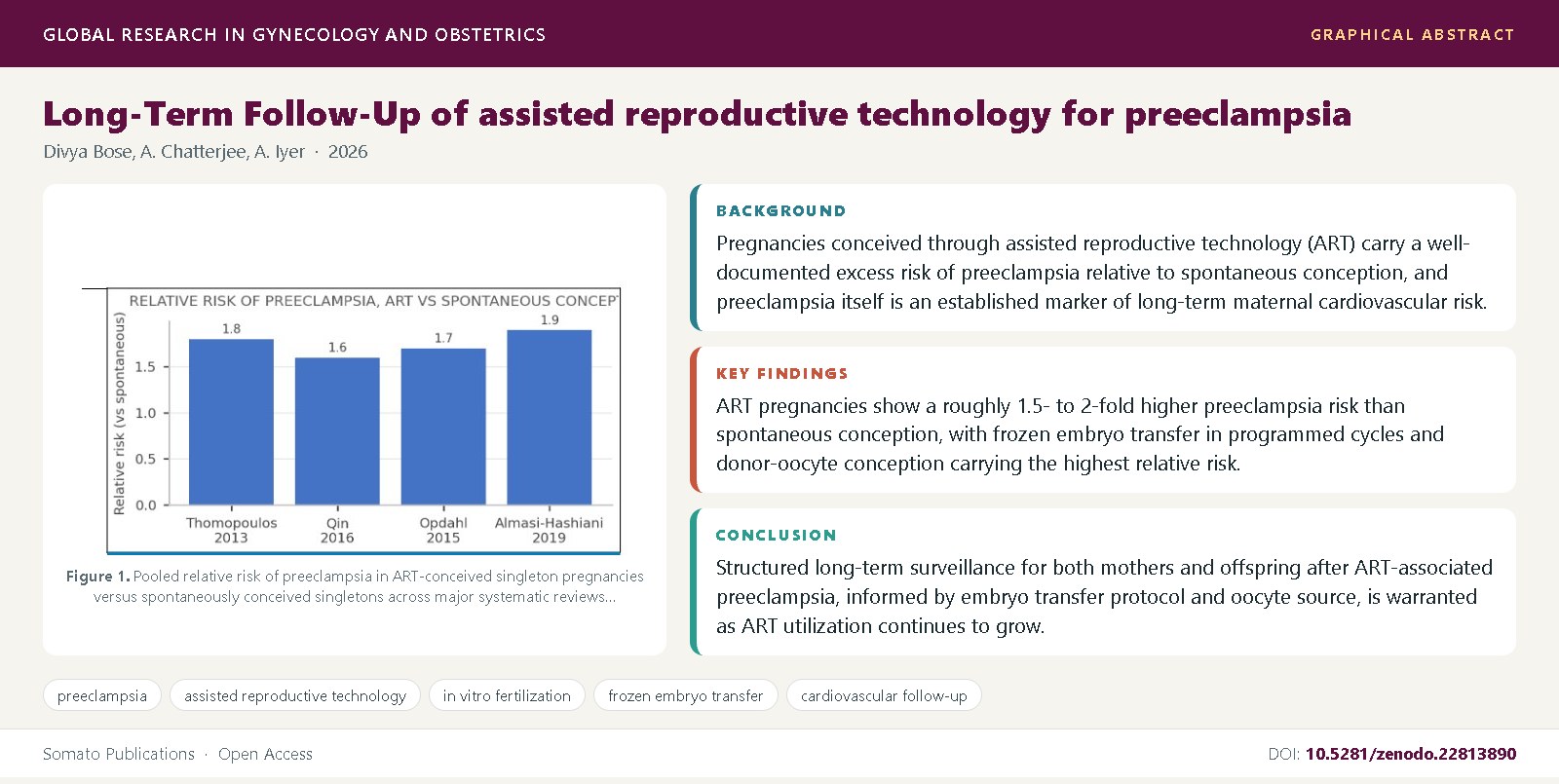
Background: Pregnancies conceived through assisted reproductive technology (ART) carry a well-documented excess risk of preeclampsia relative to spontaneous conception, and preeclampsia itself is an established marker of long-term maternal cardiovascular risk.
Objective: This review synthesizes long-term maternal and offspring follow-up evidence after ART-associated preeclampsia, including risk by embryo transfer protocol and oocyte source.
Methods: We synthesized cohort studies, national registry linkage studies, and systematic reviews addressing preeclampsia incidence after ART, comparative fresh-versus-frozen and donor-oocyte protocols, and long-term maternal and offspring outcomes.
Findings: ART pregnancies show a roughly 1.5- to 2-fold higher preeclampsia risk than spontaneous conception, with frozen embryo transfer in programmed cycles and donor-oocyte conception carrying the highest relative risk; the long-term cardiovascular and renal risks established for preeclampsia broadly appear to extend to this population.
Conclusions: Structured long-term surveillance for both mothers and offspring after ART-associated preeclampsia, informed by embryo transfer protocol and oocyte source, is warranted as ART utilization continues to grow.
References
Sunderam, S., Kissin, D.M., Zhang, Y., Jewett, A., Boulet, S.L., Warner, L., et al. (2022) Assisted Reproductive Technology Surveillance - United States, 2019. MMWR Surveillance Summaries, 71(4): 1-19. DOI: 10.15585/mmwr.ss7104a1
Chen, M., Norman, R.J., Heilbronn, L.K. (2016) Does in vitro fertilisation increase type 2 diabetes and cardiovascular risk? Current Diabetes Reports, 16(9): 84. DOI: 10.1007/s11892-016-0771-1
Thomopoulos, C., Tsioufis, C., Michalopoulou, H., Makris, T., Papademetriou, V., Stefanadis, C. (2013) Assisted reproductive technology and pregnancy-related hypertensive complications: a systematic review. Journal of Human Hypertension, 27(3): 148-157. DOI: 10.1038/jhh.2012.13
Qin, J., Liu, X., Sheng, X., Wang, H., Gao, S. (2016) Assisted reproductive technology and the risk of pregnancy-related complications and adverse pregnancy outcomes in singleton pregnancies: a meta-analysis of cohort studies. Fertility and Sterility, 105(1): 73-85.e6. DOI: 10.1016/j.fertnstert.2015.09.007
Sha, T., Yin, X., Cheng, W., Massey, I.Y. (2018) Pregnancy-related complications and perinatal outcomes resulting from transfer of cryopreserved versus fresh embryos in vitro fertilization: a meta-analysis. Fertility and Sterility, 109(2): 330-342. DOI: 10.1016/j.fertnstert.2017.10.019
Masoudian, P., Nasr, A., de Nanassy, J., Fung-Kee-Fung, K., Bainbridge, S.A., El Demellawy, D. (2016) Oocyte donation pregnancies and the risk of preeclampsia or gestational hypertension: a systematic review and metaanalysis. American Journal of Obstetrics and Gynecology, 214(3): 328-339. DOI: 10.1016/j.ajog.2015.11.020
Bellamy, L., Casas, J.P., Hingorani, A.D., Williams, D.J. (2007) Pre-eclampsia and risk of cardiovascular disease and cancer in later life: systematic review and meta-analysis. BMJ, 335(7627): 974. DOI: 10.1136/bmj.39335.385301.BE
Mongraw-Chaffin, M.L., Cirillo, P.M., Cohn, B.A. (2010) Preeclampsia and cardiovascular disease death: prospective evidence from the child health and development studies cohort. Hypertension, 56(1): 166-171. DOI: 10.1161/HYPERTENSIONAHA.110.150078
Rich-Edwards, J.W., Fraser, A., Lawlor, D.A., Catov, J.M. (2010) Pregnancy characteristics and women's future cardiovascular health: an underused resource for identifying women at risk. Epidemiologic Reviews, 32(1): 5-15. DOI: 10.1093/epirev/mxq005
Conrad, K.P. (2011) Emerging role of relaxin in the maternal adaptations to normal pregnancy: implications for preeclampsia. Seminars in Nephrology, 31(1): 15-32. DOI: 10.1016/j.semnephrol.2010.10.003
von Versen-Hoeynck, F., Schaub, A.M., Chi, Y.Y., Chiu, K.H., Liu, J., Lingis, M., et al. (2019) Increased preeclampsia risk and reduced aortic compliance with in vitro fertilization cycles in the absence of a corpus luteum. Hypertension, 73(3): 640-649. DOI: 10.1161/HYPERTENSIONAHA.118.12043
Ginström Ernstad, E., Wennerholm, U.B., Khatibi, A., Petzold, M., Bergh, C. (2019) Neonatal and maternal outcome after frozen embryo transfer: increased risks in programmed cycles. American Journal of Obstetrics and Gynecology, 221(2): 126.e1-126.e18. DOI: 10.1016/j.ajog.2019.03.010
Storgaard, M., Loft, A., Bergh, C., Wennerholm, U.B., Söderström-Anttila, V., Romundstad, L.B., et al. (2017) Obstetric and neonatal complications in pregnancies conceived after oocyte donation: a systematic review and meta-analysis. BJOG, 124(4): 561-572. DOI: 10.1111/1471-0528.14257
Palomba, S., de Wilde, M.A., Falbo, A., Koster, M.P., La Sala, G.B., Fauser, B.C. (2015) Pregnancy complications in women with polycystic ovary syndrome. Human Reproduction Update, 21(5): 575-592. DOI: 10.1093/humupd/dmv029
Wu, P., Green, M., Myers, J.E. (2021) Hypertensive disorders of pregnancy and cardiovascular disease: a review. Best Practice & Research Clinical Obstetrics & Gynaecology, 71: 97-106. DOI: 10.1016/j.bpobgyn.2020.09.005
Wu, P., Haththotuwa, R., Kwok, C.S., Babu, A., Kotronias, R.A., Rushton, C., et al. (2017) Preeclampsia and future cardiovascular health: a systematic review and meta-analysis. Circulation: Cardiovascular Quality and Outcomes, 10(2): e003497. DOI: 10.1161/CIRCOUTCOMES.116.003497
Kristensen, J.H., Basit, S., Wohlfahrt, J., Damholt, M.B., Boyd, H.A. (2019) Pre-eclampsia and risk of later kidney disease: nationwide cohort study. BMJ, 365: l1516. DOI: 10.1136/bmj.l1516
Pinborg, A., Wennerholm, U.B., Romundstad, L.B., Loft, A., Aittomaki, K., Söderström-Anttila, V., et al. (2013) Why do singletons conceived after assisted reproduction technology have adverse perinatal outcome? Systematic review and meta-analysis. Human Reproduction Update, 19(2): 87-104. DOI: 10.1093/humupd/dms044
Davis, E.F., Lazdam, M., Lewandowski, A.J., Worton, S.A., Kelly, B., Kenworthy, Y., et al. (2012) Cardiovascular risk factors in children and young adults born to preeclamptic pregnancies: a systematic review. Pediatrics, 129(6): e1552-e1561. DOI: 10.1542/peds.2011-3093
Rimawi, B.H., Turner, S., Maloney, M., Prakash, J. (2020) The long-term cardiovascular risk to offspring of a pre-eclamptic mother: a review. American Journal of Perinatology, 37(9): 949-954. DOI: 10.1055/s-0039-1687857
Sandin, S., Nygren, K.G., Iliadou, A., Hultman, C.M., Reichenberg, A. (2013) Autism and mental retardation among offspring born after in vitro fertilization. JAMA, 310(1): 75-84. DOI: 10.1001/jama.2013.7222
Opdahl, S., Henningsen, A.A., Tiitinen, A., Bergh, C., Pinborg, A., Romundstad, P.R., et al. (2015) Risk of hypertensive disorders in pregnancies following assisted reproductive technology: a cohort study from the CoNARTaS group. Human Reproduction, 30(7): 1724-1731. DOI: 10.1093/humrep/dev090
Almasi-Hashiani, A., Omani-Samani, R., Mohammadi, M., Amini, P., Navid, B., Alizadeh, A., et al. (2019) Assisted reproductive technology and the risk of preeclampsia: an updated systematic review and meta-analysis. BMC Pregnancy and Childbirth, 19(1): 149. DOI: 10.1186/s12884-019-2291-x
Maheshwari, A., Pandey, S., Shetty, A., Hamilton, M., Bhattacharya, S. (2012) Obstetric and perinatal outcomes in singleton pregnancies resulting from the transfer of frozen thawed versus fresh embryos generated through in vitro fertilization treatment: a systematic review and meta-analysis. Fertility and Sterility, 98(2): 368-377. DOI: 10.1016/j.fertnstert.2012.05.019
Sites, C.K., Wilson, D., Barsky, M., Bernson, D., Bernstein, I.M., Boulet, S., et al. (2017) Embryo cryopreservation and preeclampsia risk. Fertility and Sterility, 108(5): 784-790. DOI: 10.1016/j.fertnstert.2017.08.035
Källén, B., Finnström, O., Lindam, A., Nilsson, E., Nygren, K.G., Olausson, P.O. (2010) Blastocyst versus cleavage stage transfer in in vitro fertilization: differences in neonatal outcome? Fertility and Sterility, 94(5): 1680-1683. DOI: 10.1016/j.fertnstert.2009.12.027
Schieve, L.A., Cohen, B., Nannini, A., Ferre, C., Reynolds, M.A., Zhang, Z., et al. (2004) A population-based study of maternal and perinatal outcomes associated with assisted reproductive technology in Massachusetts. Maternal and Child Health Journal, 8(4): 229-236. DOI: 10.1007/s10995-004-0018-5
Healy, D.L., Breheny, S., Halliday, J., Jaques, A., Rushford, D., Garrett, C., et al. (2010) Prevalence and risk factors for obstetric haemorrhage in 6730 singleton births after assisted reproductive technology in Victoria, Australia. Human Reproduction, 25(1): 265-274. 10.1093/humrep/dep376
Henningsen, A.K., Pinborg, A., Lidegaard, Ø., Vestergaard, C., Forman, J.L., Andersen, A.N. (2014) Perinatal outcome of singleton siblings born after assisted reproductive technology and spontaneous conception: Danish national sibling-cohort study. Fertility and Sterility, 95(3): 959-963. DOI: 10.1016/j.fertnstert.2010.07.1075
Sazonova, A., Källen, K., Thurin-Kjellberg, A., Wennerholm, U.B., Bergh, C. (2011) Factors affecting obstetric outcome of singletons born after IVF. Human Reproduction, 26(10): 2878-2886. DOI: 10.1093/humrep/der241
Romundstad, L.B., Romundstad, P.R., Sunde, A., von Düring, V., Skjaerven, R., Gunnell, D., et al. (2008) Effects of technology or maternal factors on perinatal outcome after assisted fertilisation: a population-based cohort study. Lancet, 372(9640): 737-743. 10.1016/S0140-6736(08)61041-7
Steegers, E.A., von Dadelszen, P., Duvekot, J.J., Pijnenborg, R. (2010) Pre-eclampsia. Lancet, 376(9741): 631-644. DOI: 10.1016/S0140-6736(10)60279-6
Redman, C.W., Sargent, I.L. (2005) Latest advances in understanding preeclampsia. Science, 308(5728): 1592-1594. DOI: 10.1126/science.1111726
Roberts, J.M., Cooper, D.W. (2001) Pathogenesis and genetics of pre-eclampsia. Lancet, 357(9249): 53-56. 10.1016/S0140-6736(00)03577-7
Luke, B., Brown, M.B., Wantman, E., Stern, J.E., Baker, V.L., Widra, E., et al. (2015) Cumulative birth rates with linked assisted reproductive technology cycles. New England Journal of Medicine, 372(22): 2483-2491. 10.1056/NEJMoa1414490
Nelson, S.M. (2017) Prevention and management of ovarian hyperstimulation syndrome. Thrombosis Research, 151(Suppl 1): S61-S64. DOI: 10.1016/S0049-3848(17)30070-1 DOI: DOI: DOI: DOI:

Published
Issue
Section
License
Copyright (c) 2026 Divya Bose, et al.

This work is licensed under a Creative Commons Attribution 4.0 International License.


