
Impact of assisted reproductive technology on Quality of Life in Patients with gestational diabetes
DOI:
https://doi.org/10.5281/zenodo.22813863Keywords:
assisted reproductive technology, gestational diabetes, quality of life, in vitro fertilization, psychological distressAbstract
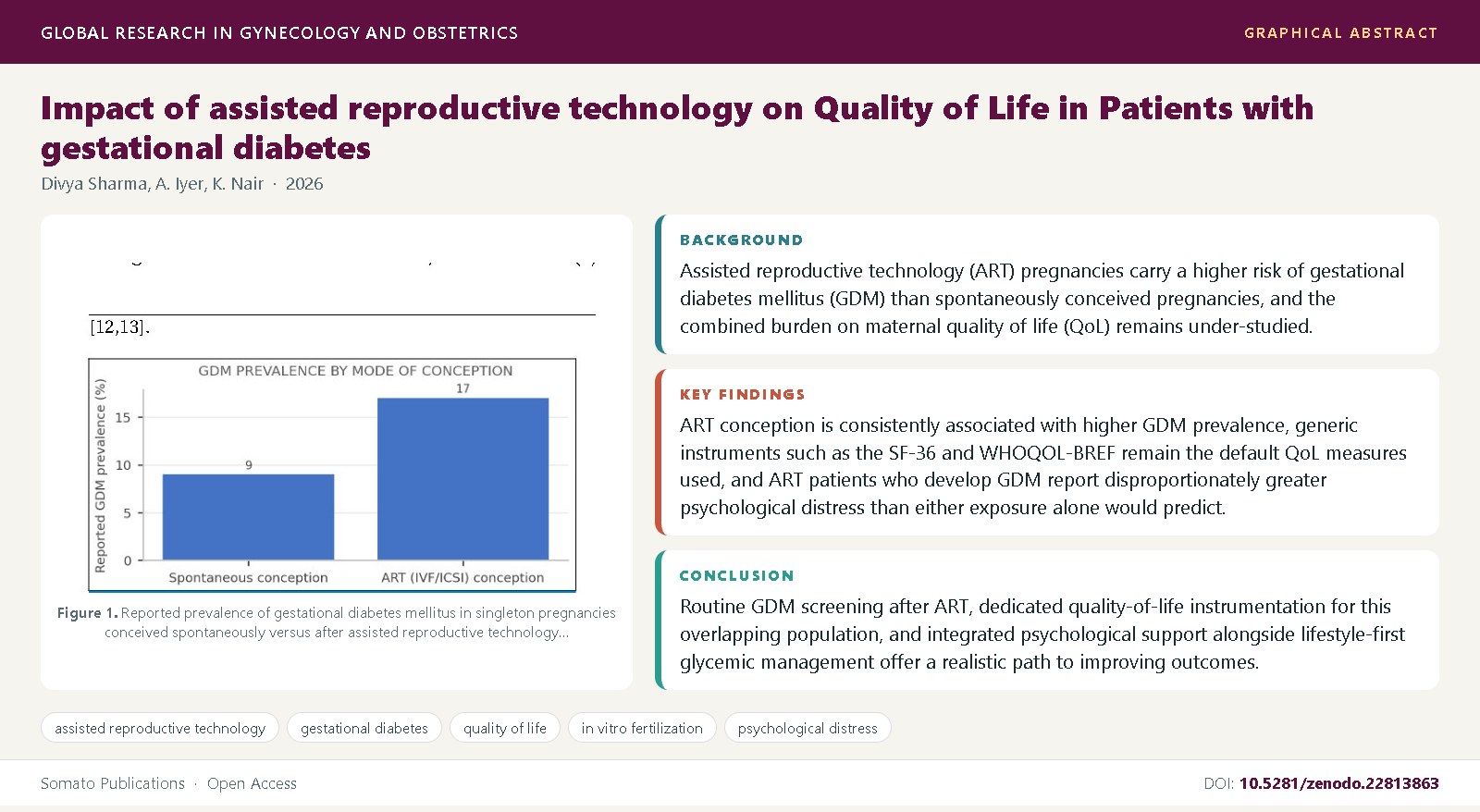
Background: Assisted reproductive technology (ART) pregnancies carry a higher risk of gestational diabetes mellitus (GDM) than spontaneously conceived pregnancies, and the combined burden on maternal quality of life (QoL) remains under-studied.
Objective: This review examines the epidemiological link between ART and GDM, the instruments used to assess QoL in this population, and the psychological burden created when a GDM diagnosis is superimposed on an ART pregnancy.
Methods: We synthesized cohort studies, meta-analyses, randomized GDM management trials, and validation studies of quality-of-life and diabetes-distress instruments from the reproductive medicine and obstetric literature.
Findings: ART conception is consistently associated with higher GDM prevalence, generic instruments such as the SF-36 and WHOQOL-BREF remain the default QoL measures used, and ART patients who develop GDM report disproportionately greater psychological distress than either exposure alone would predict.
Conclusions: Routine GDM screening after ART, dedicated quality-of-life instrumentation for this overlapping population, and integrated psychological support alongside lifestyle-first glycemic management offer a realistic path to improving outcomes.
References
International Association of Diabetes and Pregnancy Study Groups Consensus Panel. (2010) International association of diabetes and pregnancy study groups recommendations on the diagnosis and classification of hyperglycemia in pregnancy. Diabetes Care, 33(3): 676-682. DOI: 10.2337/dc09-1848
Ferrara, A. (2007) Increasing prevalence of gestational diabetes mellitus: a public health perspective. Diabetes Care, 30(Suppl 2): S141-S146. DOI: 10.2337/dc07-s206
HAPO Study Cooperative Research Group, Metzger, B.E., Lowe, L.P., Dyer, A.R., Trimble, E.R., Chaovarindr, U., et al. (2008) Hyperglycemia and adverse pregnancy outcomes. New England Journal of Medicine, 358(19): 1991-2002. DOI: 10.1056/NEJMoa0707943
Sunderam, S., Kissin, D.M., Zhang, Y., Jewett, A., Boulet, S.L., Warner, L., et al. (2022) Assisted reproductive technology surveillance - United States, 2018. MMWR Surveillance Summaries, 71(4): 1-19. DOI: 10.15585/mmwr.ss7104a1
Adamson, G.D., de Mouzon, J., Chambers, G.M., Zegers-Hochschild, F., Mansour, R., Ishihara, O., et al. (2018) International Committee for Monitoring Assisted Reproductive Technology: world report on assisted reproductive technology, 2011. Fertility and Sterility, 110(6): 1067-1080. DOI: 10.1016/j.fertnstert.2018.06.039
Palomba, S., de Wilde, M.A., Falbo, A., Koster, M.P., La Sala, G.B., Fauser, B.C. (2015) Pregnancy complications in women with polycystic ovary syndrome. Human Reproduction Update, 21(5): 575-592. DOI: 10.1093/humupd/dmv029
Boomsma, C.M., Eijkemans, M.J., Hughes, E.G., Visser, G.H., Fauser, B.C., Macklon, N.S. (2006) A meta-analysis of pregnancy outcomes in women with polycystic ovary syndrome. Human Reproduction Update, 12(6): 673-683. DOI: 10.1093/humupd/dml036
Qin, J., Liu, X., Sheng, X., Wang, H., Gao, S. (2016) Assisted reproductive technology and the risk of pregnancy-related complications and adverse pregnancy outcomes in singleton pregnancies: a meta-analysis of cohort studies. Fertility and Sterility, 105(1): 73-85. DOI: 10.1016/j.fertnstert.2015.09.007
Ashrafi, M., Gosili, R., Hosseini, R., Arabipoor, A., Ahmadi, J., Chehrazi, M. (2014) Risk of gestational diabetes mellitus in patients undergoing assisted reproductive techniques. European Journal of Obstetrics & Gynecology and Reproductive Biology, 176: 149-152. DOI:
1016/j.ejogrb.2014.02.009 10. Wang, Y.A., Nikravan, R., Smith, H.C., Sullivan, E.A. (2013) Higher prevalence of gestational diabetes mellitus following assisted reproduction technology treatment. Human Reproduction, 28(9): 2554-2561. DOI: 10.1093/humrep/det270
Bosdou, J.K., Anagnostis, P., Goulis, D.G., Zepiridis, L., Chatzimeletiou, K., Grimbizis, G., et al. (2020) Risk of gestational diabetes mellitus in women achieving singleton pregnancy spontaneously or after ART: a systematic review and meta-analysis. Human Reproduction Update, 26(4): 514-544. DOI: 10.1093/humupd/dmaa011
Pinborg, A., Wennerholm, U.B., Romundstad, L.B., Loft, A., Aittomaki, K., Soderstrom-Anttila, V., et al. (2013) Why do singletons conceived after assisted reproduction technology have adverse perinatal outcome? Systematic review and meta-analysis. Human Reproduction Update, 19(2): 87-104. DOI: 10.1093/humupd/dms044
Qin, J., Sheng, X., Wu, D., Gao, S., You, Y., Yang, T., et al. (2017) Worldwide prevalence of adverse pregnancy outcomes among singleton pregnancies after in vitro fertilization/intracytoplasmic sperm injection: a systematic review and meta-analysis. Archives of Gynecology and Obstetrics, 295(2): 285-301. DOI: 10.1007/s00404-016-4250-3
Ware, J.E., Sherbourne, C.D. (1992) The MOS 36-item short-form health survey (SF-36): I. Conceptual framework and item selection. Medical Care, 30(6): 473-483.
The WHOQOL Group. (1998) Development of the World Health Organization WHOQOL-BREF quality of life assessment. Psychological Medicine, 28(3): 551-558. DOI: 10.1017/S0033291798006667
Polonsky, W.H., Anderson, B.J., Lohrer, P.A., Welch, G., Jacobson, A.M., Aponte, J.E., et al. (1995) Assessment of diabetes-related distress. Diabetes Care, 18(6): 754-760. DOI: 10.2337/diacare.18.6.754
Chachamovich, J.R., Chachamovich, E., Ezer, H., Fleck, M.P., Knauth, D., Passos, E.P. (2010) Investigating quality of life and health-related quality of life in infertility: a systematic review. Journal of Psychosomatic Obstetrics & Gynecology, 31(2): 101-110. DOI: 10.3109/0167482X.2010.481337
Verhaak, C.M., Smeenk, J.M., Evers, A.W., Kremer, J.A., Kraaimaat, F.W., Braat, D.D. (2007) Women's emotional adjustment to IVF: a systematic review of 25 years of research. Human Reproduction Update, 13(1): 27-36. DOI: 10.1093/humupd/dml040
Cousineau, T.M., Domar, A.D. (2007) Psychological impact of infertility. Best Practice & Research Clinical Obstetrics & Gynaecology, 21(2): 293-308. DOI: 10.1016/j.bpobgyn.2006.12.003
Volgsten, H., Skoog Svanberg, A., Ekselius, L., Lundkvist, O., Sundstrom Poromaa, I. (2008) Prevalence of psychiatric disorders in infertile women and men undergoing in vitro fertilization treatment. Human Reproduction, 23(9): 2056-2063. DOI: 10.1093/humrep/den154
Massarotti, C., Gentile, G., Ferreccio, C., Scaruffi, P., Remorgida, V., Anserini, P. (2019) Impact of infertility and infertility treatments on quality of life and levels of anxiety and depression in women undergoing in vitro fertilization. Gynecological Endocrinology, 35(6): 485-489. DOI: 10.1080/09513590.2018.1540575
Egan, A.M., Dunne, F.P., Lydon, K., Conneely, S., Sarma, K., McGuire, B.E. (2017) Diabetes in pregnancy: worse medical outcomes in type 1 diabetes but worse psychological outcomes in gestational diabetes. QJM, 110(11): 721-727. DOI: 10.1093/qjmed/hcx106
Byrn, M., Penckofer, S. (2015) The relationship between gestational diabetes and antenatal depression. Journal of Obstetric, Gynecologic & Neonatal Nursing, 44(2): 246-255. DOI: 10.1111/1552-6909.12554
Kozhimannil, K.B., Pereira, M.A., Harlow, B.L. (2009) Association between diabetes and perinatal depression among low-income mothers. JAMA, 301(8): 842-847. DOI: 10.1001/jama.2009.201
Hui, A.L., Sevenhuysen, G., Harvey, D., Salamon, E. (2014) Stress and anxiety in women with gestational diabetes during dietary management. Diabetes Educator, 40(5): 668-677. DOI: 10.1177/0145721714535991
Metzger, B.E., Buchanan, T.A., Coustan, D.R., de Leiva, A., Dunger, D.B., Hadden, D.R., et al. (2007) Summary and recommendations of the Fifth International Workshop-Conference on Gestational Diabetes Mellitus. Diabetes Care, 30(Suppl 2): S251-S260. DOI: 10.2337/dc07-s225
Crowther, C.A., Hiller, J.E., Moss, J.R., McPhee, A.J., Jeffries, W.S., Robinson, J.S. (2005) Effect of treatment of gestational diabetes mellitus on pregnancy outcomes. New England Journal of Medicine, 352(24): 2477-2486. DOI: 10.1056/NEJMoa042973
Landon, M.B., Spong, C.Y., Thom, E., Carpenter, M.W., Ramin, S.M., Casey, B., et al. (2009) A multicenter, randomized trial of treatment for mild gestational diabetes. New England Journal of Medicine, 361(14): 1339-1348. DOI: 10.1056/NEJMoa0902430
Rasmussen, L., Poulsen, C.W., Kampmann, U., Smedegaard, S.B., Ovesen, P.G., Fuglsang, J. (2020) Diet and healthy lifestyle in the management of gestational diabetes mellitus. Nutrients, 12(10): 3050. DOI: 10.3390/nu12103050
Bain, E., Crane, M., Tieu, J., Han, S., Crowther, C.A., Middleton, P. (2015) Diet and exercise interventions for preventing gestational diabetes mellitus. Cochrane Database of Systematic Reviews, (4): CD010443. DOI: 10.1002/14651858.CD010443.pub2
Chambers, G.M., Sullivan, E.A., Ishihara, O., Chapman, M.G., Adamson, G.D. (2009) The economic impact of assisted reproductive technology: a review of selected developed countries. Fertility and Sterility, 91(6): 2281-2294. DOI: 10.1016/j.fertnstert.2009.04.029
Steptoe, P.C., Edwards, R.G. (1978) Birth after the reimplantation of a human embryo. Lancet, 2(8085): 366.
American Diabetes Association. (2021) Classification and diagnosis of diabetes: Standards of Medical Care in Diabetes-2021. Diabetes Care, 44(Suppl 1): S15-S33. DOI: 10.2337/dc21-S002
Bradley, C. (1994) The Diabetes Treatment Satisfaction Questionnaire: DTSQ. In: Bradley, C. (ed.) Handbook of Psychology and Diabetes. Harwood Academic Publishers, Chur, Switzerland, 111-132.

Published
Issue
Section
License
Copyright (c) 2026 Divya Sharma, et al.

This work is licensed under a Creative Commons Attribution 4.0 International License.


