
Long-Term Follow-Up of labor induction protocols for preeclampsia
DOI:
https://doi.org/10.5281/zenodo.22813874Keywords:
preeclampsia, labor induction, misoprostol, Foley catheter, long-term follow-upAbstract
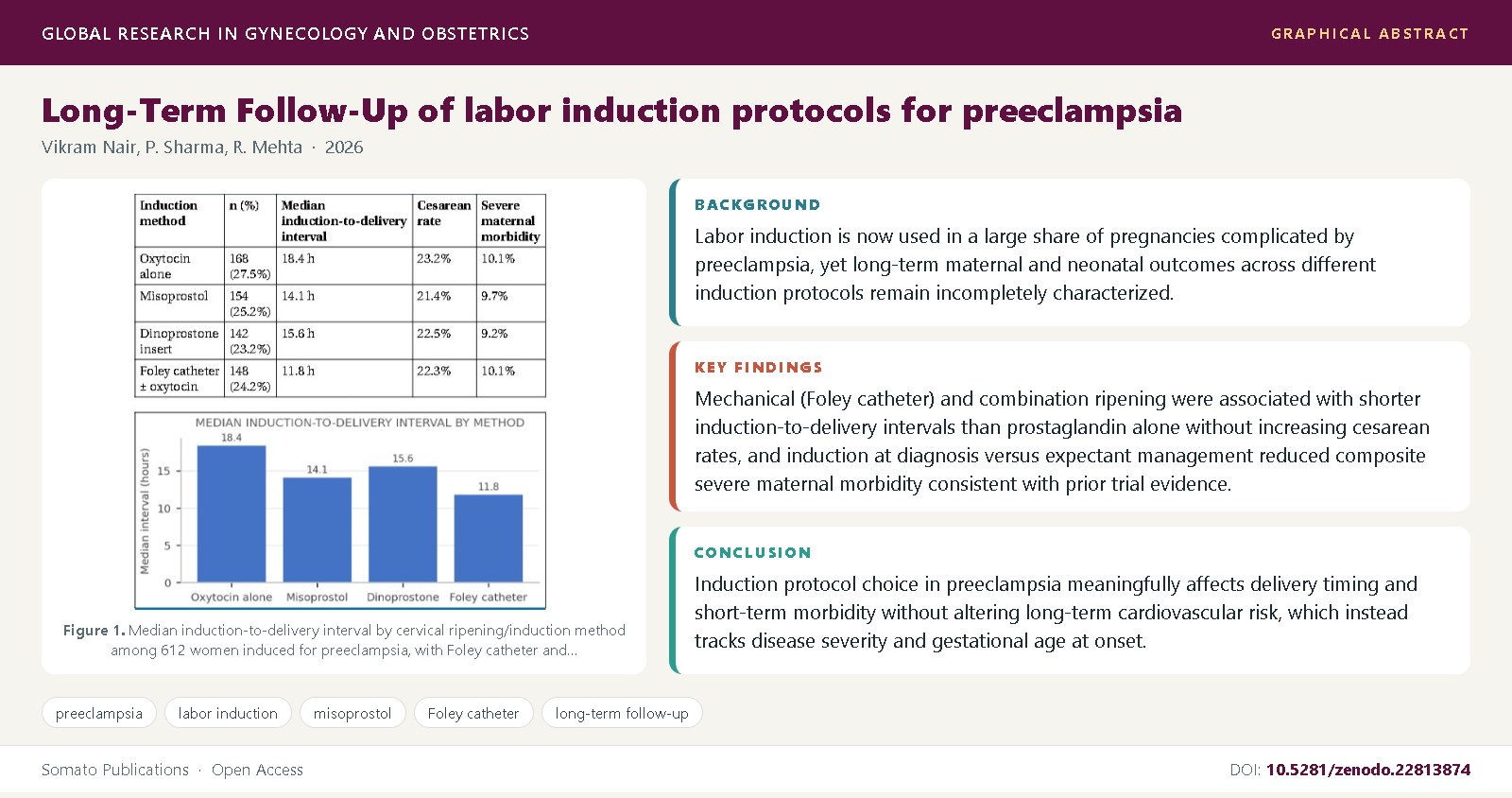
Background: Labor induction is now used in a large share of pregnancies complicated by preeclampsia, yet long-term maternal and neonatal outcomes across different induction protocols remain incompletely characterized.
Objective: This retrospective cohort study compared long-term maternal and neonatal outcomes following labor induction with oxytocin, vaginal misoprostol, dinoprostone, or Foley catheter ripening in women with preeclampsia, with follow-up extending to five years postpartum.
Methods: We analyzed 612 women with preeclampsia at or beyond 34 weeks' gestation induced across three tertiary centers between 2016 and 2020, comparing time to vaginal delivery, cesarean rate, severe maternal morbidity, and neonatal outcomes by induction method, with maternal cardiovascular and renal follow-up through 2025.
Results: Mechanical (Foley catheter) and combination ripening were associated with shorter induction-to-delivery intervals than prostaglandin alone without increasing cesarean rates, and induction at diagnosis versus expectant management reduced composite severe maternal morbidity consistent with prior trial evidence. Five-year follow-up showed elevated rates of chronic hypertension and reduced renal function among women with early-onset preeclampsia regardless of induction method.
Conclusions: Induction protocol choice in preeclampsia meaningfully affects delivery timing and short-term morbidity without altering long-term cardiovascular risk, which instead tracks disease severity and gestational age at onset, supporting protocolized induction alongside sustained postpartum cardiovascular surveillance.
References
Steegers, E.A., von Dadelszen, P., Duvekot, J.J., Pijnenborg, R. (2010) Pre-eclampsia. Lancet, 376(9741): 631-644. DOI: 10.1016/S0140-6736(10)60279-6
Hutcheon, J.A., Lisonkova, S., Joseph, K.S. (2011) Epidemiology of pre-eclampsia and the other hypertensive disorders of pregnancy. Best Practice & Research Clinical Obstetrics & Gynaecology, 25(4): 391-403. DOI: 10.1016/j.bpobgyn.2011.01.006
Duckitt, K., Harrington, D. (2005) Risk factors for pre-eclampsia at antenatal booking: systematic review of controlled studies. BMJ, 330(7491): 565. DOI: 10.1136/bmj.38380.674340.E0
Sibai, B.M., Lindheimer, M., Hauth, J., Caritis, S., VanDorsten, P., Klebanoff, M., et al. (1998) Risk factors for preeclampsia, abruptio placentae, and adverse neonatal outcomes among women with chronic hypertension. New England Journal of Medicine, 339(10): 667-671. DOI: 10.1056/NEJM199809033391004
Magee, L.A., Brown, M.A., Hall, D.R., Gupte, S., Hennessy, A., Karumanchi, S.A., et al. (2022) The 2021 International Society for the Study of Hypertension in Pregnancy (ISSHP) classification, diagnosis & management recommendations for international practice. Pregnancy Hypertension, 27: 148-169. DOI: 10.1016/j.preghy.2021.09.008
Rolnik, D.L., Wright, D., Poon, L.C., O'Gorman, N., Syngelaki, A., de Paco Matallana, C., et al. (2017) Aspirin versus placebo in pregnancies at high risk for preterm preeclampsia. New England Journal of Medicine, 377(7): 613-622. DOI: 10.1056/NEJMoa1704559
Duley, L. (2009) The global impact of pre-eclampsia and eclampsia. Seminars in Perinatology, 33(3): 130-137. DOI: 10.1053/j.semperi.2009.02.010
American College of Obstetricians and Gynecologists (2020) Gestational Hypertension and Preeclampsia: ACOG Practice Bulletin No. 222. Obstetrics & Gynecology, 135(6): e237-e260. DOI: 10.1097/AOG.0000000000003891
Koopmans, C.M., Bijlenga, D., Groen, H., Vijgen, S.M., Aarnoudse, J.G., Bekedam, D.J., et al. (2009) Induction of labour versus expectant monitoring for gestational hypertension or mild pre-eclampsia after 36 weeks' gestation (HYPITAT): a multicentre, open-label randomised controlled trial. Lancet, 374(9694): 979-988. DOI:
1016/S0140-6736(09)60736-4 10. Broekhuijsen, K., van Baaren, G.J., van Pampus, M.G., Ganzevoort, W., Sikkema, J.M., Woiski, M.D., et al. (2015) Immediate delivery versus expectant monitoring for hypertensive disorders of pregnancy between 34 and 37 weeks of gestation (HYPITAT-II). Lancet, 385(9986): 2492-2501. DOI: 10.1016/S0140-6736(15)00070-7
Chappell, L.C., Brocklehurst, P., Green, M.E., Hardy, P., Hardy, R., Juszczak, E., et al. (2019) Planned early delivery or expectant management for late preterm pre-eclampsia (PHOENIX): a randomised controlled trial. Lancet, 394(10204): 1181-1190. DOI: 10.1016/S0140-6736(19)31963-4
Bernardes, T.P., Broekhuijsen, K., Koopmans, C.M., Boers, K.E., van Wyk, L., Tajik, P., et al. (2019) Delivery or expectant management for prevention of adverse maternal and neonatal outcomes in hypertensive disorders of pregnancy: an individual participant data meta-analysis. Ultrasound in Obstetrics & Gynecology, 53(4): 443-453. DOI: 10.1002/uog.20224
Alexander, J.M., Bloom, S.L., McIntire, D.D., Leveno, K.J. (1999) Severe preeclampsia and the very low birth weight infant: is induction of labor harmful? Obstetrics & Gynecology, 93(4): 485-488. DOI: 10.1016/S0029-7844(99)00358-X
von Dadelszen, P., Payne, B., Li, J., Ansermino, J.M., Broughton Pipkin, F., Cote, A.M., et al. (2011) Prediction of adverse maternal outcomes in pre-eclampsia: development and validation of the fullPIERS model. Lancet, 377(9761): 219-227. DOI: 10.1016/S0140-6736(10)61351-7
Alfirevic, Z., Keeney, E., Dowswell, T., Welton, N.J., Dias, S., Jones, L.V., et al. (2016) Methods to induce labour: a systematic review, network meta-analysis and cost-effectiveness analysis. BJOG, 123(9): 1462-1470. DOI: 10.1111/1471-0528.14454
Hofmeyr, G.J., Gulmezoglu, A.M., Pileggi, C. (2010) Vaginal misoprostol for cervical ripening and induction of labour. Cochrane Database of Systematic Reviews, (10): CD000941. DOI: 10.1002/14651858.CD000941.pub2
Kelly, A.J., Malik, S., Smith, L., Kavanagh, J., Thomas, J. (2009) Vaginal prostaglandin (PGE2 and PGF2a) for induction of labour at term. Cochrane Database of Systematic Reviews, (4): CD003101. DOI: 10.1002/14651858.CD003101.pub2
Jozwiak, M., Bloemenkamp, K.W., Kelly, A.J., Mol, B.W., Irion, O., Boulvain, M. (2012) Mechanical methods for induction of labour. Cochrane Database of Systematic Reviews, (3): CD001233. DOI: 10.1002/14651858.CD001233.pub2
Vogel, J.P., Gulmezoglu, A.M., Hofmeyr, G.J., Temmerman, M. (2011) Combination of methods for induction of labour: a systematic review. BJOG, 118(3): 257-259. DOI: 10.1111/j.1471-0528.2011.02998.x
ten Eikelder, M.L., Oude Rengerink, K., Jozwiak, M., de Leeuw, J.W., de Graaf, I.M., van Pampus, M.G., et al. (2016) Induction of labour at term with oral misoprostol versus a Foley catheter (PROBAAT-II): a multicentre randomised controlled non-inferiority trial. American Journal of Obstetrics and Gynecology, 214(2): 273.e1-273.e9. DOI: 10.1016/j.ajog.2016.07.007
Wing, D.A., Brown, R., Plante, L.A., Miller, H., Rugarn, O., Powers, B.L. (2013) Misoprostol vaginal insert compared with dinoprostone vaginal insert. Obstetrics & Gynecology, 122(2 Pt 1): 201-209. DOI: 10.1097/AOG.0b013e3182959e33
Mishanina, E., Rogozinska, E., Thatthi, T., Uddin-Khan, R., Khan, K.S., Meads, C. (2014) Use of labour induction and risk of cesarean delivery: a systematic review and meta-analysis. Canadian Medical Association Journal, 186(9): 665-673. DOI: 10.1503/cmaj.130925
Grobman, W.A., Rice, M.M., Reddy, U.M., Tita, A.T., Silver, R.M., Mallett, G., et al. (2018) Labor induction versus expectant management in low-risk nulliparous women. New England Journal of Medicine, 379(6): 513-523. DOI: 10.1056/NEJMoa1800566
American College of Obstetricians and Gynecologists (2009) ACOG Practice Bulletin No. 107: Induction of labor. Obstetrics & Gynecology, 114(2 Pt 1): 386-397. DOI: 10.1097/AOG.0b013e3181b48ef5
Vikse, B.E., Irgens, L.M., Leivestad, T., Skjaerven, R., Iversen, B.M. (2008) Preeclampsia and the risk of end-stage renal disease. New England Journal of Medicine, 359(8): 800-809. DOI: 10.1056/NEJMoa0706790
McDonald, S.D., Malinowski, A., Zhou, Q., Yusuf, S., Devereaux, P.J. (2008) Cardiovascular sequelae of preeclampsia/eclampsia: a systematic review and meta-analyses. American Heart Journal, 156(5): 918-930. DOI: 10.1016/j.ahj.2008.06.042
Bellamy, L., Casas, J.P., Hingorani, A.D., Williams, D.J. (2007) Pre-eclampsia and risk of cardiovascular disease and cancer in later life: systematic review and meta-analysis. BMJ, 335(7627): 974. DOI: 10.1136/bmj.39335.385301.BE
Lisonkova, S., Joseph, K.S. (2013) Incidence of preeclampsia: risk factors and outcomes associated with early- versus late-onset disease. American Journal of Obstetrics and Gynecology, 209(6): 544.e1-544.e12. DOI: 10.1016/j.ajog.2013.08.019
Wing, D.A. (1999) Labor induction with misoprostol. American Journal of Obstetrics and Gynecology, 181(2): 339-345. DOI: 10.1016/S0002-9378(99)70233-1
Churchill, D., Duley, L., Thornton, J.G., Moussa, M., Ashworth, V., Jones, L. (2018) Interventionist versus expectant care for severe pre-eclampsia between 24 and 34 weeks' gestation. Cochrane Database of Systematic Reviews, (10): CD003106. DOI: 10.1002/14651858.CD003106.pub3
Duley, L., Gulmezoglu, A.M., Henderson-Smart, D.J., Chou, D. (2010) Magnesium sulphate and other anticonvulsants for women with pre-eclampsia. Cochrane Database of Systematic Reviews, (11): CD000025. DOI: 10.1002/14651858.CD000025.pub2
The Magpie Trial Collaborative Group (2002) Do women with pre-eclampsia, and their babies, benefit from magnesium sulphate? The Magpie Trial: a randomised placebo-controlled trial. Lancet, 359(9321): 1877-1890. DOI: 10.1016/S0140-6736(02)08778-0
Magee, L.A., von Dadelszen, P., Rey, E., Ross, S., Asztalos, E., Murphy, K.E., et al. (2015) Less-tight versus tight control of hypertension in pregnancy (CHIPS). New England Journal of Medicine, 372(5): 407-417. DOI: 10.1056/NEJMoa1404595
Roberts, J.M., Bell, M.J. (2013) If we know so much about preeclampsia, why haven't we cured the disease? Journal of Reproductive Immunology, 99(1-2): 1-9. DOI: 10.1016/j.jri.2013.05.003
Marchi, J., Berg, M., Dencker, A., Olander, E.K., Begley, C. (2015) Risks associated with obesity in pregnancy, for the mother and baby: a systematic review of reviews. Obesity Reviews, 16(8): 621-638. DOI: 10.1111/obr.12288
Sotiriadis, A., Hernandez-Andrade, E., da Silva Costa, F., Ghi, T., Glanc, P., Khalil, A., et al. (2019) ISUOG Practice Guidelines: role of ultrasound in screening for and follow-up of pre-eclampsia. Ultrasound in Obstetrics & Gynecology, 53(1): 7-22. DOI: 10.1002/uog.20105
Sibai, B.M., Barton, J.R. (2007) Expectant management of severe preeclampsia remote from term: patient selection, treatment, and delivery indications. American Journal of Obstetrics and Gynecology, 196(6): 514.e1-514.e9. DOI: 10.1016/j.ajog.2007.01.021
Sanchez-Ramos, L., Olivier, F., Delke, I., Kaunitz, A.M. (2003) Labor induction versus expectant management for postterm pregnancies: a systematic review with meta-analysis. Obstetrics & Gynecology, 101(6): 1312-1318. DOI: 10.1016/S0029-7844(03)00475-7
Leeman, L., Fontaine, P. (2016) Hypertensive disorders of pregnancy. American Family Physician, 93(2): 121-127. PMID: 26926408
Tita, A.T., Szychowski, J.M., Boggess, K., Dugoff, L., Sibai, B., Lawrence, K., et al. (2022) Treatment for mild chronic hypertension during pregnancy. New England Journal of Medicine, 386(19): 1781-1792. DOI: 10.1056/NEJMoa2201295
Ananth, C.V., Basso, O. (2010) Impact of pregnancy-induced hypertension on stillbirth and neonatal mortality in first and higher order births: a population-based study. Epidemiology, 21(1): 118-123. DOI: 10.1097/EDE.0b013e3181c297af

Published
Issue
Section
License
Copyright (c) 2026 Vikram Nair, et al.

This work is licensed under a Creative Commons Attribution 4.0 International License.


