
Predictors of maternal outcomes in women with infertility with preeclampsia
DOI:
https://doi.org/10.5281/zenodo.22813842Keywords:
preeclampsia, infertility, assisted reproductive technology, maternal outcomes, donor oocyteAbstract
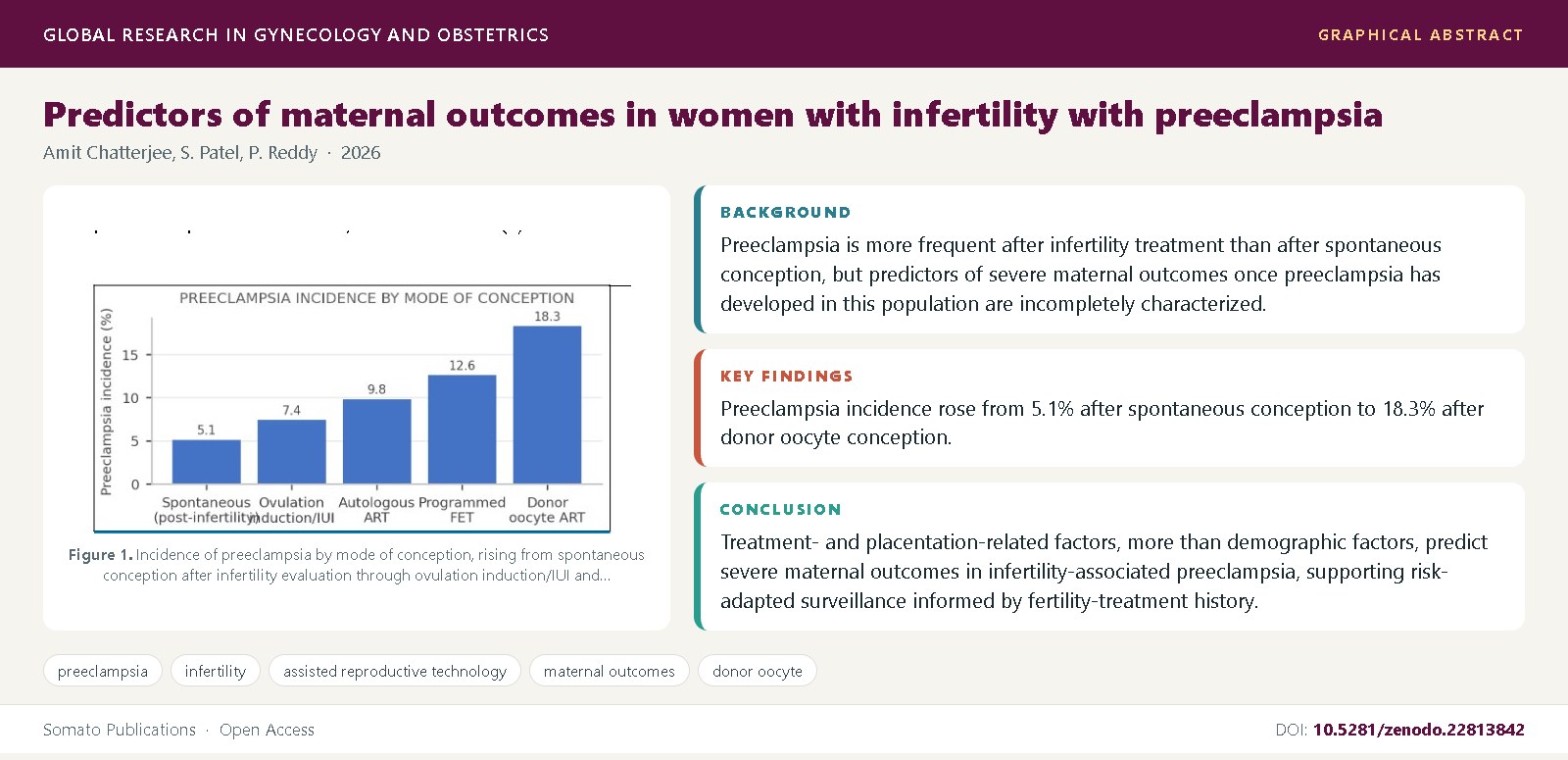
Background: Preeclampsia is more frequent after infertility treatment than after spontaneous conception, but predictors of severe maternal outcomes once preeclampsia has developed in this population are incompletely characterized.
Objective: To identify predictors of severe maternal outcomes among women with infertility who develop preeclampsia.
Methods: Retrospective cohort of women with a history of infertility diagnosed with preeclampsia during a singleton pregnancy, comparing conception mode, with multivariable logistic regression for a composite severe maternal outcome.
Results: Preeclampsia incidence rose from 5.1% after spontaneous conception to 18.3% after donor oocyte conception. Donor oocyte conception, programmed frozen embryo transfer without a corpus luteum, early-onset preeclampsia, and chronic hypertension independently predicted the composite outcome, while maternal age and body mass index lost significance after adjustment.
Conclusions: Treatment- and placentation-related factors, more than demographic factors, predict severe maternal outcomes in infertility-associated preeclampsia, supporting risk-adapted surveillance informed by fertility-treatment history.
References
Redman, C.W., Sargent, I.L. (2005) Latest advances in understanding preeclampsia. Science, 308(5728): 1592-1594.
Steegers, E.A., von Dadelszen, P., Duvekot, J.J., Pijnenborg, R. (2010) Pre-eclampsia. Lancet, 376(9741): 631-644.
Thadhani, R., Mutter, W.P., Wolf, M., Levine, R.J., Taylor, R.N., Sukhatme, V.P., et al. (2004) First trimester placental growth factor and soluble fms-like tyrosine kinase 1 and risk for preeclampsia. Journal of Clinical Endocrinology and Metabolism, 89(2): 770-775.
Levine, R.J., Maynard, S.E., Qian, C., Lim, K.H., England, L.J., Yu, K.F., et al. (2004) Circulating angiogenic factors and the risk of preeclampsia. New England Journal of Medicine, 350(7): 672-683.
Poon, L.C., Shennan, A., Hyett, J.A., Kapur, A., Hadar, E., Divakar, H., et al. (2019) The International Federation of Gynecology and Obstetrics (FIGO) initiative on pre-eclampsia. International Journal of Gynaecology and Obstetrics, 145(Suppl 1): 1-33.
Duckitt, K., Harrington, D. (2005) Risk factors for pre-eclampsia at antenatal booking: systematic review of controlled studies. BMJ, 330(7491): 565.
English, F.A., Kenny, L.C., McCarthy, F.P. (2015) Risk factors and effective management of preeclampsia. Integrated Blood Pressure Control, 8: 7-12.
American College of Obstetricians and Gynecologists (2020) Gestational hypertension and preeclampsia: ACOG Practice Bulletin No. 222. Obstetrics and Gynecology, 135(6): e237-e260.
Rolnik, D.L., Wright, D., Poon, L.C., O'Gorman, N., Syngelaki, A., de Paco Matallana, C., et al. (2017) Aspirin versus placebo in pregnancies at high risk for preterm preeclampsia. New England Journal of Medicine, 377(7): 613-622.
Sunderam, S., Kissin, D.M., Crawford, S.B., Folger, S.G., Boulet, S.L., Warner, L., et al. (2018) Assisted Reproductive Technology Surveillance - United States, 2015. MMWR Surveillance Summaries, 67(3): 1-28.
Qin, J., Liu, X., Sheng, X., Wang, H., Gao, S. (2016) Assisted reproductive technology and risk of adverse obstetric outcomes. Fertility and Sterility, 105(1): 73-85.
Jackson, R.A., Gibson, K.A., Wu, Y.W., Croughan, M.S. (2004) Perinatal outcomes in singletons following in vitro fertilization: a meta-analysis. Obstetrics and Gynecology, 103(3): 551-563.
Pandey, S., Shetty, A., Hamilton, M., Bhattacharya, S., Maheshwari, A. (2012) Obstetric and perinatal outcomes in singleton pregnancies resulting from IVF/ICSI: a systematic review and meta-analysis. Human Reproduction Update, 18(5): 485-503.
Henningsen, A.A., Pinborg, A., Lidegaard, O., Vestergaard, C., Forman, J.L., Andersen, A.N. (2011) Perinatal outcome of singleton siblings born after assisted reproductive technology and spontaneous conception. Fertility and Sterility, 95(3): 959-963.
Wang, Y.A., Chughtai, A.A., Farquhar, C.M., Pollock, W., Lui, K., Sullivan, E.A. (2016) Increased incidence of gestational hypertension and preeclampsia after assisted reproductive technology treatment. Fertility and Sterility, 105(4): 920-926.
Luke, B., Brown, M.B., Wantman, E., Forestieri, N.E., Browne, M.L., Fisher, S.C., et al. (2017) Pregnancy, birth, and infant outcomes by maternal fertility status: the Massachusetts Outcomes Study of Assisted Reproductive Technology. American Journal of Obstetrics and Gynecology, 217(3): 327.e1-327.e14.
Palomba, S., de Wilde, M.A., Falbo, A., Koster, M.P., La Sala, G.B., Fauser, B.C. (2015) Pregnancy complications in women with polycystic ovary syndrome. Human Reproduction Update, 21(5): 575-592.
Bosdou, J.K., Anagnostis, P., Goulis, D.G., Lainas, G.T., Tarlatzis, B.C., Grimbizis, G.F., et al. (2020) Risk of gestational diabetes mellitus in women achieving singleton pregnancy spontaneously or after ART. Human Reproduction Update, 26(4): 514-544.
von Versen-Hoynck, F., Schaub, A.M., Chi, Y.Y., Chiu, K.H., Liu, J., Lingis, M., et al. (2019) Increased preeclampsia risk and reduced aortic compliance with in vitro fertilization cycles in the absence of a corpus luteum. Hypertension, 73(3): 640-649.
Saito, K., Kuwahara, A., Ishikawa, T., Morisaki, N., Miyado, M., Miyado, K., et al. (2019) Endometrial preparation methods for frozen-thawed embryo transfer associated with hypertensive disorders of pregnancy. Human Reproduction, 34(8): 1567-1575.
Ernstad, E.G., Wennerholm, U.B., Khatibi, A., Petzold, M., Bergh, C. (2019) Neonatal and maternal outcome after frozen embryo transfer: increased risks in programmed cycles. American Journal of Obstetrics and Gynecology, 221(2): 126.e1-126.e18.
Maheshwari, A., Pandey, S., Amalraj Raja, E., Shetty, A., Hamilton, M., Bhattacharya, S. (2018) Is frozen embryo transfer better for mothers and babies? Human Reproduction Update, 24(1): 35-58.
Masoudian, P., Nasr, A., de Nanassy, J., Fung-Kee-Fung, K., Bainbridge, S.A., El Demellawy, D. (2016) Oocyte donation pregnancies and risk of preeclampsia: systematic review and meta-analysis. American Journal of Obstetrics and Gynecology, 214(3): 328-339.
Storgaard, M., Loft, A., Bergh, C., Wennerholm, U.B., Sostrup, B., Bay, B., et al. (2017) Obstetric and neonatal complications in pregnancies conceived after oocyte donation: a systematic review and meta-analysis. BJOG, 124(4): 561-572.
Malchau, S.S., Loft, A., Larsen, E.C., Aaris Henningsen, A.K., Rasmussen, S., Andersen, A.N., et al. (2013) Perinatal outcomes in 375 children born after oocyte donation. Fertility and Sterility, 99(6): 1637-1643.
Sha, T., Yin, X., Cheng, W., Massey, I.Y. (2019) Pregnancy-related complications and perinatal outcomes resulting from transfer of cryopreserved versus fresh embryos in vitro fertilization: a meta-analysis. Fertility and Sterility, 109(2): 330-342.
Chen, Z.J., Shi, Y., Sun, Y., Zhang, B., Liang, X., Cao, Y., et al. (2016) Fresh versus frozen embryos for infertility in the polycystic ovary syndrome. New England Journal of Medicine, 375(6): 523-533.
Roberts, J.M., Escudero, C. (2012) The placenta in preeclampsia. Pregnancy Hypertension, 2(2): 72-83.
Kroener, L., Wang, E.T., Pisarska, M.D. (2016) Predisposing factors to abnormal first trimester placentation and the impact on fetal outcomes. Seminars in Reproductive Medicine, 34(1): 27-35.
Conrad, K.P. (2011) Maternal vasodilation in pregnancy: the emerging role of relaxin. American Journal of Physiology - Regulatory, Integrative and Comparative Physiology, 301(2): R267-R275.
Schwarze, J.E., Borda, P., Vasquez, P., Ortega, C., Villa, S., Crosby, J.A., et al. (2018) Is the risk of preeclampsia higher in donor oocyte pregnancies? A systematic review and meta-analysis. JBRA Assisted Reproduction, 22(1): 15-19.
Thomopoulos, C., Tsioufis, C., Michalopoulou, H., Makris, T., Papademetriou, V. (2013) Assisted reproductive technology and pregnancy-related hypertensive complications: a systematic review. Journal of Human Hypertension, 27(3): 148-157.
Wu, P., Haththotuwa, R., Kwok, C.S., Babu, A., Kotronias, R.A., Rushton, C., et al. (2017) Preeclampsia and future cardiovascular health: a systematic review and meta-analysis. Circulation: Cardiovascular Quality and Outcomes, 10(2): e003497.

Published
Issue
Section
License
Copyright (c) 2026 Amit Chatterjee, et al.

This work is licensed under a Creative Commons Attribution 4.0 International License.


