
Impact of labor induction protocols on Quality of Life in Patients with polycystic ovary syndrome
DOI:
https://doi.org/10.5281/zenodo.22813791Keywords:
polycystic ovary syndrome, labor induction, quality of life, Foley catheter, obstetric outcomesAbstract
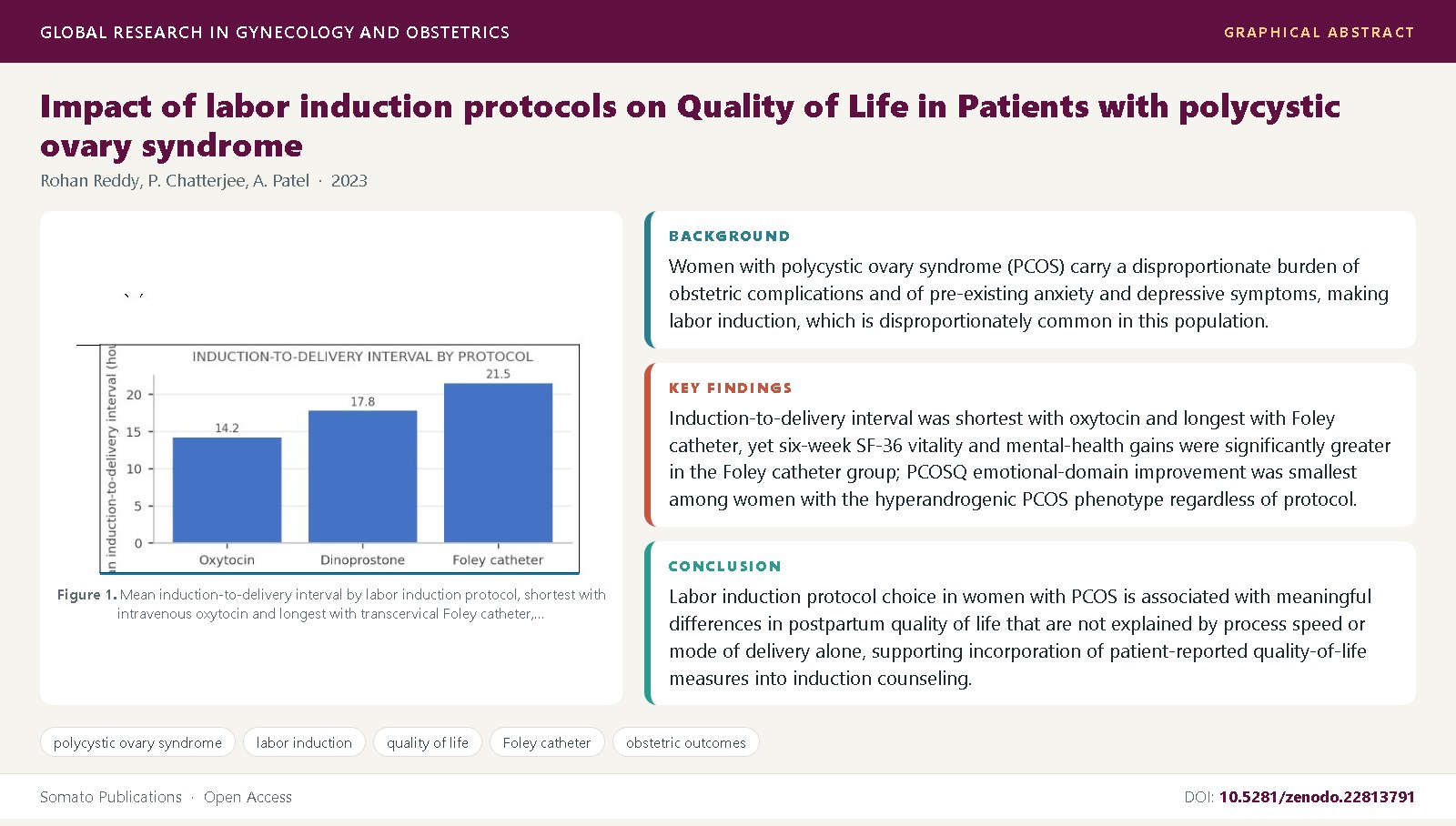
Background: Women with polycystic ovary syndrome (PCOS) carry a disproportionate burden of obstetric complications and of pre-existing anxiety and depressive symptoms, making labor induction, which is disproportionately common in this population, a process superimposed on an already vulnerable psychological baseline.
Objective: This study compared the impact of three commonly used labor induction protocols, intravenous oxytocin, vaginal dinoprostone, and transcervical Foley catheter, on peripartum quality of life among women with PCOS.
Methods: In a prospective observational cohort of term pregnant women with PCOS undergoing induction of labor, we administered the SF-36 general health survey and the disease-specific Polycystic Ovary Syndrome Questionnaire (PCOSQ) at admission, 48 hours postpartum, and six weeks postpartum, alongside obstetric process and outcome measures.
Results: Induction-to-delivery interval was shortest with oxytocin and longest with Foley catheter, yet six-week SF-36 vitality and mental-health gains were significantly greater in the Foley catheter group; PCOSQ emotional-domain improvement was smallest among women with the hyperandrogenic PCOS phenotype regardless of protocol.
Conclusions: Labor induction protocol choice in women with PCOS is associated with meaningful differences in postpartum quality of life that are not explained by process speed or mode of delivery alone, supporting incorporation of patient-reported quality-of-life measures into induction counseling and protocol selection in this population.
References
Rotterdam ESHRE/ASRM-Sponsored PCOS Consensus Workshop Group (2004) Revised 2003 consensus on diagnostic criteria and long-term health risks related to polycystic ovary syndrome. Fertility and Sterility, 81(1): 19-25. DOI: 10.1016/j.fertnstert.2003.10.004
Azziz, R., Carmina, E., Dewailly, D., Diamanti-Kandarakis, E., Escobar-Morreale, H.F., Futterweit, W., et al. (2009) The Androgen Excess and PCOS Society criteria for the polycystic ovary syndrome: the complete task force report. Fertility and Sterility, 91(2): 456-488.
Bozdag, G., Mumusoglu, S., Zengin, D., Karabulut, E., Yildiz, B.O. (2016) The prevalence and phenotypic features of polycystic ovary syndrome: a systematic review and meta-analysis. Human Reproduction, 31(12): 2841-2855.
Escobar-Morreale, H.F. (2018) Polycystic ovary syndrome: definition, aetiology, diagnosis and treatment. Nature Reviews Endocrinology, 14(5): 270-284.
Legro, R.S., Barnhart, H.X., Schlaff, W.D., Carr, B.R., Diamond, M.P., Carson, S.A., et al. (2007) Clomiphene, metformin, or both for infertility in the polycystic ovary syndrome. New England Journal of Medicine, 356(6): 551-566. DOI: 10.1056/NEJMoa063971
Boomsma, C.M., Eijkemans, M.J., Hughes, E.G., Visser, G.H., Fauser, B.C., Macklon, N.S. (2006) A meta-analysis of pregnancy outcomes in women with polycystic ovary syndrome. Human Reproduction Update, 12(6): 673-683.
Kjerulff, L.E., Sanchez-Ramos, L., Duffy, D. (2011) Pregnancy outcomes in women with polycystic ovary syndrome: a metaanalysis. American Journal of Obstetrics and Gynecology, 204(6): 558.e1-558.e6.
Bahri Khomami, M., Joham, A.E., Boyle, J.A., Piltonen, T., Arora, C., Silagy, M., et al. (2019) Increased maternal pregnancy complications in polycystic ovary syndrome appear to be independent of obesity-A systematic review, meta-analysis, and meta-regression. Obesity Reviews, 20(5): 659-674.
Yu, H.F., Chen, H.S., Rao, D.P., Gong, J. (2016) Association between polycystic ovary syndrome and the risk of pregnancy complications: a PRISMA-compliant systematic review and meta-analysis. Medicine, 95(51): e4863.
Roos, N., Kieler, H., Sahlin, L., Ekman-Ordeberg, G., Falconer, H., Stephansson, O. (2011) Risk of adverse pregnancy outcomes in women with polycystic ovary syndrome: population based cohort study. BMJ, 343: d6309.
Naver, K.V., Grinsted, J., Larsen, S.O., Hedley, P.L., Jorgensen, F.S., Christiansen, M., et al. (2014) Increased risk of preterm delivery and pre-eclampsia in women with polycystic ovary syndrome and hyperandrogenaemia. BJOG, 121(5): 575-581.
Palomba, S., de Wilde, M.A., Falbo, A., Koster, M.P., La Sala, G.B., Fauser, B.C. (2015) Pregnancy complications in women with polycystic ovary syndrome. Human Reproduction Update, 21(5): 575-592.
World Health Organization (2011) WHO Recommendations for Induction of Labour. Geneva: World Health Organization.
American College of Obstetricians and Gynecologists (2009) ACOG Practice Bulletin No. 107: Induction of labor. Obstetrics & Gynecology, 114(2 Pt 1): 386-397.
Grobman, W.A., Rice, M.M., Reddy, U.M., Tita, A.T., Silver, R.M., Mallett, G., et al. (2018) Labor induction versus expectant management in low-risk nulliparous women. New England Journal of Medicine, 379(6): 513-523. DOI: 10.1056/NEJMoa1800566
Vogel, J.P., Souza, J.P., Gulmezoglu, A.M. (2013) Patterns and outcomes of induction of labour in Africa and Asia: a secondary analysis of the WHO Global Survey on Maternal and Neonatal Health. PLoS ONE, 8(6): e65612.
Middleton, P., Shepherd, E., Crowther, C.A. (2020) Induction of labour for improving birth outcomes for women at or beyond term. Cochrane Database of Systematic Reviews, 7: CD004945.
Alfirevic, Z., Keeney, E., Dowswell, T., Welton, N.J., Medley, N., Dias, S., et al. (2016) Methods to induce labour: a systematic review, network meta-analysis and cost-effectiveness analysis. BJOG, 123(9): 1462-1470.
Hofmeyr, G.J., Gulmezoglu, A.M., Pileggi, C. (2010) Vaginal misoprostol for cervical ripening and induction of labour. Cochrane Database of Systematic Reviews, (10): CD000941.
Boulvain, M., Stan, C., Irion, O. (2005) Membrane sweeping for induction of labour. Cochrane Database of Systematic Reviews, (1): CD000451.
ten Eikelder, M.L., Oude Rengerink, K., Jozwiak, M., van Pampus, M.G., de Leeuw, J.W., Kleiverda, G., et al. (2016) Induction of labour at term with oral misoprostol versus a Foley catheter (PROBAAT-II): a multicentre randomised controlled non-inferiority trial. Lancet, 387(10028): 1619-1628.
Deeks, A.A., Gibson-Helm, M.E., Teede, H.J. (2010) Anxiety and depression in polycystic ovary syndrome: a comprehensive investigation. Fertility and Sterility, 93(7): 2421-2423.
Cooney, L.G., Dokras, A. (2018) Depression and anxiety in polycystic ovary syndrome: etiology and treatment. Current Psychiatry Reports, 20(11): 83.
Himelein, M.J., Thatcher, S.S. (2006) Depression and body image among women with polycystic ovary syndrome. Journal of Health Psychology, 11(4): 613-625.
Barnard, L., Ferriday, D., Guenther, N., Strauss, B., Balen, A.H., Dye, L. (2007) Quality of life and psychological well being in polycystic ovary syndrome. Human Reproduction, 22(8): 2279-2286.
Jones, G.L., Hall, J.M., Balen, A.H., Ledger, W.L. (2008) Health-related quality of life measurement in women with polycystic ovary syndrome: a systematic review. Human Reproduction Update, 14(1): 15-25.
Ware, J.E., Sherbourne, C.D. (1992) The MOS 36-item short-form health survey (SF-36). I. Conceptual framework and item selection. Medical Care, 30(6): 473-483. DOI: 10.1097/00005650-199206000-00002
WHOQOL Group (1998) Development of the World Health Organization WHOQOL-BREF quality of life assessment. Psychological Medicine, 28(3): 551-558. DOI: 10.1017/S0033291798006667
Cronin, L., Guyatt, G., Griffith, L., Wong, E., Azziz, R., Futterweit, W., et al. (1998) Development of a health-related quality-of-life questionnaire (PCOSQ) for women with polycystic ovary syndrome. Journal of Clinical Endocrinology & Metabolism, 83(6): 1976-1987.
Guyatt, G., Weaver, B., Cronin, L., Dooley, J.A., Azziz, R. (2004) Health-related quality of life in women with polycystic ovary syndrome, a self-administered questionnaire, was validated. Journal of Clinical Epidemiology, 57(12): 1279-1287.
Vahratian, A., Zhang, J., Troendle, J.F., Savitz, D.A., Siega-Riz, A.M. (2005) Maternal prepregnancy overweight and obesity and the pattern of labor progression in term nulliparous women. Obstetrics & Gynecology, 105(6): 1279-1286.
Wolfe, K.B., Rossi, R.A., Warshak, C.R. (2011) The effect of maternal obesity on the rate of failed induction of labor. American Journal of Obstetrics and Gynecology, 205(2): 128.e1-128.e7.
Waldenstrom, U., Hildingsson, I., Rubertsson, C., Radestad, I. (2004) A negative birth experience: prevalence and risk factors in a national sample. Birth, 31(1): 17-27.
Mumm, H., Jensen, D.M., Sorensen, J.A., Andersen, M.S., Ravn, P., Andersen, L.L., et al. (2015) Hirsutism and quality of life in women with and without polycystic ovary syndrome. Fertility and Sterility, 104(4): 972-979.
de Wilde, M.A., Lamain-de Ruiter, M., Veltman-Verhulst, S.M., Kwee, A., Laven, J.S., Lambalk, C.B., et al. (2013) Increased rates of complications in singleton pregnancies of women with polycystic ovary syndrome undergoing in vitro fertilization. Fertility and Sterility, 100(4): 1074-1080.
Teede, H.J., Misso, M.L., Costello, M.F., Dokras, A., Laven, J., Moran, L., et al. (2018) Recommendations from the international evidence-based guideline for the assessment and management of polycystic ovary syndrome. Fertility and Sterility, 110(3): 364-379. DOI: 10.1016/j.fertnstert.2018.05.004

Published
Issue
Section
License
Copyright (c) 2023 Rohan Reddy, et al.

This work is licensed under a Creative Commons Attribution 4.0 International License.


