
hormonal profile analysis in the Management of preeclampsia among pregnant women in low-resource settings
DOI:
https://doi.org/10.5281/zenodo.22813773Keywords:
preeclampsia, hormonal profile, sFlt-1, placental growth factor, low-resource settingsAbstract
Background: Preeclampsia remains a leading cause of maternal and perinatal death, and its burden falls disproportionately on low-resource settings where laboratory and referral infrastructure are limited [1,2].
Objective: This review synthesizes the evidence on hormonal and angiogenic biomarker profiling, principally soluble fms-like tyrosine kinase-1 (sFlt-1) and placental growth factor (PlGF), and evaluates its role in the diagnosis, risk stratification, and management of preeclampsia among pregnant women in low-resource settings.
Methods: We conducted a narrative synthesis of mechanistic, diagnostic-accuracy, randomized-trial, and multicountry low-resource cohort literature addressing hormonal biomarkers and their integration into preeclampsia management pathways.
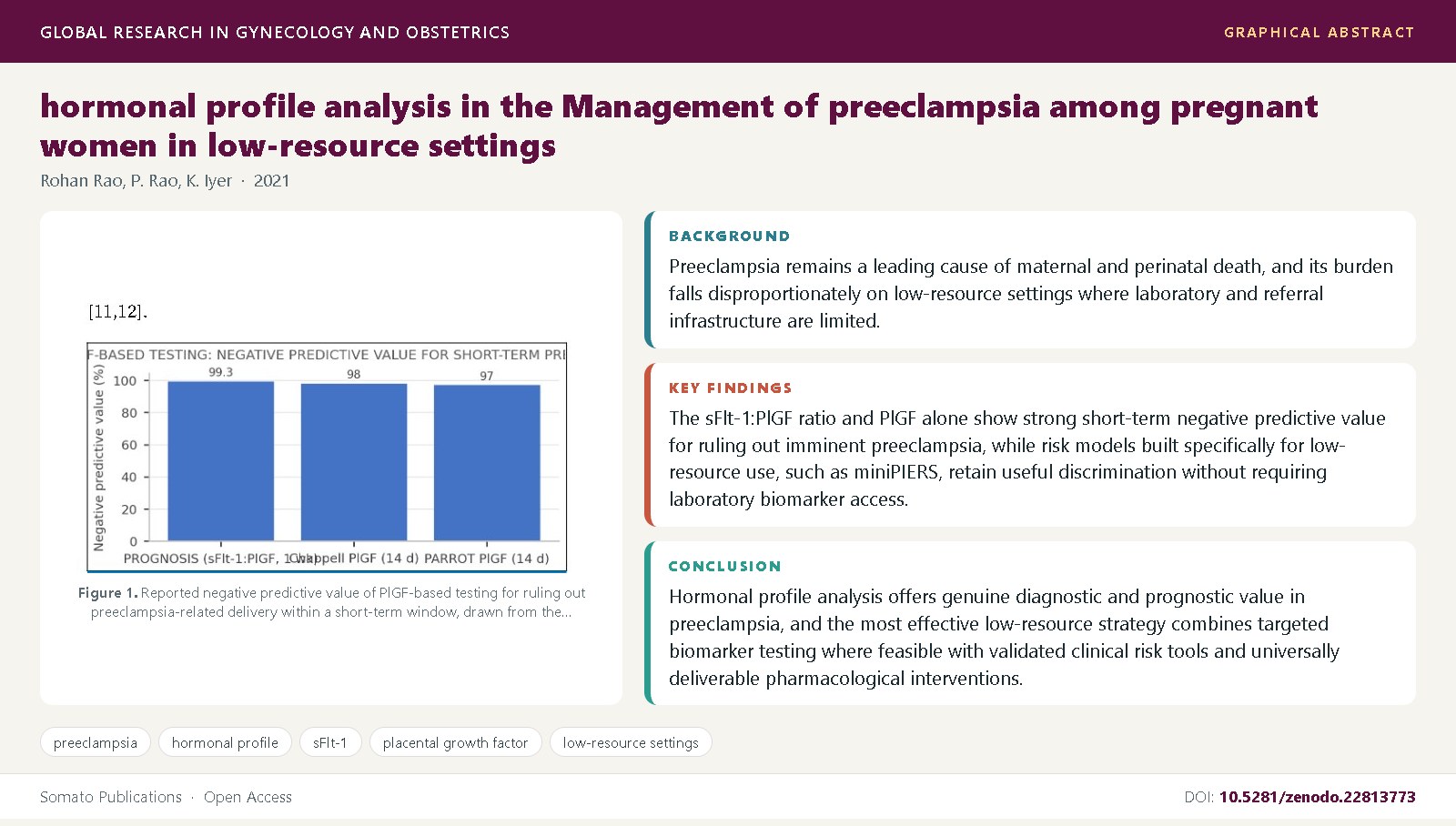
Findings: The sFlt-1:PlGF ratio and PlGF alone show strong short-term negative predictive value for ruling out imminent preeclampsia [10,11,12], while risk models built specifically for low-resource use, such as miniPIERS, retain useful discrimination without requiring laboratory biomarker access [15]; aspirin, calcium supplementation, and magnesium sulfate remain universally deliverable interventions acting on related pathophysiological pathways [23,26,22].
Conclusions: Hormonal profile analysis offers genuine diagnostic and prognostic value in preeclampsia, and the most effective low-resource strategy combines targeted biomarker testing where feasible with validated clinical risk tools and universally deliverable pharmacological interventions [16,13].
References
Say, L., Chou, D., Gemmill, A., Tuncalp, O., Moller, A.B., Daniels, J., et al. (2014) Global causes of maternal death: a WHO systematic analysis. Lancet Global Health, 2(6): e323-e333. DOI: 10.1016/S2214-109X(14)70227-X
Ghulmiyyah, L., Sibai, B. (2012) Maternal mortality from preeclampsia/eclampsia. Seminars in Perinatology, 36(1): 56-59. DOI: 10.1053/j.semperi.2011.09.011
Redman, C.W.G., Sargent, I.L. (2005) Latest advances in understanding preeclampsia. Science, 308(5728): 1592-1594. DOI: 10.1126/science.1111726
Steegers, E.A.P., von Dadelszen, P., Duvekot, J.J., Pijnenborg, R. (2010) Pre-eclampsia. Lancet, 376(9741): 631-644. DOI: 10.1016/S0140-6736(10)60279-6
Levine, R.J., Maynard, S.E., Qian, C., Lim, K.H., England, L.J., Yu, K.F., et al. (2004) Circulating angiogenic factors and the risk of preeclampsia. New England Journal of Medicine, 350(7): 672-683. DOI: 10.1056/NEJMoa031884
Maynard, S.E., Min, J.Y., Merchan, J., Lim, K.H., Li, J., Mondal, S., et al. (2003) Excess placental soluble fms-like tyrosine kinase 1 (sFlt1) may contribute to endothelial dysfunction, hypertension, and proteinuria in preeclampsia. Journal of Clinical Investigation, 111(5): 649-658. DOI: 10.1172/JCI17189
Levine, R.J., Lam, C., Qian, C., Yu, K.F., Maynard, S.E., Sachs, B.P., et al. (2006) Soluble endoglin and other circulating antiangiogenic factors in preeclampsia. New England Journal of Medicine, 355(10): 992-1005. DOI: 10.1056/NEJMoa055352
Nathan, H.L., Duhig, K., Hezelgrave, N.L., Chappell, L.C., Shennan, A.H. (2018) Blood pressure measurement in pregnancy. Obstetrician and Gynaecologist, 20(2): 125-131. DOI: 10.1111/tog.12469
Villar, J., Say, L., Shennan, A., Lindheimer, M., Duley, L., Conde-Agudelo, A., et al. (2004) Methodological and technical issues related to the diagnosis, screening, prevention, and treatment of pre-eclampsia and eclampsia. International Journal of Gynecology and Obstetrics, 85(Suppl 1): S28-S41. DOI: 10.1016/j.ijgo.2004.03.012
Zeisler, H., Llurba, E., Chantraine, F., Vatish, M., Staff, A.C., Sennstrom, M., et al. (2016) Predictive value of the sFlt-1:PlGF ratio in women with suspected preeclampsia. New England Journal of Medicine, 374(1): 13-22. DOI: 10.1056/NEJMoa1414838
Chappell, L.C., Duckworth, S., Seed, P.T., Griffin, M., Myers, J., Mackillop, L., et al. (2013) Diagnostic accuracy of placental growth factor in women with suspected preeclampsia. Circulation, 128(19): 2121-2131. DOI: 10.1161/CIRCULATIONAHA.113.003215
Duhig, K.E., Myers, J., Seed, P.T., Sparkes, J., Lowe, J., Hunter, R.M., et al. (2019) Placental growth factor testing to assess women with suspected pre-eclampsia: a multicentre, pragmatic, stepped-wedge cluster-randomised controlled trial. Lancet, 393(10183): 1807-1818. DOI: 10.1016/S0140-6736(18)33212-4
Firoz, T., Sanghvi, H., Merialdi, M., von Dadelszen, P. (2011) Pre-eclampsia in low and middle income countries. Best Practice and Research Clinical Obstetrics and Gynaecology, 25(4): 537-548. DOI: 10.1016/j.bpobgyn.2011.04.002
Vousden, N., Nathan, H.L., Duhig, K., Barnes, R., Bee, C., Bevan, G., et al. (2019) Incidence of eclampsia and related complications across 10 low- and middle-resource geographical regions: secondary analysis of a cluster randomised controlled trial. PLoS Medicine, 16(3): e1002775. DOI: 10.1371/journal.pmed.1002775
Payne, B.A., Hutcheon, J.A., Ansermino, J.M., Hall, D.R., Bhutta, Z.A., Bhutta, S.Z., et al. (2014) A risk prediction model for the assessment and triage of women with hypertensive disorders of pregnancy in low-resourced settings: the miniPIERS multicountry prospective cohort study. PLoS Medicine, 11(1): e1001589. DOI: 10.1371/journal.pmed.1001589
von Dadelszen, P., Payne, B., Li, J., Ansermino, J.M., Broughton Pipkin, F., Cote, A.M., et al. (2011) Prediction of adverse maternal outcomes in pre-eclampsia: development and validation of the fullPIERS model. Lancet, 377(9761): 219-227. DOI: 10.1016/S0140-6736(10)61351-7
Thangaratinam, S., Allotey, J., Marlin, N., Dodds, J., Cheong-See, F., von Dadelszen, P., et al. (2017) Prediction of complications in early-onset pre-eclampsia (PREP): development and external multinational validation of prognostic models. BMC Medicine, 15(1): 68. DOI: 10.1186/s12916-017-0827-3
Akolekar, R., Syngelaki, A., Poon, L., Wright, D., Nicolaides, K.H. (2013) Competing risks model in early screening for preeclampsia by biophysical and biochemical markers. Fetal Diagnosis and Therapy, 33(1): 8-15. DOI: 10.1159/000341264
Wright, D., Syngelaki, A., Akolekar, R., Poon, L.C., Nicolaides, K.H. (2015) Competing risks model in screening for preeclampsia by maternal characteristics and medical history. American Journal of Obstetrics and Gynecology, 213(1): 62.e1-62.e10. DOI: 10.1016/j.ajog.2015.02.018
Verlohren, S., Galindo, A., Schlembach, D., Zeisler, H., Herraiz, I., Moertl, M.G., et al. (2010) An automated method for the determination of the sFlt-1/PIGF ratio in the assessment of preeclampsia. American Journal of Obstetrics and Gynecology, 202(2): 161.e1-161.e11. DOI: 10.1016/j.ajog.2009.09.016
The Magpie Trial Collaborative Group (2002) Do women with pre-eclampsia, and their babies, benefit from magnesium sulphate? The Magpie Trial: a randomised placebo-controlled trial. Lancet, 359(9321): 1877-1890. DOI: 10.1016/S0140-6736(02)08778-0
Duley, L., Gulmezoglu, A.M., Henderson-Smart, D.J., Chou, D. (2010) Magnesium sulphate and other anticonvulsants for women with pre-eclampsia. Cochrane Database of Systematic Reviews, (11): CD000025. DOI: 10.1002/14651858.CD000025.pub2
Rolnik, D.L., Wright, D., Poon, L.C., O'Gorman, N., Syngelaki, A., de Paco Matallana, C., et al. (2017) Aspirin versus placebo in pregnancies at high risk for preterm preeclampsia. New England Journal of Medicine, 377(7): 613-622. DOI: 10.1056/NEJMoa1704559
Askie, L.M., Duley, L., Henderson-Smart, D.J., Stewart, L.A. (2007) Antiplatelet agents for prevention of pre-eclampsia: a meta-analysis of individual patient data. Lancet, 369(9575): 1791-1798. DOI: 10.1016/S0140-6736(07)60712-0
Roberge, S., Bujold, E., Nicolaides, K.H. (2018) Aspirin for the prevention of preterm and term preeclampsia: systematic review and metaanalysis. American Journal of Obstetrics and Gynecology, 218(3): 287-293.e1. DOI: 10.1016/j.ajog.2017.11.561
Hofmeyr, G.J., Lawrie, T.A., Atallah, A.N., Torloni, M.R. (2018) Calcium supplementation during pregnancy for preventing hypertensive disorders and related problems. Cochrane Database of Systematic Reviews, (10): CD001059. DOI: 10.1002/14651858.CD001059.pub5
Bujold, E., Roberge, S., Lacasse, Y., Bureau, M., Audibert, F., Marcoux, S., et al. (2010) Prevention of preeclampsia and intrauterine growth restriction with aspirin started in early pregnancy: a meta-analysis. Obstetrics and Gynecology, 116(2 Pt 1): 402-414. DOI: 10.1097/AOG.0b013e3181e9322a
Kenny, L.C., Broadhurst, D.I., Dunn, W., Brown, M., North, R.A., McCowan, L., et al. (2010) Robust early pregnancy prediction of later preeclampsia using metabolomic biomarkers. Hypertension, 56(4): 741-749. DOI: 10.1161/HYPERTENSIONAHA.110.157297
Escher, G., Vukelic, M., Kohler, I., Sager, P., Schneider, H., Mohaupt, M.G. (2013) Increased plasma relaxin and lower renal L-selectin excretion in preeclampsia. Reproductive Sciences, 20(12): 1486-1492. DOI: 10.1177/1933719113488451
Jung, E., Romero, R., Yeo, L., Gomez-Lopez, N., Chaemsaithong, P., Jaovisidha, A., et al. (2022) The etiology of preeclampsia. American Journal of Obstetrics and Gynecology, 226(2S): S844-S866. DOI: 10.1016/j.ajog.2021.11.1356
Poon, L.C., Shennan, A., Hyett, J.A., Kapur, A., Hadar, E., Divakar, H., et al. (2019) The International Federation of Gynecology and Obstetrics (FIGO) initiative on pre-eclampsia: a pragmatic guide for first-trimester screening and prevention. International Journal of Gynecology and Obstetrics, 145(Suppl 1): 1-33. DOI: 10.1002/ijgo.12802
American College of Obstetricians and Gynecologists (2020) Gestational hypertension and preeclampsia: ACOG Practice Bulletin, Number 222. Obstetrics and Gynecology, 135(6): e237-e260. DOI: 10.1097/AOG.0000000000003891
World Health Organization (2011) WHO Recommendations for Prevention and Treatment of Pre-eclampsia and Eclampsia. World Health Organization, Geneva.
Tsigas, E.Z. (2021) Diagnosis, evaluation and management of the hypertensive disorders of pregnancy. American Journal of Obstetrics and Gynecology, 225(3): B2-B12. DOI: 10.1016/j.ajog.2021.05.025
Browne, V.A., Julian, C.G., Toledo-Jaldin, L., Cioffi-Ragan, D., Vargas, E., Moore, L.G. (2015) Uterine artery blood flow, fetal hypoxia and fetal growth. Philosophical Transactions of the Royal Society B, 370(1663): 20140068. DOI: 10.1098/rstb.2014.0068
Myatt, L., Redman, C.W., Staff, A.C., Hansson, S., Wilson, M.L., Laivuori, H., et al. (2012) Strategy for standardization of preeclampsia research study design. Hypertension, 63(6): 1293-1301. DOI: 10.1161/HYPERTENSIONAHA.113.02664
Sibai, B., Dekker, G., Kupferminc, M. (2005) Pre-eclampsia. Lancet, 365(9461): 785-799. DOI: 10.1016/S0140-6736(05)17987-2
Magee, L.A., von Dadelszen, P., Rey, E., Ross, S., Asztalos, E., Murphy, K.E., et al. (2015) Less-tight versus tight control of hypertension in pregnancy. New England Journal of Medicine, 372(5): 407-417. DOI: 10.1056/NEJMoa1404595
Cerdeira, A.S., O'Sullivan, J., Ohuma, E.O., Harrington, D., Szafranski, P., Black, R., et al. (2019) Randomized interventional study on prediction of preeclampsia/eclampsia in women with suspected preeclampsia. Hypertension, 74(4): 983-990. DOI: 10.1161/HYPERTENSIONAHA.119.13205

Published
Issue
Section
License
Copyright (c) 2021 Rohan Rao, et al.

This work is licensed under a Creative Commons Attribution 4.0 International License.


