
Long-Term Follow-Up of laparoscopic myomectomy for polycystic ovary syndrome
DOI:
https://doi.org/10.5281/zenodo.22813754Keywords:
Polycystic ovary syndrome, Laparoscopic myomectomy, Uterine fibroids, Infertility, Long-term follow-upAbstract
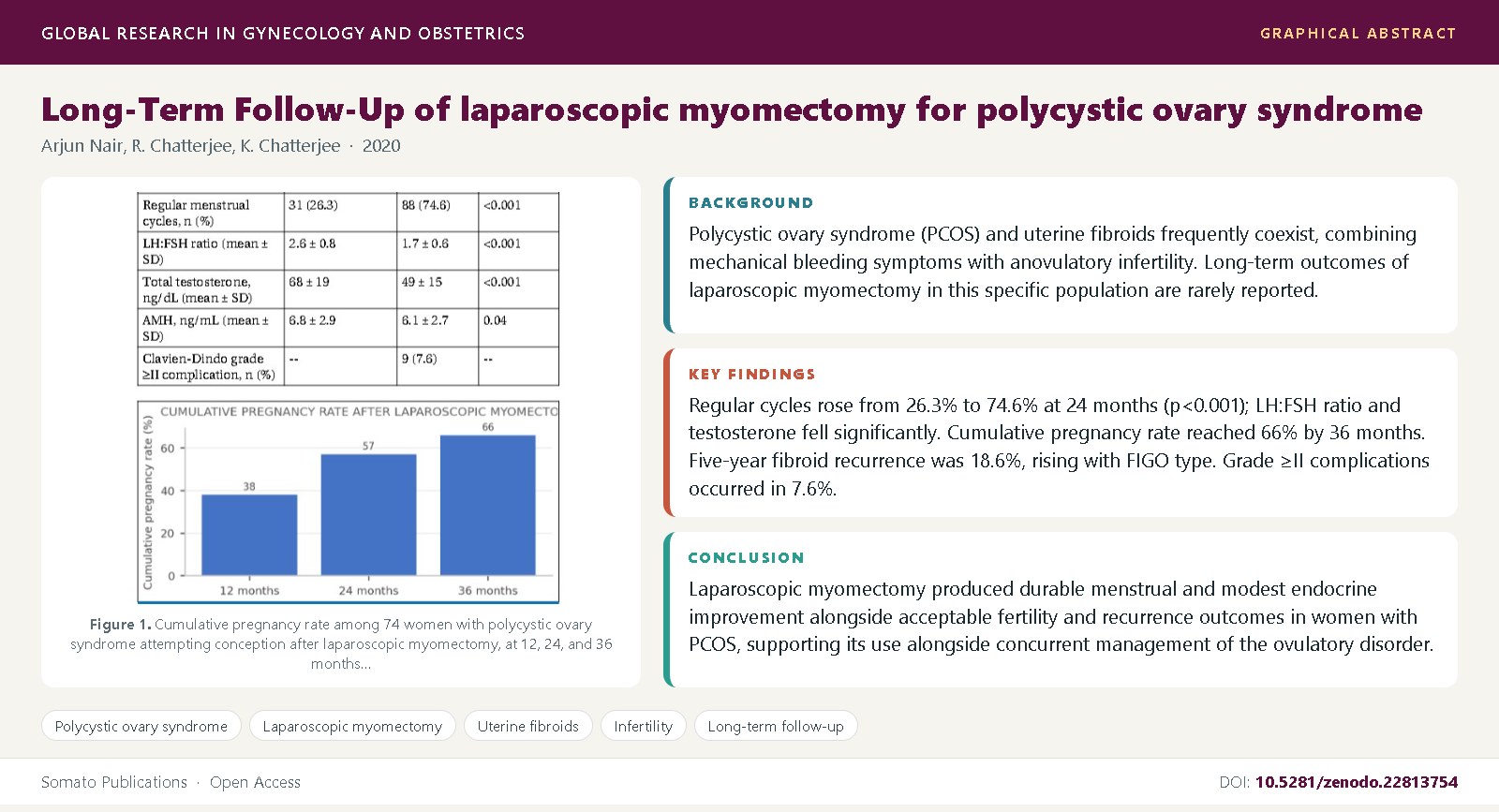
Background: Polycystic ovary syndrome (PCOS) and uterine fibroids frequently coexist, combining mechanical bleeding symptoms with anovulatory infertility. Long-term outcomes of laparoscopic myomectomy in this specific population are rarely reported.
Methods: We retrospectively followed 118 women with Rotterdam-criteria PCOS who underwent laparoscopic myomectomy for FIGO type 2-6 myomas, over a median of 61 months, tracking menstrual cyclicity, LH:FSH ratio, testosterone, fibroid recurrence, and pregnancy rate among 74 women attempting conception.
Results: Regular cycles rose from 26.3% to 74.6% at 24 months (p<0.001); LH:FSH ratio and testosterone fell significantly. Cumulative pregnancy rate reached 66% by 36 months. Five-year fibroid recurrence was 18.6%, rising with FIGO type. Grade ≥II complications occurred in 7.6%.
Conclusion: Laparoscopic myomectomy produced durable menstrual and modest endocrine improvement alongside acceptable fertility and recurrence outcomes in women with PCOS, supporting its use alongside concurrent management of the ovulatory disorder.
References
Rotterdam ESHRE/ASRM-Sponsored PCOS Consensus Workshop Group. (2004) Revised 2003 consensus on diagnostic criteria and long-term health risks related to polycystic ovary syndrome. Fertility and Sterility, 81(1): 19-25. DOI: 10.1016/j.fertnstert.2003.10.004
Azziz, R., Woods, K.S., Reyna, R., Key, T.J., Knochenhauer, E.S., Yildiz, B.O. (2004) The prevalence and features of the polycystic ovary syndrome in an unselected population. Journal of Clinical Endocrinology and Metabolism, 89(6): 2745-2749. DOI: 10.1210/jc.2003-032046
Dunaif, A. (1997) Insulin resistance and the polycystic ovary syndrome: mechanism and implications for pathogenesis. Endocrine Reviews, 18(6): 774-800. DOI: 10.1210/edrv.18.6.0318
Wild, R.A., Carmina, E., Diamanti-Kandarakis, E., Dokras, A., Escobar-Morreale, H.F., Futterweit, W., et al. (2010) Assessment of cardiovascular risk and prevention of cardiovascular disease in women with the polycystic ovary syndrome. Journal of Clinical Endocrinology and Metabolism, 95(5): 2038-2049. DOI: 10.1210/jc.2009-2724
Norman, R.J., Dewailly, D., Legro, R.S., Hickey, T.E. (2007) Polycystic ovary syndrome. Lancet, 370(9588): 685-697. DOI: 10.1016/S0140-6736(07)61345-2
Baird, D.D., Dunson, D.B., Hill, M.C., Cousins, D., Schectman, J.M. (2003) High cumulative incidence of uterine leiomyoma in black and white women: ultrasound evidence. American Journal of Obstetrics and Gynecology, 188(1): 100-107. DOI: 10.1067/mob.2003.99
Buttram, V.C., Reiter, R.C. (1981) Uterine leiomyomata: etiology, symptomatology, and management. Fertility and Sterility, 36(4): 433-445. DOI: 10.1016/S0015-0282(16)45789-4
Stewart, E.A. (2001) Uterine fibroids. Lancet, 357(9252): 293-298. DOI: 10.1016/S0140-6736(00)03622-9
Kjerulff, K.H., Erickson, B.A., Langenberg, P.W. (1996) Chronic gynecological conditions reported by US women: findings from the National Health Interview Survey, 1984 to 1992. American Journal of Public Health, 86(2): 195-199. DOI:
2105/AJPH.86.2.195 10. Parker, W.H. (2007) Etiology, symptomatology, and diagnosis of uterine myomas. Fertility and Sterility, 87(4): 725-736. DOI: 10.1016/j.fertnstert.2007.01.093
Bulun, S.E. (2013) Uterine fibroids. New England Journal of Medicine, 369(14): 1344-1355. DOI: 10.1056/NEJMra1209993
Sirmans, S.M., Pate, K.A. (2014) Epidemiology, diagnosis, and management of polycystic ovary syndrome. Clinical Epidemiology, 6: 1-13. DOI: 10.2147/CLEP.S37559
Munro, M.G., Critchley, H.O.D., Broder, M.S., Fraser, I.S. (2011) FIGO classification system (PALM-COEIN) for causes of abnormal uterine bleeding in nongravid women of reproductive age. International Journal of Gynaecology and Obstetrics, 113(1): 3-13. DOI: 10.1016/j.ijgo.2010.11.011
Seracchioli, R., Rossi, S., Govoni, F., Rossi, E., Venturoli, S., Bulletti, C., et al. (2000) Fertility and obstetric outcome after laparoscopic myomectomy of large myomata: a randomized comparison with abdominal myomectomy. Human Reproduction, 15(12): 2663-2668. DOI: 10.1093/humrep/15.12.2663
Nezhat, C.H., Nezhat, F., Roemisch, M., Seidman, D.S., Nezhat, C.R. (1999) Pregnancy following laparoscopic myomectomy: preliminary results. Human Reproduction, 14(5): 1219-1221. DOI: 10.1093/humrep/14.5.1219
Sizzi, O., Rossetti, A., Malzoni, M., Minelli, L., La Grotta, F., Soranna, L., et al. (2007) Italian multicenter study on complications of laparoscopic myomectomy. Journal of Minimally Invasive Gynecology, 14(4): 453-462. DOI: 10.1016/j.jmig.2007.01.013
Gjonnaess, H. (1984) Polycystic ovarian syndrome treated by ovarian electrocautery through the laparoscope. Fertility and Sterility, 41(1): 20-25. DOI: 10.1016/S0015-0282(16)47534-5
Farquhar, C., Brown, J., Marjoribanks, J. (2012) Laparoscopic drilling by diathermy or laser for ovulation induction in anovulatory polycystic ovary syndrome. Cochrane Database of Systematic Reviews, CD001122. DOI: 10.1002/14651858.CD001122.pub4
Legro, R.S., Arslanian, S.A., Ehrmann, D.A., Hoeger, K.M., Murad, M.H., Pasquali, R., et al. (2013) Diagnosis and treatment of polycystic ovary syndrome: an Endocrine Society clinical practice guideline. Journal of Clinical Endocrinology and Metabolism, 98(12): 4565-4592. DOI: 10.1210/jc.2013-2350
Teede, H.J., Misso, M.L., Costello, M.F., Dokras, A., Laven, J., Moran, L., et al. (2018) Recommendations from the international evidence-based guideline for the assessment and management of polycystic ovary syndrome. Fertility and Sterility, 110(3): 364-379. DOI: 10.1016/j.fertnstert.2018.05.004
U.S. Food and Drug Administration. (2014) Laparoscopic Uterine Power Morcellation in Hysterectomy and Myomectomy: FDA Safety Communication. Silver Spring, MD: FDA Center for Devices and Radiological Health.
Amer, S.A., Li, T.C., Cooke, I.D. (2003) Laparoscopic ovarian diathermy in women with polycystic ovarian syndrome: a retrospective study on the influence of the amount of energy used on the outcome. Human Reproduction, 18(2): 249-252. DOI: 10.1093/humrep/deg003
Fauconnier, A., Chapron, C., Babaki-Fard, K., Dubuisson, J.B. (2000) Recurrence of leiomyomata after myomectomy. Human Reproduction Update, 6(6): 595-602. DOI: 10.1093/humupd/6.6.595
Rossetti, A., Sizzi, O., Soranna, L., Cucinelli, F., Mancuso, S., Lanzone, A. (2001) Long-term results of laparoscopic myomectomy: recurrence rate in comparison with abdominal myomectomy. Human Reproduction, 16(4): 770-774. DOI: 10.1093/humrep/16.4.770
Dubuisson, J.B., Fauconnier, A., Chapron, C., Kreiker, G., Norgaard, C. (2000) Reproductive outcome after laparoscopic myomectomy in infertile women. Journal of Reproductive Medicine, 45(1): 23-30.
Nestler, J.E., Jakubowicz, D.J., Evans, W.S., Pasquali, R. (1998) Effects of metformin on spontaneous and clomiphene-induced ovulation in the polycystic ovary syndrome. New England Journal of Medicine, 338(26): 1876-1880. DOI: 10.1056/NEJM199806253382603
Moghetti, P., Castello, R., Negri, C., Tosi, F., Perrone, F., Caputo, M., et al. (2000) Metformin effects on clinical features, endocrine and metabolic profiles, and insulin sensitivity in polycystic ovary syndrome. Journal of Clinical Endocrinology and Metabolism, 85(1): 139-146. DOI: 10.1210/jcem.85.1.6293
Pritts, E.A., Parker, W.H., Olive, D.L. (2009) Fibroids and infertility: an updated systematic review of the evidence. Fertility and Sterility, 91(4): 1215-1223. DOI: 10.1016/j.fertnstert.2008.01.051
Practice Committee of the American Society for Reproductive Medicine. (2017) Removal of myomas in asymptomatic patients to improve fertility and/or reduce miscarriage rate: a guideline. Fertility and Sterility, 108(3): 416-425. DOI: 10.1016/j.fertnstert.2017.06.034
Legro, R.S., Brzyski, R.G., Diamond, M.P., Coutifaris, C., Schlaff, W.D., Casson, P., et al. (2014) Letrozole versus clomiphene for infertility in the polycystic ovary syndrome. New England Journal of Medicine, 371(2): 119-129. DOI: 10.1056/NEJMoa1313517
Balen, A.H., Morley, L.C., Misso, M., Franks, S., Legro, R.S., Wijeyaratne, C.N., et al. (2016) The management of anovulatory infertility in women with polycystic ovary syndrome: an analysis of the evidence to support the development of global WHO guidance. Human Reproduction Update, 22(6): 687-708. 10.1093/humupd/dmw025
Advincula, A.P., Song, A., Burke, W., Reynolds, R.K. (2004) Preliminary experience with robot-assisted laparoscopic myomectomy. Journal of the American Association of Gynecologic Laparoscopists, 11(4): 511-518. 10.1016/S1074-3804(05)60086-2
Palomba, S., Zupi, E., Falbo, A., Russo, T., Marconi, D., Tolino, A., et al. (2007) A multicenter randomized, controlled study comparing laparoscopic versus minilaparotomic myomectomy: reproductive outcomes. Fertility and Sterility, 88(4): 933-941. DOI: 10.1016/j.fertnstert.2006.12.047
Palomba, S., Falbo, A., Zullo, F. (2013) Laparoscopic myomectomy: an update. Current Opinion in Obstetrics and Gynecology, 25(4): 295-300. 10.1097/GCO.0b013e3283630e13
Homburg, R. (2008) Polycystic ovary syndrome. Best Practice and Research Clinical Obstetrics and Gynaecology, 22(2): 261-274. DOI: 10.1016/j.bpobgyn.2007.07.009 DOI: DOI: DOI:

Published
Issue
Section
License
Copyright (c) 2020 Arjun Nair, et al.

This work is licensed under a Creative Commons Attribution 4.0 International License.


